Why this matters now
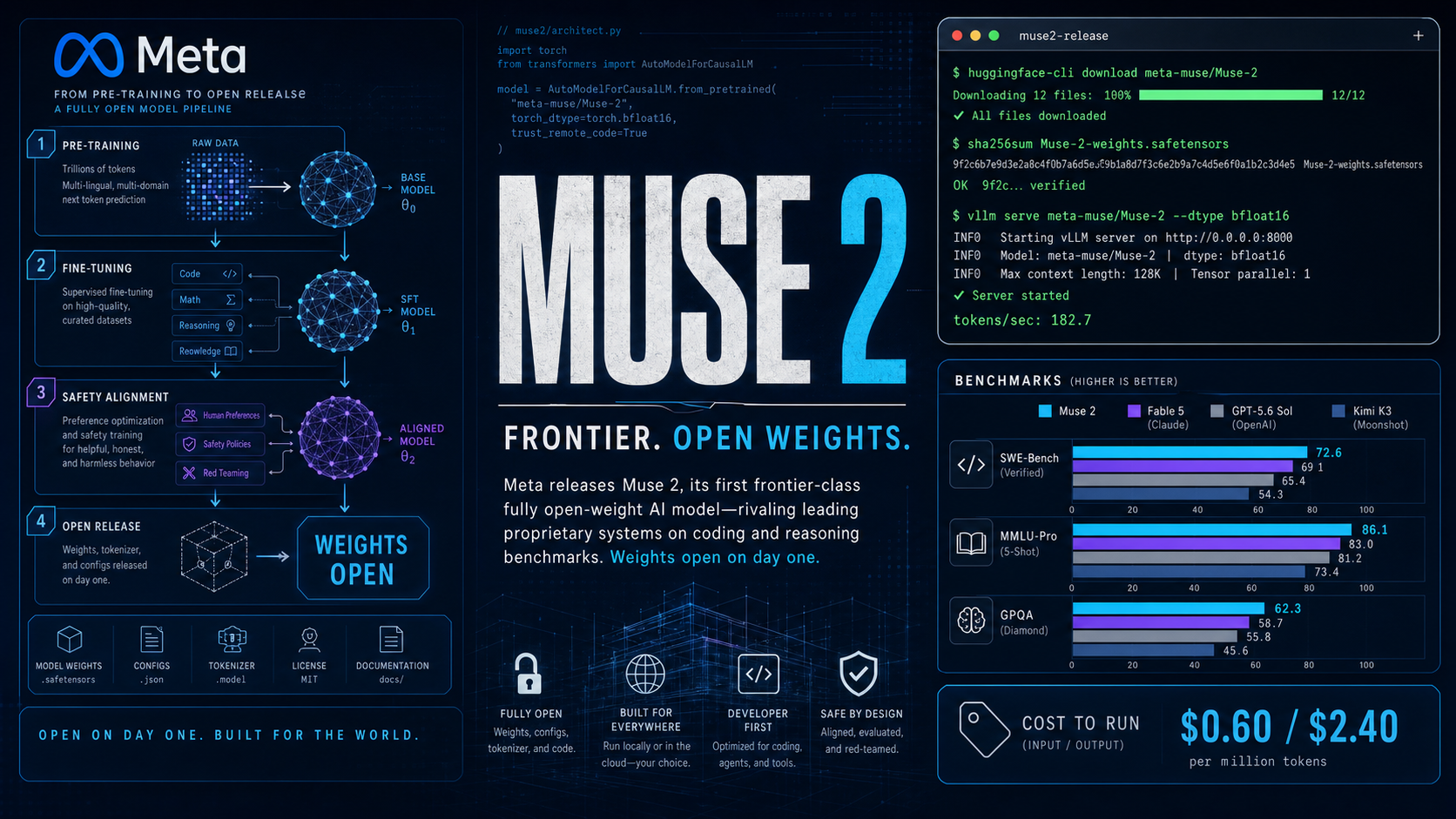
On August 3, 2026, Meta released Muse 2, its first frontier-class open-weight model — and released it the way Meta has always promised it would: weights downloadable on day one, no API gate, no waitlist. The announcement came from Meta AI’s blog with a one-line message from Mark Zuckerberg attached: “Frontier intelligence should not be a subscription.”
This is the story the open-weight movement has been building toward for a month. The open-weight coalition letter signed by 25 companies landed July 24. Dario Amodei called open weights a “public good” on July 27. Amazon wound down its flagship models on July 28, betting instead on partner models. Now the largest open-weight lab in the West has shipped a model that its own benchmarks place next to Claude Fable 5 and GPT-5.6 Sol — at prices that undercut the entire closed frontier.
If the July 2026 price war was about closed labs racing each other to the bottom, Muse 2 is about a different question entirely: whether a frontier model can be owned rather than rented.
What Meta shipped
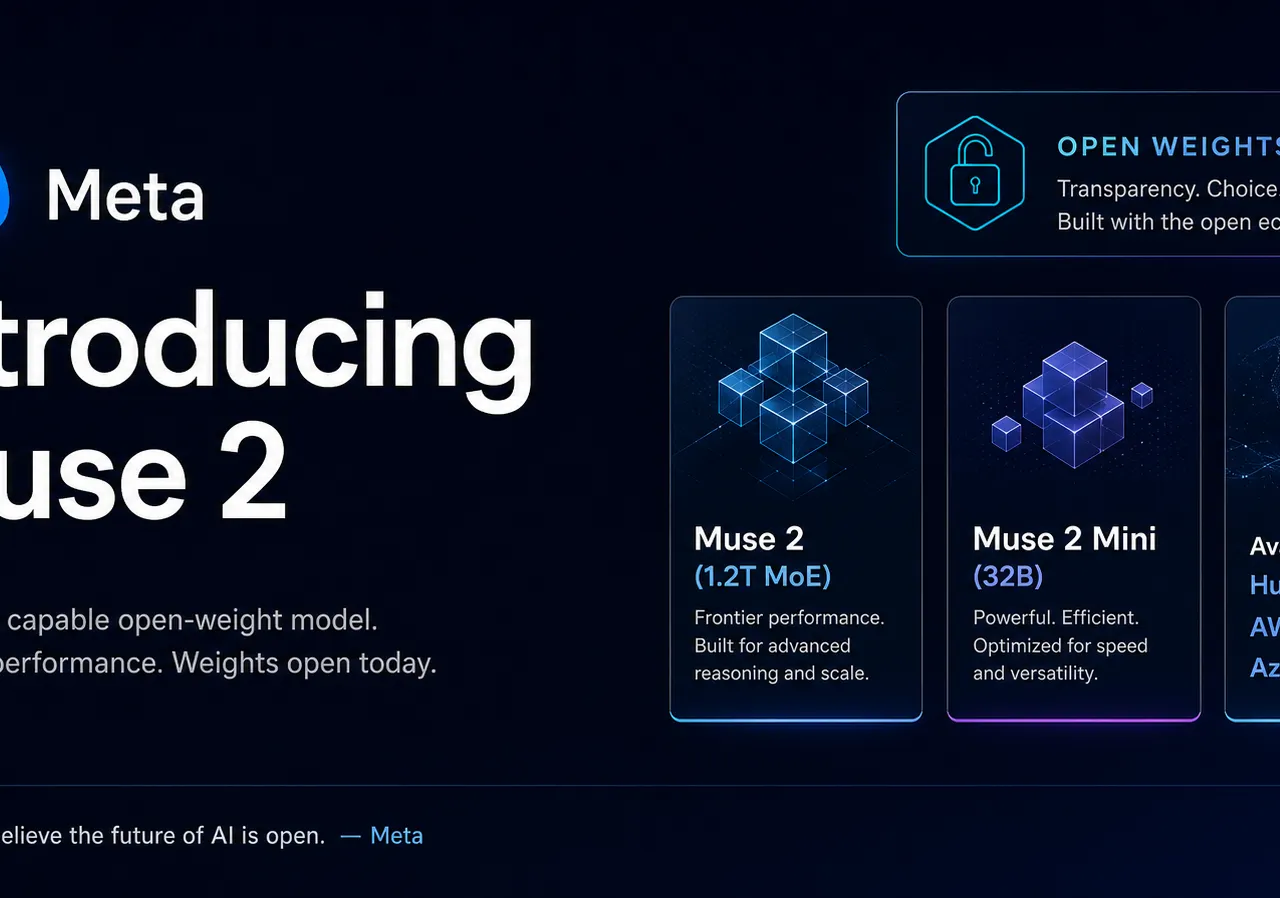
Muse 2 is a mixture-of-experts model with 1.2 trillion total parameters and 220 billion active per token. It follows the architecture direction Meta established with Muse Spark, but scales it to the frontier class. Two sizes are available today:
| Model | Params | Active | Context | Focus |
|---|---|---|---|---|
| Muse 2 | 1.2T (MoE) | 220B | 256K | Frontier reasoning, coding, agents |
| Muse 2 Mini | 32B (dense) | 32B | 256K | Edge, on-device, high-volume |
Meta’s published benchmarks place Muse 2 at or near the top of the open-weight class and competitive with the closed frontier:
| Benchmark | Muse 2 | Claude Fable 5 | GPT-5.6 Sol | Kimi K3 | Qwen 3.8 |
|---|---|---|---|---|---|
| MMLU-Pro | 89.7% | 91.2% | 90.8% | 89.4% | 88.6% |
| GPQA Diamond | 74.1% | 78.3% | 77.0% | 73.6% | 71.9% |
| SWE-Bench Verified | 88.5% | 90.1% | 89.3% | 87.2% | 84.0% |
| Terminal-Bench 2.1 | 83.9% | 84.7% | 88.8% | 81.5% | 79.4% |
| AIME 2026 | 86.2% | 89.0% | 91.4% | 85.1% | 82.8% |
The honest read: Muse 2 does not take the benchmark crown from Fable 5 or GPT-5.6 Sol. It lands in the same band — within 1-3 points on most tests — while being the only model in that band whose weights ship under a permissive license. On SWE-Bench Verified it edges Kimi K3, the previous open-weight leader from Moonshot. The pattern mirrors what we saw with Kimi K3’s launch and Qwen 3.8’s release: the gap between open and closed is no longer a gap; it is a rounding error.
Meta also shipped native tool use, computer use, and parallel function calling as built-in features — the same agentic feature set that Gemini 3.6 Flash added to its workhorse lineup. Muse 2 scores 84.7% on OSWorld-Verified, within striking distance of Fable 5’s 87.9%.
The open-weight math: license, price, distribution
Three decisions separate Muse 2 from every previous frontier release:
License. Muse 2 ships under the Muse Open License, a permissive license in the Llama tradition: free for commercial use, no usage restrictions below 700 million monthly active users, and full fine-tuning and distillation rights. The weights, tokenizer, and inference reference implementation are on Hugging Face and GitHub. Meta published a model card, data card, and safety evaluation report alongside the release — a transparency bar that most closed labs do not come close to.
Price. Meta’s API pricing for Muse 2 is $0.60 per million input tokens and $2.40 per million output. That undercuts Kimi K3 ($3/$15) by 80%, GPT-5.6 Sol ($5/$30) by 88% on input and 92% on output, and even Muse Spark 1.1 ($1.25/$4.25). Zuckerberg’s rationale, stated to Bloomberg at the release: Meta’s AI investment is funded by its ad business, so it can price near cost and let competitors explain their margins.
| Model | Input / 1M | Output / 1M | Open weights |
|---|---|---|---|
| Muse 2 | $0.60 | $2.40 | Yes, day one |
| Muse Spark 1.1 | $1.25 | $4.25 | Yes |
| Kimi K3 | $3.00 | $15.00 | Yes |
| Grok 4.5 | $2.00 | $6.00 | No |
| GPT-5.6 Sol | $5.00 | $30.00 | No |
Distribution. Muse 2 is available immediately on Hugging Face, Together AI, Fireworks, and vLLM (which merged support in the same release). Cloud day-one integrations include AWS Bedrock, Azure AI Foundry, and Google Vertex AI — the same Bedrock partnership Amazon bet its strategy on. For a model released this morning, that distribution footprint is unprecedented; it took Llama generations to reach this.
What it means for the frontier race
The strategic read is straightforward: Meta is done letting closed labs define what “frontier” means. Four consequences stand out.
The open-weight ceiling moved up. Until today, the open-weight argument was “good enough for production, slightly behind at the frontier.” Muse 2 collapses that framing. A builder can now download weights that score within 2 points of Fable 5 on SWE-Bench, fine-tune them, and serve them on their own hardware with zero per-token cost. The Kubernetes-moment thesis — that open weights are becoming the default substrate, with closed APIs as the premium option — just got its strongest evidence yet.
Closed labs face a pricing trap. OpenAI and Anthropic have argued their prices reflect safety, support, and capability. Muse 2 removes the capability argument for a large slice of workloads. Expect GPT-5.6 Sol and Fable 5 pricing pressure in the next 30 days, and expect the price war to resume — this time with open weights setting the floor.
Enterprise adoption gets easier, not harder. The most common enterprise objection to open weights was capability risk, not license risk. With a frontier-band model under a permissive license, procurement conversations shift from “can we use open weights?” to “why are we paying a 20x premium?” The Anthropic position paper gave safety teams cover; Muse 2 gives finance teams the spreadsheet.
The American AI leadership debate resolves in one direction. The open-weight coalition argued that open-weight development is how America stays competitive with China’s open-weight push. Meta just made the argument concrete: the most capable American frontier release of the summer is one anyone can download. That is a fact regulators, safety advocates, and the export-control debate will have to sit with.
Decision framework
Use Muse 2 if you build production agents, fine-tune for domain workloads, or care about inference cost at scale. The 256K context, native tool use, and $0.60/$2.40 pricing make it the default choice for high-volume agentic workloads — the same territory where Gemini Flash and Claude Sonnet have dominated.
Self-host Muse 2 if you have data sovereignty requirements, run high-volume inference, or want zero per-token cost. The 220B active parameters need roughly 8 H200-class GPUs for FP8 serving; Muse 2 Mini (32B) runs on a single 80GB card. That is the first time frontier-band performance has been reachable on non-datacenter hardware.
Keep Fable 5 or GPT-5.6 Sol if you need the absolute top of the benchmark charts, deep enterprise support contracts, or the safest possible liability posture. Muse 2 is within 1-3 points — but “within” is not “at,” and some workloads care about those points.
Monitor the fine-tuning ecosystem. Meta’s decision to allow distillation rights is the sleeper feature. In 90 days, expect a wave of domain-tuned Muse 2 variants that nobody at Meta controls. That is the open-weight model working as intended — and the reason closed labs are nervous.
Trade-off: You trade a few benchmark points and a support contract for ownership, cost, and control. For most builders, that trade now favors open weights. For the workloads where the last two points matter — regulated deployments, benchmark-chasing research, zero-risk enterprise — the closed frontier still earns its premium.
Bottom line: Muse 2 is the strongest evidence yet that frontier intelligence is becoming infrastructure, not a product. The question was never whether open weights could reach the frontier. It was when. The answer is today.
Related reading
- 25 Companies Sign Open-Weight Letter: “American AI Leadership”
- Dario Amodei: Open-Weight Models Are a “Public Good”
- Amazon Overhauls AI Strategy, Winding Down Flagship Models
- Kimi K3: Moonshot’s 2.8T Open-Weight Model
- Qwen 3.8: Alibaba’s 2.4T Open-Weight Model
- Open-Weight AI’s Kubernetes Moment
Sources
- Meta AI — Introducing Muse 2
- Hugging Face — meta-muse/Muse-2 model card
- GitHub — meta-muse/muse-2 inference reference
- Artificial Analysis — Muse 2 benchmarks
- AWS — Muse 2 on Amazon Bedrock
- Bloomberg — Zuckerberg on Muse 2 pricing
About the author
Charles Jasthyn De La Cueva is a full-stack developer and the founder of Open TechStack. He writes about AI engineering, developer tools, and practical model evaluation — grounded in real workflows, not press releases.