Why this matters now
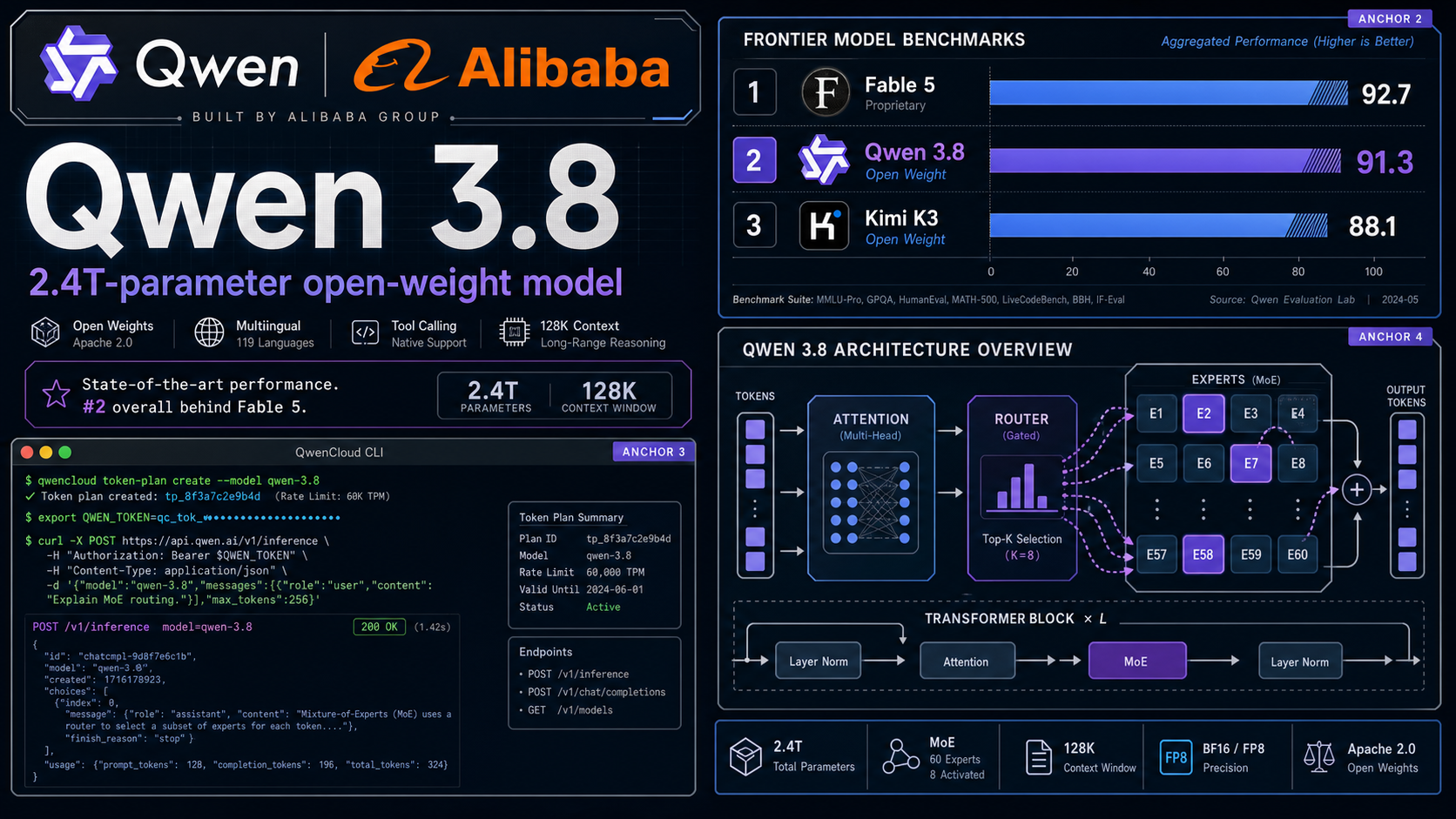
On July 19, Alibaba’s Qwen team announced Qwen 3.8 — a 2.4 trillion-parameter model that they claim is the second most capable AI model available, behind only Anthropic’s Claude Fable 5. The announcement comes less than 48 hours after Moonshot AI unveiled Kimi K3 (2.8T parameters, open weights due July 27), signalling an escalating arms race in open-weight frontier models.
The Qwen 3.8 announcement racked up 950+ comments on X within hours and hit the top of Hacker News with 431 points — reflecting the community’s hunger for genuinely competitive open-weight models that can challenge the proprietary frontier. Max Preview is available right now on QwenCloud’s Token Plan and Qwen Chat, with an open-weight release promised “soon.”
This matters because it changes the calculus for anyone building on AI: if Alibaba delivers a 2.4T open-weight model that genuinely competes with Fable 5 on key benchmarks, the cost of frontier intelligence collapses again — this time with no API dependency at all. We covered the broader price war in last week’s analysis, and the Qwen 3.8 announcement reinforces the trend.
What Alibaba announced
The Qwen team’s announcement on X was characteristically direct:
“Qwen3.8 is launching and going open-weight soon! With a massive 2.4T parameters, this model is continuously evolving. We believe it’s one of the most powerful model available today, compatible to leading frontier AI models, second only to Fable 5.”
The key points:
| Dimension | Detail |
|---|---|
| Parameters | 2.4 trillion |
| Availability | Max Preview live now on QwenCloud Token Plan + Qwen Chat (free tier) |
| Open weights | Confirmed — timeline TBD but “soon” |
| Claimed ranking | ”#2 behind Fable 5” |
| Previous generation | Qwen 3.7 Max |
| Pricing model | Subscription-based via QwenCloud Token Plan (Lite/Standard/Pro tiers) |
| Context window | Not yet disclosed (3.6 supported 128K) |
| Architecture | Not yet disclosed (likely MoE based on parameter scale) |
The Qwen 3.8 Max Preview is a separate tier — early access to the full model, available through QwenCloud’s subscription plans. The open-weight release will presumably come in a standard (non-Max) variant, following the pattern Alibaba established with earlier Qwen releases.
How it fits the current landscape
Qwen 3.8 lands in a dramatically different market than Qwen 3.6 did just three months ago. Here’s where it sits:
| Model | Parameters | Open weights | Price (per M input tokens) | Claimed ranking |
|---|---|---|---|---|
| Claude Fable 5 | Undisclosed | No | $15 | #1 (per Anthropic) |
| Qwen 3.8 | 2.4T | Soon | Subscription (Token Plan) | #2 (per Alibaba) |
| Kimi K3 | 2.8T | July 27 | $3 | #1 coding (per Moonshot) |
| GPT-5.6 Sol | Undisclosed | No | $5 (standard), $30 (pro) | Not ranked vs Fable |
| DeepSeek V4 Pro | Undisclosed | Yes | ~$0.50 | Community favorite |
| GLM-5.2 | 744B MoE | Yes | Open | Strong coder |
| Qwen 3.6 27B | 27B dense | Yes | Free (local) | Local dev sweet spot |
The strategic shift is unmistakable: Chinese labs are now competing on sheer scale. Kimi K3 at 2.8T, Qwen 3.8 at 2.4T — these are massive models, not efficient small ones. The HN community reaction to Qwen 3.8 reflects some skepticism: commenters noted that Qwen 3.7 Pro was “unusable” for SWE tasks compared to DeepSeek V4 Pro, and Qwen models have historically been among the “most censored” of Chinese models. But scale alone doesn’t win benchmarks, and the proof will be in the independent evals.
What Max Preview tells us
The Max Preview being available immediately is an unusual move — Alibaba is letting developers kick the tires before the full open-weight drop. The QwenCloud Token Plan offers three tiers:
- Lite — monthly subscription, access to multiple models, 1–2 concurrent agents
- Standard — 4x credits of Lite, 3–4 concurrent agents
- Pro — 16x credits of Lite, 6–8 concurrent agents
This is a different playbook from Moonshot, which put Kimi K3 behind a waitlist and is suspending new subscriptions entirely due to demand. Alibaba is apparently confident in its infrastructure capacity.
The model is also available through Qwen Chat’s free tier — a smart move to generate usage data and community feedback before the open-weight release.
The open-weight timeline question
The phrase “going open-weight soon” is doing a lot of work. Alibaba has generally been reliable about open-weight releases — Qwen 3.6, 3.5, and earlier versions all shipped — but “soon” could mean days, weeks, or months. Several factors are at play:
- Kimi K3’s July 27 open-weight deadline creates competitive pressure to release before or alongside Moonshot
- Licensing terms — Qwen models have used permissive licenses historically, which matters for commercial use
- Smaller variants — the community heavily wants 7B, 14B, and 27B distillations for local inference (Qwen 3.6 27B is widely considered the current sweet spot for local coding)
- Censorship concerns — Qwen models are perceived as more heavily censored than DeepSeek, which may limit adoption for certain use cases
Decision framework
Use Qwen 3.8 Max Preview if:
- You want early access to a claimed top-2 model and already have a QwenCloud subscription
- You’re evaluating Chinese open-weight ecosystems and want to compare with Kimi K3
- Your use case doesn’t depend on raw SWE performance (where DeepSeek V4 Pro currently leads per community reports)
Wait if:
- You need open weights for self-hosting — the timeline is unclear
- You require minimal censorship or unrestricted output
- You’re primarily doing software engineering — the community consensus favors DeepSeek V4 Pro and Claude Code for coding today
Trade-off: Scale vs deployability. A 2.4T model needs serious infrastructure: even the quantized version won’t run on consumer hardware. If Alibaba follows its pattern, smaller distilled variants (7B–27B MoE) will arrive later — those will be the models most builders actually use.
Bottom line: Qwen 3.8 is a credible entry in the open-weight frontier race, but the market already has strong incumbents. The open-weight release and independent benchmarks will determine whether it’s a genuine top-2 contender or another “benchmark princess” — as one HN commenter put it.
Related reading
- The July 2026 AI Model Price War: Frontier Costs Collapse
- Kimi K3: Moonshot’s 2.8T Open-Weight Model Shakes Up the AI Race
- GLM-5.2: 1M Context and IndexShare Sparse Attention for Coding
- OpenRouter Fusion: Match Fable 5 on Deep Research at Half the Cost
Sources
- Qwen on X — Qwen 3.8 announcement
- Hacker News discussion — Qwen 3.8 (431 points)
- Qwen Cloud — Token Plan pricing
- Hacker News discussion — Qwen 3.8 Max Preview (212 points)
- Qwen — Qwen 3.6 27B blog
- Qwen on X — Qwen 3.8 on Token Plan
About the author
Charles Jasthyn De La Cueva is a full-stack developer and the founder of Open TechStack. He writes about AI engineering, developer tools, and practical model evaluation — grounded in real workflows, not press releases.