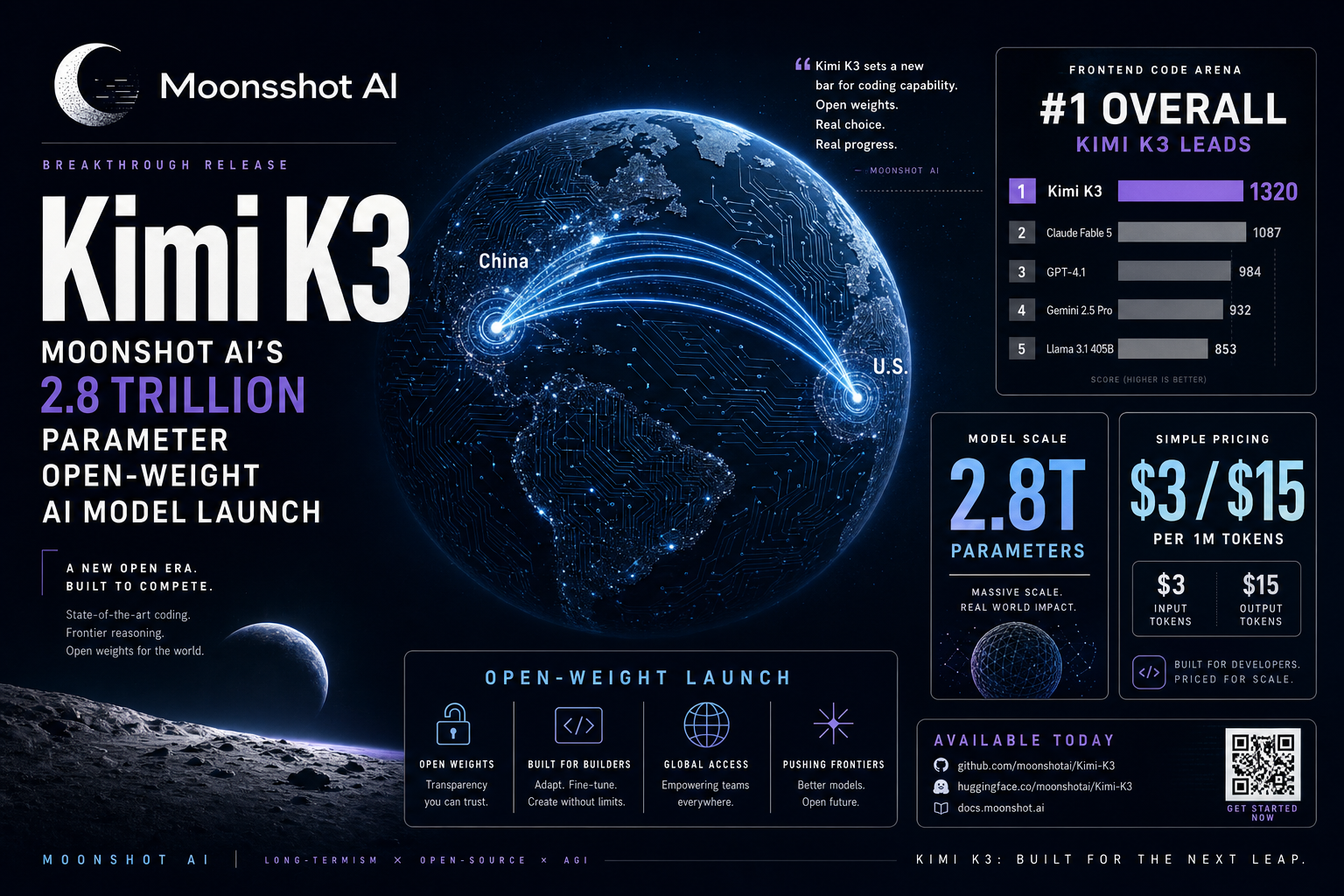
Moonshot AI dropped Kimi K3 on July 17, and it’s the biggest open-weight release of the year by a wide margin. At 2.8 trillion parameters — larger than DeepSeek V4 Pro (1.6T) and Zhipu’s GLM-5 (744B) combined — it’s the first model to credibly claim “open frontier intelligence” while matching closed models like Claude Fable 5 and GPT-5.6 Sol on key benchmarks. The hosted API is live now at $3 per million input tokens. The full weights land July 27.
This isn’t another incremental MoE refresh. Moonshot is betting that open weights at this scale can rewrite the competitive math of the AI industry, and the data so far supports the bet.
Why this matters now
The timing is everything. Anthropic’s Fable 5 spent 19 days under a US government export suspension in June — the most disruptive government-ordered model restriction in history — and that uncertainty is still rattling enterprise procurement. The Fable 5 incident showed that closed frontier models can become unavailable overnight. Open weights are the structural hedge.
Kimi K3 lands in that gap. It ships a 1-million-token context window, native vision, and Moonshot’s own Kimi Delta Attention (KDA) architecture — a hybrid linear attention scheme that the company says delivers roughly a 2.5× scaling efficiency improvement over K2. With 896 total experts activating only 16 per token (~1.8% of the pool), the model keeps inference costs manageable despite its raw size.
Moonshot’s open-weight strategy has been accelerating for a year — K2 in July 2025, K2.5 in January, K2.7-Code in June — and K3 is the flagship, not a specialist. That makes the July 27 open-weight drop a fundamentally different proposition from earlier releases.
What Kimi K3 brings to the table
The specs alone reset the open-weight ceiling:
| Metric | Kimi K3 | DeepSeek V4 Pro | GLM-5.2 | K2.7-Code |
|---|---|---|---|---|
| Total Parameters | 2.8T | 1.6T | 744B | ~500B |
| Active Per Token | 16 of 896 | ~37 of 256 | 32 of 128 | 16 of 64 |
| Context Window | 1M tokens | 128K tokens | 256K tokens | 128K tokens |
| Weight Precision | MXFP4 | FP8 | FP8 | BF16 |
| Recommended Serving | 64+ accelerators | 8–16 GPUs | 8 GPUs | 1 node |
| API Input Price (/M tokens) | $3.00 | $1.20 | $2.00 | $0.60 |
| API Output Price (/M tokens) | $15.00 | $4.00 | $8.00 | $2.40 |
The architecture introduces two novel mechanisms. Kimi Delta Attention (KDA) is a hybrid linear attention layer that reduces the quadratic memory bottleneck of standard softmax attention for long sequences — critical for sustained use of the 1M context window. Attention Residuals change how information flows between layers, preserving signal depth across 896 experts so that routing decisions remain coherent at scale.
Both are described in Moonshot’s technical blog and the KDA paper.
Benchmark performance: the numbers
Independent verification is limited until the weights drop on July 27, but the third-party data is already instructive.
Artificial Analysis Intelligence Index — the most cited independent composite — gives Kimi K3 a score of 57 across 189 tested models. That puts it fourth overall, behind Claude Fable 5 (60), and two configurations of GPT-5.6 Sol (59). Ahead of Claude Opus 4.8, GPT-5.5, Claude Sonnet 5, and GLM-5.2. As Moonshot’s own blog states with unusual candor: K3 does not beat Fable 5 on general intelligence — but it competes.
Frontend Code Arena tells a different story. K3 scored 1,679 points — first place, ahead of Fable 5 — in blind developer testing across 7 categories. It ranked #1 in 6 of 7 domains: Brand & Marketing, Reference-Based Design, Data & Analytics, and three others. This is a 17-position jump from Kimi K2.6, which sat at #18. The coding signal is not subtle.
The company also reports that K3 designed a simulated inference chip in a single 48-hour autonomous run — using open-source EDA tools and the Nangate 45nm library — closing timing at 100 MHz within 4mm² and sustaining over 8,700 tokens/second of simulated decode. Impressive as a demo, though Moonshot correctly presents it as a case study, not a benchmark.
Pricing and availability
The Kimi API is live now and compatible with the OpenAI SDK — same client, swap the endpoint and model ID kimi-k3. Cache-hit input tokens run $0.30/M, a meaningful discount for repeated queries.
| Tier | Price per million tokens |
|---|---|
| Cache-hit input | $0.30 |
| Uncached input | $3.00 |
| Output | $15.00 |
At $3/$15, K3 undercuts Anthropic’s Opus 4.8 (self-reported at $10/$50) on price by roughly 70% for input and 70% for output. It also sits below GPT-5.6 Sol, though exact Sol pricing varies by deployment tier. The OpenAI SDK compatibility means no integration overhead for teams already on an OpenAI or Anthropic stack — swap model IDs and run your existing evals.
The model is available through Kimi.com, Kimi Work, Kimi Code, Kimi API, and OpenRouter. The open weights are promised by July 27 — Moonshot has a clean record on weight releases (K2.7-Code shipped on schedule in June), but no LICENSE file, repository, or deploy guide exists yet as of this writing.
Hosting reality: 64 accelerators is not a hobby project
The single most practical detail in Moonshot’s material is the serving recommendation: K3 needs 64 or more accelerators in a supernode configuration. This is not an 8-GPU box. It is a coordinated multi-node deployment with high-bandwidth interconnect.
K3 ships weights in MXFP4 (with activations in MXFP8), applied via quantization-aware training from the SFT stage for broad hardware compatibility. But even with that optimization, the active parameter count per token is substantially larger than K2.7-Code, which runs on one H200 node with tensor parallelism 8. The gap is roughly 8× the accelerator count.
Teams serious about self-hosting should start sizing their infrastructure now. The July 17–27 window is for API qualification, not deployment planning.
The competitive landscape shift
Kimi K3 doesn’t exist in a vacuum. MiniMax is developing a 2.7-trillion parameter model targeting a Q3 2026 release, according to Reuters. Z.ai’s GLM-5.2 already scored near top US closed models in June. DeepSeek V4 Pro sits at 1.6T. The trend is unambiguous: Chinese AI labs are racing toward 3T-class open-weight models at a pace that compresses what was once thought to be a 6–12 month gap.
The strategic calculus is worth understanding. US export controls limit China’s access to the most advanced AI chips — the Biden-era October 2023 rules, deepened by the January 2026 Remote Access Security Access Act that closed the offshore cloud rental loophole. In response, Chinese labs optimized for architectural efficiency and open-weight distribution. Open-weight releases accelerate domestic AI adoption, build developer ecosystems, and, per Reuters and Bloomberg reporting, serve as a diplomatic tool to demonstrate technical capability.
Bank of America analysts described K3 as evidence that “large-scale pre-training plus architectural work can still deliver step-change gains for flagship Chinese models despite compute constraints.” That’s the single most important sentence in the coverage.
Decision framework
Use K3 now if you want frontier-competitive coding performance today via the API, especially for frontend-heavy or long-horizon agentic coding tasks. The OpenAI SDK compatibility means zero migration cost. The $3/$15 pricing undercuts every comparable closed model.
Wait on self-hosting if you haven’t provisioned 64-accelerator infrastructure. The API is the practical path today. Use the 10-day window to run your own evals — the eval harness carries over unchanged if you switch to self-hosted weights later.
Watch the license if you’re building a commercial product that might exceed 100M monthly active users. K2.7-Code shipped under Modified MIT with an attribution clause triggering at that threshold. K3’s license is unannounced. Expect a similar structure and plan your compliance review now.
Trade-off: You trade perfect third-party verifiability (weight access) for frontier-competitive pricing today. Every K3 benchmark number is a Moonshot-reported or API-derived claim until July 27. Moonshot’s track record on weight releases is good, but “promised by July 27” is not “released on July 17.”
Bottom line: Kimi K3 is the strongest open-weight launch of 2026 on paper. The API is worth integrating today. The open-weight drop on July 27 will determine whether it becomes a permanent fixture in the developer toolkit or a promising launch that couldn’t clear the infrastructure bar.
Related reading
- The Fable 5 Incident: Multi-Agent Jailbreaks and Sovereign Safety
- GPT-5 and GPT-5.6 Sol Public Release
- GLM-5.2 Open Weights with 1M Context
- Kimi K2.7: Open-Weight Agentic Coding
- July 2026 Model Price War
Sources
- PureAI — China’s Moonshot AI Releases Kimi K3, Its Largest Open-Weight Model
- Tom’s Hardware — China’s 2.8-trillion-parameter Kimi K3 beats Claude Fable 5 in Frontend Code Arena
- Reuters — China’s Moonshot unveils world’s largest open AI model, closing in on US rivals
- Digital Applied — Kimi K3 Open Weights: A July 27 Readiness Checklist
- Moonshot AI — Kimi K3 Technical Blog
- Bloomberg — China’s Powerful New Moonshot AI Model Closes Gap With US Rivals
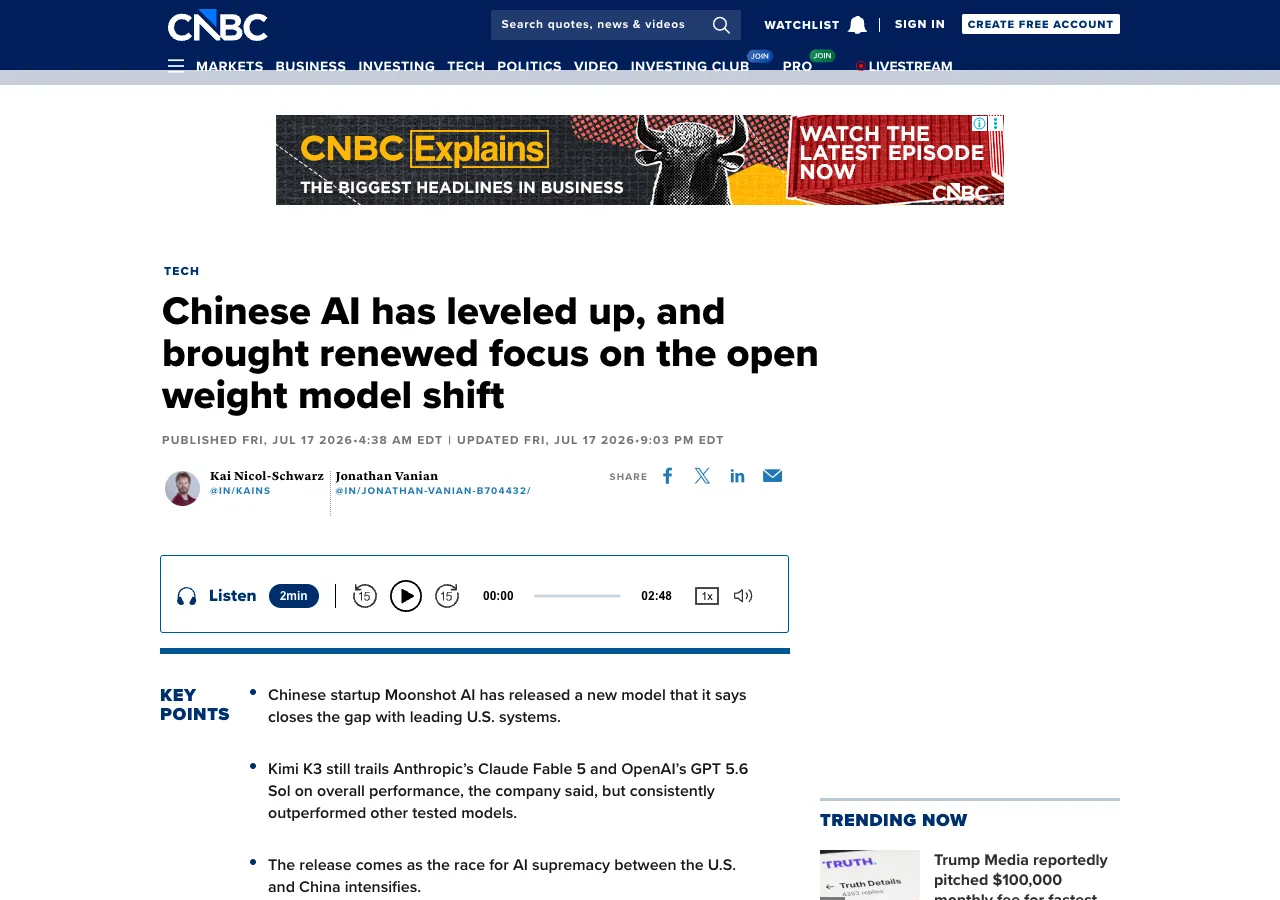
- CNBC — Bank of America: K3 shows step-change gains despite compute constraints
Built by developers, for developers. Open TechStack is an independent publication covering AI infrastructure, models, and tools for builders. Analysis and opinions are our own. Follow us on X for daily coverage.
About the author
Charles Jasthyn De La Cueva is a full-stack developer and the founder of Open TechStack. He writes about AI engineering, developer tools, and practical model evaluation — grounded in real workflows, not press releases.