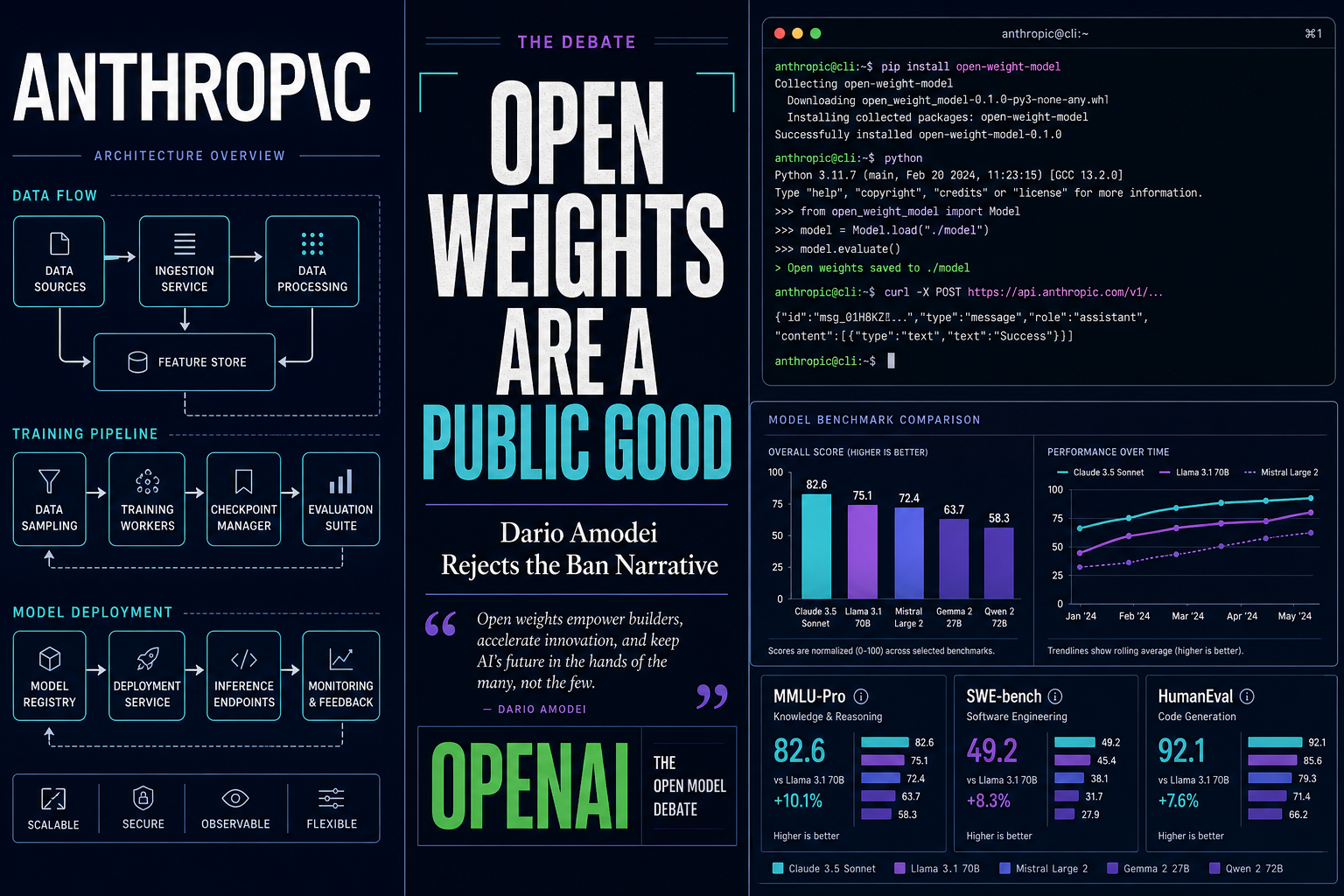
On July 27, 2026, Anthropic CEO Dario Amodei published the company’s official position on open-weight models — and it landed like a grenade in the middle of a debate that’s been building all month. His central claim: open-weight models that don’t have dangerous capabilities are a “public good.”
The statement is significant not just for what it says, but for who says it. Anthropic has been the most vocal safety advocate in the AI industry. Amodei has written extensively about catastrophic risks from AI development. And in a month where open-weight debates have dominated Hacker News, where 22 tech companies signed an open-weight letter, and where US officials reportedly consider banning Chinese open-weight models, Anthropic’s official position shapes the conversation on all sides.
The post is titled simply “Our position on open-weights models” and runs just over 1,200 words. Here’s what it says — and what it means for builders.
Why this matters now
The open-weight debate has been the defining AI story of July 2026. The timeline tells the story:
- July 17: Moonshot AI releases Kimi K3 (2.8T parameters, open weights promised by July 27)
- July 18: The AI price war coverage highlights how open-weight models are collapsing inference costs 90-97%
- July 21: Analysis of American AI’s closed strategy losing developer mindshare to China’s open-weight push
- July 25: NVIDIA, Microsoft, Meta, and 22 other companies sign an open-weight letter for “American AI Leadership”
- July 26: Tobi Knaup’s “Kubernetes moment” essay draws the platform parallel
- July 27: Amodei publishes Anthropic’s official position — and the Kimi K3 weights drop simultaneously
Amodei enters this conversation explicitly responding to “a lot of discussion about open-weights models, especially those from China.” Reports suggest US officials are considering restrictions on Chinese open-weight models. The industry open letter notably did NOT include Anthropic’s signature. And “some people have even accused Anthropic of wanting to ban open-weights models as a means of protecting our business.”
The position statement is Amodei clearing the record.
What Amodei actually said
The post makes four interconnected arguments. The full text is worth reading at anthropic.com/news/position-open-weights-models, but the key positions are:
1. Open-weight models that aren’t dangerous are a public good
“Open-weights models that don’t have dangerous capabilities are a public good: they don’t cost anything besides the compute needed to run them, and they provide value to businesses, developers, and researchers.”
This is the headline line. Amodei explicitly acknowledges the value open-weight models provide to the developer ecosystem. For a company that has historically emphasized the risks of open release, this is a meaningful concession.
2. Protectionist bans are the wrong tool
“Protectionist bans would not address my most serious national security concerns.”
Amodei identifies two nightmare scenarios: (1) authoritarian governments using AI for military superiority and repression, and (2) powerful models misused for cyberattacks or biological weapons. On both, he argues that banning US businesses from using Chinese open-weight models is irrelevant — bad actors aren’t US businesses.
“It would protect US AI companies from competition, but that has never been my goal.”
3. Three measures he DOES support
Amodei endorses three targeted interventions instead of blanket bans:
| Measure | Logic |
|---|---|
| Chip export controls | Don’t sell powerful chips or chipmaking equipment to China; crack down on smuggling. China can’t build frontier models without US chips due to scaling laws |
| Crack down on distillation | Industrial-scale distillation lets China build better models than its chip count should enable. Target the operations, not the open weights |
| Mandatory safety testing | Test all sufficiently capable models — open and closed, domestic and foreign — for cyber, biological, and alignment risks before release |
4. Disagreement with the open letter on safety claims
Amodei explicitly breaks with the industry open letter on one point:
“I don’t agree with the letter’s assertions that open-weights models necessarily make it easier to develop safeguards or that broad access to capabilities necessarily helps defenders more than attackers.”
He argues these questions should be “empirically answered by rigorous pre-release testing, not assumed in advance.”
What this changes
The position statement recasts the open-weight debate in several ways that matter for developers and teams making build decisions.
It decouples “safety concerns” from “ban advocacy.” Until now, the conversation has been framed as pro-open-weights vs anti-open-weights, with Anthropic assumed to be in the latter camp. Amodei’s post makes clear that Anthropic does not support bans. The industry now needs a more nuanced taxonomy: the debate is about how to manage frontier capability risk, not whether open weights should exist.
It validates the developer experience argument. Amodei explicitly acknowledges that open-weight models provide value to “businesses, developers, and researchers.” This is not a grudging concession — it’s an endorsement that open-weight models play a legitimate role in the ecosystem. The Matthew Saltz essay that hit #1 on HN the same day — “Using an open model feels surprisingly good” — describes exactly the developer freedom Amodei is acknowledging.
It shifts the policy debate from bans to testing. Amodei’s third proposal — mandatory safety testing for capable models — is the most concrete policy suggestion. And he argues this should be global:
“Note that to be effective, testing would need to be global, which means even the CCP would need to be on board. I think this may actually be possible.”
This reframes the discussion from “should we ban open weights” to “what capability threshold triggers testing requirements” — a debate that has actual engineering implications for model release decisions.
What it doesn’t address
Three gaps are worth noting:
No definition of “dangerous capabilities.” Amodei says models “that don’t have dangerous capabilities” are a public good, but doesn’t define where the line is. At current frontier scale (2.8T parameters for Kimi K3), nearly every capable model could be argued to have some dual-use potential. The threshold question is the entire policy debate.
No position on the Kimi K3 release. The post doesn’t address whether Kimi K3 specifically — which hit 2.8T parameters and scored at the frontier on coding benchmarks — crosses the “dangerous capabilities” line. Instead, Amodei focuses on chip controls and distillation, which are about China’s ability to train frontier models, not about the weights themselves.
No timeline for Anthropic’s own open-weight releases. If open-weight models are a public good, will Anthropic release one? The post doesn’t address this. Claude Fable 5 remains API-only.
How this fits with July’s broader pattern
Amodei’s position statement is the capstone of a month that has fundamentally reshaped the open-weight conversation:
| Date | Event | Position |
|---|---|---|
| July 17 | Kimi K3 launch (2.8T params, $3/M) | Open weights as competitive strategy |
| July 18 | AI price war analysis | Open weights driving 90%+ cost reduction |
| July 21 | American AI closed strategy critique | Open weights winning developer mindshare |
| July 25 | NVIDIA/Microsoft/Meta +22 open letter | Industry support for open weights |
| July 26 | Kubernetes moment essay | Open weights as infrastructure layer |
| July 27 | Amodei position statement | Open weights as “public good” |
| July 27 | Kimi K3 weights released | Open frontier intelligence arrives |
The pattern is clear: the question is no longer whether open-weight models should exist. It’s how the ecosystem manages the transition to a world where frontier-capable open models are the default.
Decision framework for builders
-
Use open-weight models for production workloads with confidence that the policy environment is increasingly accommodating, not restrictive. The major AI labs are aligned against blanket bans.
-
Watch the safety testing threshold. Amodei’s third proposal — mandatory testing for capable models — could create compliance requirements if adopted. For now, it’s a proposal, not regulation, but developers deploying at scale should track where the threshold lands.
-
Plan for a multi-model strategy. The industry is converging on a two-tier system: open-weight models for routine production (at 2-5% of closed API cost) and closed frontier models for the hardest tasks. Amodei’s position validates this approach.
-
Don’t treat safety concerns as anti-open-weights. Amodei’s post demonstrates that serious concern about AI risk is compatible with supporting open-weight models. The policy debate is shifting toward capability-based testing, not model-type-based restrictions.
Related reading
- Open-Weight AI’s Kubernetes Moment — The infrastructure argument behind portable model weights.
- American AI’s Closed Strategy Is Losing to China — The geopolitical and ecosystem context.
- AI Supply Chain Security and Model Provenance — How to verify what you deploy.
Sources
- Anthropic — Our position on open-weights models (Dario Amodei)
- Tobi Knaup — Open-weight AI is having its Kubernetes moment
- Matthew Saltz — Using an open model feels surprisingly good
- NVIDIA, Microsoft, Meta +22 — Open-weight letter on American AI Leadership
- SWE-bench Pro — Frontier model coding benchmark results
- Hacker News — Anthropic position discussion (889 points)
- Apertus 1.5 — Switzerland’s fully open AI model
- Open-Weight AI’s Kubernetes Moment
- American AI’s Closed Strategy Is Losing to China
About the author
Charles Jasthyn De La Cueva is a full-stack developer and the founder of Open TechStack. He writes about AI engineering, developer tools, and practical model evaluation — grounded in real workflows, not press releases.