Why this matters now
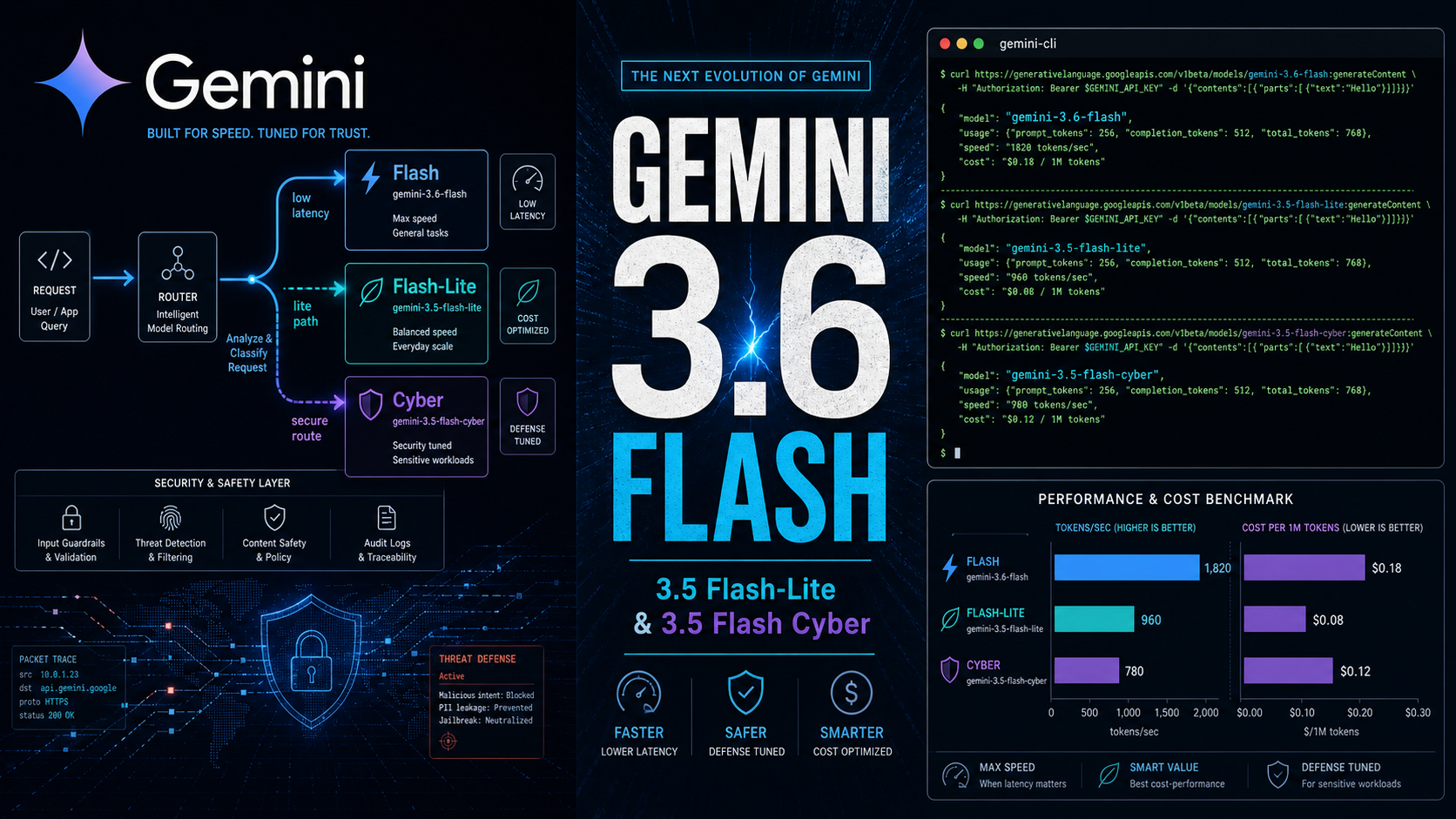
On July 21, Google announced three new Gemini models — 3.6 Flash, 3.5 Flash-Lite, and 3.5 Flash Cyber — and quietly buried the lede: the company has started pre-training Gemini 4, its most ambitious model yet. The releases land exactly four days after our Gemini 3.5 Pro launch coverage and confirm the direction we flagged: Google is betting its Flash series on agentic AI workloads, not just chat performance.
The biggest shift is pricing. 3.6 Flash comes in at $1.50 per million input tokens and $7.50 per million output tokens — cheaper than 3.5 Flash across the board. 3.5 Flash-Lite undercuts everything at $0.30/$2.50 per million. If you’ve been watching the July 2026 AI price war, this is Google’s counterpunch to Kimi K3 at $3/$15 and GPT-5.6 Sol at $5/$30 — not by matching capability claims, but by making agentic workloads affordable at scale.

What Google announced: three models, one strategy
Google’s post, authored by Senior Director of Product Management Tulsee Doshi, frames the release around a single thesis: developers building production AI agents need higher token efficiency, lower latency, and more reliable performance. The Flash series is Google’s answer to that need, not a frontier intelligence play.
| Model | Input Price / 1M | Output Price / 1M | Speed | Key Metric |
|---|---|---|---|---|
| 3.6 Flash | $1.50 | $7.50 | Standard | 17% fewer output tokens vs 3.5 Flash |
| 3.5 Flash-Lite | $0.30 | $2.50 | 350 tok/s | 54.2% SWE-Bench Pro |
| 3.5 Flash Cyber | Via CodeMender | Via CodeMender | Standard | Frontier-competitive on CyberGym |
All three are available starting today through the Gemini API, Google AI Studio, and Android Studio. 3.6 Flash also lands in Google Antigravity and the Gemini Enterprise Agent Platform.
Gemini 3.6 Flash: the workhorse gets cheaper and smarter
3.6 Flash is the headline release. It’s not a frontier model — Google explicitly positions it as a workhorse for agentic workflows — but the benchmark improvements over 3.5 Flash are real and consistent.
Token efficiency is the headline. Google reports 3.6 Flash consumes 17% fewer output tokens than 3.5 Flash on the Artificial Analysis Index. For builders paying per token, that’s a direct cost reduction on top of the already-lower per-token price. The model also takes fewer reasoning steps and tool calls to complete multi-step workflows — meaning lower latency per task, not just lower cost per token.
Coding improvements are the strongest signal. On DeepSWE (Datacurve), 3.6 Flash scores 49% vs 3.5 Flash’s 37% — a 12-point jump driven by “higher precision with fewer unwanted code edits and reduced execution loops.” On MLE Bench (machine learning research tasks), it hits 63.9% vs 49.7%. These are not SOTA numbers — Kimi K3 scores higher on Frontend Code Arena, and GPT-5.6 Sol leads Terminal-Bench at 88.8% — but they represent meaningful progress in the model class that most developers actually use.
Computer use goes built-in. Google has made computer use a native client-side tool in the Gemini API and Gemini Enterprise. 3.6 Flash scores 83.0% on OSWorld-Verified (vs 78.4% for 3.5 Flash), which measures the model’s ability to manipulate desktop UIs autonomously. This matters because it directly enables agentic workflows where the model interacts with existing software — no API integration needed.
Knowledge work sees gains too. GDPval-AA v2 (a composite of real-world task execution) shows 3.6 Flash at 1,421 Elo vs 3.5 Flash’s 1,349. The delta is modest but consistent.
| Benchmark | 3.6 Flash | 3.5 Flash | Delta |
|---|---|---|---|
| DeepSWE (coding) | 49.0% | 37.0% | +12.0 |
| MLE Bench (ML research) | 63.9% | 49.7% | +14.2 |
| OSWorld-Verified (computer use) | 83.0% | 78.4% | +4.6 |
| GDPval-AA v2 (knowledge work) | 1,421 Elo | 1,349 Elo | +72 |
| Artificial Analysis Index (token efficiency) | -17% output tokens | Baseline | Better |
Safety improvements: 3.6 Flash ships with enhanced Frontier Safety safeguards for CBRN (chemical, biological, radiological, nuclear) and cyber offense misuse, along with reduced refusals for beneficial uses.
Gemini 3.5 Flash-Lite: the budget agent champion
3.5 Flash-Lite is the surprise hit of this release. At $0.30 per million input tokens and $2.50 per million output, it’s Google’s answer to the ultra-budget tier — and the benchmark numbers suggest it significantly outperforms the previous Lite generation while staying cheap enough to deploy at scale.
350 output tokens per second (per Artificial Analysis) makes it the fastest model in the 3.5 family. That raw throughput matters for agentic search, document processing, and any workload where you’re burning through context at high volume.
The key comparison is against 3.1 Flash-Lite, the previous budget champion:
| Benchmark | 3.5 Flash-Lite | 3.1 Flash-Lite | Delta |
|---|---|---|---|
| Terminal-Bench 2.1 | 54.0% | 31.0% | +23.0 |
| GDM-MRCR v2 (long context) | 72.2% | 60.1% | +12.1 |
| GDPval-AA v2 | 1,140 Elo | 642 Elo | +498 |
| SWE-Bench Pro | 54.2% | N/A (3 Flash: 49.6%) | Beats 3 Flash |
| OSWorld-Verified | 74.0% | N/A (3 Flash: 65.1%) | Beats 3 Flash |
The most interesting data point: 3.5 Flash-Lite outperforms Gemini 3 Flash on both SWE-Bench Pro (54.2% vs 49.6%) and OSWorld-Verified (74.0% vs 65.1%). Google is effectively obsoleting its own 3 Flash tier with a model that costs pennies per million tokens.
Like 3.6 Flash, 3.5 Flash-Lite now includes computer use as a built-in tool. Google is making computer use standard across the Flash lineup, not just the flagship.
Gemini 3.5 Flash Cyber: security specialization
The third release is the most unusual. 3.5 Flash Cyber is built on 3.5 Flash, fine-tuned specifically for finding and fixing cybersecurity vulnerabilities. It runs inside CodeMender, Google’s code security agent that orchestrates multiple 3.5 Flash Cyber agents to produce combined vulnerability reports.
The model reaches “competitive performance at the frontier” on the CyberGym benchmark, according to Google. The specific numbers are not disclosed — a pattern we’re seeing more often with security-focused models.
More notable is the access restriction: 3.5 Flash Cyber will be “exclusively available to governments and trusted partners via CodeMender” as part of a limited-access pilot. Google cites dual-use concerns — a model that can find vulnerabilities can also weaponize them. This is the same logic behind GPT-5.6 Sol’s government review and Claude Fable 5’s credit gating, but applied at a narrower scope (security only, not general intelligence).
For most developers, Flash Cyber won’t be directly accessible. But the approach — fine-tuning a cost-efficient base model for a specific security domain and deploying it through an agentic orchestration layer — is a template we’ll likely see more of.
Gemini 4 pre-training has started
Buried in the post’s introduction is something that arguably matters more than any of the three releases:
“In parallel, our team is already focusing on building the next generation of models. We have started our most ambitious pre-training run yet, for Gemini 4, and are excited by the progress.”
This is Google signaling that the Flash series is its production layer, not its frontier. Gemini 4 is the true next-generation architecture, and today’s releases are the infrastructure that keeps the platform competitive while the next big thing bakes. It also explains why Google is comfortable releasing three models simultaneously — the Flash family is being set up as a self-sustaining ecosystem, not a series of one-off launches.
How this fits the landscape
The Gemini 3.6 launch reads differently in the context of the past week’s news. Here’s where it fits:
- Kimi K3 (July 17, 2.8T parameters, $3/$15) is the raw-intelligence play — it competes on benchmark ceiling, not efficiency.
- Qwen 3.8 (July 19, 2.4T, subscription) is the scale play — “second only to Fable 5” by parameter count.
- Gemini 3.6 Flash is the efficiency play — Google is not trying to win the benchmark crown. It’s making agentic workloads cheaper per task, which is a defensible strategy when your competitive advantage is infrastructure scale.
The combined effect: the AI market is segmenting into frontier intelligence (K3, Fable 5, Sol, Qwen 3.8) and production agentics (Gemini Flash, Claude Sonnet, DeepSeek V4 Pro). Different models for different jobs. The Flash lineup’s computer use and agent orchestration features reflect a bet that the real volume will be in the second category.
As we noted in our agent benchmark roundup, the benchmarks that matter for production agents — SWE-Bench, Terminal-Bench, OSWorld — are exactly where Google is publishing its Flash numbers.
Decision framework
Use 3.6 Flash if you’re building agentic workflows that need reliable coding support, computer use, or multimodal parsing, and you want to lower per-task costs compared to 3.5 Flash. The 17% token efficiency improvement compounds with the lower per-token price.
Use 3.5 Flash-Lite if you’re running high-volume agentic search, document processing, or any workload where raw throughput matters more than peak intelligence. At $0.30/$2.50 per million with 350 tok/s, it’s the best price-to-performance ratio in Google’s lineup.
Investigate 3.5 Flash Cyber if you’re in security research, have government/trusted-partner access, and need an AI-assisted vulnerability detection pipeline. Otherwise, this is an early-access preview of a direction, not a tool you can adopt today.
Wait for Gemini 4 if your use case genuinely demands frontier intelligence. The Flash series is production-grade infrastructure, not a SOTA contender. Gemini 4 is the architecture that will determine whether Google can compete at the frontier again.
Trade-off: You trade peak benchmark scores for per-task economics. If your workload runs millions of agentic tasks per month, the Flash lineup likely saves you more money than a frontier model costs in overprovisioned inference. If you need the best possible coding benchmark score, Kimi K3 or a Claude model is still the better choice.
Bottom line: Google isn’t trying to win the intelligence race with this release. It’s optimizing for the volumes where the real money will be made — and quietly signaling that Gemini 4 is the architecture that will fight the frontier war.
Related reading
- Gemini 3.5 Pro lands July 17 — the un-gated frontier model
- Enterprise AI agent benchmarks 2026
- The July 2026 AI Model Price War
- Kimi K3: Moonshot’s 2.8T Open-Weight Model
- Qwen 3.8: Alibaba’s 2.4T Open-Weight Model
- GPT-5.6 Sol Public Release
Sources
- Google Blog — Introducing Gemini 3.6 Flash, 3.5 Flash-Lite, and 3.5 Flash Cyber
- Google AI for Developers — Gemini API docs
- Google AI Studio
- Google Antigravity
- Artificial Analysis — Gemini 3.6 Flash benchmarks
- Kimi Work product launch (mentioned as competitive context)
- Google — Gemini Enterprise Agent Platform
About the author
Charles Jasthyn De La Cueva is a full-stack developer and the founder of Open TechStack. He writes about AI engineering, developer tools, and practical model evaluation — grounded in real workflows, not press releases.