Why this matters now
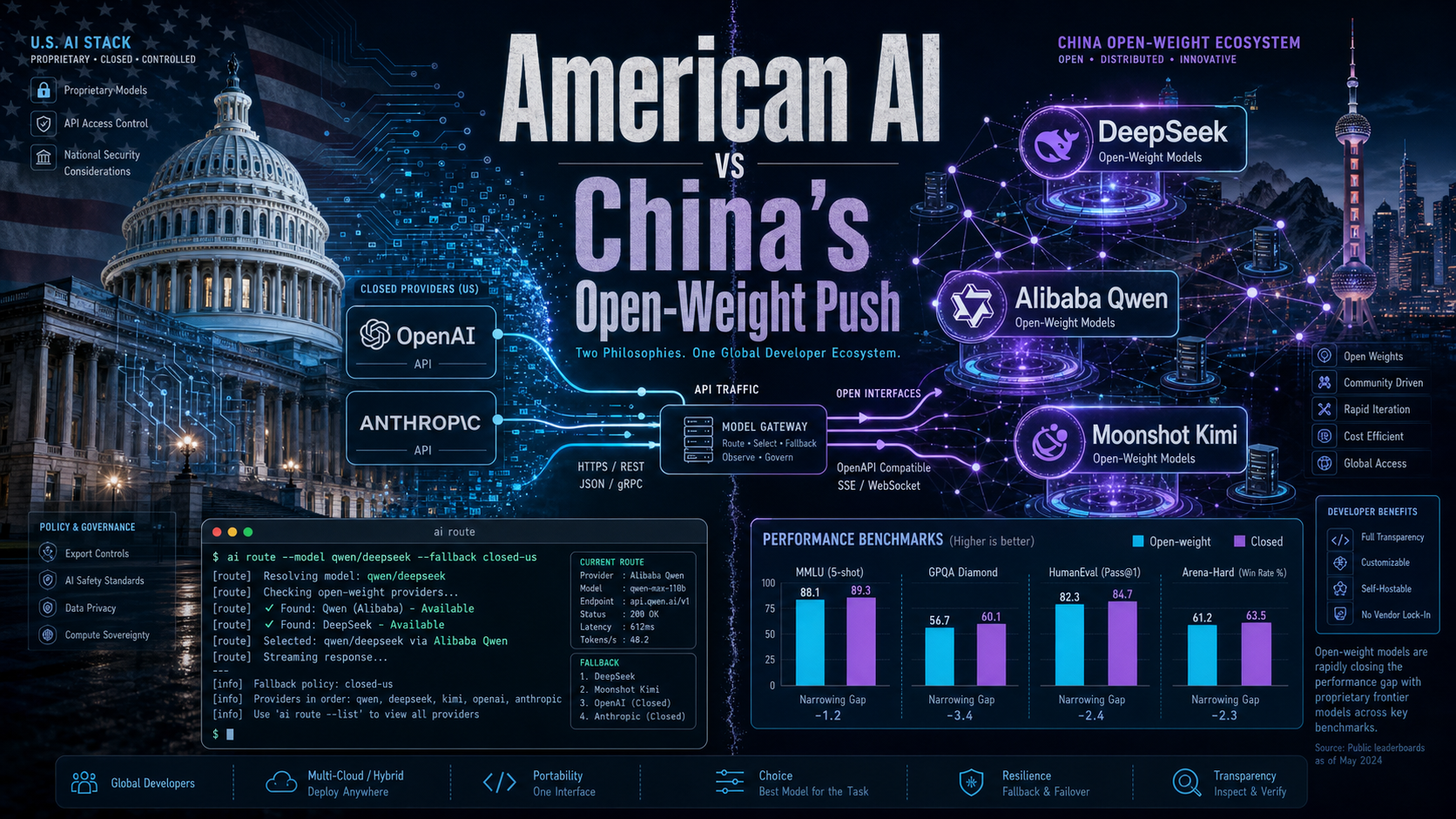
On July 20, Ben Werdmuller published an argument that crystallised a growing consensus in the developer community: American AI’s closed, proprietary strategy is losing to China’s open-weights approach. The piece, titled “American AI is locked down and proprietary. It’s losing,” hit the top of Hacker News with 109 points and drew over 100 comments in hours — because it named a dynamic every builder is feeling but few are saying out loud.
The thesis is straightforward. AI models as products have almost no technical moat. You can swap ChatGPT for Claude for Kimi K3 with minimal workflow impact — particularly on the API side, where changing the endpoint and keeping the prompt is trivial. The real moat is in enterprise services: contracts, compliance integrations, deployment tooling. And on the model layer itself, Chinese labs are releasing open-weight models that increasingly match proprietary frontier capability at a fraction of the cost.
Moonshot AI’s Kimi K3 (2.8T parameters, open weights by July 27) and Alibaba’s Qwen 3.8 (2.4T, open weights “soon”) both claim to go toe-to-toe with Anthropic’s Claude Fable 5 and OpenAI’s GPT-5.6 Sol for a fraction of the API cost — or even zero, once the weights land on Hugging Face. As we covered last week, the open-weight frontier is closing fast.

The data that backs the claim
The strongest evidence comes from a16z partner Martin Casado, who wrote in The Economist that there is an 80% chance any given startup is using Chinese AI models. The figure is striking — and contested. Several HN commenters pushed back, with one noting that startups they interviewed were “all using US models” for their core workflows. But even skeptics acknowledged Chinese models have significant mindshare, particularly for secondary tasks, cost-sensitive inference, and local deployment scenarios where open weights eliminate per-token costs.
The broader numbers tell a consistent story:
| Metric | What it shows |
|---|---|
| 80% startup usage rate (Casado/Economist) | Chinese models are deeply embedded in the startup ecosystem |
| Kimi K3 at $3/M tokens vs Claude Fable 5 at $15/M | 5x cost advantage for claimed comparable quality |
| Qwen 3.8 — 2.4T open weights | Second-largest open-weight release after Kimi K3 |
| DeepSeek V4 Pro at ~$0.50/M tokens | Community-favorite coding model at 30x less than Fable 5 |
| HN thread: 109 points, 100+ comments in hours | Developer community is actively debating the shift |
The US response has been export controls on GPUs and data-localisation rules that prevent US companies from running Chinese models on sensitive workloads. But these measures don’t stop a startup in Berlin, Bangalore, or Buenos Aires from pulling Kimi K3 off Hugging Face and running it on their own hardware.
Why open weights are winning
Open-weight models are not truly open source — training data, training code, and architecture details are rarely published. But they are portable and permissionless. You can host them where you want, modify them, fine-tune them, and use them without API keys, rate limits, or the risk of a provider cutting off access.
This last point is more salient than ever. As one HN commenter put it: “After the Fable government ban situation, it’s hard to trust US AI anymore. If the US decides to cut off access at any moment, overseas developers relying on the API would suddenly lose connection.” The Fable 5 incident — where the US government restricted access to Anthropic’s frontier model over dual-use concerns — demonstrated that API dependency is geopolitical risk. Open weights eliminate that risk entirely.
China’s strategy turns a compute disadvantage into a distribution advantage. Because US export controls limit GPU shipments to China, Chinese labs can’t build global-scale cloud services like OpenAI or Anthropic. Instead, they release open weights — commoditising the model layer where American companies make their margins — and capture value through ecosystem effects in manufacturing, research, and domestic deployment. As Ben Werd put it: “Open almost always wins when it comes to infrastructure adoption.”
The three objections — and what they miss
The HN discussion surfaced three recurring counterarguments, each worth examining.
1. “Chinese models are just dumping.” The argument that Chinese labs are offering models at below-cost to drive out competition has some merit — AI models cost tens of millions to train. But open weights, once released, can’t be taken back. Even if the strategy is predatory in intent, the effect is permanent availability. DeepSeek V2 was released two years ago and still runs fine on consumer hardware.
2. “Censorship makes Chinese models unusable.” This is the strongest objection. Chinese models refuse to discuss certain topics (Tiananmen Square, Taiwan independence, Xinjiang). For enterprise customers with compliance requirements around political neutrality, this is a dealbreaker. But as one commenter pointed out, American models have their own political slant — “try asking Fable about basic software security” — and the censorship concern is moot for technical use cases like code generation, mathematical reasoning, and document analysis.
3. “Export controls and security concerns will block adoption.” Security is a legitimate concern — can an open-weight model contain backdoors? The model weights themselves are just matrices; the real risk vector is in the tokenizer, the inference runtime, and any data exfiltration in the application layer. These are manageable with standard supply-chain security practices (model provenance verification, runtime sandboxing). And export controls only accelerate the shift to self-hosted open weights, since developers outside the US don’t want to bet on a provider that the US government might restrict.
The broader landscape: Soofi and the European response
The debate isn’t just US vs China. On July 21, the Soofi consortium in Germany released Soofi S — a 30B Mixture-of-Experts model trained on 27 trillion tokens, focused on German and English industrial applications. It’s explicitly positioned as a “sovereign open source foundation model” for European industry. This is the same open-weights playbook, now adopted by European institutions seeking digital sovereignty.
The pattern is clear: countries and regions that don’t want to depend on US proprietary APIs are turning to open-weight models as the alternative — and Chinese labs are the primary suppliers, with European efforts following slowly behind.
Decision framework
This matters most if:
- You’re building on top of AI APIs and evaluating long-term vendor risk
- You’re a non-US developer concerned about geopolitical access restrictions
- You’re deploying cost-sensitive or high-volume inference workloads
- You need self-hosted models for data privacy or compliance reasons
Less relevant if:
- Your use case requires politically neutral output across all domains
- You’re deeply integrated into a single US provider’s ecosystem (Copilot, ChatGPT Enterprise)
- Your compliance framework explicitly prohibits running non-US models
Trade-off: The cost advantage of open-weight models is real but comes with ecosystem trade-offs — less polished tooling, fewer managed services, and potential censorship or security concerns. For pure inference workloads and code generation, the calculus increasingly favors open weights. For enterprise deployments requiring SLAs, compliance certifications, and hand-holding, proprietary US providers still hold the edge.
Bottom line: The window where American frontier labs could rely on model quality alone to justify their pricing is closing. China’s open-weights strategy is working — not because Chinese models are better, but because open beats closed in infrastructure markets, and the gap in capability is narrowing fast.
Related reading
- Qwen 3.8: Alibaba’s 2.4T Open-Weight Model Claims #2 Behind Fable 5
- Kimi K3: Moonshot’s 2.8T Open-Weight Model Shakes Up the AI Race
- The July 2026 AI Model Price War: Frontier Costs Collapse
- Kimi K3’s $3.3 Trillion Chip Rout: The AI Investment Thesis Cracks
Sources
- Ben Werdmuller — American AI is locked down and proprietary. It’s losing
- Hacker News discussion — American AI is locked down (109 points)
- The Economist — Martin Casado on why open-weights AI models are a strategic asset
- Emerging Trajectories — Kimi K3, Qwen 3.8, and Anthropic’s (Potential) Unravelling
- Soofi — Sovereign Open Source Foundation Models (Soofi S)
- The Verge — China delivers a one-two punch to America’s AI dominance (Robert Hart)
About the author
Charles Jasthyn De La Cueva is a full-stack developer and the founder of Open TechStack. He writes about AI engineering, developer tools, and practical model evaluation — grounded in real workflows, not press releases.