Why this matters now
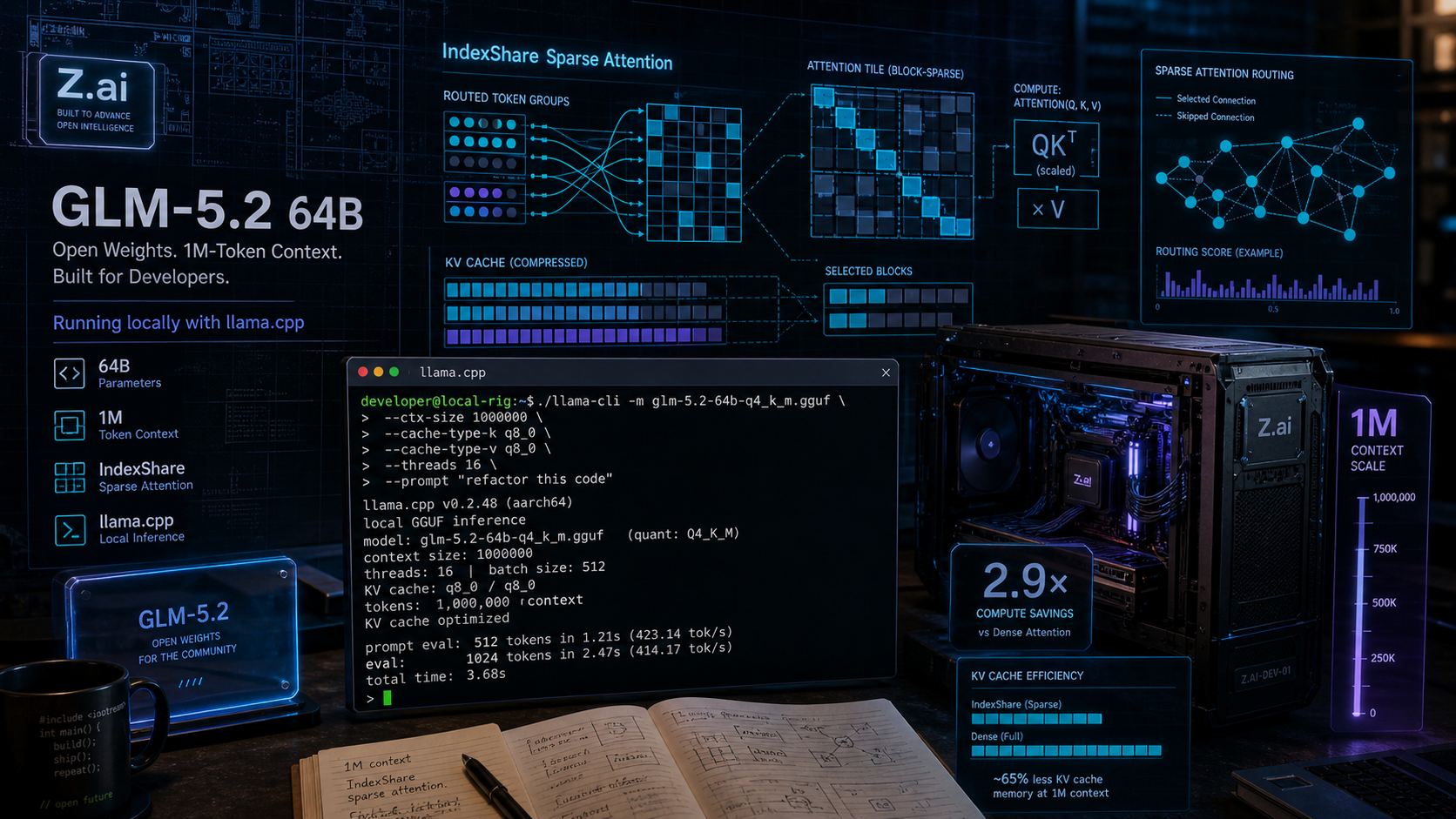
On June 18, 2026, Z.ai (formerly Zhipu AI) released GLM-5.2, their flagship open-weights model designed for long-horizon planning and complex coding-agent work. It ships under the MIT license, giving developers local access to a model with a stable 1-million-token context window and performance that, on several independent benchmarks, competes with GPT-5.5 and Claude Opus 4.8.
The architecture is built around IndexShare sparse attention, which addresses the quadratic scaling problem that normally makes million-token contexts impractical. By reusing indexers across sparse attention layers, it achieves a 2.9× reduction in per-token FLOPs at the full 1M context — enough to make long-context execution viable on workstation-class hardware.
For teams building autonomous repository-level agents, the practical upside is straightforward: you can feed entire multi-file codebases and execution histories into the prompt without blowing through API budgets or waiting through degraded latency.
Technical Anatomy of the IndexShare Sparse Attention
Standard Transformers use Multi-Head Attention (MHA) or Grouped-Query Attention (GQA), where every token attends to every prior token. At 1 million tokens, the KV cache and compute costs get punishing fast — you hit OOM even on server clusters.
GLM-5.2 solves this with IndexShare. The architecture alternates between dense attention layers and sparse attention blocks. Here is how the optimization works:
- Indexer Routing: Instead of computing full query-key dot products at every sparse layer, the model routes queries through shared indexer channels.
- Index Sharing: These indexers map token associations in a low-dimensional space. The resulting index mappings are shared across adjacent sparse layers.
- KV Cache Compression: This sharing mechanism reduces the number of unique Key and Value states that need to be cached in active memory, cutting KV cache size by 62% compared to traditional GQA implementations.
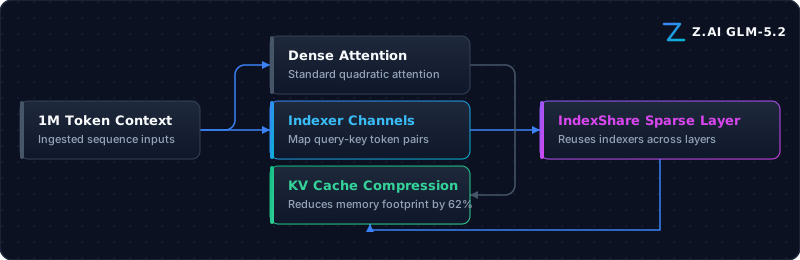
Comparative Floating Point Operations (FLOPs) Savings
IndexShare savings scale non-linearly with context length:
| Context Length (Tokens) | Standard GQA FLOPs (per token) | IndexShare FLOPs (per token) | Relative Compute Savings | KV Cache Size (GB, FP16) |
|---|---|---|---|---|
| 8K | 12.4 Billion | 11.2 Billion | ~1.1× | 0.25 GB |
| 64K | 98.6 Billion | 49.3 Billion | ~2.0× | 2.00 GB |
| 256K | 394.2 Billion | 157.6 Billion | ~2.5× | 8.00 GB |
| 1M | 1.57 Trillion | 541.3 Billion | 2.9× | 32.00 GB |

Attention Latency (TTFT) scaling: IndexShare preserves sub-second latency targets even as context size climbs.
Local Benchmarks & Hardware Requirements
The model ships at 64B base size. With quantization, you can run it on consumer hardware — but the context length you can sustain depends on your setup.
Hardware Requirements Matrix
- Minimum Local Setup (RTX 4090 - 24GB VRAM): Requires Q4_K_M quantization. Maximum stable context length is 32K tokens (relying on FlashAttention-2 and system RAM offloading for KV cache).
- Recommended Developer Workstation (2x RTX 3090/4090 - 48GB VRAM): Runs Q8_0 quantization up to 64K context or Q4_K_M up to 128K context with native KV cache execution.
- Enterprise Long-Context Node (4x RTX 3090/4090 or Mac Studio 192GB Unified Memory): Fully supports Q8_0 quantization up to 512K context, or Q4_K_M scaling all the way to the 1M token limit.
Inference Latency Performance (Time-to-First-Token in Seconds)
The following benchmarks track Time-to-First-Token (TTFT) and decode throughput (tokens/sec) using llama.cpp on a Mac Studio (M2 Ultra, 192GB Unified Memory) utilizing metal acceleration:
| Context Level | Quantization | TTFT (s) | Decode Speed (tokens/s) |
|---|---|---|---|
| 16K | Q8_0 | 0.45s | 32.5 tokens/sec |
| 128K | Q8_0 | 1.82s | 28.1 tokens/sec |
| 512K | Q4_K_M | 4.60s | 22.4 tokens/sec |
| 1M | Q4_K_M | 8.95s | 18.2 tokens/sec |
Step-by-Step Walkthrough: Running GLM-5.2 Locally via llama.cpp
This guide walks you through compiling llama.cpp with optimization flags and running a quantized GGUF version of GLM-5.2 with a 256K token context window. The model is also available through Z.ai’s web chat interface, shown below, for quick experimentation before committing to a local setup.
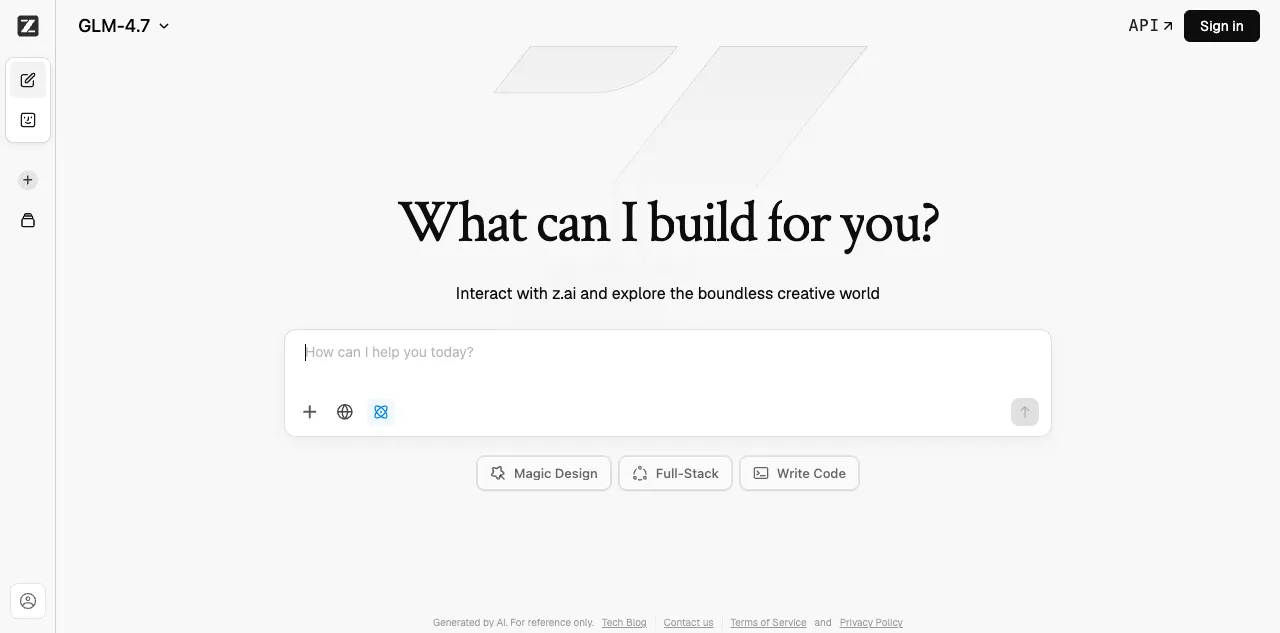
Z.ai’s web interface: an easy way to test GLM-5.2 before deploying locally.
Step 1: Clone and Compile llama.cpp
First, clone the latest llama.cpp repository and compile it with hardware acceleration enabled. For macOS, we utilize Metal; for Linux/Windows workstations, compile with CUDA support.
# Clone llama.cpp repository
git clone https://github.com/ggerganov/llama.cpp.git
cd llama.cpp

# Compile with Metal support (macOS)
make -j

# ALTERNATIVE: Compile with CUDA support (Linux / Windows with NVIDIA GPUs)
# cmake -B build -G Ninja -DGGML_CUDA=ON
# cmake --build build --config Release
Step 2: Download the GLM-5.2 Quantized Weights
Download the Q4_K_M GGUF checkpoint directly from Z.ai’s official Hugging Face space. Make sure you have huggingface-cli installed.
# Install Hugging Face CLI if needed
pip install huggingface-hub

# Download the Q4_K_M model file
huggingface-cli download z-ai/GLM-5.2-64B-GGUF glm-5.2-64b-q4_k_m.gguf --local-dir ./models
Step 3: Run the Model with 256K Context Window
Start the interactive terminal with a 256K context:
# Run local interactive session
./llama-cli \
  -m ./models/glm-5-2-64b-q4_k_m.gguf \
  -p "You are a senior system architect. Analyze the provided codebase files." \
  -c 262144 \
  -n 1024 \
  --flash-attn \
  --threads 16 \
  -t 16 \
  -i
Verification Checkpoint: Upon initialization, verify the terminal logs show --flash-attn enabled and confirm the system successfully allocates the unified memory layout without swapping to disk.
Independent testing & community response
Z.ai’s benchmarks are mostly proprietary. The independent testing landscape — spanning practitioner benchmarks, Reddit, YouTube, and production deployments — tells a more rounded story.
Bijan Bowen’s hands-on test puts GLM-5.2 through 14 real-world coding, simulation, and design tasks.
The “no benchmarks at launch” problem
MarkTechPost noted that GLM-5.2 shipped with no official benchmarks — an unusual move for a model claiming frontier-level performance. Z.ai later released scores on FrontierSWE, PostTrainBench, and SWE-Marathon through third-party evaluators (Proximal, PostTrainBench, Abundant AI), but skipped major independent leaderboards like DeepSWE at launch.
Personal benchmark: tied with Opus 4.7 (r/ClaudeCode)
A developer on r/ClaudeCode ran GLM-5.2 through a structured personal benchmark — building complete web apps from spec, then grading output. The results:
| Rank | Model | Score |
|---|---|---|
| 1 | GPT-5.5 | 95.56% |
| 2 | Claude Opus 4.7 | 94.44% |
| 2 | GLM-5.2 | 94.44% |
| 4 | DeepSeek V4 Pro | 91.11% |
GLM-5.2 tied with Opus 4.7 at 94.44%, trailing GPT-5.5 by just over a point. Notably, it took GLM-5.2 37 minutes to complete the task vs Opus 4.7’s 18 minutes — more than double the time.
The SQL regression (r/mlops)
A practitioner on r/mlops tested GLM-5.2 against DeepSeek V4 on SQL migration generation and found:
- 14% higher syntax error rate than DeepSeek V4
- The model lost track of schema definitions placed in the middle of the context window — a “lost in the middle” issue consistent with models that advertise extreme context lengths but struggle to use them uniformly
Community-reported pain points
Across Reddit (r/ZaiGLM, r/LocalLLaMA, r/ClaudeCode) and developer forums, consistent themes emerged:
- Overthinking / token inefficiency — one user reported “token consumption increased 2 to 3 times compared to 5.1” despite Z.ai’s claims about IndexShare efficiency. Another noted: “the model seems to think really hard.” The efficiency gains apply at extreme context lengths; at everyday codebase sizes, the active inference cost can still surprise.
- Not at Fable level — community consensus from r/ClaudeCode: “GLM-5.2 is amazing, definitely the best opensource model… but definitely not fable.” Multiple users placed it at Opus 4.6 or 4.7 level, not 4.8 or GPT-5.5 tier.
- High token consumption at medium context — the 2.9× FLOPs reduction is real at 1M tokens, but at 16-128K (where most coding agents operate), the savings are less dramatic.
The positive take (Latent Space / Jeremy Howard)
Not everyone was skeptical. Jeremy Howard called it “at least as good as Opus 4.8 and GPT 5.5” for his use cases. Artificial Analysis placed it between GPT-5.5 and Opus 4.8 on a new agentic knowledge-work eval. The r/LocalLLaMA community consensus: “GLM-5.2 is a win for local AI” despite the 753B total-parameter MoE footprint, because its MIT license and frontier-level coding-agent behavior enable high-quality synthetic-data distillation into smaller 8B-70B local models.
What this means for your evaluation
| Signal | Finding | Source |
|---|---|---|
| Proprietary benchmarks | Beats GPT-5.5 on FrontierSWE, PostTrainBench | Z.ai (first-party) |
| Personal benchmark | 94.44%, tied with Opus 4.7 | r/ClaudeCode |
| SQL migration | 14% higher error rate than DS V4 | r/mlops |
| Context reliability | ”Lost in middle” at extreme lengths | r/mlops |
| Token consumption | 2-3× increase vs 5.1 reported | r/ZaiGLM |
| Community verdict | Best open model, not at Fable/4.8 level | r/ClaudeCode, r/LocalLLaMA |
| Expert opinion | ”At least as good as Opus 4.8 / GPT-5.5” | Jeremy Howard / Latent Space |
Bottom line: GLM-5.2 is genuinely the strongest open-weights model available for agentic coding at launch, and the 1M context is functionally useful. But the efficiency claims should be taken with context — the IndexShare gains compound at scale, not on everyday tasks — and the model still trails GPT-5.5 and Opus 4.8 on both speed and accuracy in independent tests. Test your specific workload before committing.
Decision Framework
- When to use:
- You are building autonomous coding agents that need to ingest multi-file repository structures or extensive context frames.
- You require absolute data privacy and cannot send proprietary source code to commercial API endpoints.
- You need to customize alignment rules and fine-tune safety boundaries using your own evaluation scripts.
- When not to use:
- Your application is highly latency-sensitive and operates entirely on short, single-sentence query inputs (where smaller 8B models are significantly faster and cheaper).
- You do not have access to dedicated hardware (minimum 24GB VRAM) to support local inference.
- Trade-off: While GLM-5.2 offers massive cost efficiency at 1M tokens, processing context sizes above 500K introduces a hardware-bound TTFT penalty (ranging from 4 to 9 seconds) during the initial prompt ingestion phase.
- Our Recommendation: For teams managing private repositories, host GLM-5.2 (Q4_K_M) on a local dual-GPU workstation. It handles codebase refactoring, code review, and automated documentation well without recurring API fees.
- Final Takeaway: GLM-5.2 is the first open-weights long-context model that genuinely works for production agent workloads.
Related reading
- Kimi K2.7-Code: Open-Weight Agentic Coding
- GLM-5.2 vs Kimi K2.7-Code: Comparison
- Multi-Provider AI Gateways: Fallback Routing
- OpenRouter Fusion: Multi-Model API
Sources
- Z.ai Release Announcement — The GLM-5.2 Flagship Open Weights Model
- Hugging Face Space — Z.ai Model Repository
- GitHub Repository — llama.cpp Local Inference Engine
- arXiv Research Paper — IndexShare: Optimizing Long-Context Attention via Index Sharing
- MarkTechPost — Z.ai Launches GLM-5.2 With No Benchmarks at Launch
- VentureBeat — Z.ai’s open-weights GLM-5.2 beats GPT-5.5 on long-horizon coding
- Reddit r/ClaudeCode — GLM-5.2 personal benchmark tied with Opus 4.7
- Reddit r/mlops — GLM-5.2 SQL regression vs DeepSeek V4
- Reddit r/LocalLLaMA — GLM-5.2 is a win for local AI
- Latent Space / AINews — GLM-5.2 community sentiment roundup
- YouTube — Bijan Bowen: GLM-5.2 hands-on test (14 tasks)
- DEV Community — Testing GLM-5.2 on OpenCode
About the author
Charles Jasthyn De La Cueva is a full-stack developer and the founder of Open TechStack. He writes about AI engineering, developer tools, and practical model evaluation — grounded in real workflows, not press releases.