Why this matters now
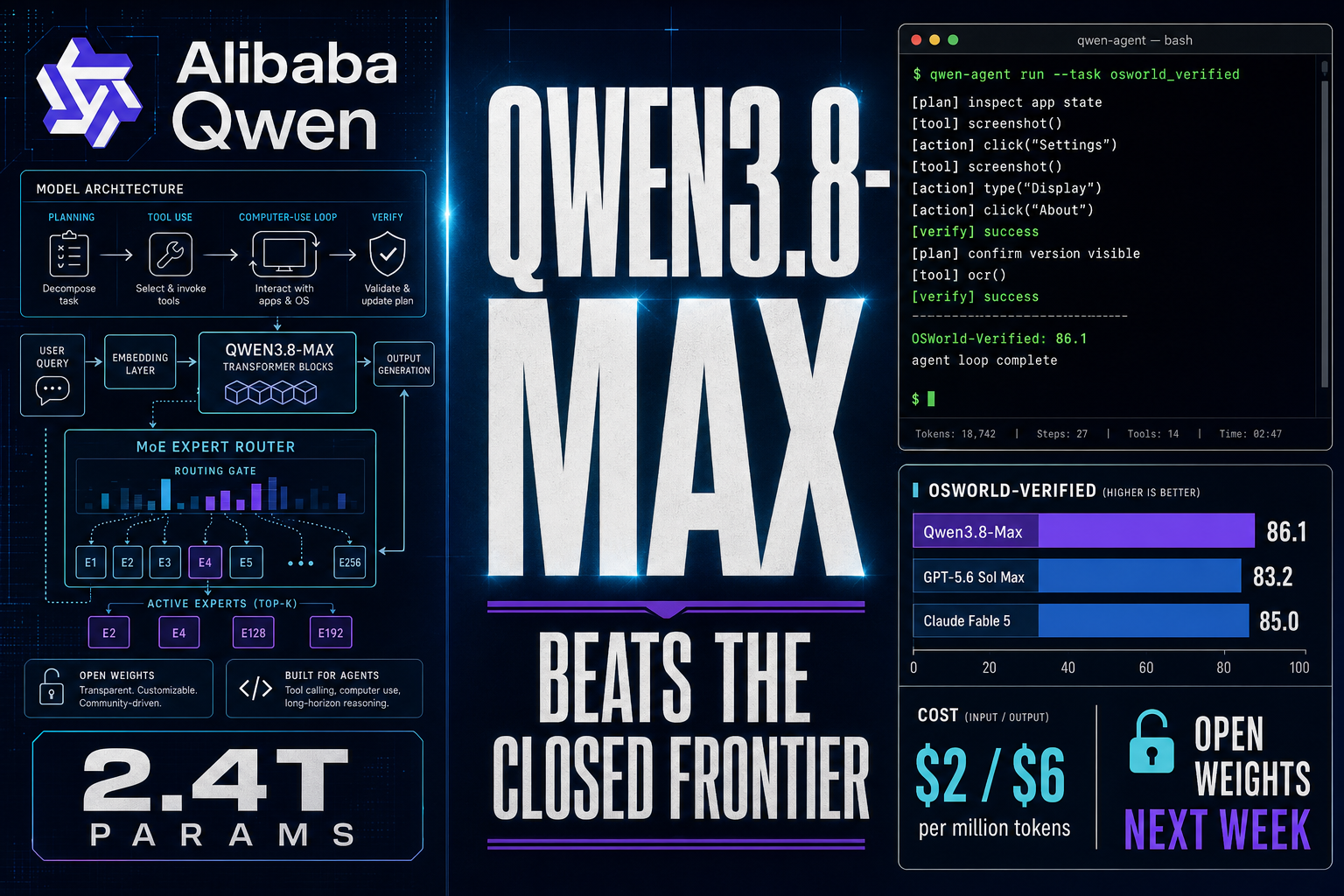
On August 3, Alibaba’s Qwen team shipped Qwen3.8-Max, a 2.4 trillion-parameter mixture-of-experts flagship that posts the highest reported score on OSWorld-Verified — the benchmark for agents that actually drive a computer — beating OpenAI’s GPT-5.6 Sol Max (86.1 vs 83.2) and Anthropic’s Fable 5 (85.0). It also claims the top spot on PaperBench, OpenAI’s own research-reproduction benchmark. And Alibaba says the weights land next week, alongside a 27B sibling.
This is the strongest signal yet in the story this blog has tracked all month: Chinese open-weight labs are no longer catching up, they are setting the pace. The July price war was about closed labs undercutting each other. Qwen3.8-Max is about an open-weight flagship that undercuts the entire closed frontier and wins the agentic benchmark race, at $2/$6 per million tokens — less than a third of Claude Opus 5’s combined price and under a quarter of GPT-5.6 Sol Max’s.
The same day, DeepSeek pushed the cost floor down again with the official V4-Flash release: a 304B open-weight model that Reuters reports is the cheapest well-known model to run, at roughly 1/105th the cost of Fable 5. Two Chinese labs, two releases, one message: the frontier is becoming commodity infrastructure, and the price is heading to zero.

What Alibaba shipped
Qwen3.8-Max is a multimodal MoE with 2.4 trillion total parameters and 95 billion active per token — about seven times the parameter count of Qwen 3.5 from February, with a 1 million-token context window and 131K-token outputs. Alibaba positions it as an autonomous coworker rather than a chatbot: it demonstrated a 16-day software project completed without human input and a 500+ step chip-design optimization task. Treat those demos as self-reported, but the benchmark table is concrete:
| Benchmark | Qwen3.8-Max | GPT-5.6 Sol Max | Fable 5 | Gemini 3.1 Pro |
|---|---|---|---|---|
| OSWorld-Verified | 86.1 | 83.2 | 85.0 | 76.2 |
| PaperBench | 93.0 | — | — | — |
| Terminal-Bench 2.1 | 86.6 | 88.8 | 84.7 | — |
| Vision2Web | 69.0 | — | — | — |
| LVBench | 81.8 | — | — | — |
| ERQA | 77.8 | — | — | — |
The pattern differs from Meta’s Muse 2, which landed within a few points of the closed frontier. Qwen3.8-Max claims outright wins where it matters most for builders: computer use, research reproduction, and multimodal agentic workflows. It trails on some software-engineering evals — OpenAI still leads SWE-Pro, and Opus 4.8 leads Agents’ Last Exam — but the balance across agentic workloads is the broadest of any release this cycle. On Frontend Code Arena it scores 1,668, within 37 points of Claude Opus 5.
The open-weight question: next week, but under what license?
Alibaba says open weights for Qwen3.8-Max ship next week alongside Qwen3.8-27B, a dense model built for commodity hardware. That would be the first Max-class Qwen available for self-hosting. But the license is the unresolved detail, and it is the one that decides everything.
Moonshot’s Kimi K3 set the precedent this month: weights public, but with a commercial license requirement and a disclosure clause for anyone offering it as model-as-a-service. If Qwen3.8-Max follows a permissive path like Apache 2.0, enterprise procurement gets a frontier-class model with no usage restrictions and no per-token meter. If it ships with a custom license, self-hosting is technically possible but commercially constrained — and the “open” label becomes marketing.
The pricing math matters even before the license lands. QwenCloud lists Qwen3.8-Max at $2 input / $6 output per million tokens:
| Model | Input / 1M | Output / 1M |
|---|---|---|
| Qwen3.8-Max | $2.00 | $6.00 |
| Kimi K3 | $3.00 | $15.00 |
| Grok 4.5 | $2.00 | $6.00 |
| Claude Opus 5 | $5.00 | $25.00 |
| GPT-5.6 Sol (Standard) | $5.00 | $30.00 |
Alibaba’s Qwen3.7-Max launched at $2.50/$7.50; the new flagship is cheaper than its predecessor. That pricing, plus the agentic benchmark wins, is why Alibaba shares rallied roughly 6% in Hong Kong on the announcement — and why The Information noted the model undercuts Kimi K3, its main Chinese rival.
DeepSeek’s same-day counterpunch
You cannot read the Qwen3.8-Max launch in isolation. The same window, DeepSeek released the official V4-Flash — a 304B open-weight model that research firms now rate as the cheapest well-known model to run, reported at roughly 1/105th the cost of Anthropic’s Fable 5. Axios called it “the race to zero” continuing; Global Times called it “a Ferrari at bicycle prices.”
The July 2026 price war reset expectations for closed-API pricing. Qwen3.8-Max + DeepSeek V4-Flash reset expectations for what open weights cost to run: if a 2.4T flagship wins OSWorld and a 304B workhorse runs for pennies, the closed labs’ pricing model has no moat left on either axis — capability or cost. The open-weight Kubernetes moment thesis — open weights become the default substrate, closed APIs become the premium option — is now backed by two Chinese flagship releases in one week.
Decision framework
Use Qwen3.8-Max if you build computer-use agents, long-horizon automation, or research-reproduction workflows. OSWorld-Verified leadership is the strongest evidence yet that open-weight models can drive real desktops, not just answer prompts. The 1M context window also makes it viable for multi-day agent sessions that would blow through shorter contexts.
Self-host when the weights land if you need data sovereignty or zero per-token cost. 95B active parameters is heavy but not datacenter-exclusive — and Qwen3.8-27B is explicitly aimed at commodity hardware. Wait for the license text before committing architecture.
Wait if your deployment is in regulated environments where a custom license clause (like Kimi K3’s MaaS disclosure) would be a problem. Alibaba has not published the license. “Open weights next week” is a promise, not a contract.
Trade-off: You get frontier-competitive agentic performance and aggressive pricing, but you are betting on a China-based vendor at the exact moment US export controls and procurement politics are tightening. For many enterprises that is fine; for others it is disqualifying regardless of the benchmark table.
Bottom line: Qwen3.8-Max is the first open-weight model to lead the benchmark that measures whether AI can do your job on your computer. The price war made frontier AI cheap. This release makes frontier AI autonomous — and open.
Related reading
- Qwen 3.8: Alibaba’s 2.4T Open-Weight Model
- Kimi K3: Moonshot’s Open-Weight Frontier Model
- Meta Muse 2: A Frontier Open-Weight Model That Changes the Math
- The July 2026 AI Model Price War
- Open-Weight AI’s Kubernetes Moment
- American AI Locked Down, Losing to China’s Open Weights
Sources
- VentureBeat — Qwen3.8-Max arrives with a bold claim: it outperforms GPT-5.6 Sol Max and Fable 5 on agentic computer use
- SiliconANGLE — Alibaba debuts Qwen3.8-Max model with 2.4T parameters
- Reuters — Alibaba unveils its largest AI model yet, DeepSeek’s latest model is ultra-low cost
- CNBC — Alibaba shares rally after unveiling its ‘most powerful’ AI model
- Qwen AI — Qwen3.8-Max: A New Bar for Coding and Cowork
- QwenCloud — Qwen3.8-Max model page
- Axios — DeepSeek’s new bargain model accelerates AI’s race to zero
About the author
Charles Jasthyn De La Cueva is a full-stack developer and the founder of Open TechStack. He writes about AI engineering, developer tools, and practical model evaluation — grounded in real workflows, not press releases.