Why this matters now
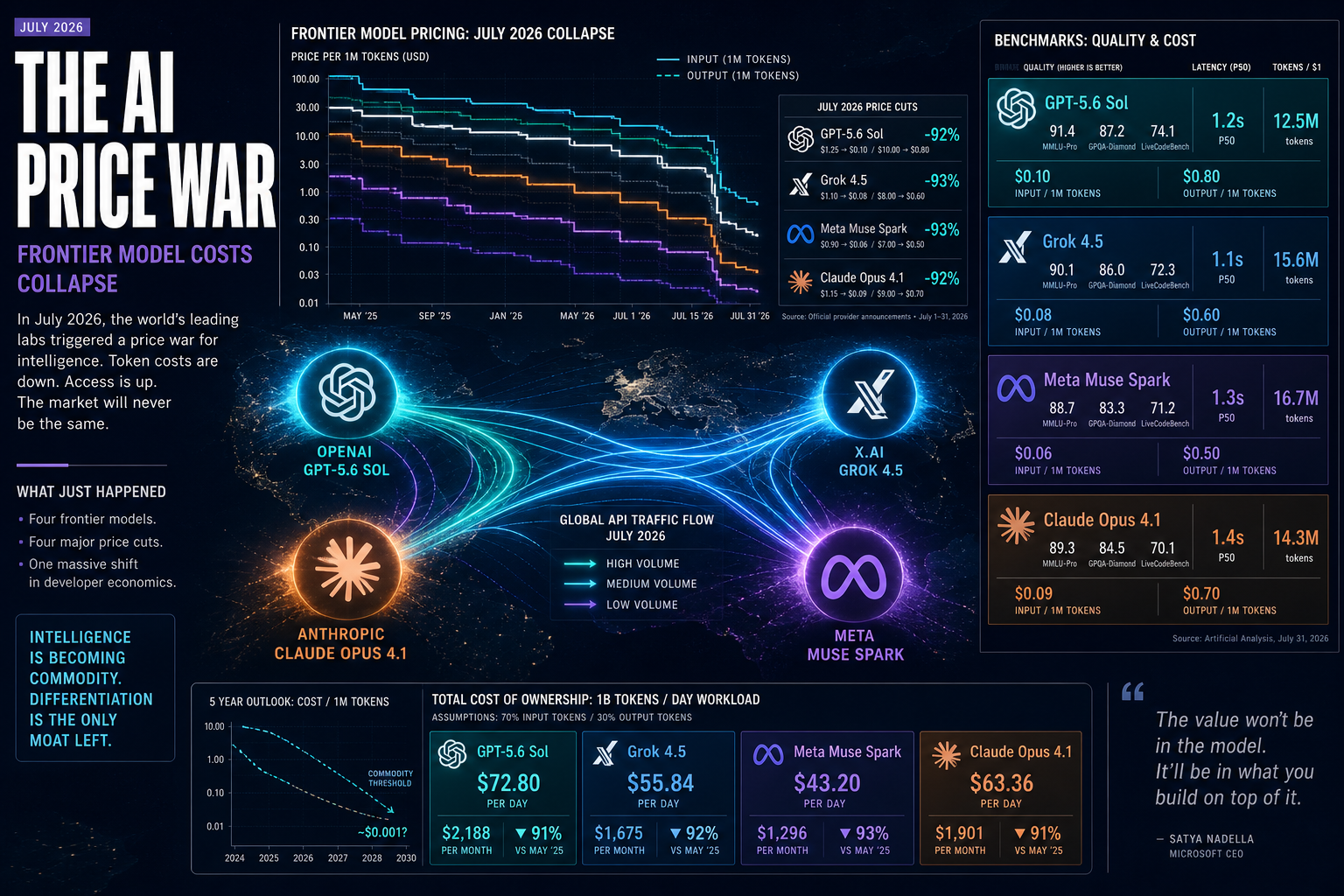
In the span of two weeks this July, every frontier AI lab shipped a new model — and the biggest headline wasn’t capability, it was cost. OpenAI moved its GPT-5.6 family to broad availability on July 9 at prices that undercut their own previous generation by 30–50%. xAI launched Grok 4.5 the day before, priced at roughly a third of OpenAI’s flagship tier. Meta released Muse Spark 1.1, its first-ever paid API model, at a price point that undercuts everyone. And on July 17, Moonshot AI dropped Kimi K3, a 2.8-trillion-parameter open-source model that rivals GPT-5.6 Sol on benchmarks for $3/$15 per million tokens.
This isn’t normal. Just last year OpenAI executives were floating $2,000/month subscription tiers. Now Sam Altman is on CNBC talking about “value for spend,” and Meta’s Mark Zuckerberg is accusing competitors of running “very high margins.”
For builders, this price war cuts both ways. Inference costs have collapsed 90–97% for equivalent intelligence compared to 2024 levels. But the proliferation of options — each with different pricing structures, context windows, and reasoning tiers — makes the model-selection problem harder than ever.

The multi-provider AI gateways and fallback routing post covered the infrastructure layer for routing across providers. This post gives you the pricing data you need to decide which model to route to, and when.
The July 2026 model wave: who shipped what
The LA Times called it an “AI price war” on July 13, and the data backs the label up. Here’s the pricing table for every new or newly-priced frontier model that landed in the past two weeks:
| Model | Lab | Input ($/M tok) | Output ($/M tok) | Context | Notes |
|---|---|---|---|---|---|
| GPT-5.6 Sol | OpenAI | $5.00 | $30.00 | 1M | Flagship tier; Cerebras at 750 tok/s |
| GPT-5.6 Terra | OpenAI | $2.50 | $15.00 | 1M | Mid-tier |
| GPT-5.6 Luna | OpenAI | $1.00 | $6.00 | 1M | Budget tier |
| Grok 4.5 | xAI | $2.00 | $6.00 | 256K | 1.5T params; Cursor-trained |
| Claude Opus 4.8 | Anthropic | $5.00 | $25.00 | 1M | Pre-July pricing, still competitive |
| Claude Sonnet 5 | Anthropic | $2.00 | $10.00 | 1M | Promo pricing |
| Meta Muse Spark 1.1 | Meta | $1.25 | $4.25 | 1M | First paid API; open weights |
| Kimi K3 | Moonshot AI | $3.00 | $15.00 | 1M | 2.8T params; open-source |
| SWE-1.7 (via Devin) | Cognition | ~$1.97/task | — | — | RL-trained on Kimi K2.7 |
Grok 4.5 comes in at roughly a third of GPT-5.6 Sol’s output price. Meta Muse Spark 1.1 costs 85% less on output. Kimi K3, an open-source model at 2.8 trillion parameters, undercuts OpenAI’s mid-tier Terra on output by matching it at $15. The pricing pressure is real and structural.
The economic forces driving the crash
Three structural factors explain why prices are falling this fast.
DeepSeek broke the dam. When DeepSeek R1 launched in January 2025 at $0.55 per million input tokens — delivering 95% of OpenAI o1’s reasoning capability at 97% less cost — it forced every incumbent to respond. OpenAI made emergency cuts. Anthropic slashed Claude 3.5 Sonnet by 67%. Google made Gemini 2.0 Flash nearly free. The trend accelerated through 2025 and hasn’t stopped.
Enterprise sticker shock is real. Companies that encouraged “tokenmaxxing” — racing to use as much AI as possible — started getting million-dollar invoices. Gautier Cloix, CEO of H Company, told Bloomberg he saw a CEO’s AI bill hit seven figures in a single month. Gil Luria of DA Davidson told the LA Times: “As they see these costs get out of control, they’re starting to ask questions about efficiency.” Labs responded by competing on price, not just capability.
Meta set a new floor. Zuckerberg told Bloomberg that rival AI labs run “very high margins” and Meta is prepared to be “aggressive” on pricing. Since Meta doesn’t need API revenue to justify its AI investment (it’s funded by the ad business), it can price Muse Spark 1.1 at cost or near-cost — forcing everyone else to match or explain why they’re charging more.
The result: the middle of the market is thinning out. Either you’re a premium frontier model (GPT-5.6 Sol, Claude Opus 4.8, Fable 5) charging $15–30/M output, or you’re a cost-effective alternative at $4–10/M output. There’s less room for models that charge premium prices without premium results. That dynamic is covered in more detail in the enterprise AI agent benchmarks 2026 post, which maps real task performance against these cost tiers.
Cost-per-task: which model wins for what
Raw per-token pricing only tells part of the story. Token efficiency varies dramatically between models. Musk claims Grok 4.5 has “twice the token efficiency” of comparable models. OpenAI says GPT-5.6 Sol “completes more work using significantly fewer tokens.”
Here’s the real cost for three common workloads using standard (non-reasoning) mode:
| Workload | GPT-5.6 Sol | Grok 4.5 | Muse Spark 1.1 | Kimi K3 |
|---|---|---|---|---|
| Customer support (500 in / 300 out) | $0.0115 | $0.0028 | $0.0019 | $0.0060 |
| Code review (3K in / 1.5K out) | $0.0600 | $0.0150 | $0.0101 | $0.0315 |
| Document analysis (10K in / 3K out) | $0.1400 | $0.0380 | $0.0253 | $0.0750 |
Muse Spark 1.1 wins on raw cost every time, thanks to Meta’s aggressive pricing. But context window matters — Spark’s 128K limit (via the hosted API) means it can’t handle the long legal documents Claude Opus 4.8 processes in a single call with its 1M context.
Grok 4.5 is the best value for coding tasks at $0.015 per review versus $0.06 on Sol. This aligns with its Cursor training data and explains why xAI shipped Grok 4.5 inside Cursor on every plan.
Kimi K3 sits in an interesting middle: open-weights, 1M context, 2.8T parameters, at $3/$15. As an open-source model, self-hosted inference could push effective costs below $1/M tokens for high-volume workloads — similar to what Muse Spark offers, but with a larger context window and different performance profile.
Decision framework
Use GPT-5.6 Sol when you need the highest consistency on persona-driven, customer-facing applications. OpenAI’s ecosystem has the best third-party integrations, and Sol’s emotional coherence advantage is measurable in retention metrics. Only use extended reasoning mode for high-stakes analysis — it’s 3x the cost.
Use Grok 4.5 when cost efficiency matters more than ecosystem depth. It’s the cheapest frontier coding model on a per-task basis, and the baked-in real-time web access saves you a separate tool-calling setup. The 256K context window is the main constraint — if you need to process 500-page documents, look elsewhere.
Use Meta Muse Spark 1.1 when you’re running high-volume, latency-tolerant workloads. At $0.60/$2.40 per million tokens in standard mode, it’s nearly a commodity. The open weights also mean you can self-host and push effective cost below $0.25/M for truly high-traffic pipelines. Skip it if your task needs a large context window or extended reasoning.
Use Kimi K3 when you want frontier-level open-source capability with a 1M context window. The self-hosting economics are potentially better than any API offering, and the 2.8T parameter count suggests strong performance on knowledge-intensive tasks. Reliability of the API and tooling ecosystem remain open questions — Moonshot’s API is newer than OpenAI’s or Anthropic’s.
Wait if you rely heavily on Claude Fable 5’s orchestration patterns — Anthropic’s published Managed Agents routing (run most steps on Sonnet 5, escalate only high-uncertainty decisions to Fable 5) achieves roughly 96% of Fable 5’s performance at 46% of the cost. That’s a better strategy than switching providers entirely.
Trade-off summary
The market is splitting into three bands: ultra-premium reasoning models (Sol, Fable 5, Opus 4.8) at $15–30/M output, mid-cost alternatives (Grok 4.5, Muse Spark, K3) at $6–15/M, and near-commodity models (Luna, Sonnet 5, DeepSeek V4) at $2–10/M. The middle band is the most contested, and that’s where the price war will keep cutting deepest.
Bottom line
Don’t pick one model. Build a routing layer that matches cost to task complexity. Use Muse Spark or Grok 4.5 for high-volume standard work. Reserve Sol or Fable 5 for the 10–20% of calls where accuracy or persona consistency makes the premium worth it. The routing architecture question is covered in the OpenRouter Fusion multi-model API post, and the cost optimization patterns from the multi-provider AI gateways post apply directly.
The price war is good news for builders — but only if you actually capture the savings instead of defaulting to the same expensive model for every task.
Related reading
- Multi-provider AI gateways and fallback routing — how to build the routing infrastructure
- OpenRouter Fusion multi-model API — routing across 100+ models
- Enterprise AI agent benchmarks 2026 — real task performance data
- Agent model cost comparison July 2026 — agent-specific cost analysis
- GPT-5.6 Sol public release — full breakdown of OpenAI’s family
Sources
- LA Times — AI price war heats up as OpenAI, Meta and Musk slash model costs
- ODSC — Last Week in AI: July 6–12, 2026
- Bloomberg — Moonshot Unveils Kimi K3, Narrowing Gap With US Rivals
- Reuters — Major AI offerings at a glance, July 2026
- CNBC — OpenAI mulls slashing prices ahead of competition from Anthropic
- WSJ — OpenAI Considers Drastic Price Cuts, Anticipating War for Users With Anthropic
- MindStudio — AI Model Pricing in 2026: GPT-5.6, Grok 4.5, Muse Spark, and Claude Fable 5 Compared
Analysis based on published API pricing as of July 18, 2026. Vendor claims (token efficiency, benchmark scores) are self-reported unless attributed to independent benchmarks. Prices are for pay-as-you-go standard mode; batch, cached, and committed-use discounts can reduce costs significantly.
About the author
Charles Jasthyn De La Cueva is a full-stack developer and the founder of Open TechStack. He writes about AI engineering, developer tools, and practical model evaluation — grounded in real workflows, not press releases.