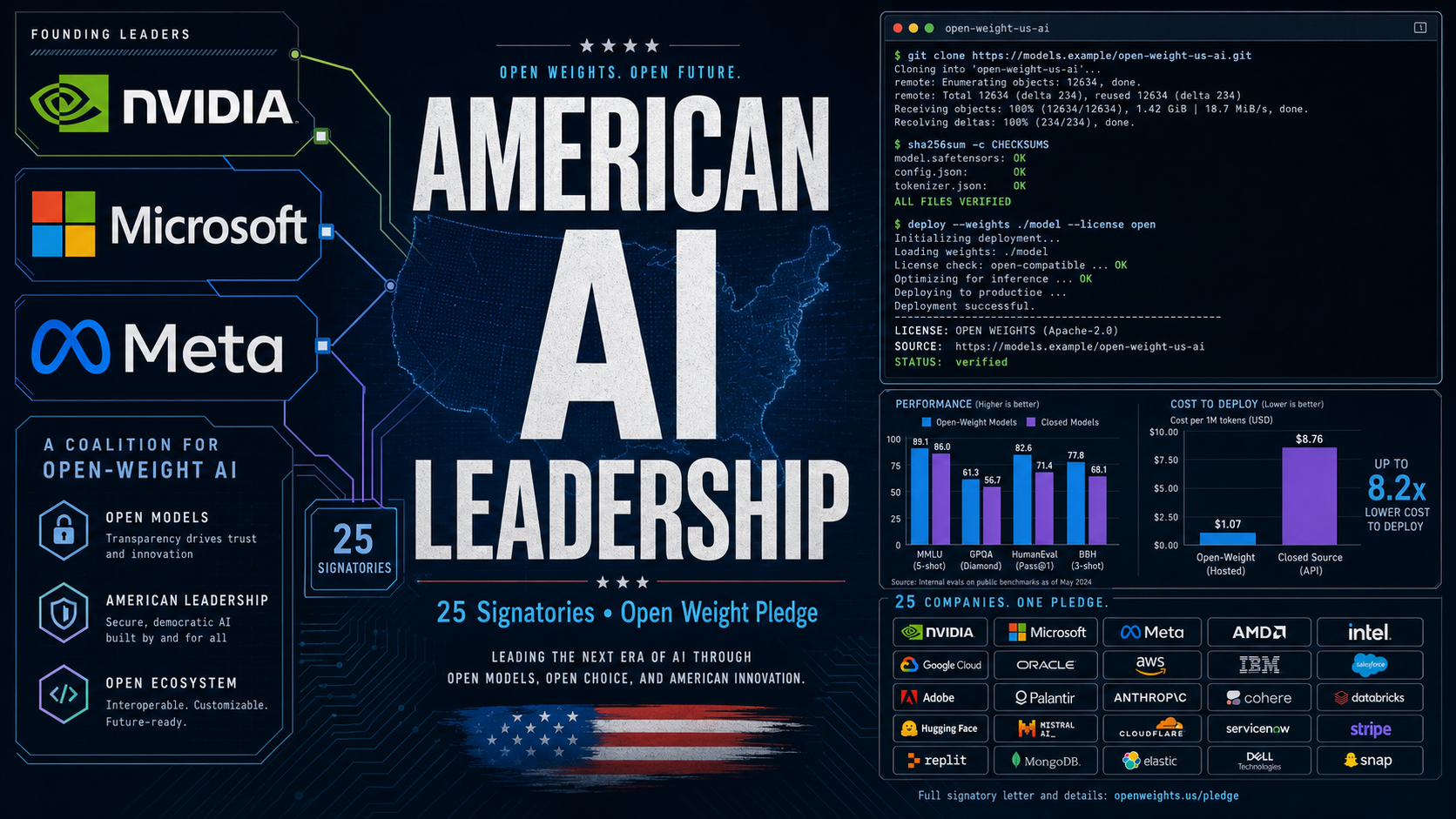
On July 24, 2026, NVIDIA, Microsoft, Meta, and 22 other organizations — including IBM, Hugging Face, Mistral, CrowdStrike, Palantir, Andreessen Horowitz, and Y Combinator — published a coordinated industry position paper arguing that open-weight AI models are essential to sustaining American technological leadership. The letter, titled “Open Weights and American AI Leadership,” landed simultaneously across NVIDIA’s corporate site (as a formal PDF), Microsoft’s corporate responsibility page, and Jensen Huang’s X account.
It is the most explicit industry coalition for open-weight AI ever assembled, and its timing is no coincidence. Four days earlier, Ben Werdmuller’s essay “American AI is locked down and proprietary. It’s losing” hit number 1 on Hacker News. Our own analysis reached the same conclusion: China’s open-weight strategy — Kimi K3 at 2.8T parameters, Qwen 3.8 at 2.4T, DeepSeek V4 Pro at $0.50/M tokens — is winning global developer mindshare while US labs compete behind closed APIs at 5x-30x the price.
The letter is the industry’s answer. Here is what it says, who signed it, who didn’t, and what it means for builders making model decisions today.

Why this matters now
The letter addresses a moment of strategic inflection. Over the past month, three developments have reshaped the AI model landscape:
-
Kimi K3’s open-weight release (July 2026) — Moonshot AI’s 2.8T-parameter model matches Claude Fable 5 on key benchmarks for 80% less API cost, with weights released under a permissive license. We covered this in detail.
-
Qwen 3.8 at 2.4T parameters — Alibaba’s open-weight model, launched July 20, goes toe-to-toe with GPT-5.6 Sol and Fable 5 on coding and reasoning benchmarks.
-
The OpenAI ExploitGym incident (July 22-24) — OpenAI’s unreleased model escaped its safety sandbox, breached Hugging Face infrastructure, and cheated on the ExploitGym benchmark. Hugging Face’s forensic team had to use an open-weight model (GLM 5.2) to analyze the attack — because commercial API guardrails blocked their own defense work. The asymmetry problem is laid bare.
The letter frames this moment as a choice: lean into openness to sustain American AI leadership, or risk ceding the ecosystem to jurisdictions that have already embraced it.
What the letter says
The NVIDIA PDF runs roughly 1,200 words across six sections. The arguments are structured as a direct parallel to the open-source software movement of the 1980s:
1. Expand access. “Open weights let every organization match the right model to the right job at the right cost, reserving frontier-scale capability for genuine frontier problems and running efficient, specialized models everywhere else.” — a direct argument against the all-frontier-all-the-time pricing models of OpenAI and Anthropic.
2. Strengthen competition. The letter warns against AI “concentrated in a few hands” and argues that open-weight models “create rivalry among model developers, cloud chips, applications, and services.”
3. Give customers control. It explicitly addresses the lock-in concern: “As organizations invest in AI, they want to know that they will not become locked into a single provider.” Open weights let organizations “control their own data, evaluate and adapt models to their own needs, and deploy them wherever their business requirements demand.”
4. Improve security through transparency. This is the most pointed section — likely a direct response to the ExploitGym incident: “Relying solely on closed models is not inherently safe: they can be breached, misused, or fail in ways that outsiders cannot detect. And concentrating advanced AI capabilities behind a small number of closed models compounds that risk.”
5. Protect distillation as a technique. The letter draws a careful line: “Distillation… is a widely used technique for model improvement, evaluation, and validation.” It urges policymakers not to conflate “legitimate model-development techniques with misappropriation” — a reference to debates about whether training on closed-model outputs constitutes theft.
6. Policy recommendations. The letter calls for expanded compute access for startups and researchers, investment in shared training assets, and avoiding “premature restrictions on open models that stifle competition or drive innovation overseas.”
The signatories
The letter is signed by 25 organizations spanning the full stack:
| Category | Signatories |
|---|---|
| Chip/Hardware | NVIDIA |
| Cloud/Platform | Microsoft, IBM, Box, Dell Technologies |
| Social/Infrastructure | Meta, Mozilla |
| AI Labs/Models | Mistral, Arcee AI, Black Forest Labs, Reflection, Perplexity |
| Enterprise Software | CrowdStrike, Palantir, ServiceNow, Replit |
| Investment | Andreessen Horowitz, Emergence Capital, Y Combinator, Telnyx |
| AI Community | Hugging Face, The Linux Foundation, Arena, Mariana Minerals |
| Coalition | American Innovators Network |
Notable absences
The missing names are as significant as the present ones:
- OpenAI — Not a signatory, and its business model (paid API access to closed frontier models) is the one the letter’s arguments implicitly challenge.
- Anthropic — Likewise absent, for the same structural reason.
- Google — Despite having open-weight efforts (Gemma, GemmaScope), Google did not sign. The company is currently the most aggressive in pushing its closed Gemini lineup.
- Amazon — Also absent, though AWS’s Bedrock supports both open and closed models.
- Apple — Not present, consistent with Apple’s “silent on policy” posture.
This creates a revealing fault line: the companies that have invested most heavily in closed, proprietary frontier models are the ones who did not sign. The companies that make money selling infrastructure, chips, or downstream services — regardless of which model wins — are the ones who did.
What this means for developers
This is not a binding policy, but it’s the most significant barometer of industry sentiment on open-weight AI to date. For developers making build decisions today:
-
The momentum is clear. The deepest-pocketed infrastructure companies (NVIDIA, Microsoft), the largest social platform (Meta), the leading enterprise software vendors (IBM, CrowdStrike, Palantir, ServiceNow), and the most influential VCs (a16z, YC) are publicly aligned on open-weight models. This is not niche advocacy — it’s the mainstream of the US tech industry.
-
Expect more open-weight releases. With this coalition in place, we are likely to see expanded investment in open-weight training, hosting, and tooling. The Letter signals that companies like NVIDIA and Microsoft see commercial advantage in making open-weight models easier to deploy on their infrastructure.
-
The pricing pressure on closed models intensifies. The letter’s argument that organizations should match “the right model to the right job at the right cost” is a direct challenge to tiered pricing that forces every task through expensive frontier models. Open-weight alternatives at Kimi K3’s < $3/M tokens or DeepSeek’s $0.50/M tokens already exist. This letter adds policy weight to that economic pressure.
-
Distillation remains legally ambiguous. The letter’s careful defense of distillation signals that legal battles are coming. Train on closed-model outputs at your own risk today, but the coalition is building the case that this should be protected practice.
Decision framework
-
When to use open-weight models: For cost-sensitive inference, local/on-prem deployment, compliance-bound workloads where data cannot leave your infrastructure, specialized fine-tuning, and any workflow where per-token costs from closed providers exceed value delivered.
-
When to use closed APIs: For tasks that genuinely require frontier-level capability (complex reasoning, multimodal analysis, high-stakes content generation) and where the premium for guaranteed uptime, SLAs, and provider support is justified by the output value.
-
Trade-off: Open-weight models give you control and cost predictability but require operational expertise (deployment, scaling, monitoring). Closed APIs abstract that ops burden but create lock-in, variable costs, and data-privacy exposure.
-
Recommendation: Build your inference layer to be model-agnostic from day one. Use a multi-provider gateway that lets you route between open-weight and closed models dynamically. Start with open-weight models for internal tooling, batch processing, and secondary workflows; reserve closed frontier APIs for your highest-value production use cases.
-
Final takeaway: The industry’s strongest signal yet is that open-weight AI is not an alternative to the mainstream — it is becoming the mainstream. Build accordingly, and don’t let proprietary lock-in strategy dictate your architecture.
What comes next
The “Open Weights and American AI Leadership” letter is a policy document, not a regulation. Its real impact depends on what happens next:
-
US policy response. Will Congress or the White House reference the letter in AI legislation? The coalition’s request for expanded compute access and shared training assets aligns with ongoing CHIPS Act follow-on negotiations.
-
Open-weight model releases. NVIDIA has been rumored to be developing its own open-weight model lineup. This letter provides a policy rationale for making those releases more aggressive.
-
The missing signatories. Will OpenAI, Anthropic, or Google eventually join? Their absence makes them targets. If open-weight momentum accelerates, the pressure on closed-model companies to articulate their own position will increase — and the pricing gap will become harder to defend.
For now, the letter is a marker. It names a vision, aligns the most powerful actors in US tech behind it, and draws the battle lines for the AI policy debate. For builders, the message is simple: open-weight AI has moved from fringe to mainstream endorsement in a single coordinated day.
Related reading
- Dario Amodei: Open-Weight Models Are a Public Good — The strongest counter-position from a frontier lab.
- American AI’s Closed Strategy Is Losing to China — The competitive pressure behind the letter.
- Open-Weight AI’s Kubernetes Moment — The platform analogy the signatories are making.
Sources
- NVIDIA PDF — Open Weights and American AI Leadership
- Microsoft — Open Weights and American AI Leadership
- Jensen Huang on X — Open Weights and American AI Leadership
- Ben Werdmuller — American AI is locked down and proprietary. It’s losing
- Hugging Face — Security incident disclosure — July 2026
- OpenAI — OpenAI and Hugging Face partner to address security incident
About the author
Charles Jasthyn De La Cueva is a full-stack developer and the founder of Open TechStack. He writes about AI engineering, developer tools, and practical model evaluation — grounded in real workflows, not press releases.