Why this matters now
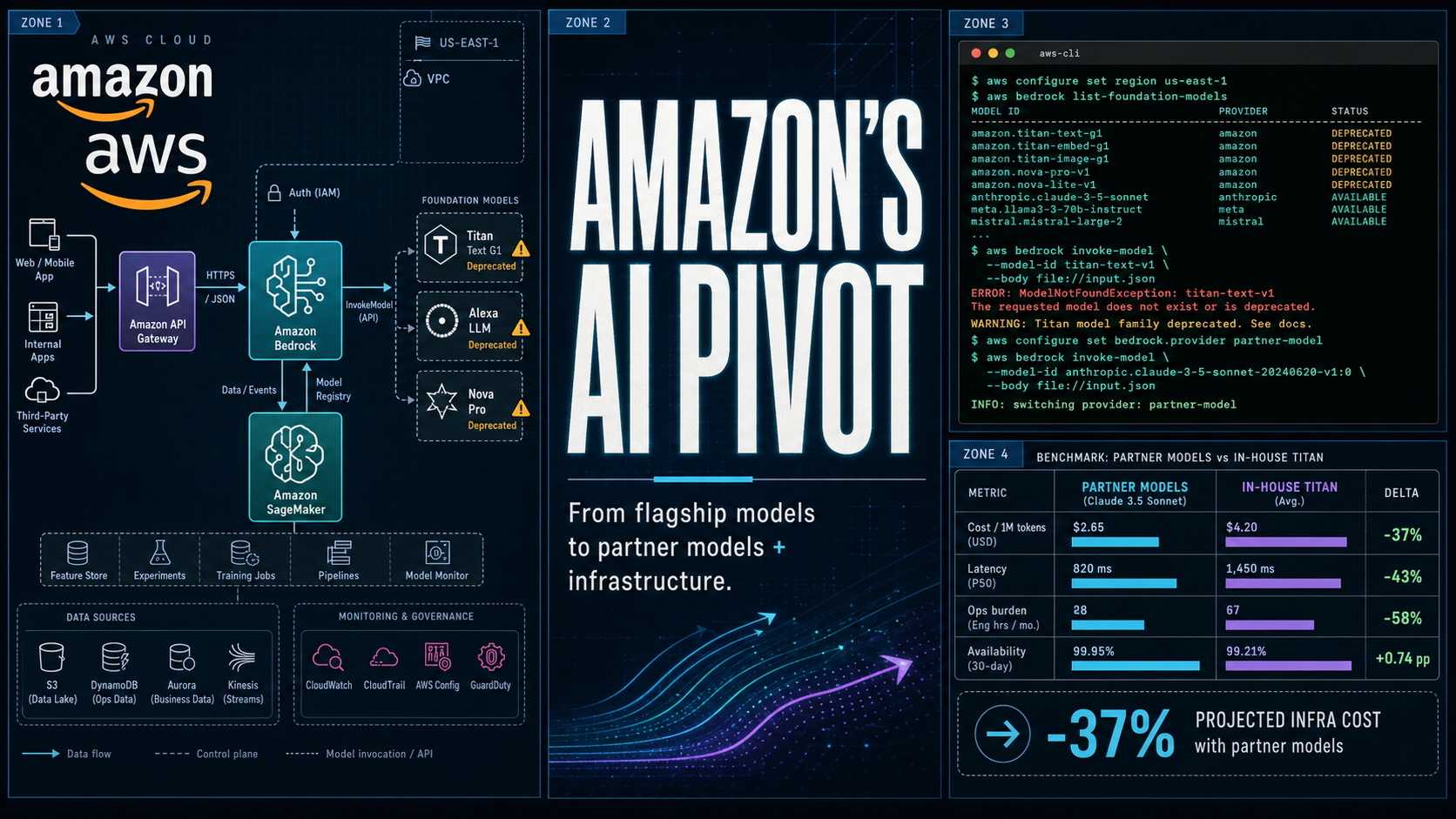
On July 28, 2026, Reuters reported that Amazon is deprecating several flagship Nova models while sharpening its focus on a new frontier-model effort. The shift favors frontier research, partner models, and infrastructure over a broad in-house lineup.
Amazon is not abandoning AI or Nova altogether. It is narrowing the portfolio while keeping the infrastructure bet intact. That distinction matters for AWS customers evaluating model availability, lock-in risk, and the value of the platform layer. The ongoing AI price war is the economic backdrop.

If you’re building on AWS or evaluating AI infrastructure, this changes your calculus on model availability, lock-in risk, and where the real value is in the AI stack. The rest of the market — including Andrew Ng’s new AI education startup, Trump’s humanoid robot ban, and another AI stock selloff day — is covered in the roundup below.
What Amazon is winding down
Reuters identifies four Nova models being deprecated:
- Nova Premier — the high-end model.
- Nova Omni — the multimodal model.
- Nova Reel — the video-generation model.
- Nova Canvas — the image-generation model.
The same report says Amazon continues to support other Nova models, including Nova 2 Lite, Nova 2 Sonic, and Nova Forge, while investing in a new frontier model led by Pieter Abbeel. Reuters does not report that Titan or an Alexa LLM is part of this specific wind-down, so those claims are excluded here.
What survives in the strategic picture: AWS AI infrastructure services such as Bedrock, SageMaker, Trainium, and Inferentia; the continuing Nova portfolio; and the new frontier-model effort.
The logic is straightforward. After spending years building foundation models, Amazon concluded that the market for general-purpose LLMs is commoditizing faster than it can differentiate. The real margin, in Amazon’s view, is in the infrastructure and services layer — the chips, the orchestration, the managed services — not in owning the model itself.
What this means for the AI landscape
Amazon’s retreat from flagship models is the most visible sign yet that the foundation model market is undergoing a structural shift. Here’s what it signals:
| Signal | Implication |
|---|---|
| Model commoditization is accelerating | If Amazon can’t find a moat in its own models, it reinforces the thesis that LLMs are becoming a commodity layer — like compute or storage. |
| The infrastructure layer is the real market | Amazon is betting that the money is in Trainium, Bedrock orchestration, and SageMaker — not in the model weights themselves. |
| Partner models win the platform | Amazon will push Anthropic Claude, Meta Muse, and other third-party models through Bedrock rather than competing with them. |
| Custom silicon is still strategic | Trainium 2 and Inferentia 3 remain core investments. The differentiation is at the hardware+software stack, not the model layer. |
This aligns with Satya Nadella’s thesis that we covered in the enterprise AI benchmarks post: the lasting value in AI is in the infrastructure and evaluation layer, not in any single model. Amazon is effectively admitting the same thing — but doing it with action, not just positioning.
The timing also matches the market dynamics from our July 2026 price war analysis. When inference prices are collapsing 90%+ and open-weight models from Meta, Alibaba, Moonshot, and others are matching closed-source quality, building your own foundation model is a harder business case to justify — even for a trillion-dollar company.
What survives and what doesn’t
The key distinction in Amazon’s pivot is which AI investments survive and which get cut:
Surviving (and prioritized):
- AWS Bedrock — the managed model-serving platform, now explicitly positioned as the multi-model orchestration layer (Claude, Llama, Muse, and whatever comes next)
- Trainium 2 / Inferentia 3 — Amazon’s custom AI chips, which power Bedrock and will be sold to enterprise customers for self-hosted inference
- SageMaker — the ML platform that helps enterprises train and deploy models (including non-Amazon models)
- Anthropic partnership — Amazon’s $8B+ investment in Anthropic continues, with Claude becoming the default model across Amazon’s AI surfaces
- CodeWhisperer / Q Developer — developer productivity tools that are model-agnostic and integrate with multiple backends
- Alexa voice AI — but now powered by partner models (likely Claude) rather than Amazon’s own LLM
Wound down:
- Nova Premier, Nova Omni, Nova Reel, and Nova Canvas — deprecation reported by Reuters
- Some in-house model breadth — reduced as Amazon concentrates resources
- Nothing in the Reuters report supports a Titan or Alexa LLM wind-down claim
This is not an AI retreat. Amazon is still spending heavily on AI. But it’s a tactical pivot from model builder to AI infrastructure provider. The economic logic is the same one that made AWS successful in the first place: sell the picks and shovels, don’t try to own the gold mine.
How AWS customers are affected
For teams building on AWS, this pivot has immediate practical implications:
If you use Nova Premier, Omni, Reel, or Canvas via Bedrock: verify the model-specific support and migration path with AWS before committing to a replacement. Reuters reports deprecation, not an immediate shutdown date.
If you use Bedrock as your model router: this is net positive. Amazon’s incentives now fully align with making Bedrock the best multi-model platform rather than steering you toward their own models. Expect better integrations with Anthropic Claude, Meta Muse Spark, and other partners.
If you’re building on Trainium/Inferentia: existing investments remain supported. Amazon’s custom silicon strategy is unchanged — in fact, it’s reinforced. The chip business is separate from the model business.
If you’re evaluating AI vendor lock-in: Amazon’s pivot reduces the risk that you’ll be locked into a proprietary Amazon model that gets deprecated. The multi-model, open-platform approach is actually better from a risk perspective.
For routing strategy, our multi-provider AI gateway guide covers how to build model-agnostic infrastructure that can adapt to exactly this kind of supplier shakeout.
The broader July 28-29 AI news cycle
The Amazon story broke on the same day as several other major AI developments, creating a picture of an industry in rapid flux:
-
Tech stocks tumbled on AI spending concerns — The NYT reported a broad sell-off driven by worries about AI infrastructure ROI and China chip restrictions. South Korea’s KOSPI hit a three-month low as AI-linked semiconductor stocks fell. Fitch issued a warning that an AI market correction is becoming a “major global credit risk.”
-
Visa is cutting 7% of employees as AI reshapes work — CNBC reported that Visa is laying off roughly 7% of its workforce in an “efficiency push” driven by AI automation. The move follows similar cuts at other financial services firms and signals that AI’s impact on white-collar employment is accelerating.
-
Andrew Ng launched LearnVector with $100M from Coursera — Axios exclusively reported that Andrew Ng’s new AI-native education company, LearnVector, has received a $100 million strategic investment from Coursera. The startup is building adaptive AI learning systems — a direct bet that AI will transform how technical education is delivered, not just consumed.
-
Trump administration to ban Chinese humanoid robots — Reuters reported an executive action targeting Chinese humanoid robots and related inverters, framed as protecting the US AI buildout. The move extends the ongoing tech decoupling into physical AI systems.
-
Apple smart home push with Siri AI — Bloomberg reported that Apple’s long-rumored smart home hub is nearing release, with Siri AI at the center of the experience. This positions Apple to compete with Google, Amazon, and Samsung in the AI-powered home.
-
NPR covered the AI distillation IP debate — Following the Moonshot/Anthropic Fable allegations, NPR examined whether AI model distillation constitutes IP theft and where the legal boundaries sit. The debate has real implications for how open-weight models are trained and distributed.
These stories share a common thread: the AI industry is moving from the “build the best model” era into the “figure out what models are actually worth” era. Amazon’s pivot is the most dramatic corporate recognition of that shift, but it’s happening across the board.
Decision framework
Plan migrations away from Nova Premier, Nova Omni, Nova Reel, or Nova Canvas if you’re using them in production today. Reuters reports deprecation for those four models, but not an immediate shutdown date. Verify the model-specific support and migration path with AWS before committing to a replacement.
Double down on AWS Bedrock if you value multi-model flexibility and want an orchestration layer that won’t push you toward any single provider’s model. Amazon’s incentives now align with making Bedrock genuinely model-agnostic.
Reconsider AI infrastructure strategy if you were building a custom model strategy on the assumption that in-house models provide a moat. Amazon’s pivot suggests that even at massive scale, the model layer is hard to differentiate. The moat may be in infrastructure, data pipelines, or evaluation frameworks instead.
Watch the Anthropic relationship — Amazon’s default model going forward is Claude. If you’re in the AWS ecosystem, understanding the Anthropic product roadmap becomes more important, not less. Our Claude Sonnet 5 and Opus pricing post covers the current landscape.
Trade-off: You gain platform neutrality and avoid single-model lock-in, but you lose the potential upside if Amazon’s models had eventually differentiated. Given the rate of commoditization, that bet seems increasingly unlikely to pay off — Amazon’s leadership appears to agree.
Bottom line: Amazon is making a painful but smart strategic choice. The foundation model arms race is increasingly a zero-sum game with winner-take-most dynamics, and Amazon correctly identified that its competitive advantage is in infrastructure and distribution, not model research. For AWS customers, the pivot toward genuine multi-model neutrality is a net positive.
Related reading
- The July 2026 AI Model Price War — the pricing context that makes Amazon’s decision rational
- Enterprise AI agent benchmarks 2026 — the measurement layer Amazon is betting on instead of model ownership
- Multi-provider AI gateways and fallback routing — how to build the routing infrastructure for a multi-model world
- Claude Sonnet 5 and Opus-level pricing — a relevant alternative for teams comparing hosted model economics
- AI supply chain security and model provenance — why model provenance matters more when you don’t build your own
Sources
- Business Insider (via Reuters) — Amazon overhauls its AI strategy, winding down most flagship models
- CNBC — Visa cutting 7% of employees in efficiency push as AI reshapes work
- Axios — Andrew Ng’s new AI-powered ed tech startup gets $100 million
- Reuters — Trump administration to ban new Chinese humanoid robots
- Bloomberg — Apple Set to Make Big Smart Home Push With Siri AI at Center
- NPR — Allegations of AI distillation spark debate about IP theft
Analysis based on Reuters reporting published July 28, 2026. Amazon said it continues to support Nova models customers rely on and is investing in its next generation of frontier-model research.
About the author
Charles Jasthyn De La Cueva is a full-stack developer and the founder of Open TechStack. He writes about AI engineering, developer tools, and practical model evaluation — grounded in real workflows, not press releases.