Why this matters now
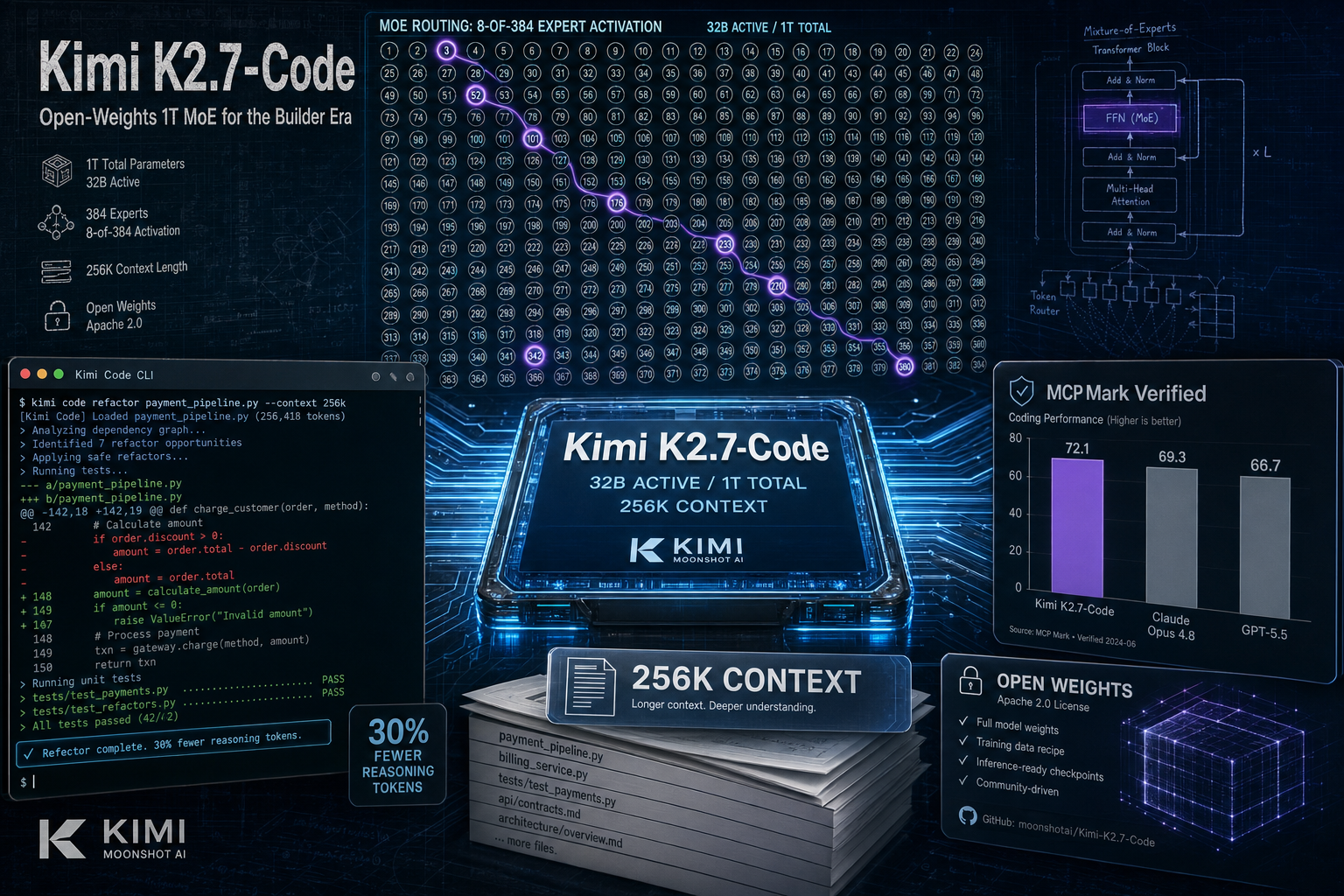
On June 12, 2026, Moonshot AI dropped Kimi K2.7-Code, the newest version of their open-weights Mixture-of-Experts coding model. It arrives in a month that already saw GLM-5.2 unlock 1M-token local inference and DeepSeek V4-Flash push 284B MoE to MIT-licensed production. K2.7-Code targets a different problem than those models: doing more with fewer tokens.
The numbers: +21.8% over K2.6 on Kimi Code Bench v2, ~30% fewer reasoning tokens than its predecessor, and it beats Claude Opus 4.8 on MCP Mark Verified (81.1 vs 76.4). At $0.95/M input tokens, it costs about 5× less than equivalent frontier models while staying competitive on agentic coding tasks.
For teams running automated coding agents at any kind of volume, the math shifts. With K2.7-Code, a reasoning model becomes your default agent. Expensive frontier models get reserved for the tasks that actually need them.
What changed: K2.6 → K2.7-Code
Kimi K2.7-Code is not a full rewrite. It uses the same 1-trillion-parameter MoE backbone as K2.5 and K2.6, but Moonshot tilted the training heavily toward coding data. Here is what that means.
Architecture (Unchanged from K2.6)
| Specification | Detail |
|---|---|
| Total Parameters | ~1 Trillion |
| Active Parameters | 32B per token |
| Experts | 384 total (8 selected + 1 shared per token) |
| Layers | 61 (60 MoE + 1 dense) |
| Attention | Multi-head Latent Attention (MLA) — compresses KV cache into latent space |
| FFN | SwiGLU |
| Context Window | 256K tokens (262,144) |
| Vision Encoder | MoonViT (~400M params for image / video input) |
| Disk Size | ~595 GB |
| License | Modified MIT — open weights, commercial use with attribution |
What Moonshot improved
-
Long-horizon reliability — the model keeps its head through complex multi-step coding tasks (12+ hours, 4,000+ tool calls on record) without forgetting earlier constraints, re-introducing fixed bugs, or losing track of which file it was editing.
-
~30% reduction in reasoning tokens — earlier K2 versions showed signs of “overthinking” (long reasoning traces that didn’t improve output quality). K2.7-Code produces more concise thinking chains while maintaining or improving benchmark scores across the board.
-
Stronger tool-calling performance — gains are concentrated in agentic benchmarks (MCP Atlas, MCP Mark Verified, Kimi Claw 24/7 Bench) rather than static coding scores, suggesting the training emphasis was on multi-step tool use rather than single-turn code generation.
-
Hallucination reduction — K2.7-Code’s hallucination rate dropped from K2.6’s ~65% to approximately 39% at the API level, a meaningful improvement for autonomous agent workloads where incorrect tool outputs cascade.
⚠️ Locked parameters
Kimi K2.7-Code enforces strict, non-negotiable inference settings. You cannot override these:
temperature— server-locked at 1.0top_p— server-locked at 0.95n— server-locked at 1presence_penalty/frequency_penalty— locked at 0.0- Thinking mode — always on (disabling it returns an API error)
If your existing integration pipeline sets temperature=0 for deterministic output, you will need to remove that override before calling K2.7-Code. The API surfaces the model’s reasoning trace via a reasoning_content field.
Benchmark results
All vendor-reported results run inside Kimi Code CLI (K2.7-Code), Codex xhigh (GPT-5.5), and Claude Code xhigh (Claude Opus 4.8).
| Benchmark | K2.6 | K2.7-Code | GPT-5.5 | Claude Opus 4.8 | Δ K2.7 vs K2.6 |
|---|---|---|---|---|---|
| Kimi Code Bench v2 | 50.9 | 62.0 | 69.0 | 67.4 | +21.8% |
| Program Bench | 48.3 | 53.6 | 69.1 | 63.8 | +11.0% |
| MLS Bench Lite | 26.7 | 35.1 | 35.5 | 42.8 | +31.5% |
| Kimi Claw 24/7 Bench | 42.9 | 46.9 | 52.8 | 50.4 | +9.3% |
| MCP Atlas | 69.4 | 76.0 | 79.4 | 81.3 | +9.5% |
| MCP Mark Verified | 72.8 | 81.1 | 92.9 | 76.4 | +11.4% |
Reading the benchmarks
- K2.7-Code beats Claude Opus 4.8 on MCP Mark Verified (81.1 vs 76.4). If your agent pipeline leans on MCP tool servers (file ops, shell commands, database queries), K2.7-Code is genuinely competitive with frontier models in that specific area.
- MLS Bench Lite (35.1) lands within 1% of GPT-5.5 (35.5). That is a strong showing for an open-weights model at 5× lower cost.
- It still trails GPT-5.5 and Opus 4.8 on raw programming benchmarks (Program Bench, Kimi Code Bench v2) by 10–15 points. The gap is closing, but not closed.
- The 30% reasoning-token reduction is the one to watch. Fewer output tokens means lower latency per agent step and more steps before hitting the 32K max-output cap.
Independent testing & community response
Moonshot’s benchmarks are first-party. The independent testing landscape tells a more nuanced story. Here is what third-party testers and the developer community found in the first week after release.
WorldofAI’s independent test pits K2.7-Code against Opus 4.8 Max, GPT-5.5, Fable 5, and others on a strange attractors coding benchmark.
The KernelBench regression (Elliot Arledge)
Independent tester Elliot Arledge ran K2.7-Code through KernelBench-Hard, a benchmark that requires models to generate correct CUDA kernels. The results cut against Moonshot’s narrative:
- K2.7-Code generated real Triton kernels for 5 out of 6 problems (K2.6 used library wrappers — more honest, but not more capable).
- 2 kernels broke on their own bugs.
- MoE kernel score regressed from 0.222 (K2.6) to 0.157 (K2.7).
- Arledge’s verdict: “K2.7 is more honest but not more capable.”
The DeepSWE challenge (Sugumaran Balasubramaniyan)
Sugumaran Balasubramaniyan, who built a model-task-router for Hermes Agent using DeepSWE as his reference signal, publicly challenged Moonshot’s benchmark methodology:
“Respectfully, every model ‘improves’ double digits on its own test suite.”
Key points:
- K2.6 scored 24% on DeepSWE (tied with GPT-5.4-mini) — a benchmark with a 70-point spread.
- K2.7-Code was not submitted to DeepSWE or any other major independent leaderboard at launch.
- Balasubramaniyan’s conditional: “I would route coding tasks to K2.7-Code if the independent numbers hold up.”
WorldofAI independent benchmark
YouTuber WorldofAI tested K2.7-Code against Opus 4.8 Max, GPT-5.5, Fable 5, Qwen 3.7 Max, and Grok 4.3 on a strange attractors coding test judged by GPT-5.5 Pro. The results placed K2.7-Code competitively on value but not at the frontier for pure coding quality.
Community-reported pain points
Across Reddit (r/LLMDevs, r/kimi, r/LocalLLM) and developer forums, two consistent complaints emerged:
- Verbose outputs — the model consistently over-explains. A yes/no question returns three paragraphs. A simple file-rename script comes back with a CLI interface, progress bars, and error logging. The documented workaround is adding “Keep it simple. No unnecessary abstractions.” to the system prompt, which helps but doesn’t fully eliminate the tendency.
- Over-engineering — K2.7-Code tends to add abstractions that were not requested. Developers running agentic pipelines report needing to closely review generated code for unnecessary complexity.
The efficiency signal thesis (r/LLMDevs)
A widely-upvoted thread on r/LLMDevs framed K2.7-Code not as a new frontier model but as a signal that open coding models have crossed a threshold:
“K2.7 Code is less interesting as a new coder model and more interesting as an efficiency signal. The gap to GPT-5.5 / Opus is still real on coding benches. If that holds, the interesting use case is not replacing the best frontier model everywhere. It is using cheaper/faster open models as the default worker for bounded coding loops, then saving the expensive model for review and edge cases.”
This matches our own recommendation below: K2.7-Code is a default worker model, not a frontier replacement.
What this means for your evaluation
| Signal | Finding | Source |
|---|---|---|
| Proprietary benchmarks | +21.8% on Kimi Code Bench v2 | Moonshot (first-party) |
| Independent CUDA kernels | Regression 0.222 → 0.157 | KernelBench-Hard (Arledge) |
| Independent SWE benchmark | Not submitted (K2.6 scored 24%) | DeepSWE (Balasubramaniyan) |
| Community verbosity | Consistent over-engineering | Reddit, PureAILabs |
| Cost at volume | 75-90% API spend reduction reported | Developer reports |
| Value positioning | Best as default worker, not frontier replacer | r/LLMDevs consensus |
Bottom line: Test against your own workload before committing production spend. The 30% token reduction and cost advantage are real. The gap to frontier models on complex reasoning is also real.
API pricing: the real draw
For teams operating agent loops at volume, pricing is where K2.7-Code stands apart from the crowd.
| Provider | Model | Input / 1M tokens | Output / 1M tokens | Context | License |
|---|---|---|---|---|---|
| Moonshot AI | Kimi K2.7-Code | $0.95 | $4.00 | 256K | Open (Modified MIT) |
| Anthropic | Claude Opus 4.8 | $5.00 | $25.00 | 1M | Closed |
| OpenAI | GPT-5.5 | ~$5.00 | ~$20.00 | 256K | Closed |
| Moonshot AI | Kimi K2.6 (cached) | $0.19 | — | 256K | Open |
At $0.95/M input and $4.00/M output, K2.7-Code is roughly 5–6× cheaper than GPT-5.5 or Claude Opus 4.8. For agentic workloads that send multi-thousand-token prompts and produce long reasoning chains, that difference adds up fast.
Practical example: A code-review pipeline processing 100 PRs/day at ~50K input tokens per review with ~10K output tokens would cost roughly $0.52/day with K2.7-Code versus $3.25/day with GPT-5.5. Over a month, that is ~$82 (or ~$980/year per pipeline).
Step-by-step walkthrough: using the Kimi API
Kimi K2.7-Code uses an OpenAI-compatible API. The model name is kimi-k2.7-code. The Kimi Code CLI provides a terminal-native interface with live session management, as shown below.
Kimi Code CLI terminal simulation: the default experience for interacting with K2.7-Code from your command line.
Step 1: Get an API key
Sign up at platform.moonshot.ai and generate a key. The Kimi API uses the same key as the broader Moonshot platform.
Step 2: Install dependencies
pip install openaiStep 3: Run a coding task
import os
from openai import OpenAI

client = OpenAI(
    api_key=os.environ.get("MOONSHOT_API_KEY"),
    base_url="https://api.moonshot.ai/v1",
)

messages = [
    {
        "role": "system",
        "content": "You are a senior software engineer. Refactor code carefully."
    },
    {
        "role": "user",
        "content": (
            "Review utils.py in this repository. Identify 3 specific "
            "duplicate functions and write a refactor plan that consolidates "
            "them without changing the API surface."
        )
    },
]

response = client.chat.completions.create(
    model="kimi-k2.7-code",
    messages=messages,
    max_tokens=32768,
    # Do NOT override temperature, top_p, n, or penalties.
    # tool_choice must be "auto" or "none"
)

# The reasoning trace is in response.choices[0].message.reasoning_content
result = response.choices[0].message.content
print(result)
Step 4: Multi-step agent loop (preserve thinking)
For multi-turn agent workflows, the full message object — including reasoning_content — must be preserved in context for subsequent calls.
# Append the assistant's full response for the next turn
# This preserves reasoning_content so the model can continue its thought chain
messages.append(response.choices[0].message.model_dump())

# Add the next user input
messages.append({"role": "user", "content": "Now apply that refactor plan."})

response = client.chat.completions.create(
    model="kimi-k2.7-code",
    messages=messages,
    max_tokens=32768,
)
Verification checkpoint: Confirm the API response includes reasoning_content in the message. If absent, the model may not be in thinking mode — check that you are not sending a temperature override in the payload.
Decision framework
-
When to use:
- High-volume agentic coding pipelines (PR reviews, automated refactoring, test generation) where API cost is the primary constraint.
- MCP-based tool-use workflows where the model competes head-to-head with frontier models on MCP Mark Verified and MCP Atlas benchmarks.
- Self-hosted deployment teams with GPU clusters capable of serving a ~595 GB MoE model (8× H200 or equivalent).
- Workflows that benefit from lower reasoning-token burn — faster iterations, more steps before context limits.
-
When not to use:
- Single-turn code completions where smaller 7B–14B models (Qwen3-Coder, DeepSeek V4-Flash) provide better latency-per-token at a fraction of the infrastructure cost.
- Deterministic output pipelines that require
temperature=0— K2.7-Code does not support parameter overrides. - Teams without GPU clusters for self-hosting. The API is the practical path unless you have enterprise-scale infrastructure.
-
Trade-off: K2.7-Code is competitive with frontier models on agentic coding for a fraction of the API cost, but its locked sampling parameters (temperature 1.0, thinking always on) reduce flexibility. Teams accustomed to tuning inference knobs will need to adapt their workflows, and the 256K context window trails GLM-5.2’s 1M-token capacity for whole-repo ingestion tasks.
-
Our recommendation:
- API-first teams: Use K2.7-Code as the default agent model for coding tasks. Route to GPT-5.5 or Opus 4.8 only when K2.7-Code’s benchmark gap matters (raw programming scores) or when you need the 1M context window.
- Self-hosters: Skip the full weights unless you have an existing MoE-serving infrastructure. The API pricing is low enough that the break-even point on GPU depreciation and power costs may take 12+ months at moderate volume.
-
Final takeaway: For cost-constrained teams, K2.7-Code is the first open-weights model where the answer to “should we make this our default agent” is a clear yes. It is not the most capable coding model on the market. It is the most cost-effective one that is still close enough to matter.
Implementation notes
-
Other models in this family:
- GLM-5.2 Deep Dive: 1M Context and IndexShare — Z.ai’s open-weights 64B model with 1M-token context and sparse attention, ideal for whole-repo ingestion tasks that exceed K2.7-Code’s 256K limit.
- Introducing Open-TechStack Builders — our editorial framework for evaluating AI models, tools, and workflows in a reproducible, benchmarked way.
- Coming soon: Qwen3-Coder-Next review and comparison with K2.7-Code on agentic coding benchmarks.
-
Infrastructure note: The ~595 GB disk footprint means K2.7-Code is strictly a server-cluster model. It will not run on consumer hardware or workstation-class GPUs. For local development, the Kimi Code CLI ($19/month subscription) provides a terminal-native interface with the same model.
-
Cache pricing: Cached input tokens on the Kimi API are billed at $0.19/M tokens, making repeated prompts against the same codebase much cheaper. For CI/CD pipelines that analyze the same repository structure across multiple PRs, caching yields roughly 80% input cost reduction.
Related reading
- GLM-5.2: Open-Weight 1M Context Model
- GLM-5.2 vs Kimi K2.7-Code: Comparison
- OpenRouter Fusion: Multi-Model API
- Multi-Provider AI Gateways: Fallback Routing
Sources
- Moonshot AI — Kimi K2.7-Code on Hugging Face
- Moonshot AI — Kimi Code CLI platform
- Moonshot AI — Kimi API documentation
- MarkTechPost — Moonshot AI Releases Kimi K2.7-Code
- AI/ML API — Kimi K2.7 Code Complete Guide
- Reddit r/LocalLLM — Kimi K2.7 Code discussion
- Kilo Code — Best Open-Source Coding Models 2026
- VM0 — Kimi K2.7 Code model page
- VentureBeat — Kimi K2.7-Code cuts thinking tokens 30% — but practitioners say benchmarks don’t check out
- PureAILabs — Kimi Code Review 2026: Is K2.7 the Best Open-Source Coding Agent for the Price?
- Reddit r/LLMDevs — K2.7 Code as an efficiency signal
- YouTube — WorldofAI: Kimi K2.7 Code fully tested vs Opus 4.8, GPT-5.5, Fable 5
- YouTube — Bijan Bowen: Kimi K2.7 Code hands-on test (14 tasks)
- Flowtivity — Kimi K2.7 Review: Benchmarks, Coding, and Local Performance Tested
About the author
Charles Jasthyn De La Cueva is a full-stack developer and the founder of Open TechStack. He writes about AI engineering, developer tools, and practical model evaluation — grounded in real workflows, not press releases.