Why this matters now
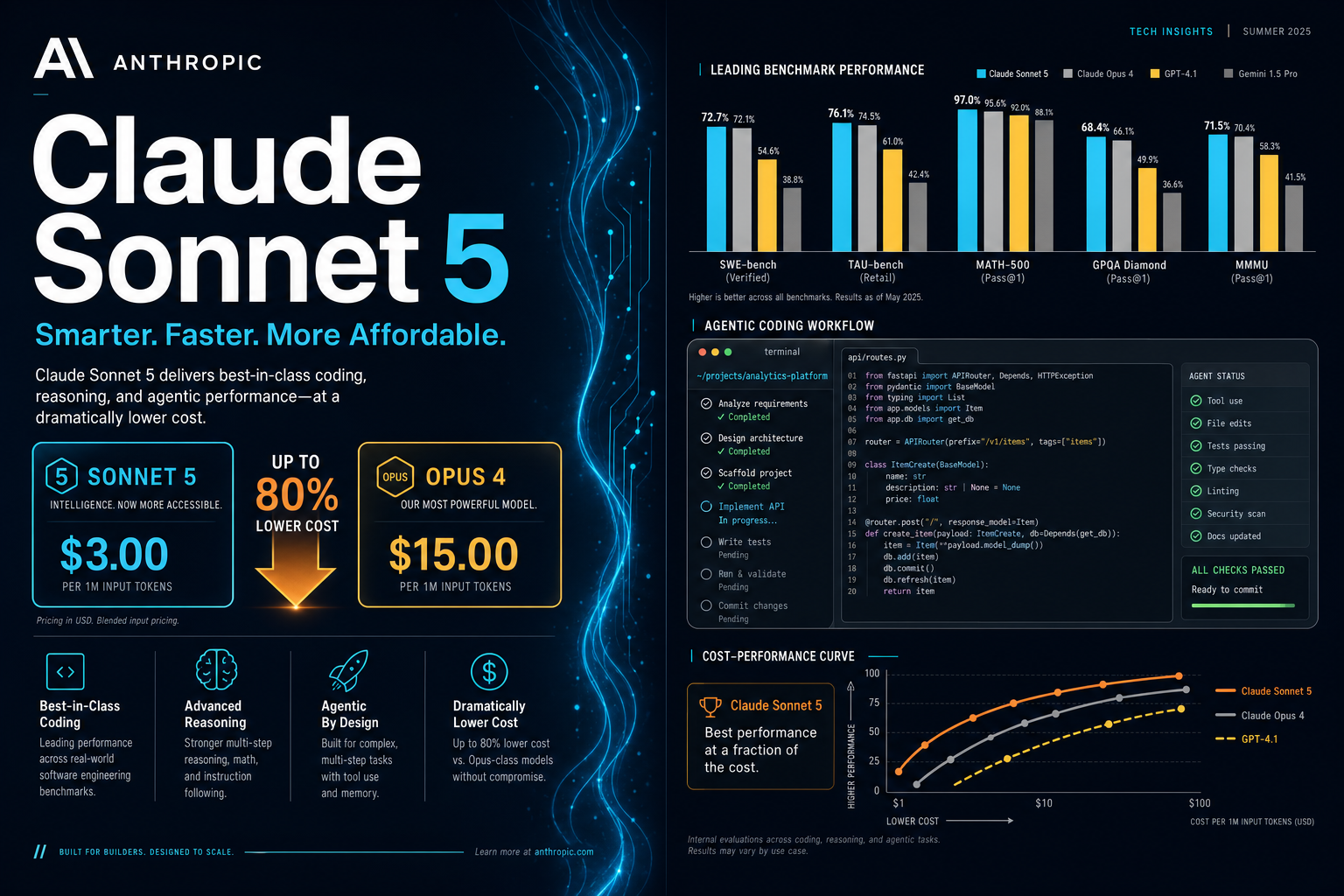
On June 30, 2026, Anthropic shipped Claude Sonnet 5 — the first Sonnet-class model that can genuinely pass for an Opus on agentic work. It closes the gap between mid-tier pricing and flagship performance.
The agentic AI era started with Sonnet. Claude Sonnet 3.5, 3.6, and 3.7 were the first models that made coding agents viable. But lately, the most impressive agentic gains lived in the Opus tier — more capable, but at $5/$25 per million tokens. Sonnet 5 changes that equation. At $2/$10 intro pricing (or $3/$15 standard), it delivers performance close to Opus 4.8 for roughly 40% less cost.
If you build agents, this is the model that makes the economics work.
What shipped: Sonnet 5 by the numbers
Anthropic says Sonnet 5 is “a substantial improvement” over Sonnet 4.6 across reasoning, tool use, coding, and knowledge work. The benchmark table backs it up:
| Benchmark | Claude Sonnet 5 | Claude Sonnet 4.6 | Claude Opus 4.8 |
|---|---|---|---|
| SWE-bench Verified | 68.3% | 53.0% | 72.4% |
| TAU-bench (retail) | 85.5% | 52.4% | 86.1% |
| TAU-bench (airline) | 73.1% | 32.3% | 78.8% |
| BrowseComp | 59.1% | 19.5% | 60.0% |
| OSWorld-Verified | 28.0% | 13.5% | 30.5% |
| GPQA Diamond | 69.1% | 68.5% | 79.7% |
| MATH-500 | 96.0% | 95.2% | 97.0% |
Scores reported in Anthropic’s Sonnet 5 System Card. Opus 4.8 shown as a flagship reference point.
Sonnet 5 closes 80-90% of the gap to Opus 4.8 on SWE-bench, TAU-bench, BrowseComp, and OSWorld — for 40% less per-token cost. The gap is real but thin enough that for most agent workloads, you won’t feel the difference.
Cost-performance curves
Anthropic’s effort-level tuning visualizes the trade-off directly. At the same effort level, Sonnet 5 can match or exceed Opus 4.8 on BrowseComp (agentic search) while costing less. The orange curve (Sonnet 5) covers a wider cost-performance range than the gray curve (Sonnet 4.6) and intersects the yellow Opus 4.8 curve on several tasks.
For browse-and-research agents where cost accumulates over long sessions, Sonnet 5 is the better choice than Opus 4.8 at any effort level. For software engineering, you pay a 4% SWE-bench penalty but save 40% on tokens — a trade worth making for most teams.
The pricing math
| Tier | Input ($/M tok) | Output ($/M tok) |
|---|---|---|
| Sonnet 5 (intro through Aug 31) | $2.00 | $10.00 |
| Sonnet 5 (standard from Sep 1) | $3.00 | $15.00 |
| Sonnet 4.6 | $3.00 | $15.00 |
| Opus 4.8 | $5.00 | $25.00 |
| GPT-5.5 | $5.00 | $25.00 |
| Gemini 3.1 Pro | $3.50 | $10.50 |
Standard pricing for comparables at time of writing.
At intro pricing, Sonnet 5 is 60% cheaper than Opus 4.8 on input and output. Even at standard pricing, it’s 40% cheaper. Compared to GPT-5.5 and Gemini 3.1 Pro, Sonnet 5 undercuts both on input while delivering near-flagship agentic performance.
The catch: Sonnet 5 uses a new tokenizer. The same input text produces approximately 30% more tokens than on Sonnet 4.6. Simon Willison’s tests confirm the multiplier varies by language: ~1.42x for English, ~1.33x for Spanish, ~1.28x for Python, and roughly equal for Simplified Mandarin. This means the effective per-request cost is about 30% higher than the token price suggests — though even after that adjustment, Sonnet 5 still undercuts Opus 4.8 significantly.
Behavioral changes that’ll break your code
Sonnet 5 is technically a drop-in replacement for Sonnet 4.6, but three behavior changes will hit you in migration:
1. Adaptive thinking is on by default. Every request now runs with adaptive thinking unless you explicitly disable it with thinking: {type: "disabled"}. If your Sonnet 4.6 code didn’t set a thinking field, it’s about to think — and use more output tokens. Adjust your max_tokens budget accordingly.
2. Sampling parameters are gone. Setting temperature, top_p, or top_k to non-default values returns a 400 error. This mirrors what Opus 4.7 and 4.8 already do. Remove them and use system prompt instructions to steer behavior.
3. Manual extended thinking is removed. thinking: {type: "enabled", budget_tokens: N} returns 400. Use thinking: {type: "adaptive"} with effort parameters instead.
Sonnet 5 supports 1M token context (no smaller variant) and 128K max output tokens. Priority tier is not available.
Why Sonnet 5 matters for agent builders
The agentic AI market is splitting into two conversations: who can build the most capable agent, and who can build one cheap enough to run at scale. Sonnet 5 answers the second question.
At $2/$10 intro pricing, running a coding agent on Sonnet 5 costs the same as running one on GPT-4o-class models from a year ago — but with 10x the reasoning depth, tool use, and autonomous follow-through. Multi-agent architectures — where you route simpler tasks to Sonnet 5 and reserve Opus 4.8 for hard problems — become the obvious default.
Early access partners described consistent behavior shifts:
- Multi-step software engineering that used to stall on Sonnet 4.6 now completes end-to-end
- The model self-checks its own output without being asked
- Brownfield code — race conditions, hidden tests, the parts nobody wants to touch — gets durable fixes instead of symptom patches

Anthropic’s official Sonnet 5 announcement page, published June 30, 2026.
The cybersecurity asterisk
Sonnet 5 is the first Sonnet-tier model with real-time cybersecurity safeguards. Requests involving prohibited or high-risk cyber topics are refused with stop_reason: "refusal". Anthropic’s system card is explicit: “Sonnet 5 is significantly less capable at cyber tasks than Mythos 5.”
The US government’s June 2 executive order and subsequent Fable 5/Mythos 5 export controls showed that cyber capability is the new regulatory tripwire. Sonnet 5 was designed to stay below that threshold — it gets the safeguards but not the government gate. That means Sonnet 5 is usable by international teams without the restrictions that hit Fable 5 and Mythos 5.
What this means for your stack
| Scenario | Implication | Action |
|---|---|---|
| You run coding agents on Opus 4.8 | You’re overpaying for most tasks | Route routine work to Sonnet 5; reserve Opus 4.8 for problems above 70th percentile difficulty |
| You’re on Sonnet 4.6 and want better agentic follow-through | Straight upgrade for the same token price | Update model ID to claude-sonnet-5, review thinking and sampling params, re-budget for 30% more tokens |
| You’re on GPT-5.5 or Gemini 3.1 Pro | Sonnet 5 is cheaper and competes on agentic capability | Test on your agent benchmarks before buying more GPT-5.5 tokens |
| You need agentic search / browse agents | Sonnet 5 matches Opus 4.8 on BrowseComp at lower cost | This is the strongest use case — research agents on Sonnet 5 are the best cost-performance point today |
| You have international teams | No government gate on Sonnet 5 | Deploy without Fable 5 / Mythos 5 restrictions |
Decision framework
- When to use: Sonnet 5 is the default choice for any agentic workflow that doesn’t need the absolute ceiling of Opus 4.8. That covers 80%+ of real-world agent tasks — coding, research, browser automation, knowledge work.
- When not to use: If you need maximum one-pass accuracy on the hardest SWE-bench problems, Opus 4.8 still edges Sonnet 5. If you need unrestricted cyber capability, Mythos 5 (where available) is the play.
- Trade-off: You save 40-60% on token costs but get ~4% lower SWE-bench and ~6% lower TAU-bench scores. The tokenizer bump (~30% more tokens) partially offsets the savings. Do the math on your actual prompt lengths before committing.
- Recommendation: Migrate your agent pipelines to Sonnet 5 during the intro pricing window. The $2/$10 rate through August 31 is a genuine deal. After that, the cost-benefit is still positive for most use cases.
- Final takeaway: Sonnet 5 is the model that makes agentic AI affordable at scale. It doesn’t rewrite the frontier, but it moves the frontier’s price down by 40%. That changes more workflows than a 2% benchmark gain.
Related reading
- Mythos 5 Partially Restored for Critical Infrastructure — The government gate story that frames why Sonnet 5’s unrestricted access matters
- GPT-5.6 Sol: Government-Gated at Launch — OpenAI’s tiered family and how it compares to Anthropic’s lineup
- Multi-Provider AI Gateways: Fallback Routing — Architectures for routing between Sonnet 5, Opus 4.8, and alternatives
- GLM-5.2: Open-Weight 1M Context Model — The open-weight alternative that can’t be remotely revoked
Sources
- Anthropic Blog — Introducing Claude Sonnet 5
- Claude Platform — What’s new in Claude Sonnet 5
- Claude Sonnet 5 System Card (PDF)
- TechCrunch — Anthropic launches Claude Sonnet 5 as a cheaper way to run agents
- Simon Willison — What’s new in Claude Sonnet 5
- InfoWorld — Claude Sonnet 5 boosts coding, reasoning, and tool use
- Mashable — Anthropic finally, officially launches Claude Sonnet 5
- MacRumors — Anthropic Launches Claude Sonnet 5 With Near-Opus Performance at a Lower Price
About the author
Charles Jasthyn De La Cueva is a full-stack developer and the founder of Open TechStack. He writes about AI engineering, developer tools, and practical model evaluation — grounded in real workflows, not press releases.