Tobi Knaup knows what a platform shift looks like. In 2013 he co-founded Mesosphere around Apache Mesos, watched Kubernetes consume his market, and built DC/OS before the tide became irreversible. When he says open-weight AI is having its Kubernetes moment, it’s worth paying attention.
His essay — published July 25 and already near the top of Hacker News — draws a line from cloud-native infrastructure to the current AI ecosystem. The thesis is simple and powerful: once an open platform that people can customize becomes the industry’s center of gravity, no single vendor can match the combined rate of innovation around it.

Here’s why that matters for every team building on or around foundation models.
Why this matters now
Three converging forces make Knaup’s argument timely:
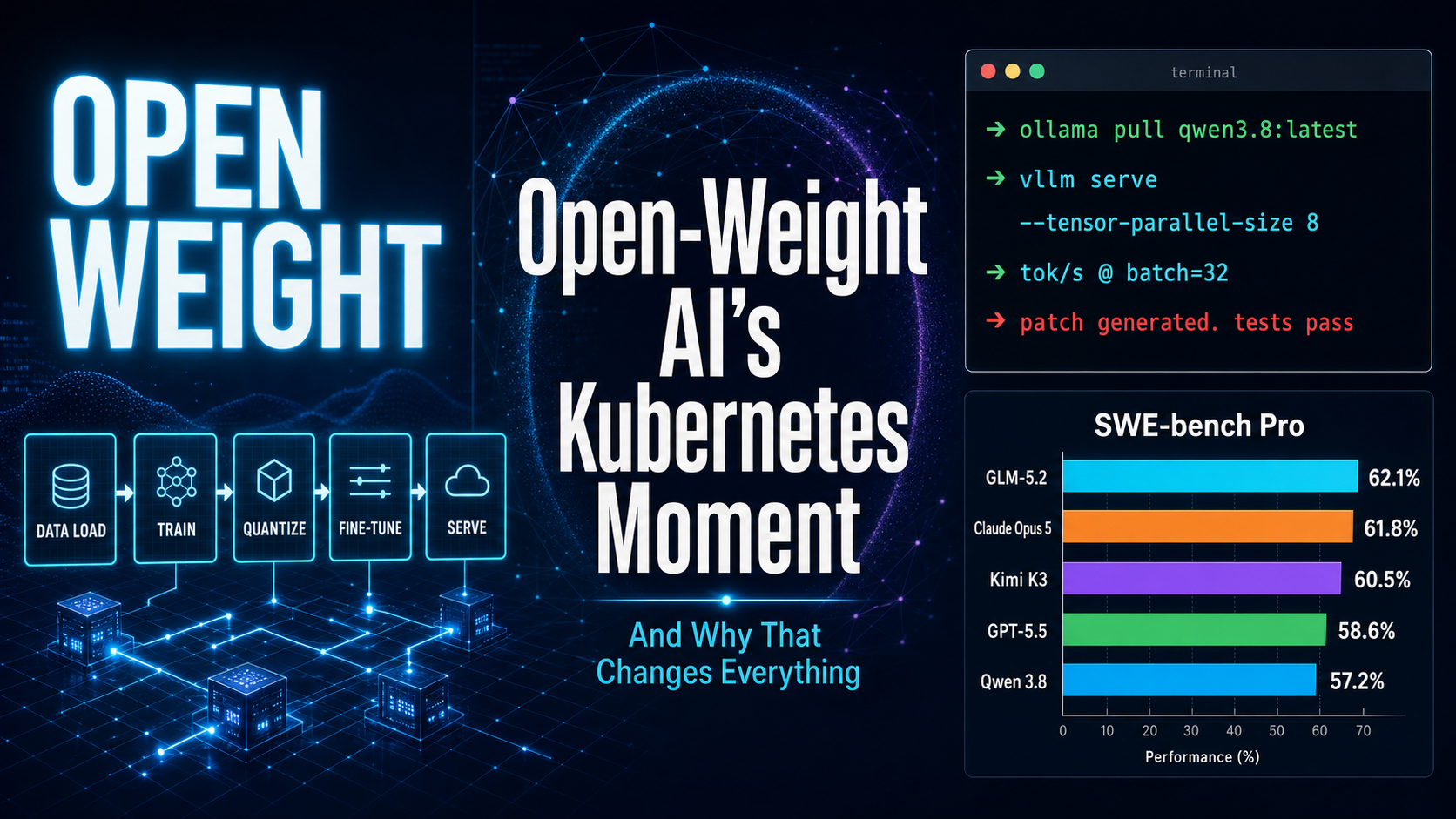
First, the capability gap is closing. Z.ai’s GLM-5.2 scores 62.1% on SWE-bench Pro — matching Claude Opus 5 at 61.8% and beating GPT-5.5 at 58.6%. Kimi K3, whose weights drop July 27, scores alongside Opus 4.8 and GPT-5.5 in independent evaluations. This isn’t “good enough for a free model” territory anymore — it’s frontier performance.
Second, the serving stack is mature. vLLM, SGLang, llama.cpp, Ollama, and MLX have turned self-hosting from a research exercise into a production capability. You can ollama pull qwen3.8 and get 98 tok/s at batch 32 on quantized 4-bit weights. The operational layer exists.
Third, the policy question is live. The Trump administration is reportedly considering restrictions on Chinese open-weight models. Knaup’s argument arrives in the middle of that debate with a clear position: a ban would cut US developers off from the fastest-growing ecosystem, not protect them.
As we covered earlier this month, American AI’s closed strategy is already losing developer mindshare. The Kubernetes moment argument frames the same dynamic as a platform play, not a geopolitical one.
What the Kubernetes analogy gets right
Knaup’s core observation is worth quoting directly:
“Kubernetes did not win simply because its repository was public. It became a neutral substrate that engineers, cloud providers and enterprise vendors could all extend to fit their customers’ needs.”
Open-weight models are following the same trajectory. Hugging Face now hosts more than two million public models. Around families like Qwen and Gemma, developers produce quantized weights for different silicon, fine-tunes for specific domains, LoRA adapters for specialized workflows, model merges, and runtime adapters for vLLM, TensorRT-LLM, and MLX.
The Kubernetes analogy isn’t perfect — Knaup acknowledges the differences. Model fine-tunes don’t flow improvements back into upstream the way Kubernetes patches do. There’s no CNCF-like neutral governance body for AI weights. And frontier models still require expensive hardware to run. But the mechanism is the same: a sufficiently capable, portable substrate attracts complementary innovation far beyond what its original creator could produce alone.
The table below maps the comparison:
| Layer | Kubernetes Era | Open-Weight AI Era |
|---|---|---|
| Substrate | Container runtime (Docker/rkt) | Open-weight model (Qwen, Gemma, GLM) |
| Orchestration | Kubernetes itself | vLLM, SGLang, Ollama |
| Networking | CNI plugins (Calico, Cilium) | Model parallelism (tensor/pipeline) |
| Storage | CSI plugins | Quantized formats (GGUF, AWQ, GPTQ) |
| Ecosystem | Helm charts, Operators | LoRA adapters, model merges, fine-tunes |
| Governance | CNCF | ? (open question) |
The real insight is about innovation velocity. When Kubernetes was the platform, every infrastructure engineer in the world had a reason to build on it. The same is happening with open-weight models — and once that flywheel spins up, a closed API provider can’t match it.
The geography of open-weight AI
Knaup’s most pointed observation is about where innovation is accumulating. Chinese models accounted for 41% of Hugging Face model downloads over the past year. Qwen, GLM, Kimi, and DeepSeek are the most downloaded families.
This isn’t just about cost. Chinese labs are increasingly releasing under permissive licenses — GLM-5.2 is MIT, Kimi K3 has promised open weights by July 27. American labs are moving in the same direction: NVIDIA’s Nemotron, Thinking Machines’ Inkling (Apache 2.0), OpenAI’s gpt-oss, and Google’s Gemma 4 are all permissively licensed. But the weight of activity is shifting.
The policy question — should the US ban Chinese open-weight models — is the wrong frame, according to Knaup. The right question is: how does the US compete in the open ecosystem rather than wall itself off from it?
His answer has four parts:
- Release frontier-grade American open-weight models under licenses startups can actually build on
- Use government procurement to create demand for portable, interoperable systems (the DoD’s Platform One playbook)
- Build the rest of the stack — serving, tooling, support, operational layers — as a US-led industry
- Set independent safety standards rather than blanket bans
This mirrors the argument made by NVIDIA, Microsoft, Meta, and 22 other companies who signed an open-weight letter on “American AI Leadership” earlier this month. The difference is Knaup frames it as a platform strategy, not a policy statement.
What the open-weight stack looks like today
A production open-weight stack in July 2026 looks like this:
| Component | Options | Status |
|---|---|---|
| Model | Qwen 3.8 (2.4T), GLM-5.2, Kimi K3 (Jul 27) | Frontier-capable |
| Serving | vLLM, SGLang, TGI | Production-grade |
| Quantization | 4-bit AWQ, GGUF, GPTQ | Inference at 98 tok/s @ batch 32 |
| Orchestration | Ray Serve, BentoML, Skypilot | Multi-GPU, multi-node |
| Monitoring | Langfuse, Helicone, Braintrust | OpenTelemetry-compatible |
| Hardware | H100/B200, AMD MI400, Groq LPU | Available across neoclouds |
This stack isn’t hypothetical. Teams are running GLM-5.2 on 8×H100 nodes and matching GPT-5.5 output quality for roughly 2% of the API cost. The performance on SWE-bench Pro — a benchmark that measures real-world coding task completion — shows open-weight models within striking distance of closed frontier models.
The remaining gaps are in agentic reliability (long-horizon tasks still favor closed models with better tool-use training) and in the operational tooling layer (observability, sandboxing, evaluation frameworks are earlier-stage). But these are exactly the gaps that an open ecosystem fills fastest, because every team that deploys an open-weight model has an incentive to build them.
Decision framework
- When to adopt open-weight models: You need data sovereignty, cost predictability below $0.003/token, or the ability to fine-tune for domain-specific tasks. The serving stack is ready for production workloads up to 131K context.
- When to stay with closed APIs: You need the absolute best performance on agentic long-horizon tasks today, or you lack the operational expertise to manage your own inference infrastructure.
- Trade-off: Open-weight models cost 2-5% of API pricing at equivalent throughput, but require GPU management, model selection, and operational investment. Closed APIs cost more but deliver instant access and zero ops.
- Recommendation: Run a hybrid strategy. Use open-weight models (GLM-5.2, Qwen 3.8) for high-volume production workloads where cost and data control matter. Keep a closed API budget (GPT-5.5, Claude Opus 5) for the hardest agentic tasks and for fallback.
- Final takeaway: Open-weight AI is infrastructure, not a product. The teams that treat it that way — investing in the operational layer and the model selection strategy — will have the same advantage that early Kubernetes adopters had over proprietary PaaS users.
Implementation notes
The Kubernetes analogy is not perfect, but it is useful. The mistake would be to wait until the parallels are exact — by then, the platform shift will already have happened. Start evaluating open-weight models against your production workloads today. The cost difference alone makes it worth the operational investment.
Related reading:
- American AI’s Closed Strategy Is Losing to China’s Open-Weight Push
- 22 Companies Sign Open-Weight Letter: “American AI Leadership”
- GLM-5.2: Open Weights, 1M Context, MIT License
- Kimi K3: Moonshot’s 2.8T Open-Weight Model Shakes Up the AI Race
- Qwen 3.8 — Alibaba’s 2.4T Open-Weight Model
- The July 2026 AI Model Price War
Related reading
- Dario Amodei: Open-Weight Models Are a Public Good — Anthropic’s more cautious version of the argument.
- American AI’s Closed Strategy Is Losing to China — The market and geopolitical stakes.
- AI Supply Chain Security and Model Provenance — The security work required for an open model stack.
Sources
- Tobi Knaup — Open-weight AI is having its Kubernetes moment. Let’s not ruin it.
- Hugging Face — 41% of model downloads from Chinese models
- Artificial Analysis — Kimi K3 independent evaluation
- Z.ai — GLM-5.2 release and SWE-bench Pro results
- SWE-bench Pro — Frontier model coding benchmark results
- The Information — Trump administration considers restrictions on Chinese open-weight models
- OpenAI — gpt-oss release under Apache 2.0
About the author
Charles Jasthyn De La Cueva is a full-stack developer and the founder of Open TechStack. He writes about AI engineering, developer tools, and practical model evaluation — grounded in real workflows, not press releases.