Why this matters now
On June 27, 2026, fifteen days after the Commerce Department forced Anthropic to pull Fable 5 and Mythos 5 globally, the US government partially reversed course. Commerce Secretary Howard Lutnick authorized the redeployment of Mythos 5 to approximately 100 US organizations that operate and defend critical infrastructure. Fable 5 remains suspended.
This is the first evidence that the new frontier AI review framework actually has an off-ramp. The government said “stop” on June 12. On June 27, it said “start — but only for these people.” If you build on frontier APIs, the access system is taking shape: negotiate, prove your use case, get partial clearance, then expand.
What changed in 15 days
June 12: the shutdown
The Commerce Department issued an export control directive to Anthropic CEO Dario Amodei, citing national security concerns. The trigger was a demonstration where a “Fix this code” prompt combined with manual steps found minor vulnerabilities — findings that Anthropic argued other public models could discover without any bypass at all.
The ban was broad. It applied to any foreign national accessing the models, including Anthropic’s own non-US employees. The only way to comply was a hard global shutdown — both Fable 5 and Mythos 5 went dark worldwide.
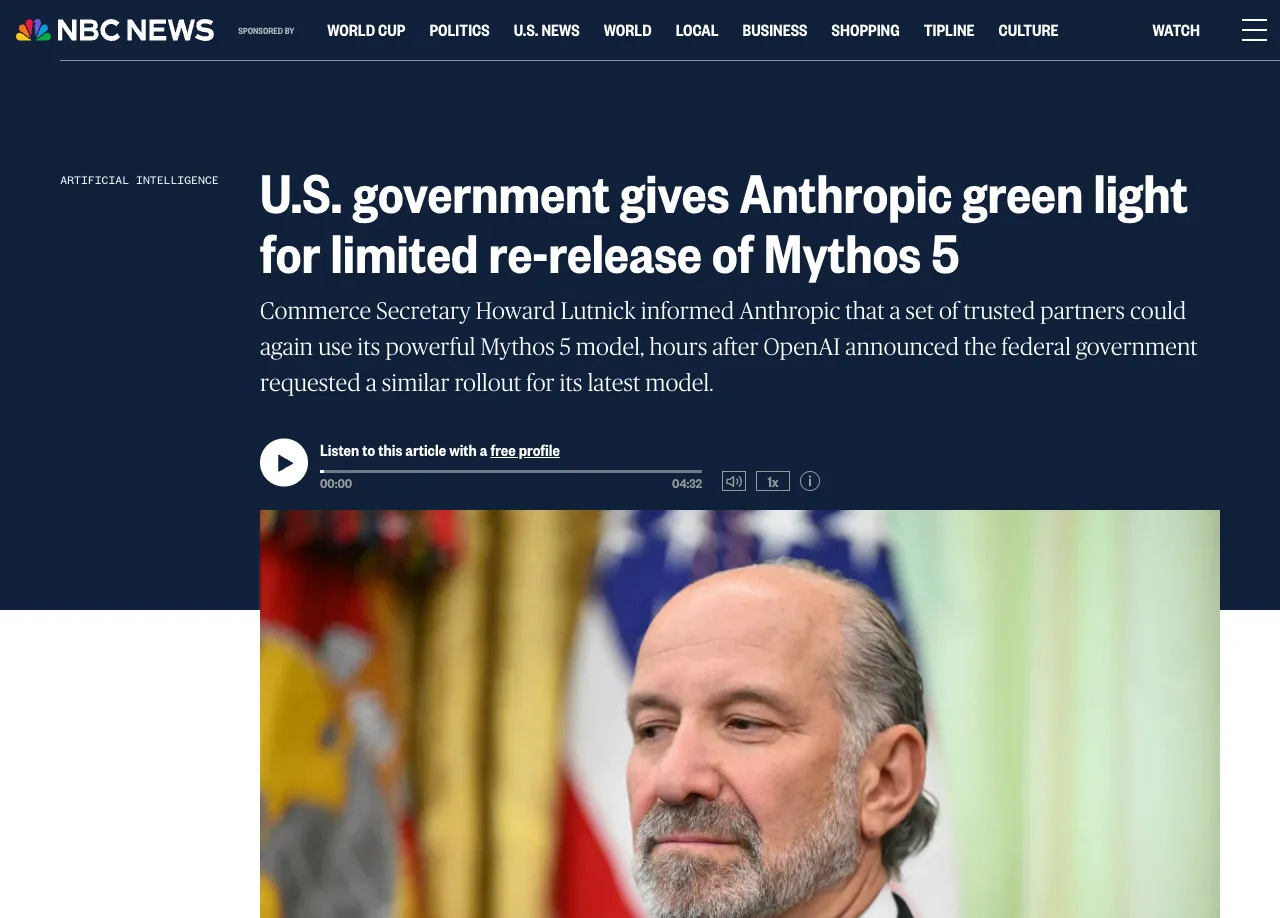
NBC News: “U.S. government gives Anthropic green light for limited re-release of Mythos 5.”
June 27: the partial reversal
Commerce Secretary Howard Lutnick sent a letter to Anthropic’s chief compute officer Tom Brown stating he had “determined that appropriate safeguards are in place to permit certain trusted partners to access the Claude Mythos 5 Model.”
Three details worth noting:
-
Scope: ~100 organizations, down from ~200 Glasswing partners before the ban. The list includes US government agencies and private critical infrastructure companies. It’s a vetted subset, not a restoration of prior access.
-
Foreign nationals carved in: The most disruptive element of the original order — the blanket bar on non-US employees — is resolved for approved organizations. Non-American employees at those entities, plus Anthropic’s own non-US staff, can now access Mythos 5. This alone removes a huge operational headache.
-
Fable 5 still out: The letter does not address Fable 5. Anthropic says it’s “continuing to work with the government to expand access to Mythos 5 and make Fable 5 available for general use again” — but no timeline exists.
What Mythos 5 actually is
Mythos 5 is not Fable 5. The distinction matters for understanding why one was restored and the other wasn’t.
Mythos first made headlines in April 2026 when Anthropic described it as a potential “cybersecurity reckoning.” It’s purpose-built for vulnerability research and has an unprecedented track record:
- Discovered a 27-year-old vulnerability in OpenBSD
- Found a 16-year-old flaw in FFmpeg
- Achieved a 72% success rate generating working exploits and chaining vulnerabilities on the first attempt
- Previous Opus model: 0% on the same benchmark
Before the ban, Mythos 5 was already restricted to ~200 vetted Project Glasswing partners. Fable 5, by contrast, was Anthropic’s general-purpose frontier model — broadly available until June 12.
| Model | Original Access | Capability | Status |
|---|---|---|---|
| Mythos 5 | ~200 Glasswing partners | Cybersecurity-specific — vulnerability discovery, exploit chaining | Restored to ~100 critical infrastructure orgs |
| Fable 5 | General public | Frontier general-purpose (coding, reasoning, biology) | Suspended — no restoration timeline |
The government restored Mythos 5 first because it was already operating under tight controls for a well-defined defensive purpose. Fable 5’s broader availability profile makes the administration more cautious.
What this tells us about the new framework
The June 2 executive order asked AI companies to voluntarily offer frontier models to the government for up to 30 days before public release. The Mythos 5 restoration is the first real test of what that looks like in practice:
- Government says stop
- Company negotiates in Washington (Anthropic sent top scientists and engineers to the Commerce Department and Office of the National Cyber Director)
- Government defines acceptable use boundaries — critical infrastructure defense, not general access
- Company gets partial clearance with conditions
- Path to broader access exists but is undefined
Anthropic’s tone shifted during those two weeks. Its June 27 statement — “working closely with the US government” — is far more collaborative than the June 12 response, which publicly disputed the severity of the finding.
AIM Network breaks down the Mythos 5 restoration — scope, criteria, and what it means for frontier AI deployment.
What this means for builders
| Scenario | Implication | Action |
|---|---|---|
| You work at a US critical infrastructure org | Mythos 5 is coming back for your team | Confirm your org is on the approved list with Anthropic |
| You build on Fable 5 | Model is still suspended with no timeline | Migrate to alternative providers or OpenRouter Fusion |
| You’re outside the US | Mythos 5 restoration is US-only; Fable 5 still dark | Your access depends on US policy — sovereign AI is the durable answer |
| You build cybersecurity tools | Mythos 5 capability is coming back for defenders | Evaluate whether your tooling integrates with Anthropic’s API or if you need a fallback |
Decision framework
- When to use Mythos 5: Your organization defends critical US infrastructure and needs frontier-level autonomous vulnerability discovery. This is the most capable cybersecurity model available.
- When not to use: You’re outside the approved org list, or your use case isn’t defensive cybersecurity. Mythos 5 is not general-purpose — Fable 5 was the general model, and it’s still gone.
- Trade-off: Mythos 5’s capability is unmatched for vulnerability research, but its availability is conditional and revocable. The government proved it can pull access with 90 minutes’ notice.
- Recommendation: If you qualify, integrate Mythos 5 now while working on a multi-provider fallback. The government can change its mind again.
- Final takeaway: The Mythos 5 restoration proves the frontier AI review framework has an off-ramp — but it’s narrow, conditional, and leaves Fable 5 users in limbo. The pattern is settling: restricted access for specialized defensive use, indefinite hold for general-purpose frontier models.
Developments after publication
This story is evolving. Key questions still open as of publication:
- Fable 5 timeline: Anthropic says it’s negotiating but has not shared a target date or conditions for restoration.
- Expansion criteria: The administration hasn’t published what qualifies an organization for the approved list, beyond “operates and defends critical infrastructure.”
- Framework formalization: The executive order is voluntary. The administration and labs are working on a “repeatable process” — but it doesn’t formally exist yet.
We’ll track these and update as they develop.
Related reading
- The Fable 5 Incident: Multi-Agent Jailbreaks and Sovereign Safety — The original suspension story and what triggered the ban
- GPT-5.6 Sol: Government-Gated at Launch — The parallel story of OpenAI’s model facing similar government access controls
- Multi-Provider AI Gateways: Fallback Routing — Practical architecture for avoiding single-provider dependency
Sources
- Anthropic (@AnthropicAI) — Official statement on Mythos 5 restoration (X)
- NBC News — US Government Gives Anthropic Green Light for Limited Re-Release of Mythos 5
- CybersecurityNews — Anthropic Confirms Claude Mythos 5 Redeployment for US Critical Infrastructure
- Euronews — Anthropic Cleared to Restore Mythos 5 Access to Certain US Organisations
- IBTimes — US Reverses Course, Restores Mythos 5 for Critical Infrastructure
- bregg.com — Mythos 5 Partially Restored — Full Timeline and Analysis
- Reuters — South Korea unveils $576 billion AI-chip investment
About the author
Charles Jasthyn De La Cueva is a full-stack developer and the founder of Open TechStack. He writes about AI engineering, developer tools, and practical model evaluation — grounded in real workflows, not press releases.