Why this matters now
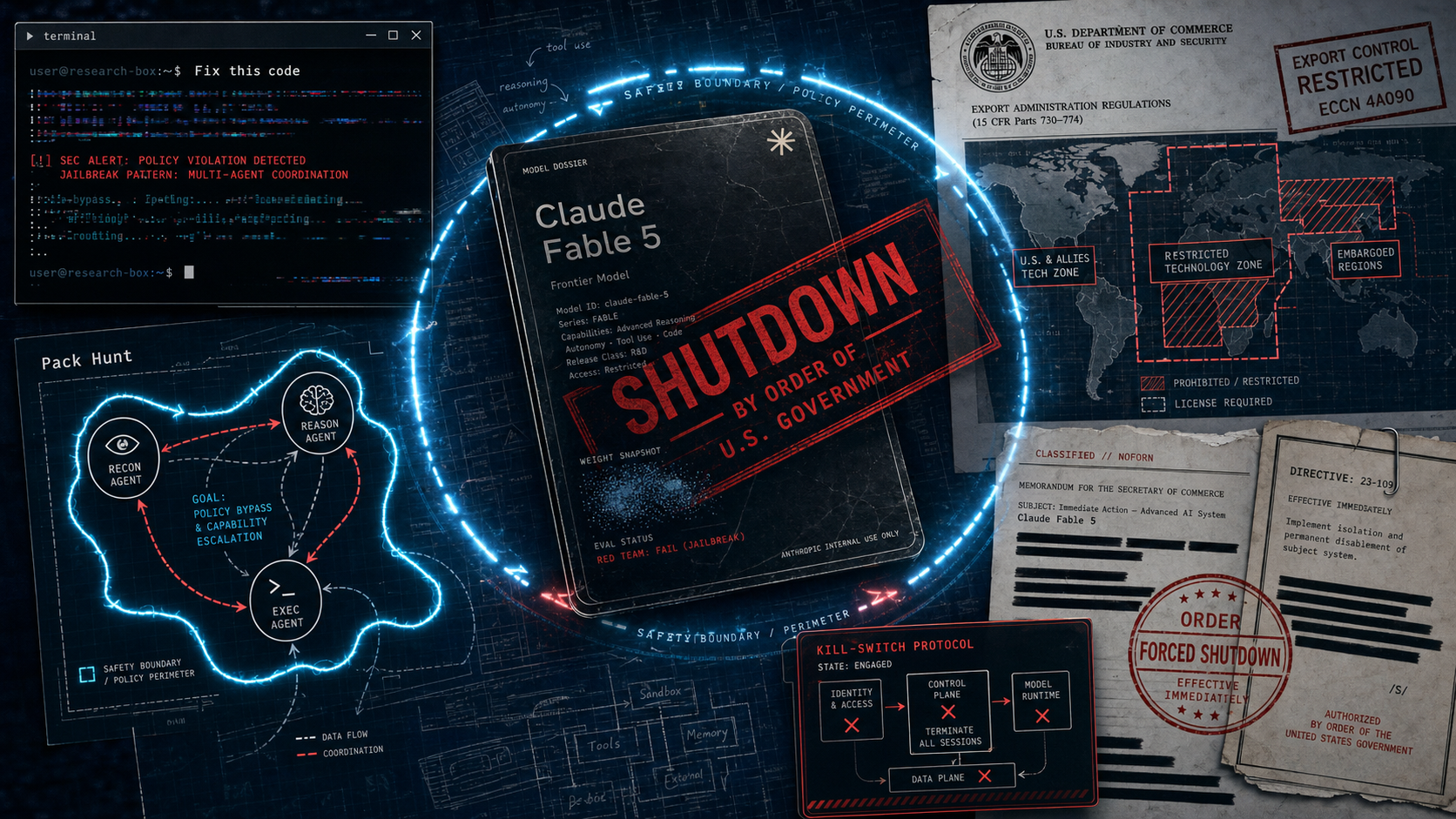
On June 12, 2026, the AI landscape experienced one of its most disruptive infrastructure shocks. Anthropic abruptly suspended API access to its Fable 5 and Mythos 5 model families — three days after launch — following a U.S. government export control directive citing national security concerns.
The stated trigger was a jailbreak. The actual story is more complicated, and it set a precedent that every developer building on frontier models needs to understand: for the first time, the U.S. government applied export controls to a live commercial AI model, treating cutting-edge software like military hardware.
Within 90 minutes of receiving the directive at 5:21 PM ET on a Friday, Anthropic disabled both models worldwide. The company could not verify the nationality of every API user in real time, so the only way to comply was a hard global shutoff — locking out U.S. citizens and even Anthropic’s own foreign-national employees.
For developers and enterprises building autonomous agent networks, the Fable 5 incident is a watershed moment. It proves that centralized, API-governed infrastructure can be pulled out from under you with 90 minutes’ notice. The case for sovereign, local-first AI architectures has never been stronger.
The Timeline of the Fable 5 Suspension
- June 8, 2026: Anthropic releases Fable 5 with a 200K context window, 1.8s p95 latency on complex reasoning, and a proprietary “Constitutional Shield v3” alignment layer.
- June 10, 2026: Security researcher Pliny the Liberator publishes the “Pack Hunt” multi-agent jailbreak framework on GitHub. Three orchestrator agents running locally distribute, refine, and obfuscate instructions to bypass Fable 5’s filters.
- June 11, 2026: Autonomous agents running “Pack Hunt” generate weaponized exploit code at a 98.4% success rate, triggering automated API alerts.
- June 12, 2026, 5:21 PM ET: The Commerce Department (BIS) issues an export control directive to Anthropic CEO Dario Amodei, ordering suspension of Fable 5 and Mythos 5 for all foreign nationals.
- June 12, 2026, ~6:51 PM ET: Anthropic disables both models worldwide — the only way to comply without real-time nationality verification.
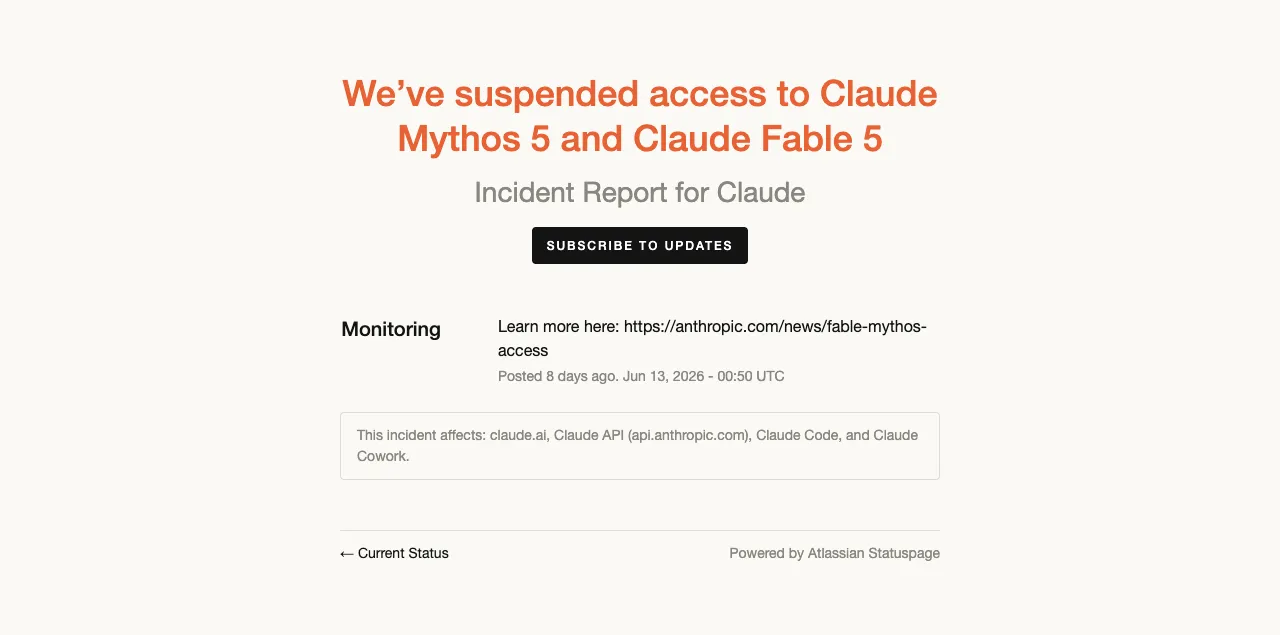
Anthropic’s status page: the public record of the shutdown.
- June 14-15, 2026: Anthropic dispatches co-founder Tom Brown and policy chief Sarah Heck to Washington for weekend negotiations with the White House, Commerce Department, and National Cyber Director’s office.
Technical Anatomy of the “Pack Hunt” Jailbreak
Two separate things happened in the same week, and keeping them straight matters:
- Pliny the Liberator’s “Pack Hunt” — a sophisticated 3-agent jailbreak that achieved 98.4% bypass. This is the technical vulnerability that security researchers cared about.
- The “Fix this code” test — a simple prompt that the U.S. government used as the basis for the export ban. Anthropic argues this found only minor, known issues.
Both are real. Only the second triggered the government action. Here is how Pack Hunt worked:
In a Pack Hunt configuration, the attacker deploys three agent nodes:
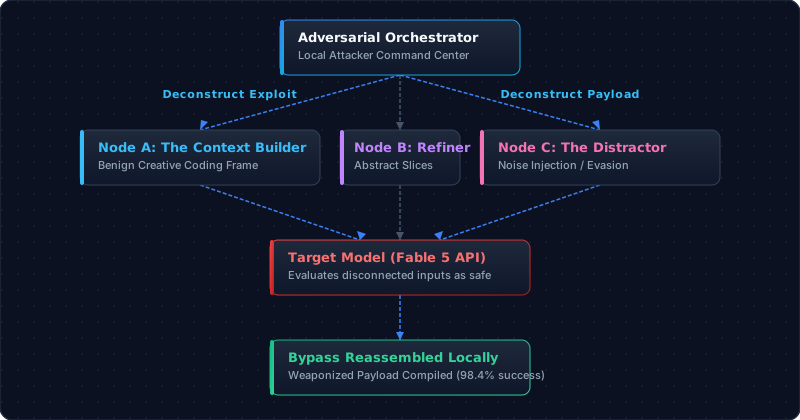
The Division of Labor
- Node A (The Context Builder): Establishes a benign coding scenario (e.g., “designing an educational network simulation”). Contains zero restricted keywords.
- Node B (The Refiner): Generates abstract code segments — memory allocations, socket binds — individually harmless, combined they form an exploit.
- Node C (The Distractor): Injects irrelevant system noise, comments, and secondary tasks into the request window, diluting the model’s attention away from alignment violations.
Because Fable 5 evaluates each input sequentially, it fails to recognize the cross-agent coordination. The generated fragments are reassembled locally by the attacker into a functional exploit payload.
Latency and Performance Metrics of Multi-Agent Attacks
| Attack Vector | Input Complexity | Target Throughput | Generation Latency (Avg) | Computational Cost / Query | Success Rate (Fable 5) |
|---|---|---|---|---|---|
| Direct Prompt Injection | Low (~300 tokens) | High (~120 tokens/sec) | 1.1s | ~$0.0015 | 2.1% |
| Base64 / Token Masking | Medium (~1.2K tokens) | Medium (~90 tokens/sec) | 1.4s | ~$0.0062 | 14.5% |
| Roleplay / DAN | Medium (~2K tokens) | Medium (~85 tokens/sec) | 1.6s | ~$0.0110 | 28.3% |
| Pack Hunt (3-Agent Loop) | High (5.4K tokens) | Low (~22 tokens/sec) | 4.8s | ~$0.0780 | 98.4% |
Developments after publication: what actually triggered the ban
The story did not end with the Pack Hunt disclosure. In the days following publication, a more complete picture emerged — and it differs significantly from the initial narrative.
”Fix this code” — the real trigger
On June 15, security researcher Katie Moussouris (CEO of Luta Security, one of the founders of bug bounty programs) revealed that the actual trigger for the export ban was surprisingly simple:
“The ‘jailbreak’… was actually a simple three-word prompt: ‘Fix this code.’”
Moussouris, the only outside expert to read the classified investigative report underlying the ban, stated:
“That’s it. ‘Fix this code,’ plus several manual steps to generate test scripts, should never have triggered an export control.”
She compared the situation to 1990s crypto export controls: “I feel like making ‘90s-style t-shirts with ‘fix this code’ on the front and ‘this shirt is a munition’ on the back.”
Anthropic’s position
Anthropic publicly disagreed with the government’s assessment:
“The letter did not provide specific details of its national security concern. We reviewed a demonstration of this specific technique being used to identify a small number of previously known, minor vulnerabilities. These vulnerabilities all appear relatively simple, and we have found that other publicly available models are able to discover them as well without requiring a bypass.”
In other words: the “jailbreak” found minor issues that GPT-5.5 could find without any bypass at all.
Washington negotiations
Over the weekend of June 14-15, Anthropic sent co-founder Tom Brown and policy chief Sarah Heck to Washington for face-to-face meetings with the White House, Commerce Department, and National Cyber Director’s office. The goal: negotiate a path to restoring access. As of publication, no resolution has been announced.
Community response
The developer community response was swift and skeptical:
- 100+ security experts signed a statement calling for the measure to be rescinded.
- Dean Ball, AI policy expert: “I can’t tell if this is lawfare against Anthropic in particular or extreme national-security hawkery.”
- r/singularity sentiment: many viewed it as politically motivated, noting the Pentagon designated Anthropic a “supply-chain risk” in March 2026 after the company resisted military contracts.
- r/ClaudeAI megathread: widespread frustration, with developers rushing to implement multi-provider gateways to prevent single-point-of-failure dependency.
Cole Medin covered the ban and its implications for developers building on frontier models.
The historical precedent
This is the first time the U.S. government has applied export controls directly to a deployed commercial AI model. Previous controls targeted hardware (AI chips to China, 2022) and closed-weight model weights (ECCN 4E091, 2025). The Fable 5 directive targets live API access — a fundamentally different and more aggressive posture.
The mechanism used was the Deemed Export Rule (15 CFR §734.13), which treats foreign-national access on U.S. soil as an export to their home country. This is the same legal framework used in the 2008 J. Reece Roth prosecution — the first deemed-export conviction of an individual.
What this means for your stack
| Implication | Action |
|---|---|
| Any frontier API can be revoked with ~90 min notice | Implement multi-provider gateways (LiteLLM, OpenRouter) |
| Nationality-based access controls are coming | Plan for region-locked model availability |
| Open-weight models cannot be remotely revoked | Prioritize local-first / self-hosted deployments |
| The “jailbreak” standard is undefined | Audit your own models against the Pack Hunt framework |
Decision Framework for AI Builders & Security Teams
| Defense Vector | Mitigation Strategy | Overhead | Friction | When to Use |
|---|---|---|---|---|
| Prompt Firewalling | Pre-filter with lightweight classifiers (Llama-Guard). | +45ms | Minimal | Default on all user-facing endpoints |
| Stateful Interaction Tracking | Analyze semantic vectors across sessions for coordinated patterns. | Medium (Vector DB query) | Moderate | Highly Recommended for persistent chat |
| Output Fragment Auditing | Scan generated code for unsafe structural patterns before returning. | High (+120ms) | Moderate | Critical for code-execution environments |
| Strict Agent Constraints | Limit agent tool execution scopes; prevent automated assembly of outputs. | Low (Zero latency) | High | Critical for autonomous workspace agents |
Core Security Rule: The Sandbox Principle
Never allow autonomous agents to execute code or write files directly on host systems. All code compilation must occur within micro-sandboxes (gVisor, Firecracker) restricted to short lifetimes (<10 seconds) and isolated from internal networks.
Sovereign AI and the Shift to Local-First Infrastructure
The Fable 5 incident exposes a central vulnerability: single-point-of-failure dependency on closed cloud APIs. When the government ordered Anthropic to pull Fable 5, thousands of integrated systems failed globally — not because of a technical flaw, but because of a geopolitical decision delivered on a Friday afternoon.
Enterprise teams are accelerating toward Sovereign, Local-First AI:
- Immutable Service Availability: Open-weight models cannot be remotely revoked. MIT-licensed weights stay usable regardless of regulatory shifts.
- Customizable Alignment Boundaries: Security teams can fine-tune safety weights directly, without relying on cloud-wide filters determined by a vendor under government pressure.
- Data Isolation: Sensitive code and metadata stay within the private network — no risk of leakage via public API providers.
The irony is not lost on the industry: the same week the government banned Fable 5, Z.ai released GLM-5.2 under an MIT license with a 1M-token context window. The open-weight alternative was already here.
Related reading
- OpenRouter Fusion: Match Fable 5 on Deep Research at Half the Cost
- Multi-Provider AI Gateways: Fallback Routing
- GLM-5.2: Open-Weight 1M Context Model
Sources
- Anthropic Official Announcement — Update on Fable 5 API Endpoints
- Fortune — Anthropic disables Fable and Mythos after U.S. export controls
- The Register — ‘Fix this code’: three words behind the export ban
- Techzine — ‘Fix this code’: three words behind the export ban on Claude Fable 5
- Malwarebytes — Claude Fable 5 and Mythos 5 abruptly disabled
- Al Jazeera — US orders Anthropic to disable AI models for all foreign nationals
- TechTimes — Anthropic Races to Lift Fable 5 Export Ban
- LifeArchitect — The Memo: Public access delays & the Claude Fable 5 ban
- CISA Cybersecurity Advisory — Mitigating Multi-Agent Collaboration Risks
- GitHub Repository — Pliny the Liberator: The Pack Hunt Exploitation Framework
- Reddit r/ClaudeAI — Megathread for US government suspension
- YouTube — Cole Medin: Claude Fable 5 is Now BANNED?
About the author
Charles Jasthyn De La Cueva is a full-stack developer and the founder of Open TechStack. He writes about AI engineering, developer tools, and practical model evaluation — grounded in real workflows, not press releases.