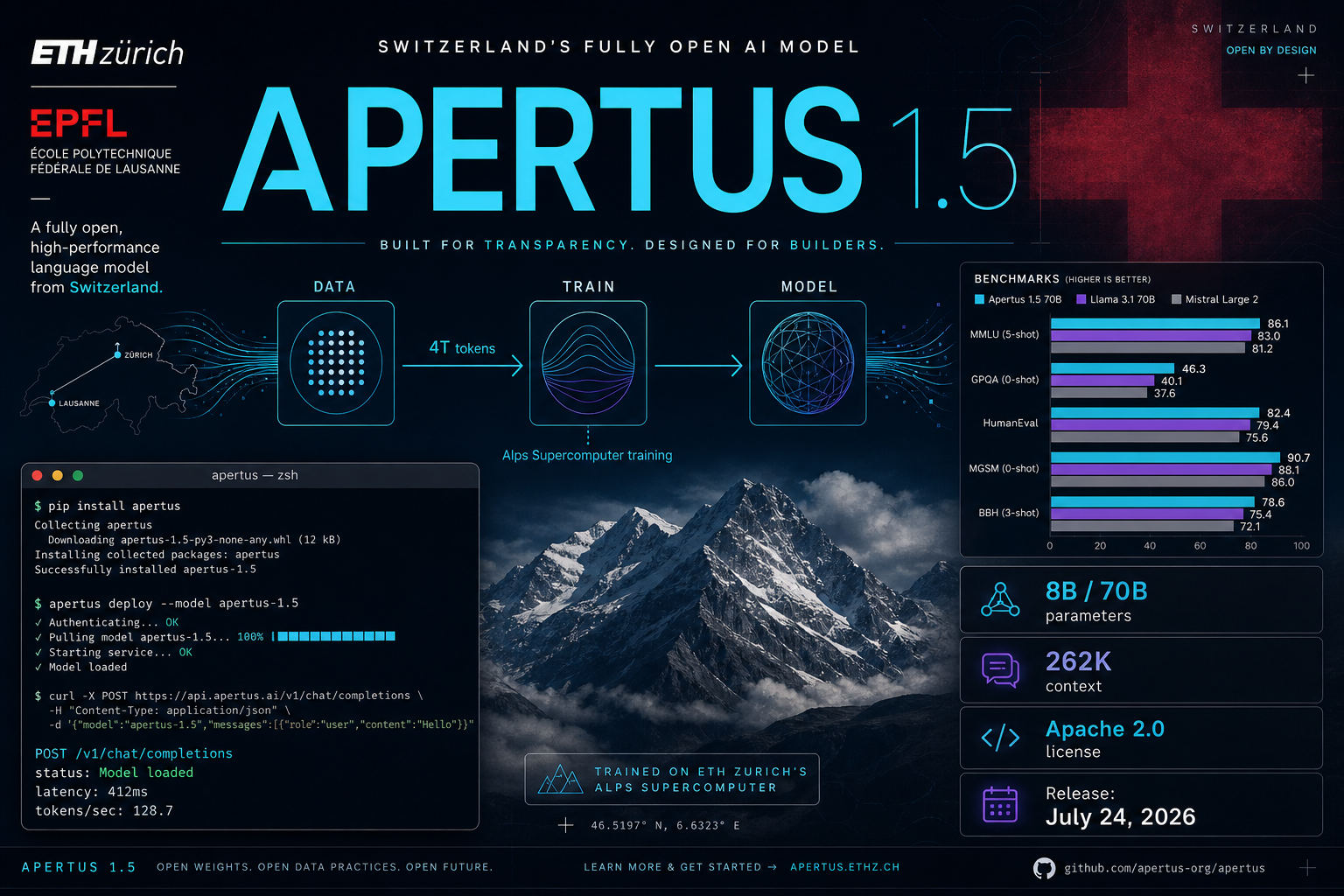
On July 24, 2026, ETH Zurich, EPFL, and the Swiss National Supercomputing Centre (CSCS) released Apertus 1.5 — the latest version of Switzerland’s fully open large language model. Trained on the Alps supercomputer in Lugano, Apertus 1.5 is one of the world’s largest fully open AI models, providing complete transparency into its training data, code, and development process under the Apache 2.0 license.
The release includes 8-billion and 70-billion parameter variants, with the 8B model receiving 4 trillion additional tokens of text and multimodal training data, and the 70B model receiving 2 trillion. Both versions gain native image understanding, an optional thinking mode, a 262,144-token context window, improved instruction-following, and better tool-use capabilities.
What makes Apertus 1.5 different from every other model release this month is the openness commitment. Not just open weights — but open data, open training code, and full development details. In a landscape dominated by closed APIs and partially open models, Apertus is the most transparent large-scale AI project in production.
Why this matters now
The timing is strategic. July 2026 has been the most active month for model releases in AI history — Kimi K3 (2.8T parameters), Qwen 3.8 (2.4T), GPT-5.6 Sol, Gemini 3.6 Flash, and Claude Fable 5 all landed within weeks of each other. The July 2026 AI price war has driven inference costs down 90–97% compared to 2024 levels, and the open-weight letter signed by NVIDIA, Microsoft, and Meta signaled that the industry’s deepest-pocketed players are aligned on open-weight models as the future.
Apertus 1.5 enters this landscape from a different angle. It is not trying to beat Kimi K3 on benchmarks or undercut GPT-5.6 Sol on price. It is building what the project leads call “sovereign AI infrastructure” — an open alternative to proprietary commercial models that any organization can inspect, adapt, and deploy on its own terms.
“Apertus is not about competing with frontier models from private companies, but about providing trustworthy, transparent AI that organizations big and small can build upon with confidence,” says Dr Imanol Schlag, research scientist at ETH Zurich.
The model is already in production use. The Canton of Ticino runs an in-house AI translation service on Apertus, keeping sensitive government documents off commercial APIs. EPFL researchers use it as a foundation for MeditronFO, the world’s first fully open medical LLM framework. And Basel-based news outlet Bajour runs a locally-hosted Apertus instance to analyze cantonal parliament transcripts and power its daily newsletter.
What Apertus 1.5 brings
The headline changes from Apertus 1.0 (released earlier in 2026) are significant:
| Feature | Apertus 1.0 | Apertus 1.5 |
|---|---|---|
| Parameters | 8B, 70B | 8B, 70B (continued pretraining) |
| Additional Training Data | — | 4T tokens (8B), 2T tokens (70B) |
| Context Window | 65K tokens | 262K tokens (4× increase) |
| Image Understanding | Text only | Native image + experimental audio |
| Thinking Mode | No | Optional reasoning-before-answering |
| Instruction-Following | Baseline | Improved adherence |
| Tool Use | Basic | Enhanced tool integration |
| License | Apache 2.0 | Apache 2.0 |
| Training Infrastructure | Alps (CSCS) | Alps (CSCS) |
The architecture remains a standard Transformer, but the continued pretraining strategy is what drives the quality improvements. Rather than training a new model from scratch, the team applied an additional 4 trillion tokens of curated text and multimodal data to the existing 8B checkpoint, and 2 trillion tokens to the 70B checkpoint. This is a pragmatic approach that lets existing deployments upgrade without retooling their entire stack.
What “fully open” actually means
This is the distinction that matters for builders evaluating Apertus against other open-weight releases.
Most open-weight models — including Kimi K3, Qwen 3.8, and GLM-5.2 — release weights and often a technical report, but keep training data composition, intermediate checkpoints, and training infrastructure private. Apertus publishes all of it: weights, data recipes, training pipelines, intermediate checkpoints, EU governance documentation (Code of Practice and Public Summary PDFs are included in the Hugging Face repository), and a detailed usage policy.
The practical implications:
- Auditability. Any organization can verify what went into the model, not just what came out. For regulated industries (healthcare, finance, government), this is a procurement requirement, not a nice-to-have.
- Reproducibility. Researchers can trace capability gains to specific data mixtures and training decisions — something impossible with closed or partially-open models.
- Customization. Because the full data pipeline is documented, fine-tuning for domain-specific use cases starts from a known baseline rather than a black box.
The trade-off is performance. Apertus 1.5 does not match Kimi K3 on DeepSWE or GLM-5.2 on MMLU-Pro. It is not designed to. The project’s goal is transparency and sovereignty, not leaderboard dominance.
The infrastructure story: Alps supercomputer
Apertus 1.5 is trained on the Alps supercomputer at CSCS in Lugano, Switzerland. Alps is Switzerland’s most powerful AI training system, purpose-built for large-scale scientific computing and machine learning workloads. CSCS is also launching a dedicated inference service for Apertus 1.5, providing a free API endpoint for all CSCS users and the Swiss academic community.
This is relevant beyond Swiss academia. The GPU supply constraints and export control dynamics that shape the broader AI market make regional supercomputing infrastructure a strategic asset. Apertus demonstrates that sovereign AI training infrastructure can produce competitive open models without relying on US hyperscaler GPU clusters.
The Apertus Mini suite, released alongside Apertus 1.5, extends this further: 16 compact models created via distillation and quantization from the flagship models, designed for resource-constrained deployments. This gives teams a deployment ladder from laptop-sized models up to the full 70B variant.
Decision framework
-
Use Apertus 1.5 if transparency, auditability, or regulatory compliance are your primary constraints. The Apache 2.0 license with full training data documentation makes it the safest choice for government, healthcare, and financial services deployments.
-
Use it if you need a capable open model with image understanding and a 262K context window, and you want to deploy on your own infrastructure without licensing uncertainty.
-
Use it if you are building in or for the European market and need EU AI Act compliance documentation — the model ships with EU Code of Practice and Public Summary PDFs pre-attached.
-
Use frontier models (Kimi K3, GPT-5.6 Sol, Claude Fable 5) if benchmark performance is your binding constraint. Apertus 1.5 is not designed to compete on DeepSWE or MMLU-Pro scores. If your application needs maximum capability per dollar of inference, the closed APIs and larger open models are the better choice.
-
Trade-off. You trade top-tier benchmark scores for complete transparency and deployment sovereignty. For many organizations — especially in regulated industries — that is the right trade. For startups racing to ship product features, it may not be.
-
Bottom line. Apertus 1.5 is the most transparent large-scale AI model ever released. If your build depends on knowing exactly what is inside your model, it is the only option at this scale.
What comes next
The Apertus team plans regular model updates with steadily expanding capabilities. The project is jointly led by professors Martin Jaggi and Antoine Bosselut from EPFL and Dr Imanol Schlag from ETH Zurich, with a roadmap that includes larger model scales, additional modalities, and expanded tool-use capabilities.
The team is also hiring — engineer positions are open at ETH Zurich and EPFL for researchers and engineers who want to work on “fully open, responsibly trained, and truly global open source AI.”
For developer tooling to bridge between open-weight models like Apertus and production deployments, our multi-provider AI gateway guide covers the routing and fallback layer. And for comparing Apertus’s pricing and capability profile against other models, the July 2026 model cost comparison has the data.
Related reading
- Open-Weight AI’s Kubernetes Moment — Why transparent weights change deployment economics.
- AI Supply Chain Security and Model Provenance — A checklist for verifying model artifacts.
- GLM-5.2: 1M Context and IndexShare Sparse Attention — A practical local-model deployment comparison.
Sources
- CSCS — Apertus 1.5: Building the next generation of open AI infrastructure
- Apertus AI — Apertus 1.5 release announcement
- Hugging Face — swiss-ai/Apertus-v1.5-8B model card
- Hugging Face — swiss-ai/Apertus-v1.5-70B model card
- Hacker News — Apertus 1.5 discussion
- Swiss AI Initiative — About Apertus
About the author
Charles Jasthyn De La Cueva is a full-stack developer and the founder of Open TechStack. He writes about AI engineering, developer tools, and practical model evaluation — grounded in real workflows, not press releases.