
Why this matters now
On June 26, 2026, OpenAI announced its GPT-5.6 model family (Sol, Terra, Luna) and immediately restricted access to a small group of vetted partners at the request of the U.S. government. It’s the first time OpenAI has voluntarily gated a public launch at Washington’s directive, and it follows the Fable 5 incident where Anthropic was forced to pull its frontier models worldwide with 90 minutes’ notice.
If you build on frontier APIs, this is the second time in two weeks a frontier model shipped behind a government gate instead of an API key page.
What happened: the timeline
- June 2, 2026: President Trump signs an executive order establishing a voluntary framework for AI developers. Companies with “covered frontier models” are asked to offer them to the U.S. government for up to 30 days before releasing to trusted partners.
- June 12, 2026: Anthropic disables Fable 5 and Mythos 5 worldwide after the Commerce Department issues an export control directive.
- June 26, 2026, ~2:00 PM ET: OpenAI announces GPT-5.6 Sol, Terra, and Luna. The blog post simultaneously confirms the models are limited to a small group of trusted partners, and that OpenAI shared partner identities with the government.
- June 26, 2026, ~2:15 PM ET: Sam Altman posts on X: “extensive safety testing is not a bad idea. I just don’t like the idea of the government picking the customers.”
OpenAI says the preview is a short-term step toward broader availability in the coming weeks. The company is working with the administration on a “repeatable process” for future model releases under the new executive order framework.
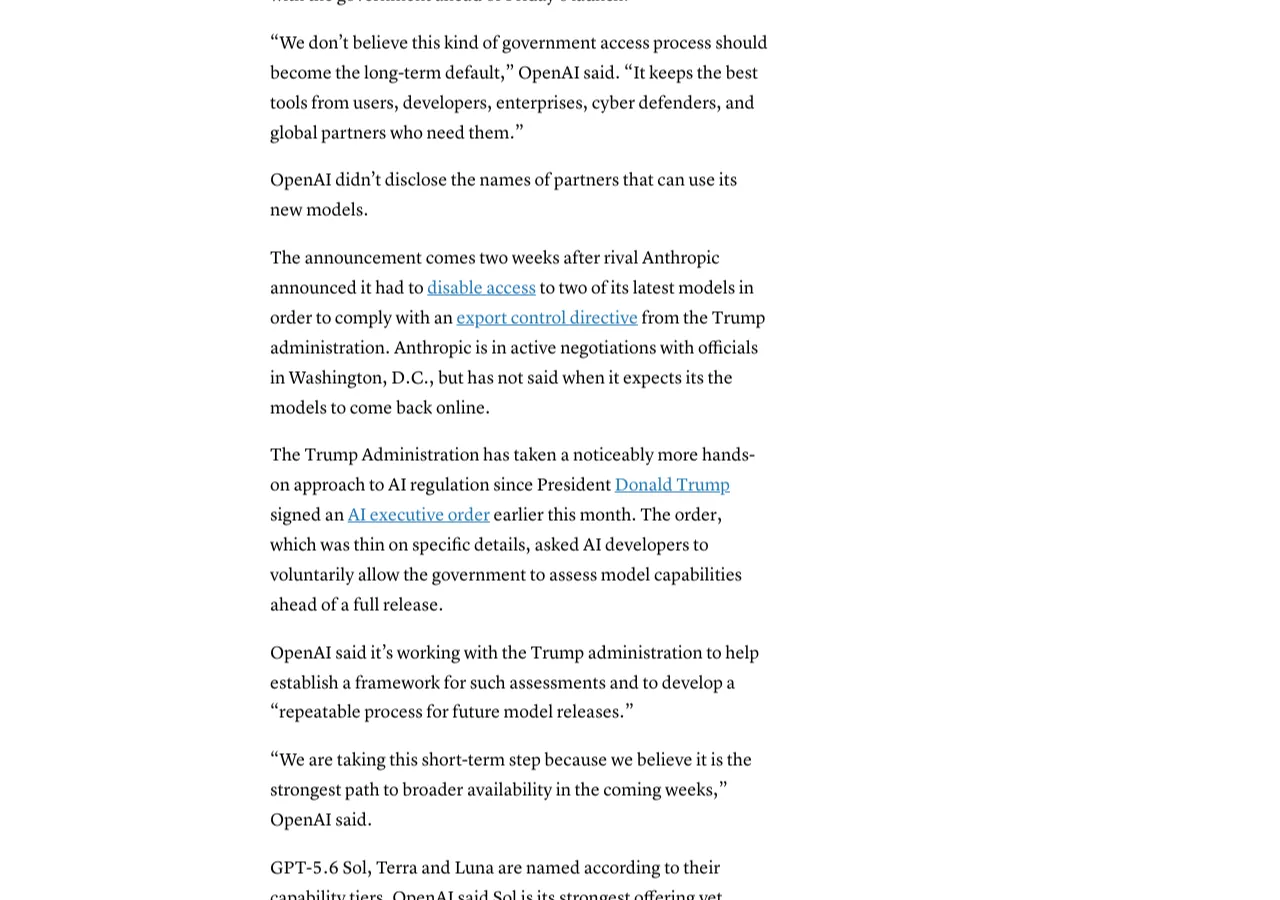
CNBC’s report on the limited preview, published June 26.
What actually shipped: Sol, Terra, Luna
OpenAI structured the GPT-5.6 generation as three durable capability tiers rather than a single monolithic model. The naming convention (Sol, Terra, Luna) suggests these tiers will persist and improve independently. That has pricing implications for builders.
The three tiers
| Model | Role | Input ($/1M tok) | Cached ($/1M tok) | Output ($/1M tok) |
|---|---|---|---|---|
| Sol | Flagship — long-horizon agentic work | $5.00 | $0.50 | $30.00 |
| Terra | Balanced — GPT-5.5 class at half price | $2.50 | $0.25 | $15.00 |
| Luna | Volume — classification, extraction, routing | $1.00 | $0.10 | $6.00 |
Prompt caching gets a solid upgrade: 90% discount on cache reads, with a guaranteed 30-minute minimum retention and explicit breakpoints. That makes agentic session costs more predictable — write once, read cheap for half an hour.
Sol — the headline model
Sol introduces two new reasoning modes:
maxreasoning effort — deeper single-agent reasoning on hard problems. Gives Sol more time to think before it responds.ultramulti-agent mode — natively coordinates sub-agents to split and accelerate long-horizon work. This is the orchestration pattern teams used to hand-build, now baked into the model’s architecture.
| Benchmark | Score | Notes |
|---|---|---|
| Terminal-Bench 2.1 (Sol ultra) | 91.9% | Edges Claude Mythos 5 (~88%) |
| Terminal-Bench 2.1 (Sol standard) | 88.8% | |
| Agent’s Last Exam (code mode) | ~50.9% | First model to clear 50% across 55 domains |
| GeneBench v1 | Beats GPT-5.5 | Uses fewer tokens |
| ExploitBench | Competitive w/ Mythos preview | Roughly 1/3 the output tokens |
The benchmarks are OpenAI-reported. What stands out is how few tokens Sol needs to get there: it matches or edges rivals while using significantly fewer output tokens.
Safety architecture
OpenAI designed Sol’s guardrails differently from Anthropic’s approach with Fable 5. Instead of an external safety filter that routes high-risk topics to an older model, Sol has four hardened layers:
- Model-level refusals trained directly into the weights — no separate filter to bypass
- Real-time classifiers for cyber and bio outputs, capable of pausing and triggering larger model review
- Account-level review — cross-conversation pattern analysis to distinguish persistent misuse from legitimate dual-use work
- Automated red-teaming — 700K+ A100-equivalent GPU hours of universal jailbreak hardening
OpenAI says Sol does not cross the “Cyber Critical” threshold. It’s better at finding and fixing bugs than executing autonomous full-chain exploits. The safety architecture is built to avoid the Fable 5 scenario, where an external filter caused widespread false positives and a government pull order.
The de facto licensing regime
The government request that OpenAI complied with is formally voluntary. Dean Ball, a former White House AI adviser now heading into OpenAI, calls the executive order a “de facto involuntary licensing regime” for frontier AI.
The framework works like this:
- AI developers offer “covered frontier models” to the U.S. government
- The government gets exclusive preview access for up to 30 days
- Then the model goes to “trusted partners” whose identities are shared with authorities
- Public release happens after that, on a timeline the government can influence
Builders feel this directly. OpenAI itself acknowledged the friction in its blog post:
“We don’t believe this kind of government access process should become the long-term default. It keeps the best tools from users, developers, enterprises, cyber defenders, and global partners who need them.”
Ball argues that without clearly defined safety standards, the government’s approach will delay launches, hand China an advantage in the AI race, and jeopardize the billions flowing into AI infrastructure.
Prompt Engineering’s breakdown of GPT-5.6 Sol, covering benchmarks, pricing, regulation concerns, and access limits.
What this means for your stack
| Scenario | Implication | Action |
|---|---|---|
| You need Sol’s agentic capability | You’re waiting. Sol is behind a partner gate. | Explore multi-provider routing via OpenRouter Fusion for fallback |
| You’re on GPT-5.5 and looking to migrate | Terra is your target — same capability at $2.50/$15 per M tokens | Plan migration to Terra once it hits the API |
| You run high-volume classification/routing | Luna at $1/$6 per M tokens is the cheapest frontier-tier option today | Evaluate on your workload before the public API opens |
| You’re worried about API access continuity | This is the second frontier gating in two weeks | Build multi-provider gateways into your architecture |
| You’re outside the US or work with international teams | Partner-gated releases may exclude you by default | Prioritize sovereign, local-first deployments where possible |
Decision framework
- When to use: If you need frontier-tier agentic capability (Sol), a reliable mid-tier workhorse (Terra), or cheap volume throughput (Luna) — the pricing is competitive and the tiered structure simplifies routing decisions.
- When not to use: If your deployment requires guaranteed access for international teams or unrestricted API availability. The gated preview is not a production-ready channel.
- Trade-off: The pricing and efficiency are strong. The access situation is uncertain. Terra and Luna may reach public API faster than Sol.
- Recommendation: Plan your routing architecture around the three tiers, but don’t depend on Sol for production until the public API is confirmed. Build a fallback strategy using OpenRouter or a multi-provider gateway.
- Final takeaway: The GPT-5.6 family is OpenAI’s strongest offering yet, and the tiered pricing is genuinely good for builders. But the regulatory overhang is real — this is the second frontier gating in two weeks.
Related reading
- The Fable 5 Incident: Multi-Agent Jailbreaks and Sovereign Safety — The government pull order precedent that led to this moment
- Multi-Provider AI Gateways: Fallback Routing — Practical architectures for avoiding single-provider dependency
- OpenRouter Fusion: Match Fable 5 on Deep Research at Half the Cost — Alternative access to frontier model capability
- GLM-5.2: Open-Weight 1M Context Model — The open-weight alternative that cannot be remotely revoked
Sources
- OpenAI Blog — Introducing GPT-5.6: Sol, Terra, and Luna
- TechCrunch — OpenAI limits GPT-5.6 rollout after government request
- Reuters — OpenAI defers public rollout of GPT-5.6 as US seeks early access
- CNBC — OpenAI limits new AI models to trusted partners at request of government
- Digital Applied — GPT-5.6 Sol, Terra & Luna: Open AI’s New Model Family Preview Guide
- Trump’s AI executive order (June 2, 2026) — TechCrunch analysis
- Dean Ball — It’s not about Anthropic vs OpenAI anymore
- OpenAI, Broadcom unveil chip for faster, cheaper inference
About the author
Charles Jasthyn De La Cueva is a full-stack developer and the founder of Open TechStack. He writes about AI engineering, developer tools, and practical model evaluation — grounded in real workflows, not press releases.