Why this matters now
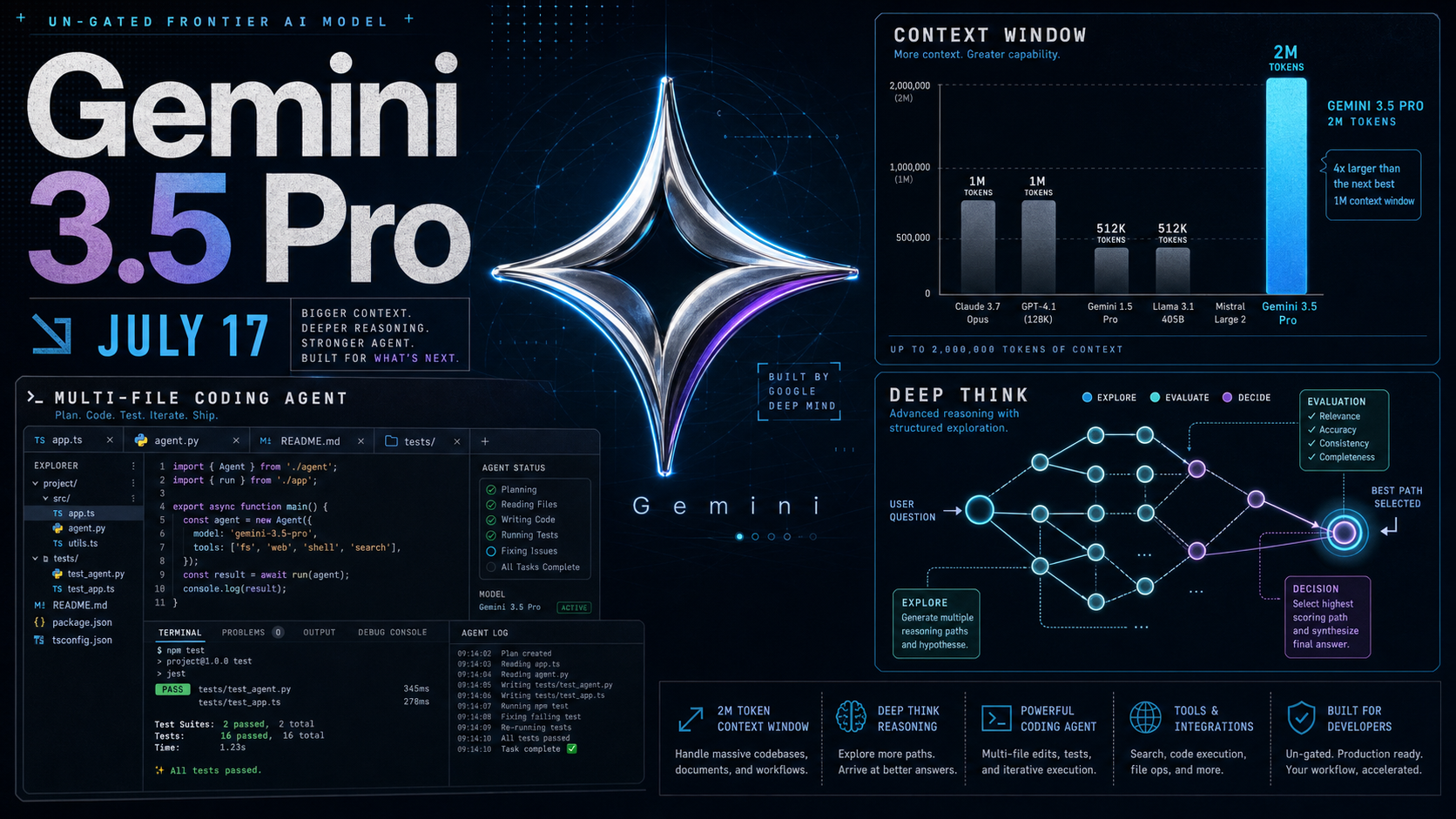
Google is targeting July 17, 2026 for general availability of Gemini 3.5 Pro — the flagship tier of the Gemini 3.5 family that shipped its Flash sibling at I/O back in May. If it lands on schedule, 3.5 Pro becomes the only major frontier model you can sign up for without tripping a government access review. That is a bigger deal than any benchmark number, and it reframes the whole “which model is winning” conversation we’ve been having around GPT-5.6 Sol’s government-gated rollout and Claude Fable 5’s credit-gated launch.
The model slipped from a June target. Sundar Pichai all but admitted the delay on stage at I/O on May 19, telling a restless developer crowd “give us until next month to get it to you” — and that month came and went. Third-party reporting now points to July 17, backed by a rebuild Google reportedly ran from scratch after enterprise testing exposed gaps in math, SVG scene generation, and image quality.
What’s actually confirmed vs what’s leaked
Separate the official from the rumored before you write a single line of integration code. Google confirmed at I/O that a Deep Think reasoning mode exists and that 3.5 Pro was in internal use. Everything else about the Pro tier — the context window, the pricing, the final benchmarks — is third-party reporting that Google has not stamped.
| Claim | Status | Source |
|---|---|---|
| July 17 GA target | Reported, not confirmed by Google | TechTimes, Business Insider |
| 2M-token context window | Leaked, absent from official API docs | Multiple outlets, unconfirmed |
| Deep Think reasoning mode | Confirmed at Google I/O (May 19) | Google official |
| Deep Think gated to Google AI Ultra plan | Confirmed direction | Google official |
| ~$15 input / $60 output per 1M tokens | Estimated from prior Pro pricing | Bind AI, Codersera analysis |
| Stronger agentic / multi-file coding | Confirmed direction | Google I/O positioning |
The two numbers that matter most for builders — the 2M context and the $15/$60 pricing — are the ones Google has not published. Treat them as planning estimates, not contract terms, until the model card drops.
How it stacks up against Sol and Sonnet 5
The availability angle is where 3.5 Pro wins on paper. GPT-5.6 Sol cleared a 13-day government cybersecurity review before public release. Grok 4.5 shipped with EU unavailability. Claude Fable 5 requires credit approval. Gemini 3.5 Pro, by contrast, sits behind no access restriction — its differentiators are reasoning depth and long-context retrieval, not offensive cyber capability, which is the trigger that pulled Sol and Fable 5 into review.
| Feature | Gemini 3.5 Pro | GPT-5.6 Sol | Claude Sonnet 5 |
|---|---|---|---|
| Context window | 2M (reported) | 1.05M | 1M |
| Input price / 1M | ~$15 (est.) | $5 | $2 (intro) |
| Output price / 1M | ~$60 (est.) | $30 | $10 (intro) |
| Government restriction | None | 13-day review cleared | None |
| Extended reasoning | Deep Think (Ultra) | Max reasoning effort | Extended thinking |
| Terminal-Bench 2.1 | TBD at launch | 88.8% (SOTA) | 80.4% |
| SWE-bench Pro | TBD at launch | Not published | 63.2% |
Read that pricing row carefully. At an estimated $60 per million output tokens, 3.5 Pro would run 2x the cost of Sol and 6x the cost of Sonnet 5’s intro rate. The 2M context is the only thing that justifies that spread, and only if long-context recall holds up at distance — a weakness that has bitten other long-context models.
What the 3.5 family already proved with Flash
You do not have to wait for Pro to see Google’s agentic direction. Gemini 3.5 Flash has been GA since May 19 and the benchmark card is public. It beats the older 3.1 Pro on the workloads that look like real work, not the ones that look like trivia contests.
| Benchmark | 3.5 Flash | 3.1 Pro | Delta |
|---|---|---|---|
| Terminal-Bench 2.1 | 76.2% | 70.3% | +5.9 |
| MCP Atlas | 83.6% | 78.2% | +5.4 |
| Finance Agent v2 | 57.9% | 43.0% | +14.9 |
| GDPval-AA (Elo) | 1656 | 1314 | +342 |
| Humanity’s Last Exam | 40.2% | 44.4% | -4.2 |
| ARC-AGI-2 | 72.1% | 77.1% | -5.0 |
All scores self-reported by Google. The pattern: Flash trades dense parametric knowledge for agentic execution. It loses on Humanity’s Last Exam and ARC-AGI-2 but wins on tool use, finance agents, and economic-value tasks. If Pro extends that curve upward while keeping the 2M window, it becomes the default for long-horizon agent builds — the exact use case we tracked in our enterprise agent benchmark roundup.
Decision framework
Use 3.5 Flash now if your workload is a multi-step agent that plans, calls tools, and finishes a real task. It is GA, cheap relative to its class ($1.50/$9 per 1M), and already ahead of 3.1 Pro on agentic suites.
Wait for 3.5 Pro if you need a verified 2M-token window for retrieval over entire codebases or document sets, and you can absorb a likely premium price. Hold judgment until Google publishes the model card and SWE-bench Pro numbers.
Trade-off: Pro almost certainly costs more per token than Sol or Sonnet 5. You are paying for context length and reasoning depth, not raw benchmark leadership — Sol still leads Terminal-Bench at 88.8%.
Bottom line: The differentiator is availability, not capability. A frontier model you can actually use today beats a benchmark leader stuck in review. That is the story of this launch.
Related reading
- GPT-5.6 Sol’s government-gated rollout — what the 13-day review means
- The Fable 5 incident: multi-agent jailbreaks and sovereign safety
- Enterprise AI agent benchmarks 2026: what the suites actually measure
- Gemini Spark ships to macOS with real-time connected apps
Sources
- Google The Keyword — Gemini 3.5: frontier intelligence with action
- Google AI for Developers — What’s new in Gemini 3.5 Flash
- TechTimes — Gemini 3.5 Pro targets July 17 after full rebuild
- AIToolsRecap — Gemini 3.5 Pro targets July 17: 2M context, Deep Think, unrestricted availability
- LLM Stats — Gemini 3.5 Flash: benchmarks, pricing, and complete specs
- Enterprise DNA — Gemini 3.5 Pro July 17 rebuild vs DeepSeek V4
Written by the open-techstack editorial team. We cover model releases, agent benchmarks, and the infrastructure decisions builders actually face. Opinions are our own; vendor benchmark figures are self-reported unless noted.
About the author
Charles Jasthyn De La Cueva is a full-stack developer and the founder of Open TechStack. He writes about AI engineering, developer tools, and practical model evaluation — grounded in real workflows, not press releases.