Why this matters now
For three years the AI agent story has been sold on leaderboards. SWE-bench scores, MMLU lines, demo videos of an agent booking a flight. None of that tells you whether an agent survives your Slack, your Salesforce instance, your permission boundaries, and your 14-year-old spreadsheet of policy terms. That gap is exactly why most enterprise AI deployments stall before they scale.
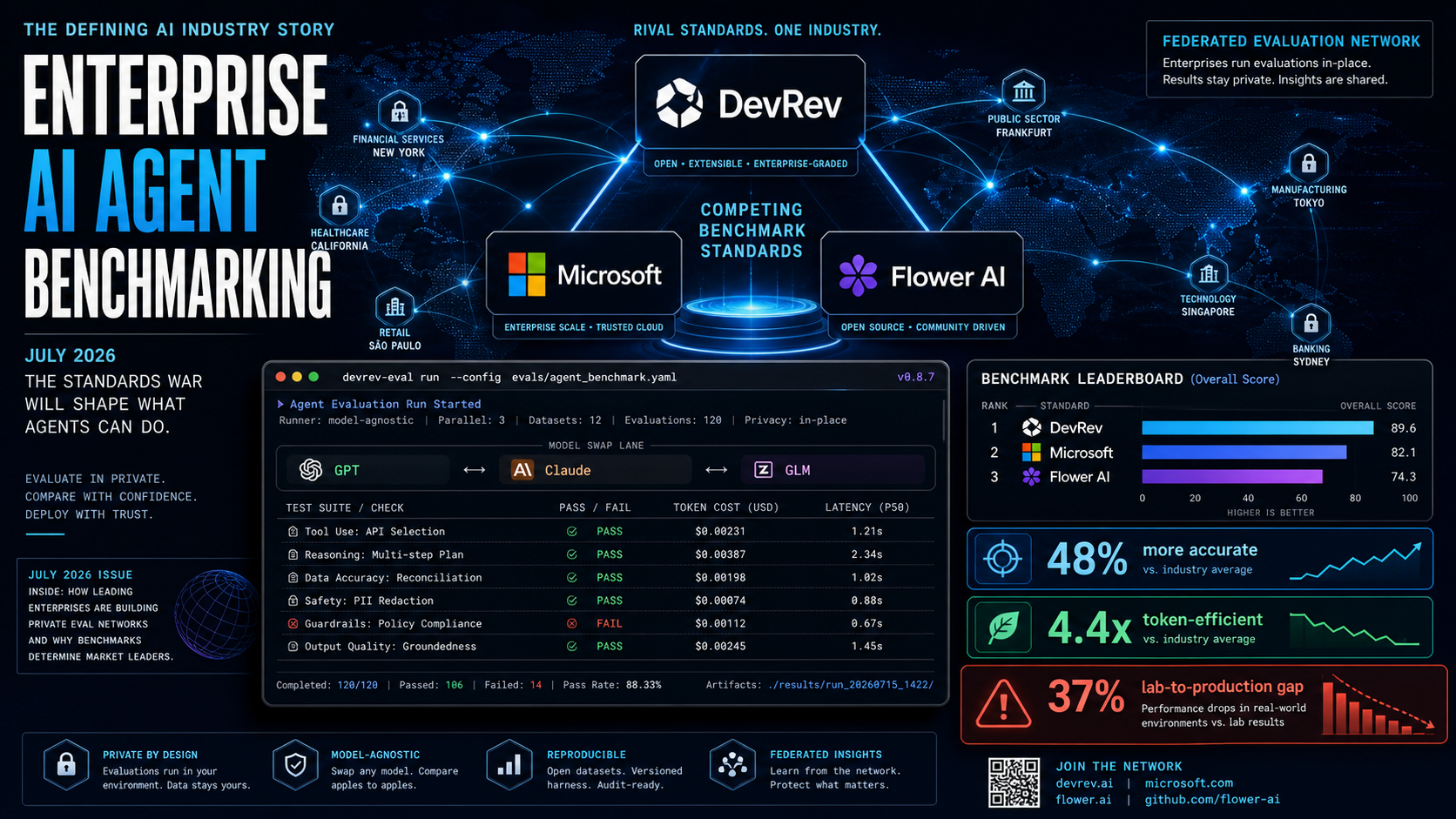
In a single July 2026 week, three independent efforts tried to close that gap. DevRev shipped Enterprise-Bench, an open vendor-neutral benchmark for production enterprise agents. Flower AI opened FlowerBench, a federated benchmark that runs evaluation inside your own environment. And Microsoft’s Satya Nadella published an essay arguing the real answer is private evals you own inside a trust boundary. Different shapes, same realization: the model leaderboard was never the thing that mattered for enterprise work. If you are wiring agents into production, this is the week the measurement conversation got serious. Our multi-provider AI gateway guide covers the routing layer this all sits on top of.
The timing is not random. McKinsey’s 2025 State of AI survey, cited in DevRev’s release, found nearly two-thirds of organizations have not begun scaling AI across the enterprise, and in any given function no more than 10% are scaling AI agents. The models are ready. The measurement of whether they actually work in your mess is not.
The three approaches, side by side
All three target the same failure: public benchmarks test clean, binary, consumer-style tasks. Enterprise work is fragmented data, siloed systems, and permission boundaries. Here is how the new entrants differ.
| Axis | Enterprise-Bench (DevRev) | FlowerBench (Flower AI) | Private evals (Microsoft thesis) |
|---|---|---|---|
| Openness | Fully public dataset, harness, traces | Public framework, private task data | Private by design |
| Where data lives | Centralized public dataset | In-place at each org | In your tenant |
| What it measures | Org complexity: fragmented data, siloed systems, permission boundaries | Real workflow completion across finance, healthcare, insurance, ops, legal | Your own golden tasks + accountability |
| Who runs it | Any vendor or researcher, public leaderboard | Organizations in the Flower Network | You, on your own harness |
| Maturity | L1-L2 live, L3-L4 planned | Pilot findings published | Methodology, not a product |
The throughline: stop trusting a single vendor’s demo. Measure agents against the chaos they will actually face.
Enterprise-Bench: the TPC play for AI
DevRev is explicit about the analogy. In the early 1990s, database vendors made competing performance claims with no neutral basis to compare them. The Transaction Processing Performance Council (TPC) introduced common, auditable standards and shifted the conversation from marketing to evidence. DevRev argues enterprise AI has reached that same inflection point.
Enterprise-Bench was built with the Laude Institute, whose Harbor harness ran the evaluation, and validated by UC Berkeley professor Alexandros Dimakis. The full dataset, methodology, results, and traces are public. Any vendor, customer, or researcher can run it and submit to the leaderboard.
The benchmark progresses like autonomous-driving levels. L1-L2 spans factual retrieval and complex multi-source queries and is the first release; L3-L4 (strategic orchestration and autonomous operation) are planned for later this year and into next. It scores on three axes most benchmarks ignore:
- Precision — correct answer, verifiable source, auditable path.
- Efficiency — does cost scale with question complexity or data volume.
- Safety — permission boundaries respected, every action traceable.
The headline result is where you should put on your skeptic hat. On identical L1-L2 tasks, using the same data, the same model, and the same independent LLM judge, DevRev’s own product Computer was 48% more accurate and 4.4x more token-efficient than Claude Code. That is a DevRev product beating a competitor on a DevRev-published benchmark. Treat it as a self-reported claim, not independent proof. What it does show is that architecture and data-retrieval design move the needle as much as raw model capability. The methodology is the contribution; the leaderboard placement is marketing until other labs submit.
FlowerBench: evaluate where the work lives
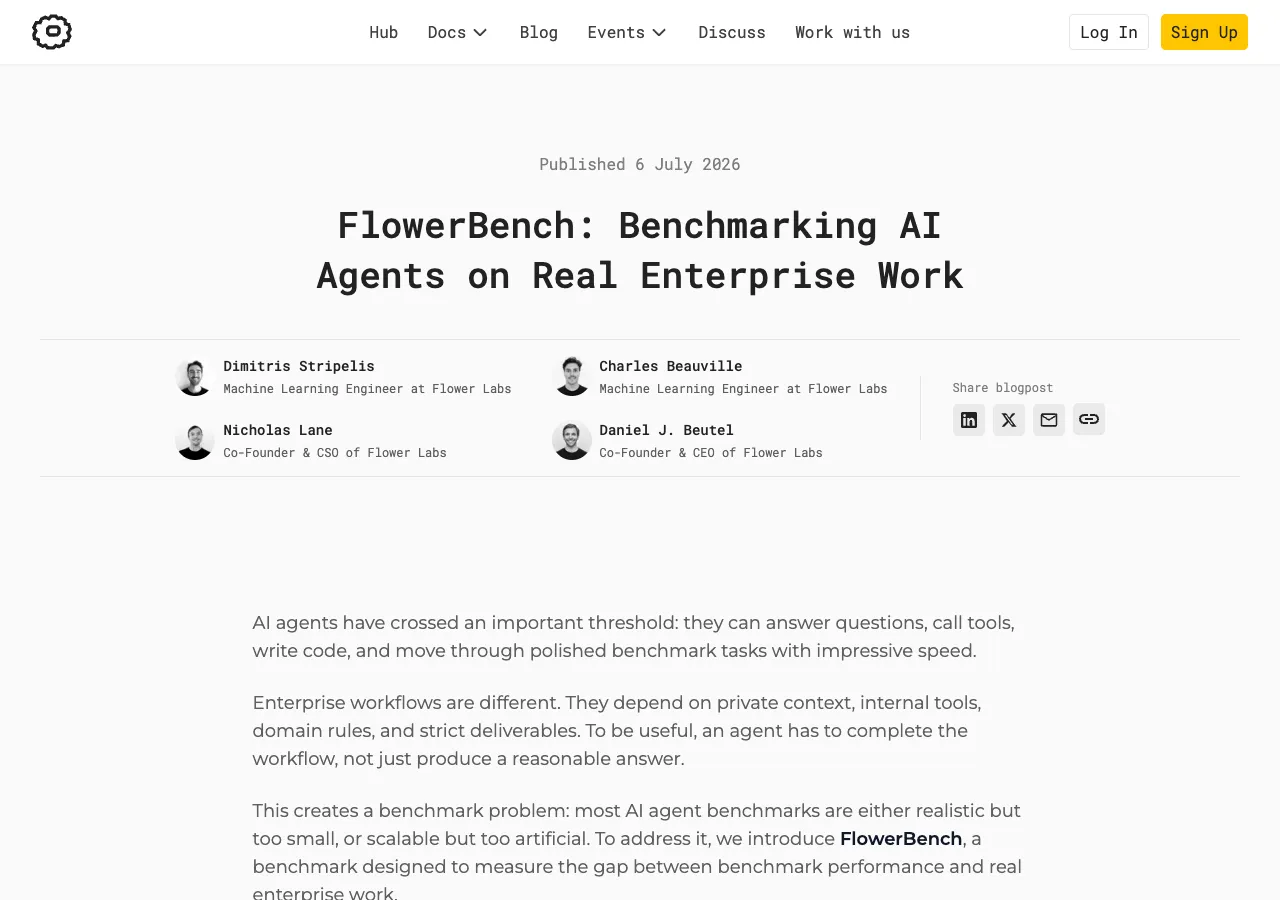
FlowerBench attacks the problem from the privacy side. The most realistic enterprise tasks are locked inside organizations behind proprietary data and internal systems too sensitive to centralize into a public benchmark. So instead of asking enterprises to upload work, FlowerBench runs the evaluation where the work already lives. Same principle as Flower itself: move computation to the data, not data to computation.
The Flower Enterprise Evaluation Network is a privacy-preserving, opt-in layer that connects private task environments from different organizations into a shared evaluation network. Each org keeps proprietary work in its own environment; only sanitized results surface to the network. A sample insurance task requires an agent to extract policy terms, cleanse a statement of values, run a rating model, generate quote tables, and finalize a quote report that passes strict verifier checks. The benchmark reports not just a score but how many intermediate artifacts the agent produced correctly, how long it took, how many tokens it used, and what the run cost.
The early pilot finding is the useful one for builders: higher-scoring agents are not always the fastest or cheapest. Quality and cost separate. If you are buying agent capacity, that trade-off is the entire procurement conversation, and public leaderboards hide it. For teams already building internal agent routing, our open-source multi-provider routing walkthrough shows how to make that trade-off adjustable per task.
Nadella’s case: own your evals
Microsoft’s angle is the most adversarial to the public-leaderboard model. Nadella frames what he calls the Reverse Information Paradox: intelligence exhaust compounds for vendors, not customers. Every correction, every edge case, every human fix becomes training signal for the model provider. His prescription is direct — create your private evals, because evals define what “good” looks like inside your organization.
The number to remember is roughly a 37% lab-to-production gap. Public benchmark scores under-predict messy enterprise reality by a wide margin. A model that nails SWE-bench can still fall over on your incident triage because the public task is wrong, the harness is wrong, and the data is clean. explainx.ai’s breakdown of the Nadella essay puts it plainly: public benchmarks tell you who wins marketing, not who wins your workflows.
The builder takeaway is architectural. Run the same golden task set across GPT, Claude, and an open-weights model inside a trust boundary, with your own harness, your own tools, and your own scoring. Keep traces in your object store. Version the harness. Feed failures back as new regression cases. That loop is the moat, not the model API you rent this quarter. Our July 2026 model cost comparison is the input data for that kind of per-lane cost math.
Decision framework
Use Enterprise-Bench if you want a neutral, auditable bar to pressure-test a vendor claim or to publish your own results against a shared standard.
Use FlowerBench if your blockers are data privacy and regulatory exposure — you cannot ship proprietary tasks to a public dataset but still want comparable scores across the industry.
Use private evals if you are past the evaluation phase and into procurement, regression testing, and compound learning. This is the operating system, not the R&D signal.
Wait if you have not chartered a single high-stakes workflow yet. None of these help until you know which loop you are actually measuring. Start with one: incident triage, KYC review, or internal API migration.
Trade-off. Public benchmarks give you comparability and community signal but leak your particular knowledge and risk vendor-optimized harnesses. Private evals give you control and compounding learning but cost real engineering headcount and never show up on a public leaderboard.
Bottom line. Stop screening agents on SWE-bench. Pick the eval shape that matches your constraint — openness, privacy, or control — and measure the gap between the demo and your production reality before you sign the contract. For multi-model setups, our OpenRouter fusion writeup covers the API layer that makes model-agnostic eval runs practical.
Related reading
- Multi-provider AI gateways: fallback and routing — the routing layer enterprise agent evaluation sits on top of.
- Agent model cost comparison, July 2026 — per-lane cost data for model-agnostic eval runs.
- AI supply chain security and model provenance — why traceability and permission boundaries matter in eval design.
- The Fable 5 incident: multi-agent jailbreaks and sovereign safety — what happens when permission boundaries are not enforced.
Sources
- GlobeNewswire — New Open Benchmark Creates Global Standard for Evaluating Enterprise AI. DevRev Tops the Leaderboard
- Flower AI — FlowerBench: Benchmarking AI Agents on Real Enterprise Work
- explainx.ai — How to Build Your Own Enterprise AI Benchmark After Nadella’s Paradox
- McKinsey & Company — The State of AI 2025
- explainx.ai — Satya Nadella’s Reverse Information Paradox
Written by the open-techstack editorial team. We cover the infrastructure, models, and evaluation practices that actually ship — not the leaderboard theater.
About the author
Charles Jasthyn De La Cueva is a full-stack developer and the founder of Open TechStack. He writes about AI engineering, developer tools, and practical model evaluation — grounded in real workflows, not press releases.