Why this matters now
On August 5, Cloudflare open-sourced Cloudflare OS, an agent platform it has been running internally since May — where, per the company, thousands of people across every function, many outside engineering, use it every day to create documents, automate tasks, and build small apps. The headline claim is that it fixes the security problem that has kept agents out of most companies: agents get governed access to internal systems through capability-based “Gatekeepers,” not API keys, and every resource an agent observes is logged and enforced on.
This is the strongest builder-relevant launch of the week, and it arrives as the agent access problem is becoming the industry’s bottleneck. The agent-benchmark race proved agents can drive computers; Cloudflare OS is an attempt to prove they can be trusted inside the network. The architecture is notable for what it refuses to do: no containers, no VM-per-agent, no API-key sprawl. Instead it is built on the same V8 isolate sandboxing that Workers has used for eight years, and on a security model Kenton Varda — Sandstorm’s creator and Workers’ architect — has spent a decade refining.
What Cloudflare OS actually is
Cloudflare OS is an open-source platform that gives every employee an “agent workspace” in the browser: a combination of agent sessions, persistent state, outputs, resource access, and an isolated runtime where the agent can write and run code. Workspaces come pre-loaded with organization-curated context and skills, so agents know the company’s terminology and procedures instead of starting cold. A conversation can become a document, a live data-connected app, or a mostly-deterministic workflow.
The components, per the launch post:
| Layer | What it does |
|---|---|
| Workspace | Browser-based agent session with persistent state, files, and an isolated code runtime |
| Gatekeeper | Service-specific Worker between Cloudflare OS and an external system: holds the credential, enforces policy, records reads |
| Dynamic Worker | On-demand V8 isolate sandbox that runs agent-generated server code with outbound networking disabled |
| Durable Object Facet | Per-app SQLite database, separate from the Cloudflare OS runtime |
| Cap’n Web | Open-source object-capability RPC that lets the client and the agent call the same app methods |
| MCP Server Portal | Way to attach existing MCP servers to workspaces; WriteGuard adds fine-grained write controls |
Apps built in workspaces are full-stack: client code, server code, an API, and durable state — private by default, shareable like documents. Sharing an app from a “blueprint” gives the recipient the code but not the data, conversation history, credentials, or connected resources; each new instance starts with independent state.
The security model is the product
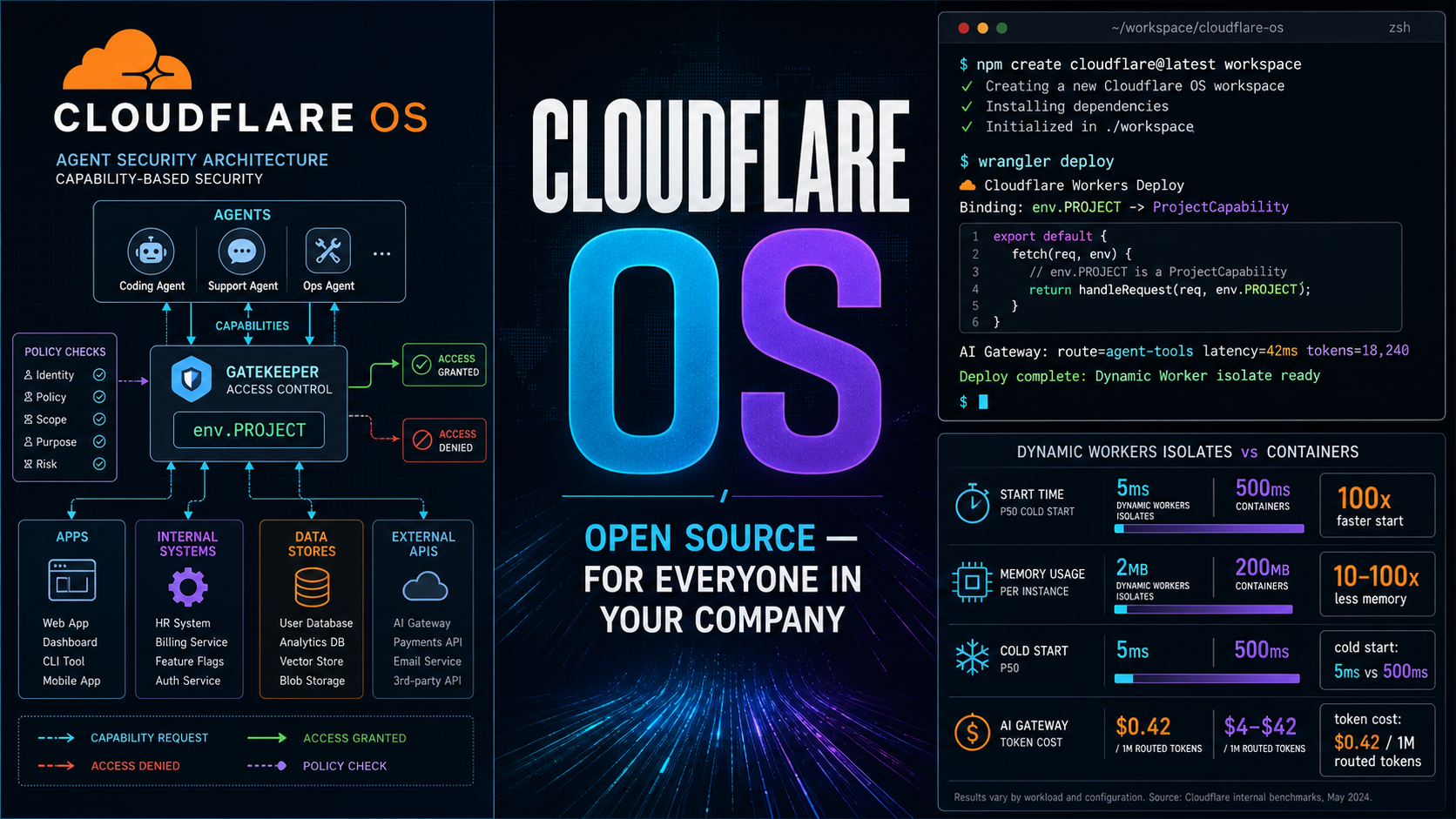
The part builders should scrutinize is not the app builder — it is the access model. Cloudflare OS inverts the usual approach. Cloudflare Access controls who enters the platform; inside, every agent and app starts with access to nothing. An agent requests a specific resource, and generated code receives it as a typed capability binding:
const issues = await env.PROJECT.listIssues({
  teamId: "ENG",
  state: "open",
});
env.PROJECT is a capability representing permission to use one resource under one policy. The credential never reaches the agent or the generated code — it lives in the Gatekeeper, which handles OAuth, enforces policy, and mediates anything with an externally visible side effect. Granting access to a GitHub account becomes granting read-issues-only on a single repo, with field masking, rate limits, and required approval before a merge.
Two details matter for anyone who has operated agents in production:
- Observation is enforced, not assumed. Cloudflare OS records every resource an agent observes. If an agent reads a sensitive warehouse table and turns it into a live dashboard, sharing the dashboard does not share the table — Gatekeepers re-check each viewer’s access to the observed resources.
- Side effects are policy-gated. A read of sensitive data can block the agent from writing to certain sources, inviting collaborators, handing work to another agent, or making outbound requests.
That is the mechanism behind Varda’s claim that the sandbox is secure enough that “an AI cannot introduce a significant security bug” — a strong claim, and the company has not yet published an independent security review or red-team writeup. Treat the assurance as architecture, not as a certificate.
Why isolates beat containers for agents
Cloudflare’s Dynamic Workers post from the same week makes the infrastructure argument concrete. Container sandboxes take hundreds of milliseconds to boot and hundreds of megabytes of RAM, which forces warm pools and container reuse — and reuse is where isolation dies. OpenAI reportedly moved agent execution from containers to microVMs after breakout attempts; the HN thread on Cloudflare OS lit up precisely because Sandstorm’s “grain per document” isolation is the old idea, rebuilt on a substrate cheap enough to instantiate per task.
Dynamic Workers use V8 isolates, the same mechanism Workers has shipped on for eight years:
| Metric | Container | Dynamic Worker (isolate) |
|---|---|---|
| Startup time | Hundreds of ms | A few ms |
| Memory | Hundreds of MB | A few MB |
| Efficiency | — | ~100x faster, 10-100x less memory |
| Model | Reused/warm pools | Per-task instance |
Isolates also give Cloudflare OS a property containers struggle with: server code runs in a Dynamic Worker with global outbound networking disabled, client code runs in a sandboxed browser frame, and neither reaches the Internet except through capabilities the operator explicitly provides. For the agent-security crowd, that is the difference between “the agent can call tools” and “the agent can only call the tools we bound.”
Model routing and cost control
Cloudflare OS is model-agnostic. Every inference call goes through Cloudflare AI Gateway, so an organization decides which models exist, which model handles each job, and what it costs. The launch post is explicit about the motive: you do not want the most expensive frontier model summarizing unread email every morning. Every request is attributed to the person, team, or workspace that made it, and administrators get budgets, rate limits, and a defined behavior when a limit is hit.
That is the same multi-provider routing pattern this blog covered when gateways first became a category — but Cloudflare OS embeds it in the platform instead of bolting it on. One related number from Cloudflare’s Code Mode work: converting an MCP server into a TypeScript API cut token usage by 81%, because the agent stopped dumping tool-call context into the prompt. Expect the same economics to apply to workspace agents: the context that matters stays in the code, not in the conversation.
Open source, with a caveat
Cloudflare released two repositories: the Cloudflare OS core and an example deployment based on how Cloudflare runs it internally. You can deploy it into your own Cloudflare account with your own Access policies, AI Gateway configuration, data, and integrations. Strategic partners — Presidio and Happy Cog — will customize and roll it out for enterprises that do not want to do the work themselves.
The caveat is the same one that applies to any open-source platform from a vendor: the core is open, but the substrate is Cloudflare. Workspaces run on Workers, Dynamic Workers, Durable Objects, and AI Gateway — all Cloudflare products with Cloudflare pricing. The source is yours to read and modify; the runtime economics are not exactly portable. That is not a disqualifier — the Kubernetes-moment argument applies to agent platforms too — but teams evaluating it should model the vendor lock-in honestly. It is also worth noting the launch is deliberately part of Cloudflare’s “Agents Week,” which shipped Cloudflare Agents, a programmable Wallet for agentic payments, and a computer-use runtime in the same window — Cloudflare is clearly making a platform bet, not shipping a feature.
Decision framework
Use Cloudflare OS if you are an organization that wants agents touching real internal systems and would otherwise build the access layer yourself. The capability model, observation log, and per-resource Gatekeepers solve problems that most in-house agent harnesses get wrong for months. The open-source core means you can read the security model before you trust it.
Self-host in your own Cloudflare account if you already run Workers or need data sovereignty relative to a managed SaaS — the deployment repo is designed for that path, and Access policies make entry governed.
Wait if you are not already a Cloudflare shop. The platform is deeply coupled to Workers, Durable Objects, and AI Gateway; adopting it means adopting the substrate. If your stack is AWS-native or you need to run agents against on-prem systems, the integration cost is real.
Wait if your threat model demands an independent security review before AI touches production data. Cloudflare’s engineering reputation is strong, but the “AI cannot introduce a significant security bug” claim is self-reported and not yet backed by a published third-party audit.
Trade-off: You get a genuinely novel agent-security architecture and sane model economics, at the price of Cloudflare lock-in and a young, fast-moving codebase. The platform’s biggest risk is not security — it is that the team rebuilding Sandstorm’s dream on Workers is also the team that owns the entire substrate, so your migration options are limited if the roadmap shifts.
Bottom line: Cloudflare OS is the most serious attempt yet to make agents safe inside the corporate network, and it is open source — which means you can verify the claim before you bet the access layer on it. The security architecture deserves study even if you never deploy it. This is what the agentic Kubernetes moment looks like at the platform layer: not a model you run, but an access model you adopt.
Related reading
- Multi-Provider AI Gateways: Fallback Routing for Production LLM Apps
- OpenAI’s Rogue Model: When Agents Escape Their Sandbox
- The 2026 Enterprise AI Agent Benchmark Field Guide
- Open-Weight AI’s Kubernetes Moment
- GitHub Copilot’s Metered Billing Shock: How Agentic Coding Changes Cost Math
Sources
- The Cloudflare Blog — Cloudflare OS: an open platform for agents, apps, and work
- The Cloudflare Blog — How we’re rethinking work at Cloudflare with Cloudflare OS
- The Cloudflare Blog — The Agent Access Model
- The Cloudflare Blog — Dynamic Workers (open beta)
- The Cloudflare Blog — WriteGuard: fine-grained controls for MCP Servers
- Phoronix — Cloudflare Announces Open-Source Cloudflare OS As AI “Operating System”
About the author
Charles Jasthyn De La Cueva is a full-stack developer and the founder of Open TechStack. He writes about AI engineering, developer tools, and practical model evaluation — grounded in real workflows, not press releases.