Why this matters now
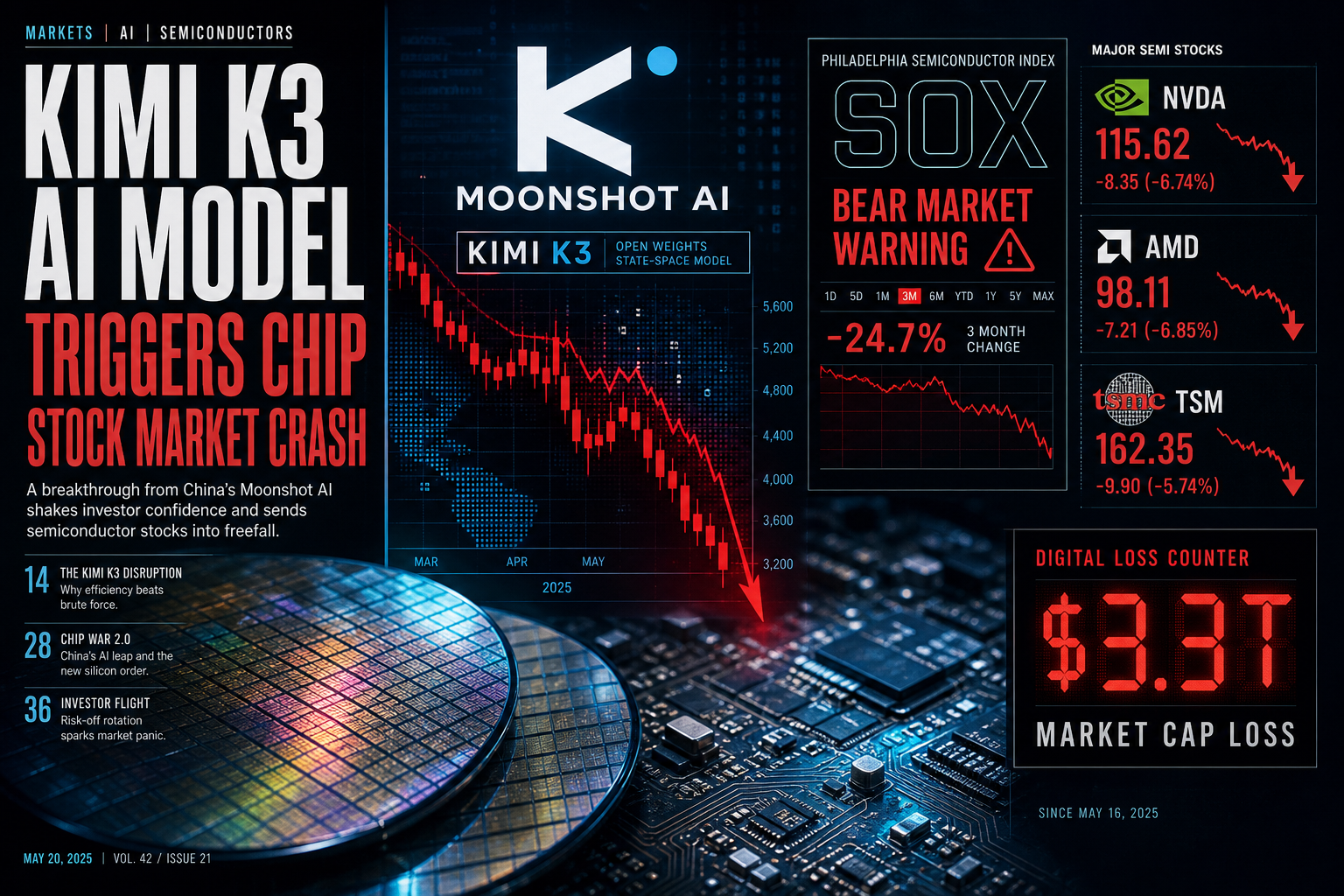
The week of July 13–17, 2026, will be remembered as the moment the AI investment thesis hit the wall. Moonshot AI’s Kimi K3 — a 2.8 trillion-parameter open-weight model — triggered the worst semiconductor selloff since the DeepSeek shock of January 2025, wiping approximately $3.3 trillion in market value from global chip stocks. The Philadelphia Semiconductor Index (SOX) plunged into bear market territory, falling more than 20% from its late-June peak.
K3 is not the sole cause — the selloff had been building for weeks on Meta Compute fears, Intel’s 18A delays, and rate-hike jitters. But K3 was the trigger that broke the market’s back, and it reopened a question investors thought they’d settled: can US frontier labs keep charging premium prices for AI models?
We covered Kimi K3’s technical specs, pricing, and benchmark performance in our earlier review. This piece focuses on the market earthquake and what it means for AI infrastructure investing from here.
What happened: the numbers
The scale of the July 17 selloff demands hard numbers, not vibes. Here is the damage across the major benchmarks and names:
| Metric | Move | Context |
|---|---|---|
| SOX Index | -10% for the week | Steepest weekly drop since April 2025; entered bear market (>20% from June peak) |
| Nasdaq Composite | -2.8% for the week | Worst week since Iran war lows in March |
| S&P 500 | -1.5% for the week | Led lower by tech; Dow fell 406 pts on Friday alone |
| Global semi market cap | -$3.3T | Wiped since June 22, per Yahoo Finance data |
| SOXX ETF | -18%+ in July | On track for worst month since November 2008 |
| TSMC | -3% (Fri) | Fell despite beating earnings and raising 2026 guidance |
| Nvidia | -1.4% (Fri) | Lost world’s most valuable company title to Apple |
| AMD | -1%+ (Fri) | ~$800B market cap, down 7-8% over prior sessions |
| Applied Materials | -4.6% (Fri) | One of the hardest-hit names |
| Intel | -21% over 7 sessions | 18A yield delays + AMD overtakes in data-center revenue |
| Seagate / Micron | +3-4% (Fri) | Memory makers bucked the trend; Micron up 209% YTD |
The selloff was global. South Korea’s KOSPI index plunged nearly 10% intraday, triggering circuit breakers, as Samsung Electronics and SK Hynix each slid 9-12% — despite Samsung reporting an 1,800% year-over-year profit surge. When a company posting ¥89.4 trillion won in operating profit gets sold off, the market is signaling something deeper than earnings disappointment.
Why Kimi K3 was the trigger, not the cause
The semiconductor selloff didn’t start on July 17. Multiple pressures had been building through early July:
Meta Compute (July 1). Reports that Meta plans to sell surplus AI inference and training capacity as a cloud service — Meta Compute — fundamentally challenged the perpetual GPU scarcity thesis. Meta’s stock surged 8.8% while every major chip supplier fell. If hyperscalers have enough excess capacity to become sellers, the supply-demand equation for AI hardware is shifting.
Intel’s 18A delay. Intel’s most advanced foundry process won’t reach profitable yields until late 2026 or 2027. The stock, up ~270% YTD entering July, compressed violently as the perfect-execution thesis cracked. AMD posted $8.8B in data-center revenue against Intel’s $7.1B — the first time AMD has led in that segment.
Rate hike fears. Futures markets in mid-July priced ~52% odds of a September rate hike, per the CME FedWatch Tool. Higher rates make the enormous borrowing required for AI infrastructure more expensive, compressing forward multiples on capital-intensive chip stocks.
Kimi K3 entered this environment as the final straw. Its $3/$15 per million tokens pricing — comparable to GPT-5.6 Terra and above Claude Sonnet 5 — landed in a market already questioning whether AI infrastructure spending would ever pay off. The model’s pricing isn’t the bargain some expected: it costs 50-70% more to run per task than GPT-5.6 once its always-on max-reasoning token burn is factored in, according to Gavin Baker of Atreides Management.
The bear case that won’t go away
Three structural questions now hang over the AI chip complex:
1. Compute surplus. If open-weight models like K3 deliver frontier-level performance at competitive prices, the thesis that only the most expensive proprietary models justify the infrastructure buildout weakens. Enterprises gain a credible self-hostable alternative. The moat around premium model pricing — the foundation of OpenAI’s rumored $300B+ valuation and Anthropic’s confidential IPO filing — narrows.
2. Capex ROI timeline. The gap between AI infrastructure spending ($300B+ industry-wide in 2026) and measurable enterprise revenue from AI remains wide. ABC News and others quoted analysts calling this a “resetting of frothy momentum,” not a verdict on AI itself. But the market is now demanding evidence of returns, not promises.
3. China competition velocity. The DeepSeek shock of January 2025 was dismissed by some as a one-off. Kimi K3, arriving 18 months later, shows Chinese labs are iterating faster than the market assumed. David Sacks, former White House AI czar, called K3’s performance “concerning” on X, warning “this is how you lose the AI race.” Whether or not you share his alarm, the trend line is unmistakable: the gap between US and Chinese frontier models is compressing.
The bull case: perspective
Not everyone is panicking. The same data that spooked traders also supports a more measured read:
- Most chip stocks are still up YTD. Nvidia has grown 10% in 2026. Micron has soared 209%. Sandisk has climbed 506%. A 10-20% pullback after a 130% SOX rally over 12 months is normal profit-taking, not a structural collapse.
- Memory makers rallied on Friday. Micron, Seagate, and Sandisk climbed 3-4% even as the broader semi index fell, suggesting the market is rotating within the sector rather than abandoning it.
- K3’s full weights don’t ship until July 27. Until independent researchers can inspect, modify, and test the model, its real-world capabilities remain unverified. Early benchmarks are encouraging but inconsistent — a single-day’s leaderboard position isn’t a durable verdict.
- Gavin Baker’s measured take. Instead of panic, Baker argued K3 is an “inflection point” that squeezes closed-model margins while benefiting the chipmakers, cloud providers, and application companies built on top of them. The model layer loses pricing power; the infrastructure layer gets more demand, not less.
Decision framework
If you’re a developer evaluating K3: The API is live and worth testing for long-horizon coding tasks, especially frontend work where K3 leads Arena’s leaderboard. But watch your token burn — the always-on max reasoning setting means your effective cost per task is higher than the headline $3/$15 suggests. Our Kimi K3 review has the full technical breakdown.
If you’re an investor in AI infrastructure: The rotation out of extended momentum names is painful but historically normal for a cycle this stretched. The question isn’t whether AI matters — it’s whether the companies building it can price their products sustainably. Watch the July 27 K3 open-weights release as the next catalyst. If independent hosting providers serve K3 profitably at lower costs, the pricing pressure on proprietary frontier models intensifies.
Trade-off: Open-weight models create more total AI consumption (good for chip demand) but compress margins for proprietary model providers (bad for OpenAI/Anthropic valuation narratives). The net effect on chip stocks depends on which force wins — volume or margin compression. Baker’s bet is on volume.
Bottom line: The Kimi K3 selloff is a correction, not a collapse. But it’s the second major “China AI shock” in 18 months. If a third one hits, the market will stop calling them shocks and start calling them a pattern.
Related reading
- Kimi K3: Moonshot’s 2.8T Open-Weight Model Shakes Up the AI Race — full technical review
- The AI Model Price War Heats Up: July 2026 Pricing Comparison — market-wide pricing analysis
- Enterprise AI Agent Benchmarks 2026: Which Models Deliver Real Results — performance across model tiers
- Multi-Provider AI Gateways: Smart Fallback Routing for Production — infrastructure strategy for the multi-model world
Sources
- WSJ — China’s Moonshot AI Adds More Fuel to Wall Street’s Chip Selloff
- Barron’s — Stock Market News July 17, 2026: Nasdaq Slides as Tech Selloff Deepens
- GovInfoSecurity — China’s Kimi K3 Triggers Chip Stocks Into Bear Market
- NYT — Stocks Sink on Anxiety About Tech and A.I. Spending
- ABC News — What to Know About the AI Chip Stock Selloff
- Reuters — Hedge Funds Dumped Chip Stocks for a Fourth Week
- Yahoo Finance — Semiconductor Stocks Trim Losses as Investors Buy the Dip
Open TechStack is an independent publication covering AI models, tools, and industry economics. Our analysis reflects independent research and should not be construed as investment advice. Vendor performance claims are self-reported unless independently verified.
About the author
Charles Jasthyn De La Cueva is a full-stack developer and the founder of Open TechStack. He writes about AI engineering, developer tools, and practical model evaluation — grounded in real workflows, not press releases.