
Why this matters now
South Korea’s SK Hynix priced its American Depositary Receipts at $149 on Thursday, July 9, and started trading on Nasdaq the next morning — raising roughly $26.5 billion in the largest first-time US share sale ever by a foreign company. For AI builders, this isn’t a finance-side story. SK Hynix is the lead supplier of high-bandwidth memory (HBM) to NVIDIA, and HBM is the component that decides how many AI GPUs actually ship and what they cost. If you track agent model costs, the memory supply behind those GPUs belongs on the same board.
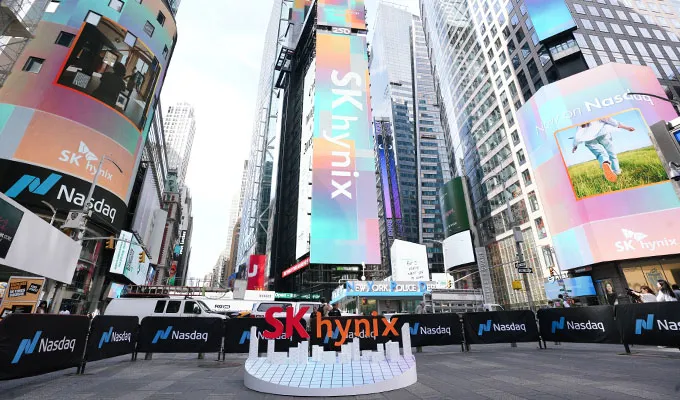
The listing topped Alibaba’s $25 billion US debut from 2014 and ranks second only to SpaceX’s $75 billion offering in June 2026 among all US stock sales on record. Demand ran more than seven times the shares on offer. The ADRs opened around $170 on Friday — about 14% above the offer price — a clean signal that public markets still want direct exposure to the AI memory boom even after a rough few weeks for chip stocks.
The numbers
| Metric | Value |
|---|---|
| ADR offer price | $149 per share |
| ADRs sold | 177.9 million |
| Total raised | ~$26.5 billion |
| Oversubscription | >7x the available shares |
| US listing rank (foreign) | #1 — largest ever |
| US listing rank (all-time) | #2 — behind SpaceX’s $75B (Jun 2026) |
| Prior record (foreign) | Alibaba $25B (2014) |
| First trade open | ~$170 (+14% vs offer) |
SK Hynix was already a public company in Seoul (000660.KS); the Nasdaq line is an ADR representing the Korean-listed shares, not a fresh flotation of a private business. That structure explains the premium: the US instruments trade about 17% above the Seoul close because holders can’t freely arbitrage the two. The capital gives SK Hynix firepower to expand HBM fabrication as it races to keep NVIDIA — and now AMD and custom-silicon shops — supplied.
Why HBM is the real story
A modern AI accelerator is mostly memory with a compute die attached. HBM is stacked DRAM bonded directly above the GPU, and it’s the scarce input that gates accelerator output. SK Hynix locked in the early lead on HBM3E and holds roughly 60% of the HBM market — the single largest share of any supplier. Micron and Samsung split most of the rest, with Samsung positioning as the first HBM4 supplier to NVIDIA.
| HBM market fact | Figure | Note |
|---|---|---|
| SK Hynix HBM share | ~60% | Lead supplier to NVIDIA |
| 2026 HBM market size | ~$58 billion | Industry estimate |
| 2028 HBM market size | ~$100 billion | Projected |
| 2026 HBM output | Sold out | SK Hynix and Micron report full-year books closed |
| Memory shortage window | ”A few years” | Per NVIDIA CEO Jensen Huang, Jul 2026 |
NVIDIA’s Jensen Huang said last month that SK Hynix remains NVIDIA’s largest memory partner and that the current shortage will persist for a few years given demand. SK Hynix and Micron have both reported their entire 2026 HBM production is already sold out. When the memory is sold out, the GPUs that need it are sold out too — and inference pricing follows.
HBM isn’t a static product. The industry is already shifting from HBM3E to HBM4, where Samsung has positioned itself as the first NVIDIA supplier while SK Hynix co-develops HBM4 with TSMC. The next capacity cycle decides which lab ships the most accelerators in 2027, and that transition — not this quarter’s headline numbers — is what the $26.5B raise is really building toward. A public balance sheet lets SK Hynix fund fabs years ahead of demand without leaning entirely on Korean debt markets.
What it signals for AI builders
Three takeaways for anyone shipping on top of model APIs:
-
Inference cost is a memory story. The same HBM shortage that fills SK Hynix’s order book is what keeps GPU spot prices high. That’s why multi-provider routing and model-cost comparisons matter more than ever — you can’t control the silicon, but you can control which model and which provider you call.
-
Supply-chain risk is concentrated. A single Korean fab holding ~60% of HBM means a geopolitical or fabrication event lands directly on your latency and your bill. The AI supply-chain security conversation — provenance, fallback providers, model redundancy — is no longer academic.
-
The capital is now public. A $26.5B US listing funds HBM capacity expansion that won’t reach the market for years. Today’s shortage is priced into the stock; the relief shows up in 2027–2028 fabs. Plan your cost model on that lag, not on hope.
Decision framework
Build on it if: you’re architecting for 2026–2027 and can absorb current GPU/HBM pricing; you already use fallback routing so a memory spike doesn’t sink a single dependency.
Wait if: you’re betting the business on HBM prices collapsing this year. They won’t — the order books are closed through 2026.
Trade-off: direct NVIDIA HBM supply = performance leadership now, but concentration risk. Open-weight and alternative-silicon paths trade some peak performance for supply independence.
Bottom line: SK Hynix going public doesn’t change the bottleneck — it puts a price tag on it. The memory shortage is funded, not fixed.
Related reading
- Agent model cost comparison — July 2026 — where HBM pricing lands in your API bill
- Multi-provider AI gateways and fallback routing — stop one memory spike from breaking a dependency
- AI supply-chain security and model provenance — why a single HBM supplier is a risk surface
- OpenRouter Fusion: one API, many models — abstract the provider, dodge the shortage
Sources
- Reuters — SK Hynix raises $26.5 billion in US offering after pricing ADRs at $149
- Bloomberg — SK Hynix Raises $26.5 Billion in Biggest Foreign Debut in US
- WSJ — SK Hynix to Debut on Wall Street After Biggest Share Sale by Foreign Company
- The Globe and Mail — SK Hynix Just Raised $26.5 Billion in the Biggest U.S. IPO Ever by a Foreign Company
- SK hynix Newsroom — SK hynix Lists ADRs on NASDAQ
- CNBC — SK Hynix files confidentially for U.S. listing as it rides ‘unprecedented growth’ in memory market
About the author
Charles Jasthyn De La Cueva is a full-stack developer and the founder of Open TechStack. He writes about AI engineering, developer tools, and practical model evaluation — grounded in real workflows, not press releases.