Why this matters now
On July 10, 2026, Apple filed a lawsuit against OpenAI in the U.S. District Court for the Northern District of California, alleging trade secret theft and breach of contract. The complaint centers on OpenAI’s push into consumer hardware — a device that would directly compete with the iPhone — and accuses OpenAI’s senior leadership of orchestrating a systematic campaign to poach Apple talent and exfiltrate confidential design information.
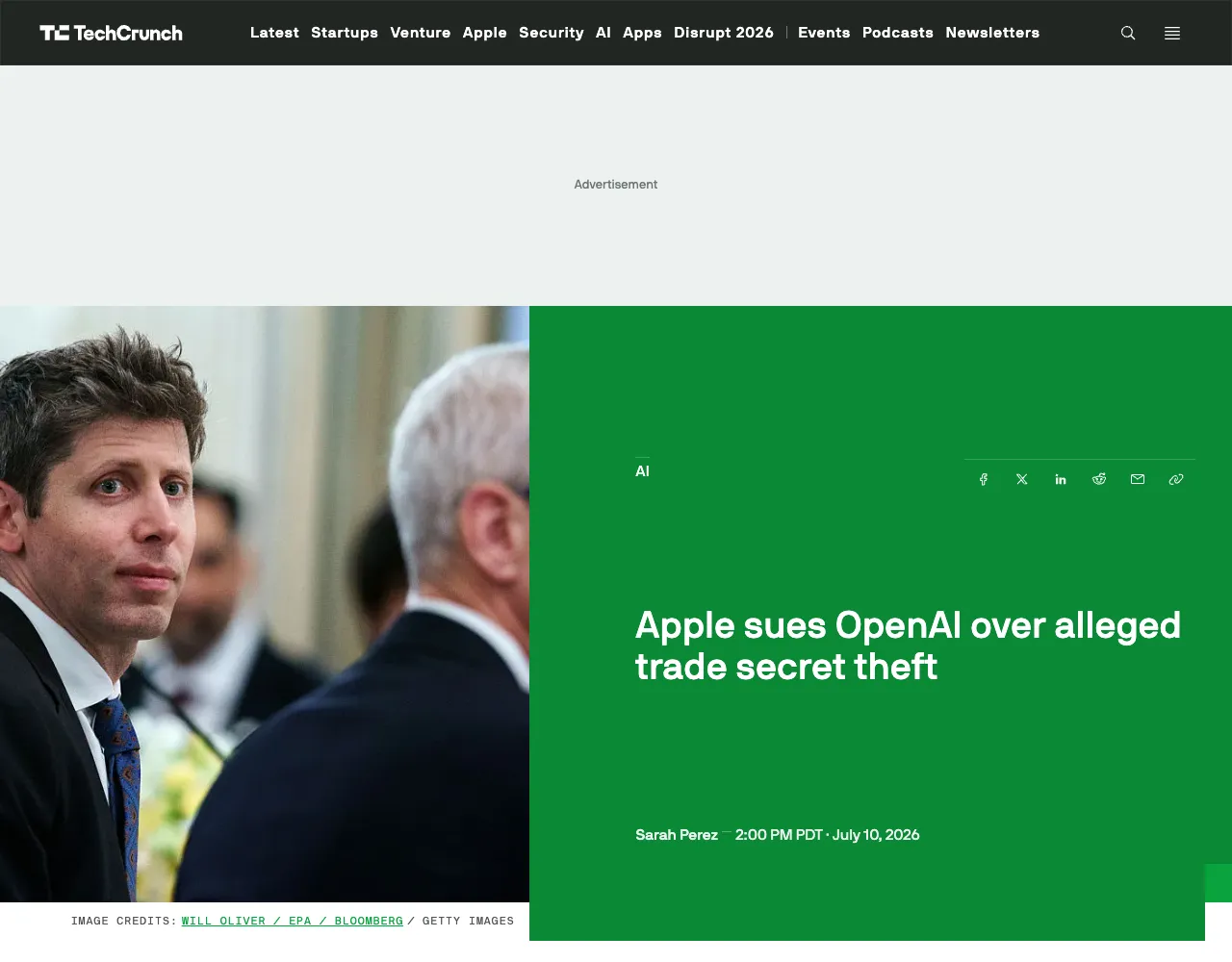
This is not a routine intellectual property dispute. The suit names OpenAI’s Chief Hardware Officer, a 24-year Apple veteran, as central to the alleged scheme, and references Jony Ive’s $6.5 billion hardware startup acquisition as context. If OpenAI is building an AI-first smartphone — and the evidence strongly suggests it is — this lawsuit could shape the competitive landscape for the next generation of mobile devices.
The allegations
Apple’s complaint paints a detailed picture of systematic misconduct:
| Allegation | Detail |
|---|---|
| Recruiting with stolen intel | Tang Tan used Apple’s confidential project code names during candidate recruitment, asking applicants to bring Apple hardware components to interviews |
| Evading security | Tan coached departing Apple employees on how to circumvent the company’s security procedures when leaving |
| Unreturned laptop | Chang Liu, a former Apple senior systems engineer, kept an Apple-issued laptop and used it to download confidential technical documents after joining OpenAI |
| Senior leadership involvement | Apple alleges the pattern of theft was “directed by OpenAI’s senior leadership” |
| Hardware competition | OpenAI’s first device — rumored to be an AI-native smartphone — would directly compete with the iPhone |
Tang Tan spent 24 years at Apple, most recently as VP of product design for the iPhone and Apple Watch, before joining OpenAI as Chief Hardware Officer in 2025. His deep knowledge of Apple’s supply chain, design processes, and unannounced products is central to Apple’s claim that OpenAI gained an unfair competitive advantage.
Chang Liu is a former Apple senior systems electrical engineer who left for OpenAI in 2026. Apple alleges he failed to return a company-issued laptop and used it to download confidential technical documents after his departure.
The hardware context
OpenAI’s hardware ambitions have been an open secret. In 2025, the company acquired io Products — Jony Ive’s hardware startup — for $6.5 billion, bringing Apple’s former chief design officer into the fold. While Ive is not named in the lawsuit, io Products is referenced as part of the factual background.
In April 2026, analyst Ming-Chi Kuo reported that OpenAI’s first device could be a smartphone that replaces apps with AI agents — a fundamentally different mobile experience than the iPhone’s app-grid paradigm. At Davos in January 2026, OpenAI’s chief global affairs officer Chris Lehane confirmed the device would come in the “first half of 2026.”
The timing of the lawsuit — filed just as GPT-5.6 Sol went public and Grok 4.5 launched — is not coincidental. OpenAI is at its peak visibility and preparing for its IPO. A trade secrets lawsuit from Apple complicates both narratives.
The legal stakes
| Dimension | Implication |
|---|---|
| Jurisdiction | Northern District of California (home to both companies) |
| Claims | Trade secret misappropriation, breach of contract |
| Key evidence | Laptop with downloaded documents, recruiting communications |
| Apple’s ask | Injunctive relief + damages (undisclosed) |
| Potential impact on OpenAI | Could delay hardware launch, complicate IPO narrative, trigger employee restrictions |
Apple is seeking injunctive relief — a court order that could delay or restrict OpenAI’s hardware development — plus monetary damages. The laptop evidence (Liu’s unreturned machine with downloaded Apple documents) is the kind of concrete forensic detail that makes this more than a he-said-she-said.
The lawsuit also creates complications for OpenAI’s anticipated IPO. Trade secret litigation introduces uncertainty that underwriters and institutional investors will need to evaluate. Apple’s timing — filing during OpenAI’s highest-profile launch week — is strategically designed to maximize disruption.
What Apple is protecting
Apple’s hardware business is built on two things: supply chain secrecy and talent retention. The iPhone alone generates over 50% of Apple’s revenue. A competitor that shortcuts years of hardware design experience by recruiting Apple’s most senior hardware engineers — and allegedly using Apple’s own confidential data in the process — threatens both pillars.
The lawsuit specifically cites Tan’s role in product design for the iPhone and Apple Watch. Those are Apple’s two largest hardware categories. If OpenAI is building a device that competes with either, Apple’s claim that the competitive damage is “irreparable” is credible.
What this means for builders
This lawsuit has implications beyond Apple and OpenAI:
For teams building on OpenAI: The lawsuit does not affect API access, model availability, or GPT-5.6 Sol usage. It’s a hardware/IP dispute, not a product shutdown.
For the AI hardware landscape: An OpenAI smartphone would be the first major AI-native device from a frontier lab. If the lawsuit delays or derails it, the AI hardware race narrows to established players (Apple, Google, Samsung).
For multi-provider strategy: This reinforces the case for provider diversification. If OpenAI faces prolonged legal uncertainty — even unrelated to its API business — having alternative routing paths through Anthropic, Google, Mistral, or xAI becomes more valuable.
Related reading
- GPT-5.6 Sol Goes Public
- Grok 4.5: SpaceXAI’s Opus-Class Challenge at Half the Price
- How to Set Up Multi-Provider AI Routing in Laravel
Sources
- TechCrunch — Apple sues OpenAI over alleged trade secret theft
- Reuters — Apple sues OpenAI, two former employees for trade secrets theft
- CNBC — Apple sues OpenAI alleging trade secret theft
- NYT — Apple Sues OpenAI, Accusing It of Stealing Company Secrets
- Axios — Apple sues OpenAI over trade secrets
About the author
Charles Jasthyn De La Cueva is a full-stack developer and the founder of Open TechStack. He writes about AI engineering, developer tools, and practical model evaluation — grounded in real workflows, not press releases.