Why this matters now
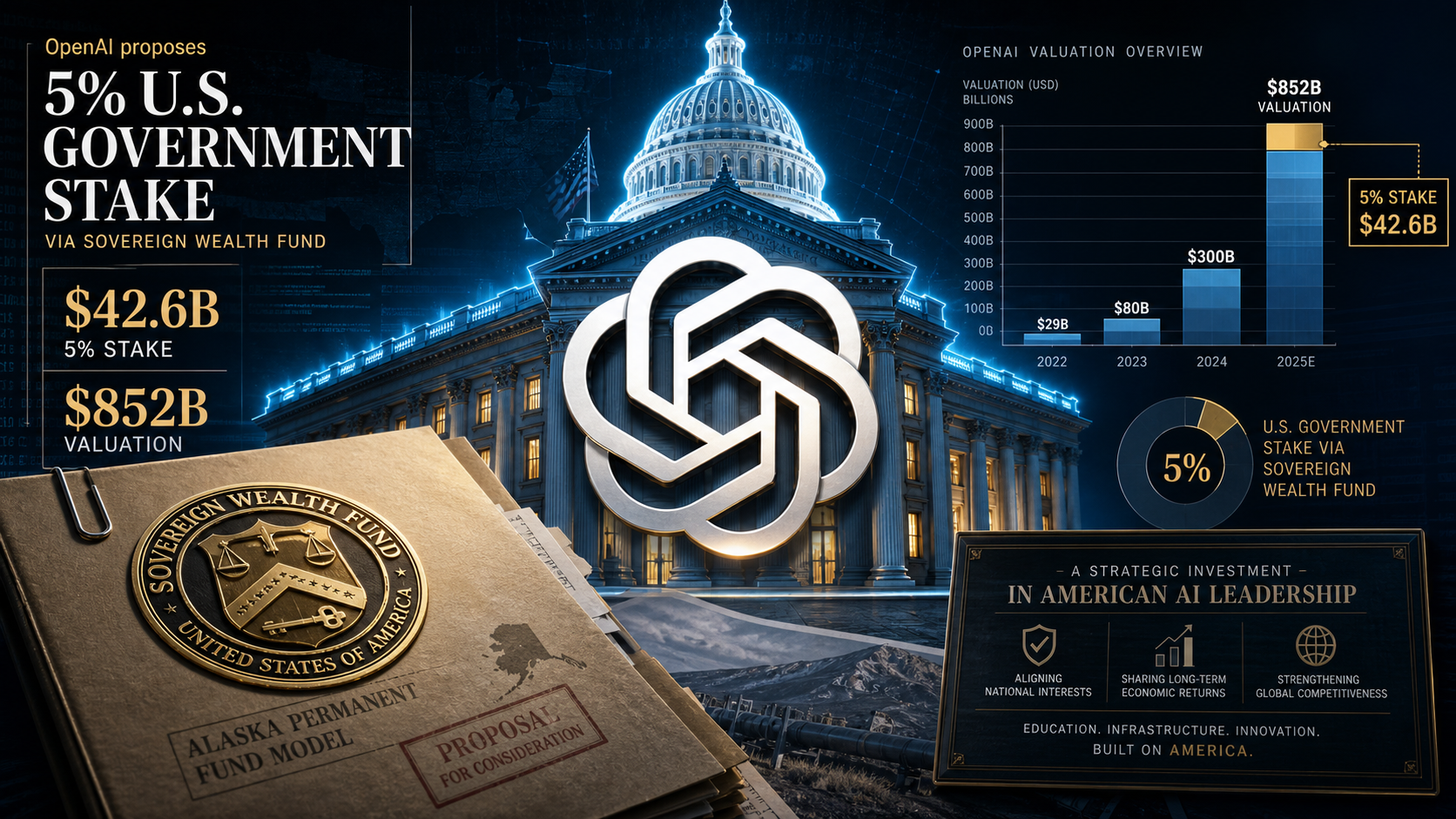
On July 2, 2026, the Financial Times reported that OpenAI CEO Sam Altman proposed handing the US government a 5% equity stake in OpenAI — a holding worth roughly $42.6 billion at the company’s $852 billion post-money valuation. This wasn’t a one-off ask. Altman reportedly wants every leading US AI lab to cede a similar slice into a sovereign wealth fund modeled on Alaska’s Permanent Fund, with Washington as a silent partner in the entire American frontier stack.
The timing is the story. Three weeks before the proposal, the federal government pulled Anthropic’s Fable 5 and Mythos 5 models from foreign users and delayed OpenAI’s GPT-5.6 public launch over national-security concerns — a de facto approval regime for frontier releases that did not exist a month earlier. Read together, the 5% stake looks less like charity and more like an insurance policy against the regulator that can now ground your best model with a single letter. See our breakdown of GPT-5.6 Sol’s government-gated rollout and the Fable 5 export-control incident.
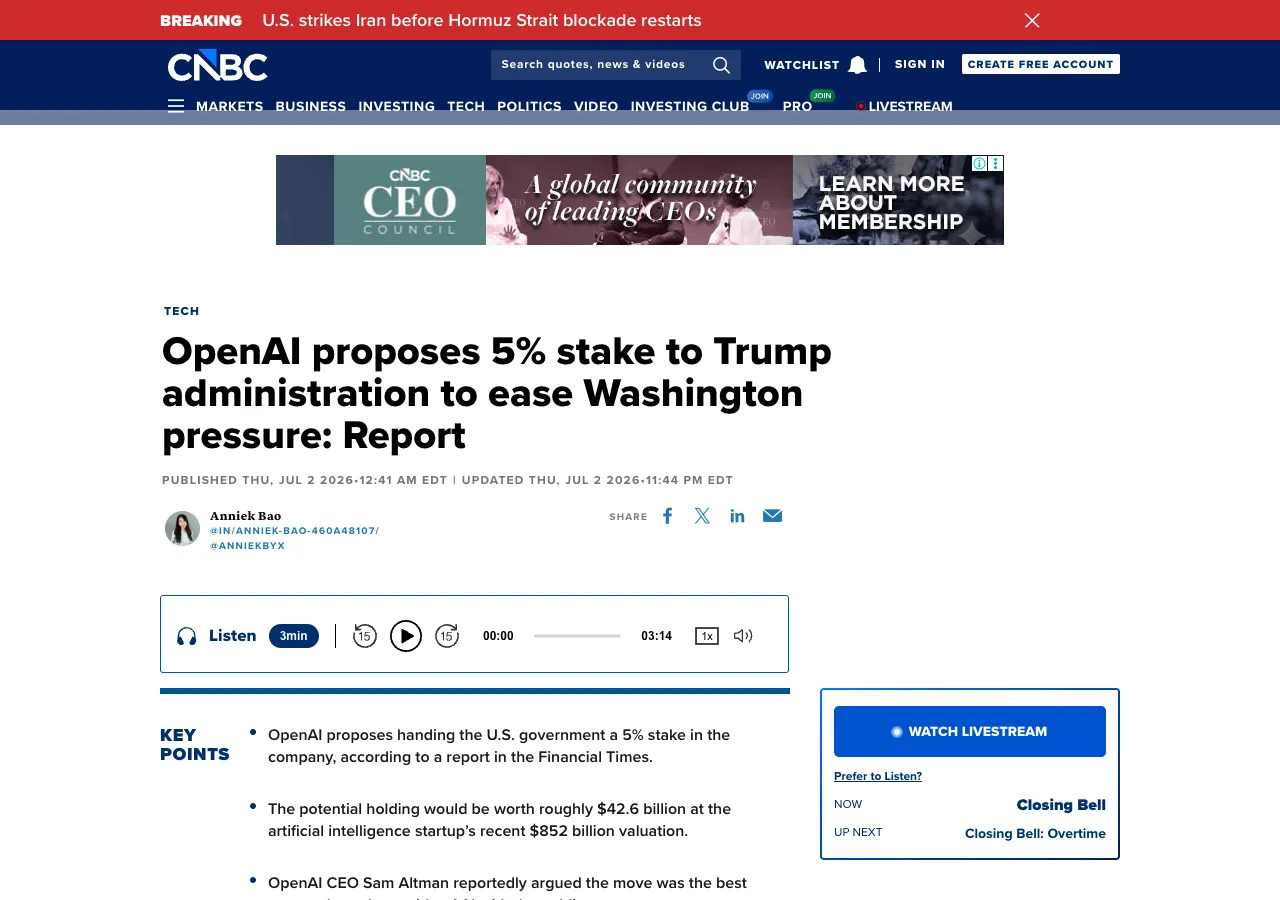
Altman’s own framing — that giving the public a financial interest is “the best way to share the upside of AI” — is a self-reported rationale from the company making the ask. The FT attributes the details to “two people familiar with the discussions” and calls the plan “conceptual” and at an “early stage.” Nothing is finalized, and any deal would need an act of Congress.
The proposal, by the numbers
| Parameter | Detail |
|---|---|
| Stake offered | 5% of OpenAI equity |
| Implied value | ~$42.6B at $852B post-money valuation |
| Valuation basis | Record $122B funding round closed March 2026 |
| Peers named | Google, Anthropic, Meta, xAI (some reports add Nvidia, Micron, AMD) |
| Vehicle model | Alaska Permanent Fund — dividends to citizens |
| Discussed with | President Trump, Commerce Sec. Howard Lutnick, Treasury Sec. Scott Bessent |
| Status | ”Conceptual,” early stage; requires congressional approval |
| Counterpart | Sen. Sanders’ 50% public-stake bill (see below) |
The math is straightforward: 5% of $852 billion is $42.6 billion. That figure only describes OpenAI. If the frame extends to Google, Anthropic, Meta, and xAI at similar ratios, the public vehicle would hold tens of billions more — a structural claim on the industry’s upside, not a one-time payment.
One detail worth flagging: Anthropic has told reporters it has not discussed any government stake on its own behalf, and it is far from clear which labs would accept the arrangement. The proposal is Altman’s sketch, not a signed term sheet.
Why now: the leverage has shifted
For most of the last decade, frontier labs operated as if model releases were theirs to ship. That assumption broke in June 2026. The government’s export-control directives took Fable 5 and Mythos 5 offline for foreign users from June 12 to July 1; OpenAI delayed GPT-5.6’s wide release at Washington’s request. A regulator that can stop your flagship model has enormous leverage over your roadmap.
A 5% equity stake reframes that relationship. Instead of the state being an outside rule-maker, it becomes a co-owner with a direct interest in the company’s prosperity. For the labs, that is a way to buy predictability: a government that draws dividends from your success is harder to persuade to regulate you into the ground. For the public, it is at least a share of the rents.
That logic has been building for over a year. CNBC reported Altman first raised the possibility of government equity participation with the administration in early 2025. In April 2026, OpenAI published “Industrial Policy for the Intelligence Age,” a 13-page paper proposing a public wealth fund that would invest in AI labs and distribute returns to citizens. The July proposal is the commercial version of that policy memo.
Three rival blueprints for public ownership
| Model | Mechanism | Scope | Status |
|---|---|---|---|
| OpenAI / Altman | Voluntary 5% stake into Alaska-style fund | OpenAI first, invites peers | Conceptual, early stage |
| Sanders Act | One-time 50% tax on AI-company stock | All “systemically important” AI firms | Introduced June 2026, not yet in committee |
| EU approach | AI Act regulation, no equity | All high-risk AI in the bloc | Enforcement deadline Aug 1, 2026 |
Sen. Bernie Sanders’ American AI Sovereign Wealth Fund Act goes far further than Altman’s sketch. It would impose a one-time 50% tax on the stock of major AI companies, deposit the shares into a public fund, and grant the government board seats and voting power, with proceeds paid as a universal dividend. Companies where AI is only part of the business — Google and SpaceX are named examples — could spin off non-AI units to limit exposure. The bill has not advanced to committee.
The EU represents the opposite philosophy: sovereignty through rules, not ownership. The AI Act imposes obligations by risk tier and protects rights without taking equity. The American path, as this proposal reveals, leans on aligning interests — if the state profits when AI prospers, it has reason to let it prosper. The risk is capture: a shareholder state regulates poorly what enriches it.
What it means for builders
If you ship AI features, this is not abstract policy. A government that owns 5% of your model provider has a structural incentive to keep that provider dominant — which raises concentration risk exactly when the open-weight alternative is getting good.
Use if:
- You already route across multiple providers and treat any single lab as a single point of failure
- You want a hedge against a future where national champions get regulatory favor
- You’re evaluating open-weight models for self-hosting to reduce dependence on a championed incumbent
Wait if:
- You need independent confirmation that the proposal will survive Congress (it almost certainly won’t in current form)
- You’re betting that vendor relationships stay stable — the political floor under these labs is now a moving target
- You’re an Anthropic-only shop; Anthropic says it isn’t in these talks
Trade-off: State ownership could stabilize the labs politically (less abrupt regulation) while entrenching them (less competitive pressure, more moat protection). Builders get steadier roads and fewer choices.
Bottom line: Don’t wait for the law. The smart move is architectural — spread inference across providers now so no single government-backed lab becomes your bottleneck. Our guides on multi-provider fallback routing and Laravel multi-provider routing show the pattern. And if you want a provider outside the US regulatory orbit, Tencent’s Hy3 open MoE is a working example of how fast open-weight alternatives are maturing.
Related reading
- GPT-5.6 Sol: Government-Gated Release
- The Fable 5 Incident: Multi-Agent Jailbreaks and Sovereign Safety
- Apple Sues OpenAI Over Alleged Trade Secret Theft
- Multi-Provider AI Gateways: Fallback Routing
- Tencent Hy3: A 295B Open MoE Model Built for Agents
Sources
- Financial Times — OpenAI proposes US government take 5% stake
- TechCrunch — OpenAI proposed donating 5% of its equity to a US sovereign wealth fund
- CNBC — OpenAI proposes 5% stake to Trump administration to ease Washington pressure
- ActuIA — The AI Sovereign Wealth Fund: what Altman’s proposal reveals
- OpenAI — Industrial Policy for the Intelligence Age (PDF)
- Sen. Bernie Sanders — American AI Sovereign Wealth Fund Act press release
About the author
Charles Jasthyn De La Cueva is a full-stack developer and the founder of Open TechStack. He writes about AI engineering, developer tools, and practical model evaluation — grounded in real workflows, not press releases.