Why this matters now
The AI ecosystem in 2026 moves fast. Every week brings new model checkpoints, wrapper tools, agent frameworks, and infrastructure protocols. Marketing says everything is “revolutionary” — tools that “fully automate engineering,” cloud setups with “zero overhead.”
For people actually building things, that creates a noise problem. Sorting out what works locally, what costs what at scale, and what safety issues lurk underneath takes hours of hands-on testing.
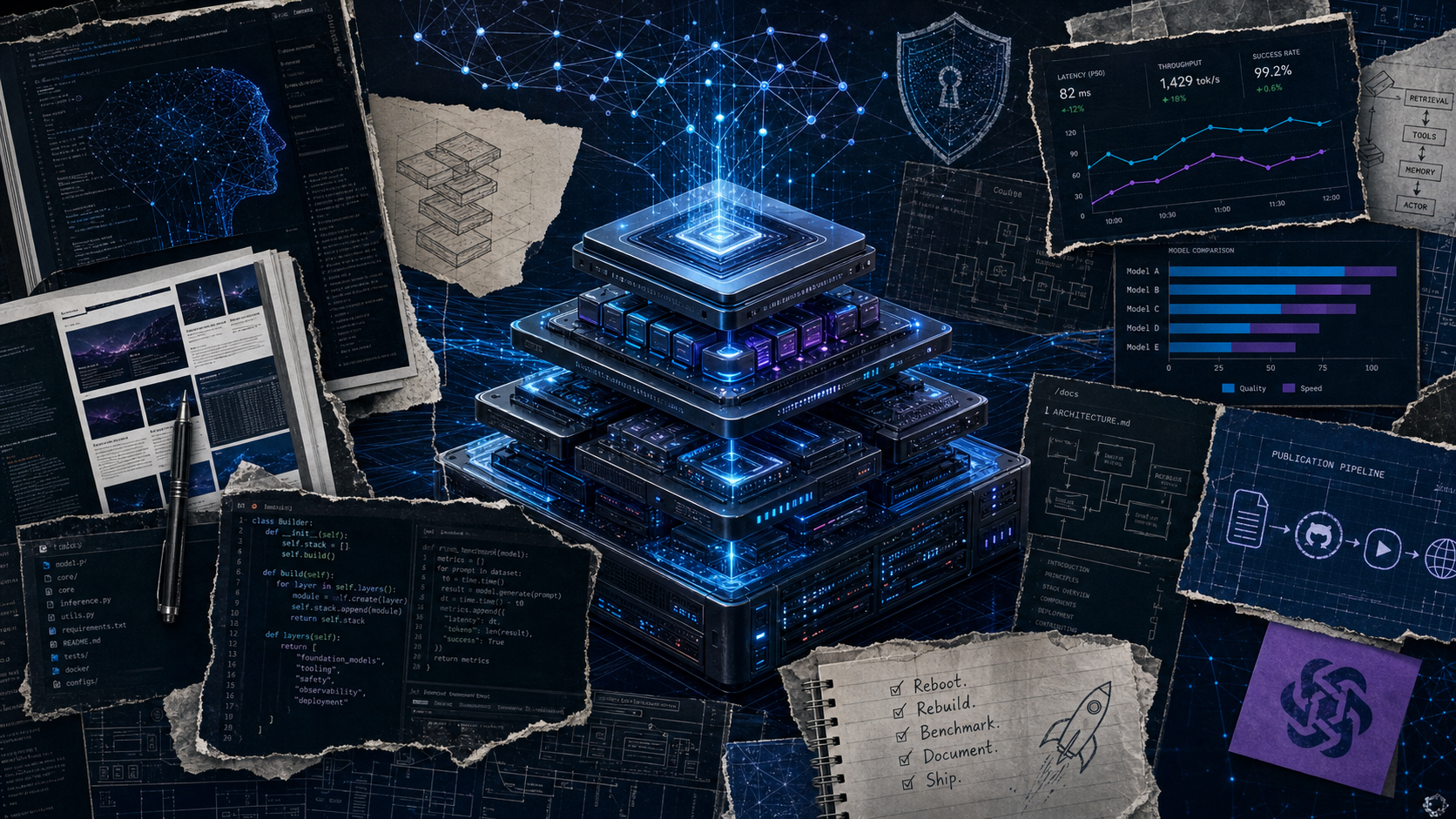
Open-TechStack exists to fix that. We are a technical publication and sandbox that cuts through the hype with grounded, benchmarked, reproducible reviews. We do not write summaries. We install the binaries, check out the source, profile the tokens, measure the latency, and write about what we find.
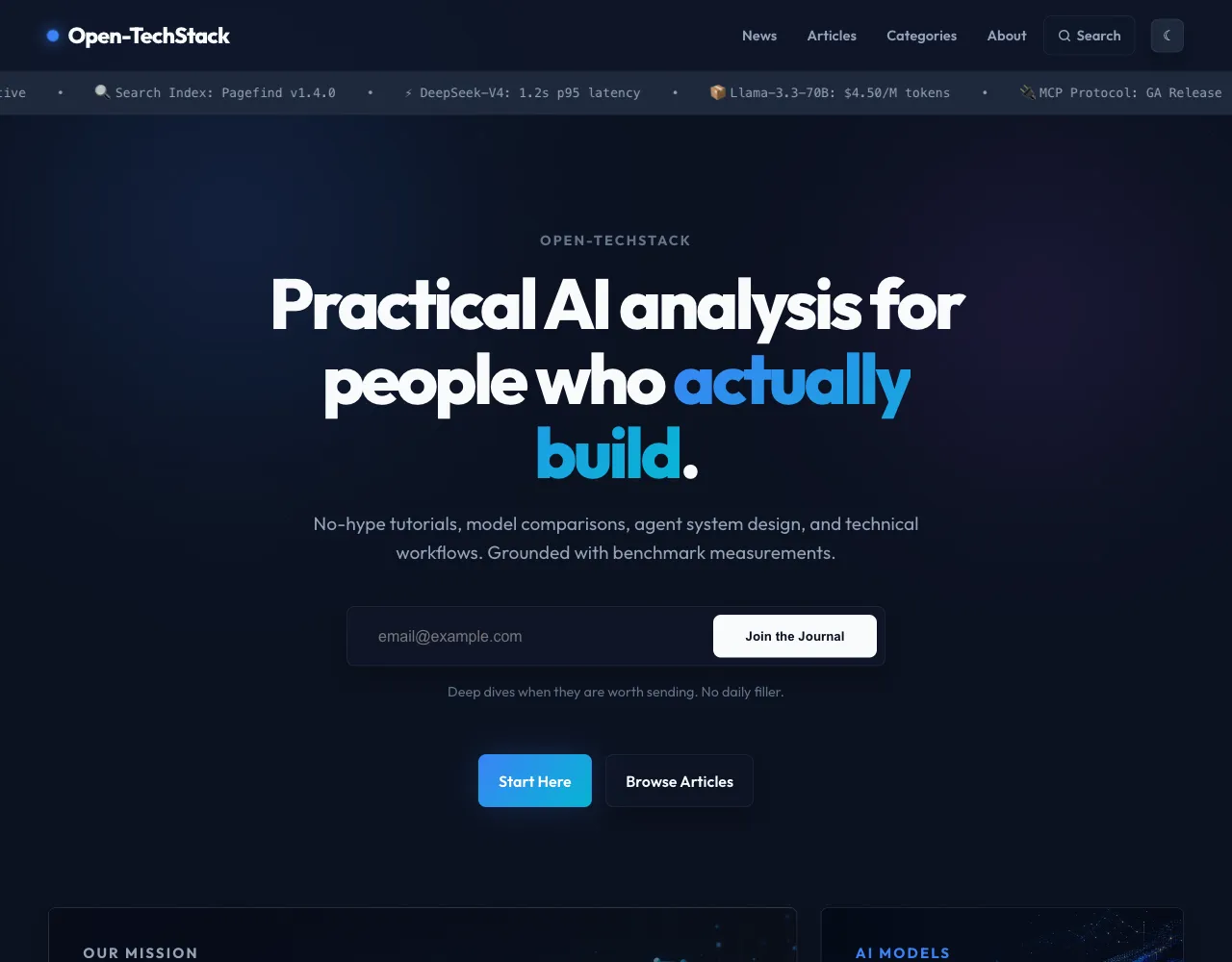
Current Open-TechStack homepage: the relaunch positions the site as a builder-focused AI journal, not a generic news feed.
What We Cover: Our Six Core Pillars
We focus on six areas where technical clarity gives builders the most leverage.
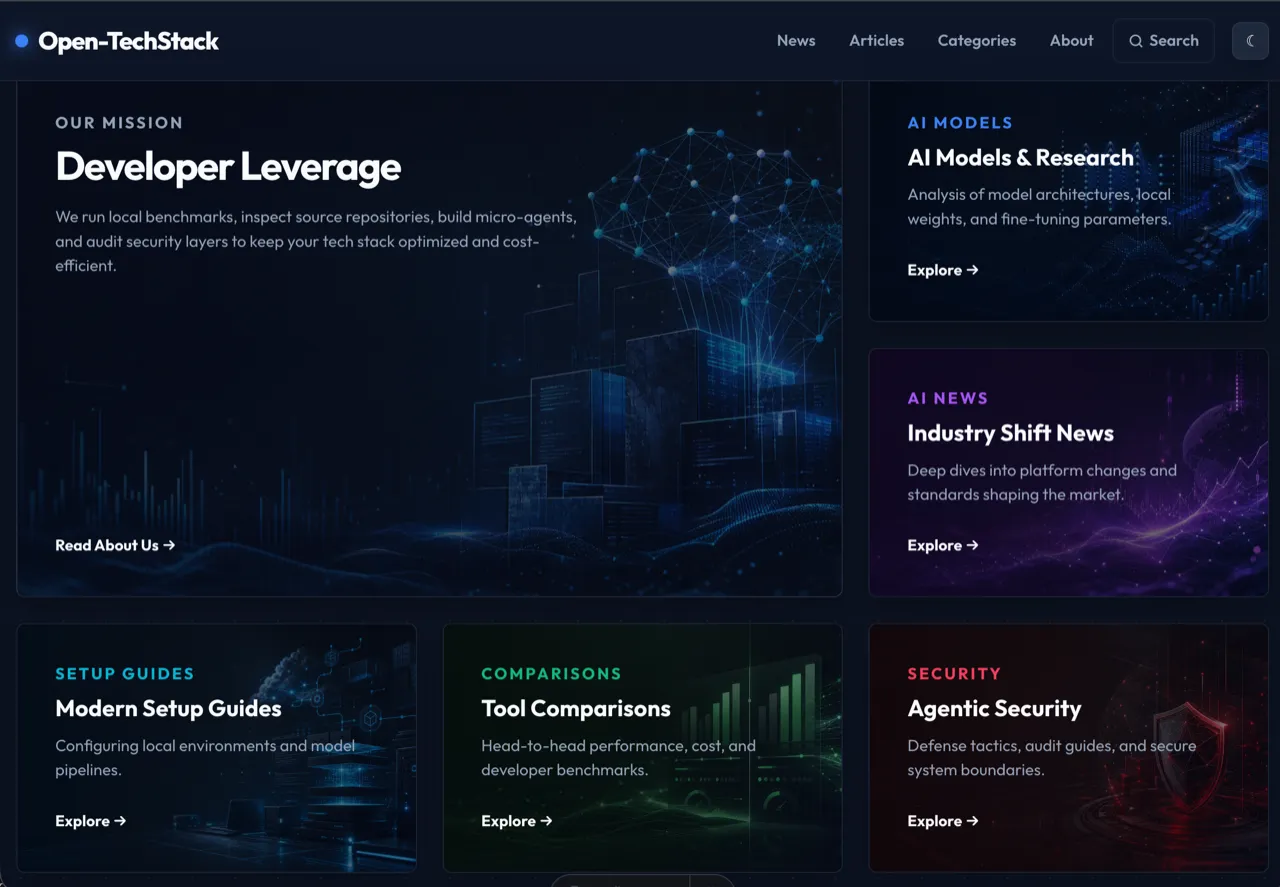
The pillar grid makes the coverage model concrete: mission, models, news, setup guides, comparisons, and security are all presented as clearly defined editorial lanes.
1. AI Models & Research
We break down the architectures behind modern models. Whether it is a new open-weights release, a reasoning model deep dive, or local fine-tuning with Unsloth or vLLM, we focus on:
- Hardware Constraints: What GPU size, VRAM footprint, and quantization levels are required for inference.
- Latency Benchmarks: Time-to-first-token (TTFT) and throughput measurements under load.
- Parameter Analysis: Why a specific attention mechanism or context window configuration matters for your queries.
2. Open-Source (GitHub Codebases)
Open-source repos are the foundation of developer freedom. We search for and evaluate promising repositories, frameworks, and CLI utilities — checking code quality, dependency footprints, configuration patterns, and community health. Then we write guides explaining how to clone, configure, and integrate them into your local stack.
3. Tool Comparisons
When faced with choices like Ollama vs. LM Studio or PydanticAI vs. LangGraph, developers need more than a list of features. We run head-to-head testing across real-world workloads, tracking:
- Cost Comparisons: API spending and server resource metrics.
- Reliability Profiles: How frameworks handle exceptions, rate limits, and fallback strategies.
- Developer Experience: The learning curve, type safety, and ease of integration into standard pipelines.
4. Step-by-Step Setup Guides
Every technical tutorial we write contains copy-pasteable commands, configuration files, and verification checkpoints. We assume no magic settings; if a guide requires an environment variable or a specific Docker network bridge, it is written explicitly in the walkthrough steps.
5. Agentic Security & Auditing
As AI agents gain execution capabilities — running commands, using browser tools, accessing files — the attack surface expands. We cover:
- Prompt Injection Defense: How to secure system prompts and input boundaries.
- Sandboxing: Configuring secure runtimes, Docker containers, and permission models.
- WAF & CDN Rules: Safely managing incoming agent traffic to prevent scrapers from overloading resources.
6. AI Niches & Workflows
We explore custom workflows that compound developer productivity. This includes configuring personal Obsidian research vaults, building custom CLI assistant scripts, and optimizing local RAG (Retrieval-Augmented Generation) pipelines for private code repositories.
Our Technical Sandbox & Testing Process
To provide reliable insights, we run a dedicated testing sandbox for every tool and model we review. Here is how we verify technical workflows:
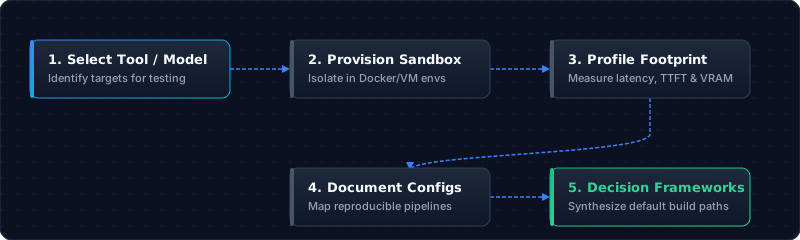
- Reproducible Sandboxes: Every configuration is deployed in an isolated environment (such as Docker containers or local virtual machines) to verify dependency settings.
- Performance Benchmarking: We record raw measurements (TTFT, VRAM usage, API latency) to verify physical performance characteristics under load.
- Source Verification: We audit repository source files to check default configuration pathways, security permissions, and licensing profiles.
- Clear Attribution: We link directly to official documentation, source repositories, and primary research papers so readers can easily trace our assertions back to the source.
Relaunch & Production Roadmap
Open-TechStack has been rebuilt from the ground up. The frontend runs Astro v5 on the Cloudflare edge network, indexed with Pagefind for static search. Page loads average under 100ms — no database cold starts, no slow queries.
Coming in the next few weeks:
- Local Fine-Tuning Pipelines: How to fine-tune open weights models using Unsloth on consumer hardware.
- Secure Agent Architectures: Designing approval pipelines for agents that interact with external file systems.
- LiteLLM Config Blueprints: Managing multiple model fallback layers and track API token usage.
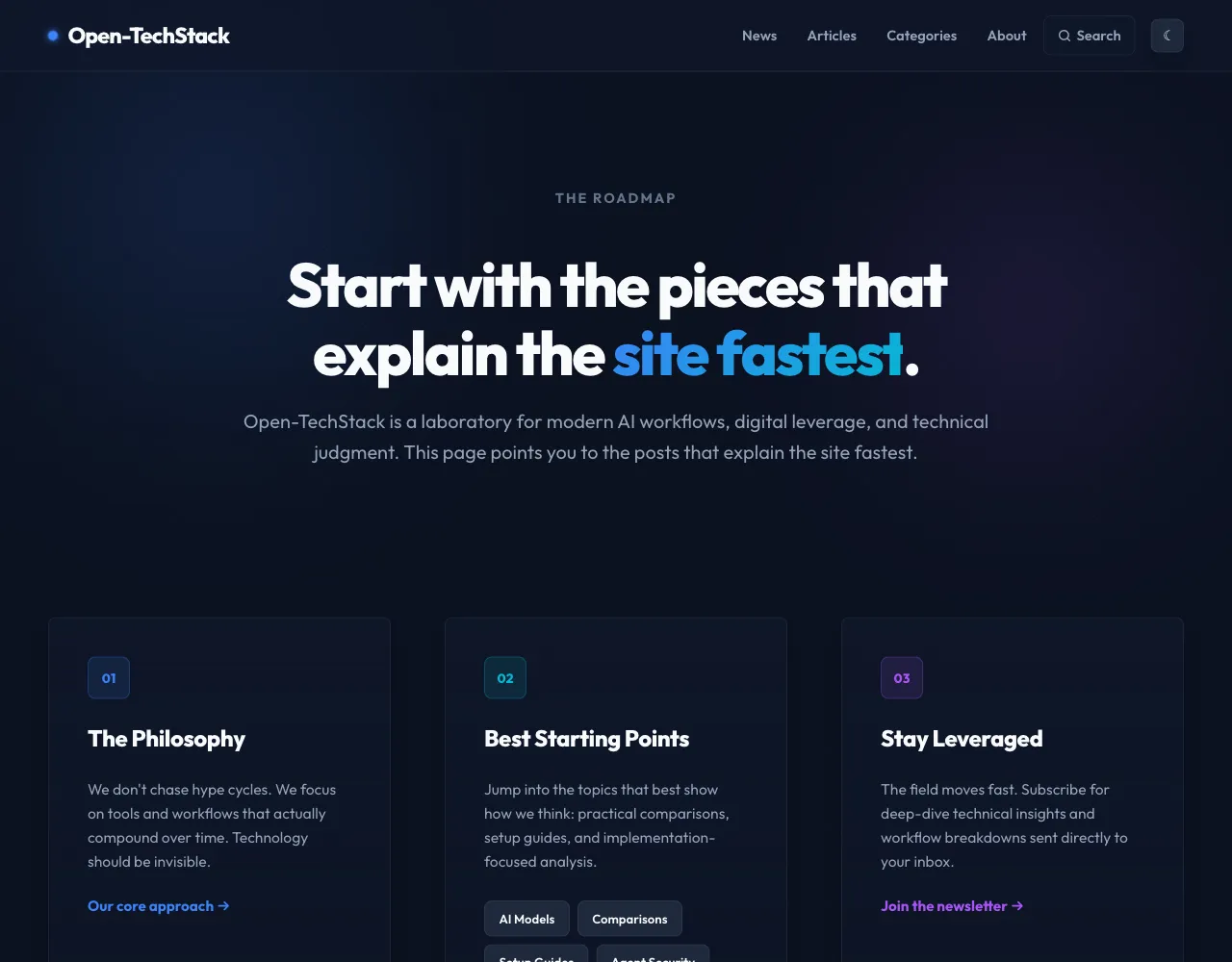
The Start Here page makes the reboot practical: it gives new readers a clear path into the site instead of dropping them into an unstructured archive.
Decision Framework
- When to read: You are building software, setting up model pipelines, or deploying agent systems, and you need exact setup commands, cost breakdowns, and benchmark data.
- When not to read: You are looking for high-level market summaries, startup investment news, or non-technical commentary.
- Trade-off: We prioritize depth over velocity. We do not publish daily digests — we publish comprehensive articles when there is something worth documenting.
- Our Recommendation: Subscribe to receive technical deep dives in your inbox, and start exploring the pillars above.
- Takeaway: Open-TechStack is the engineering logbook for modern AI architecture and developer leverage.
Related reading
- Multi-Provider AI Gateways: Fallback Routing
- The Fable 5 Incident: Multi-Agent Jailbreaks
- GLM-5.2: Open-Weight 1M Context Model
Sources
- Open-TechStack About Page
- Open-TechStack Category Navigator
- Open-TechStack Start Here Roadmap
- Astro Web Framework Documentation
- Pagefind Static Search Library
- Laravel HTTP Client Documentation
- Anthropic API Reference
- Google Gemini API Docs
About the author
Charles Jasthyn De La Cueva is a full-stack developer and the founder of Open TechStack. He writes about AI engineering, developer tools, and practical model evaluation — grounded in real workflows, not press releases.