Why this matters now
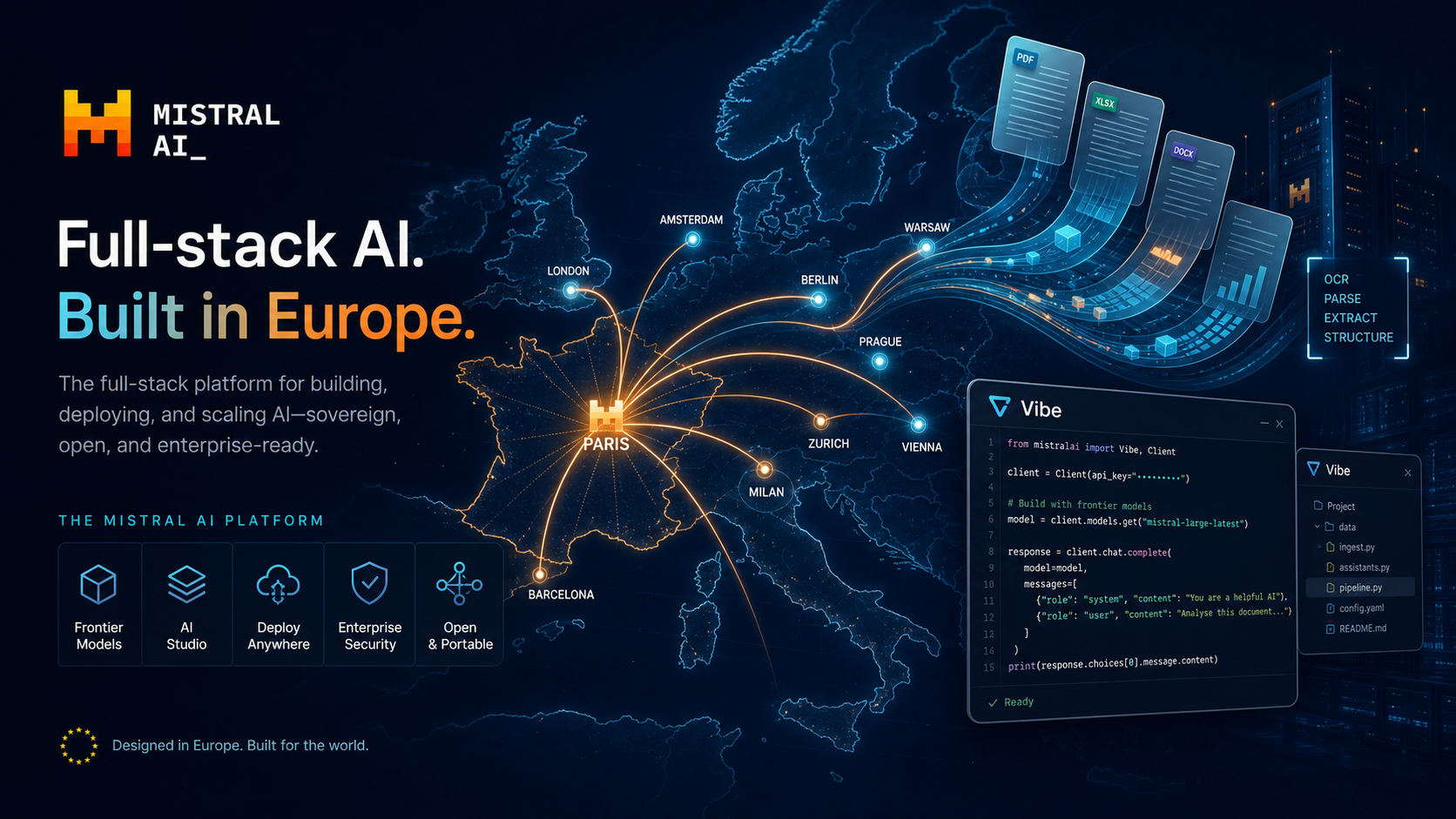
While the AI world has been watching Anthropic’s Sonnet 5 launch, OpenAI’s government proposals, and Google’s Gemini Spark updates, Mistral AI has been quietly building the broadest product portfolio of any European AI company — and one of the broadest anywhere.
Since late May 2026, Mistral has shipped:
- Vibe — a unified AI agent for both work and software development, with Work Mode, Code Mode, VS Code integration, remote execution, and custom subagents
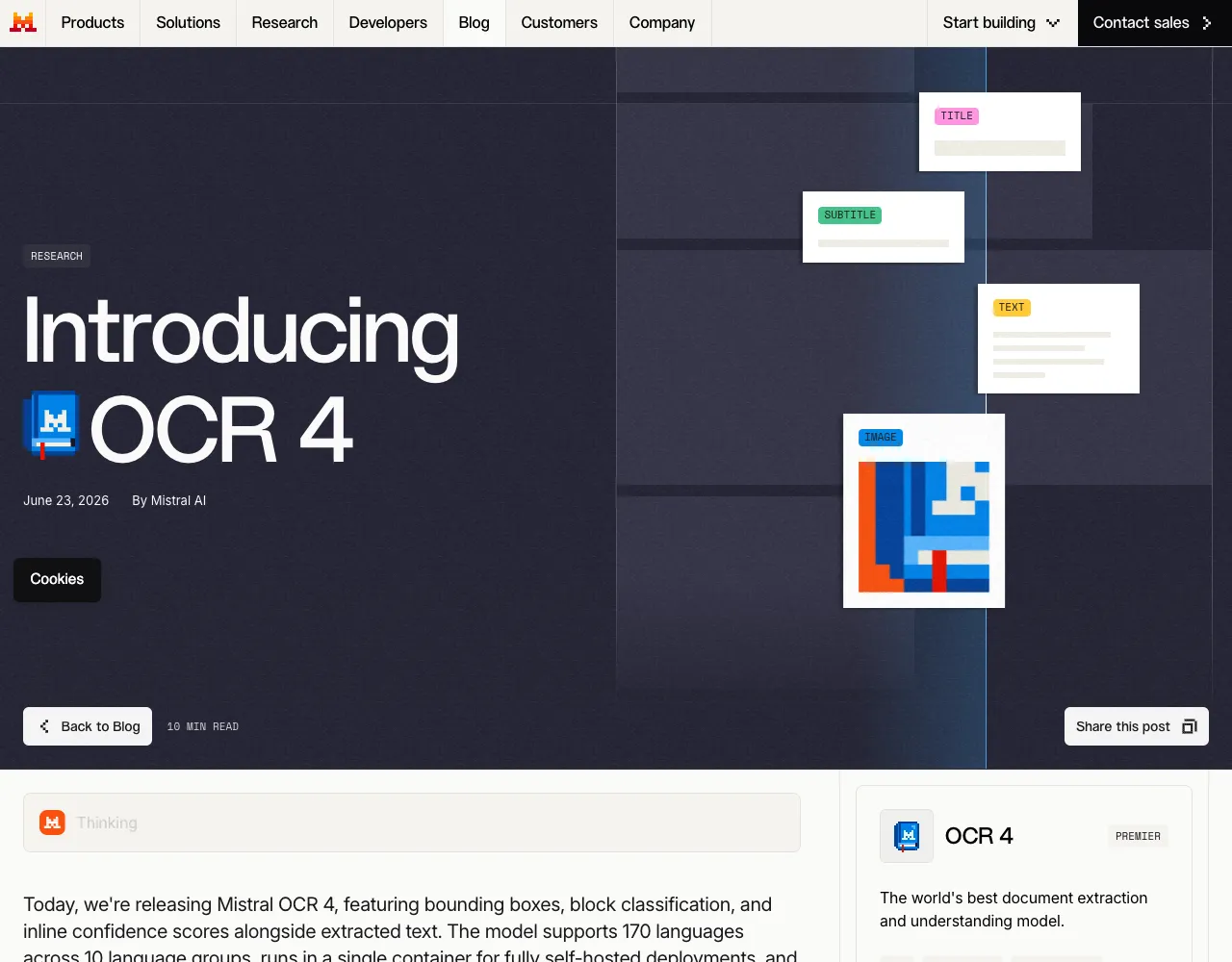
- OCR 4 — state-of-the-art document intelligence with 170-language support, bounding boxes, block classification, and self-hosted deployment in a single container
- Search Toolkit — an open-source, composable framework for production-grade search and retrieval pipelines
- Industrial AI stack — with Airbus, BMW Group, and ASML as named launch customers
- A new 10 MW inference data center in Les Ulis, near Paris, targeting Q3 2026
This isn’t a research lab shipping papers. It’s a company building a full-stack enterprise platform — models, agents, infrastructure, and data sovereignty — while valued at $13.8 billion and backed by the French government, NVIDIA, and ASML.
Claude Science bets on workflow. Gemini Spark bets on ecosystem. Mistral bets on open-weight infrastructure — and it’s the only company doing all three.
Vibe: Mistral’s unified agent platform
Mistral rebranded its consumer assistant, Le Chat, and expanded it into Vibe — a single agent for productivity work and software development. The architecture has two modes:
Work Mode handles long-running, multi-stage tasks across enterprise tools: inbox management, research synthesis, document drafting, calendar coordination. It’s designed for knowledge workers who need a persistent agent that stays with a task through completion.
Code Mode provides a dedicated coding surface in the web app (chat.mistral.ai/code), with GitHub integration, project management, and end-to-end pull request creation. It also ships as a VS Code extension and a CLI tool — the same agent, three surfaces.
| Capability | Work Mode | Code Mode |
|---|---|---|
| Enterprise tool integration | Email, calendar, docs | GitHub, VS Code, terminal |
| Task scope | Multi-step, long-running | Feature dev → PR |
| Interface | Web app | Web, VS Code, CLI |
| Agent type | Persistent coordinator | Interactive coding agent |
| Custom subagents | Yes (Vibe 2.0) | Yes (Vibe 2.0) |
| Remote execution | — | From phone (remote agents) |
The remote agent feature is worth calling out. Powered by Mistral Medium 3.5 (open-weight), developers can start a coding session from their phone and let it run on Mistral’s infrastructure — no need to keep a laptop running. This is functionally similar to Gemini Spark’s upcoming macOS remote execution, but Mistral shipped it first.
Vibe 2.0, released in early July, added custom subagents, multi-choice clarifications (the agent pauses and asks you to pick a direction before proceeding), and slash-command skills. It’s available on Le Chat Pro and Team plans with pay-as-you-go credits for power users.
OCR 4: Document intelligence that’s hard to ignore
Mistral OCR 4, released June 23, is the company’s most technically impressive product launch this year. It’s a document intelligence model that does things general-purpose vision models struggle with:
- Bounding boxes, block classification, and inline confidence scores — every extracted element knows what type it is (heading, paragraph, table, figure) and how confident the model is
- 170 languages across 10 language groups — including Latin, Cyrillic, Arabic, Devanagari, CJK, and Indic scripts
- Self-hosted in a single container — no multi-service orchestration, no cloud dependency
- 2,000 pages per minute on a single compute node
| Benchmark | Mistral OCR 4 | Notes |
|---|---|---|
| OlmOCRBench | 85.20 | SOTA among available OCR models |
| Win rate vs. competitors | 72% | Head-to-head against leading document parsers |
| API pricing | $4/1,000 pages | $2 with Batch API |
| Self-hosted | Single container | No external dependencies |
At $4 per 1,000 pages ($2 batched), it undercuts most competing document intelligence APIs while matching or exceeding their accuracy. Google Document AI starts at $1.50/1,000 for basic OCR but jumps to $10-$30 for layout parsing and form extraction — Mistral charges the same flat rate regardless of document complexity.
The self-hosting option is the differentiator. For enterprises with sensitive documents that can’t leave their infrastructure, OCR 4 runs in a single container. No cloud dependency, no data egress. That’s a direct appeal to regulated industries — finance, legal, government, healthcare — where model provenance and data sovereignty are non-negotiable.
OCR 4 integrates directly with Mistral’s Search Toolkit (open-source, composable retrieval pipelines) for end-to-end document ingestion → indexing → search workflows.
The industrial AI bet: Airbus, BMW, ASML
Mistral’s enterprise strategy is anchored by three named customers that cover aerospace, automotive, and semiconductor manufacturing:
- Airbus — AI-assisted engineering workflows for aircraft design and manufacturing
- BMW Group — production optimization and quality control across automotive lines
- ASML — lithography system intelligence and semiconductor manufacturing workflows
The industrial AI stack combines custom model training (via Mistral Forge), MCP-based tool connectors, and on-premise deployment options. The pitch is straightforward: European manufacturers working with sensitive IP and subject to EU data regulations want an AI provider that keeps their data on European infrastructure. Mistral’s new Les Ulis data center (10 MW, Q3 2026) is the infrastructure anchor for this story.
This is a smarter strategy than trying to beat OpenAI and Anthropic on general benchmarks. Mistral targets verticals where data sovereignty is a purchasing criterion — and those verticals have deep budgets.
Comparing the three AI platform plays
| Dimension | Anthropic | Mistral | |
|---|---|---|---|
| Agent product | Claude Code + Claude Science | Gemini Spark | Vibe (Work + Code) |
| Document AI | Claude with vision | Document AI | OCR 4 + Document AI |
| Search | Web search via API | Google Search AI | Open-source Search Toolkit |
| Infrastructure | Cloud API | Cloud API + GCP | Self-host + Paris DC |
| Data sovereignty | US-based | US-based | EU-based |
| Open-weight | No | Some models (Gemma) | Yes (Medium 3.5, Small 4) |
| Enterprise customers | Broad | Broad | Deep vertical (Airbus, BMW, ASML) |
Decision framework
Use Mistral if:
- Your organization needs EU data sovereignty and self-hosted deployment options
- You’re doing high-volume document processing across multiple languages (OCR 4 is best-in-class value)
- You want an open-weight coding agent (Medium 3.5) that runs where you control the stack
- You’re in manufacturing, aerospace, automotive, or semiconductors
Wait or skip if:
- You’re deeply embedded in Anthropic’s or OpenAI’s ecosystem — model-switching cost may not justify the infrastructure benefit
- You only need a coding agent (Claude Code and Gemini Spark are more mature)
- You’re outside regulated European industries — the data-sovereignty advantage matters less
Trade-off: Mistral trades model-tier benchmark leadership for infrastructure flexibility and sovereign deployment. You don’t get Opus-level scores, but you get a model that can live entirely inside your network and a platform that covers work, code, documents, and search.
The bottom line: Mistral’s spring 2026 product blitz makes it the most complete European AI platform by a wide margin. The bet is that data sovereignty and open-weight infrastructure will matter more than benchmark scores — and for a growing number of buyers, that bet is already paying off.
Related reading
- Claude Science: Anthropic’s AI Workbench for the Lab
- Gemini Spark Goes Desktop: macOS, Connected Apps, and Real-Time Monitoring
- AI Supply Chain Security: Model Provenance and Provider Risk
- Multi-Provider AI Gateways: Fallback Routing
Sources
- Mistral AI — Vibe gets to work
- Mistral AI — Introducing Mistral OCR 4
- Mistral AI — Search Toolkit
- Mistral AI — Remote agents in Vibe + Mistral Medium 3.5
- Futurum Group — Mistral AI shifts to full-stack strategy with Vibe and industrial AI
- Mistral AI — Vibe 2.0
- Eden AI — Mistral OCR 4 vs top document parsing APIs
About the author
Charles Jasthyn De La Cueva is a full-stack developer and the founder of Open TechStack. He writes about AI engineering, developer tools, and practical model evaluation — grounded in real workflows, not press releases.