
Why this matters now
June 30, 2026 marked the close of GitHub Copilot’s first complete 30-day token billing cycle. The invoices now arriving are the first real data point on what the end of flat-rate AI costs developers.
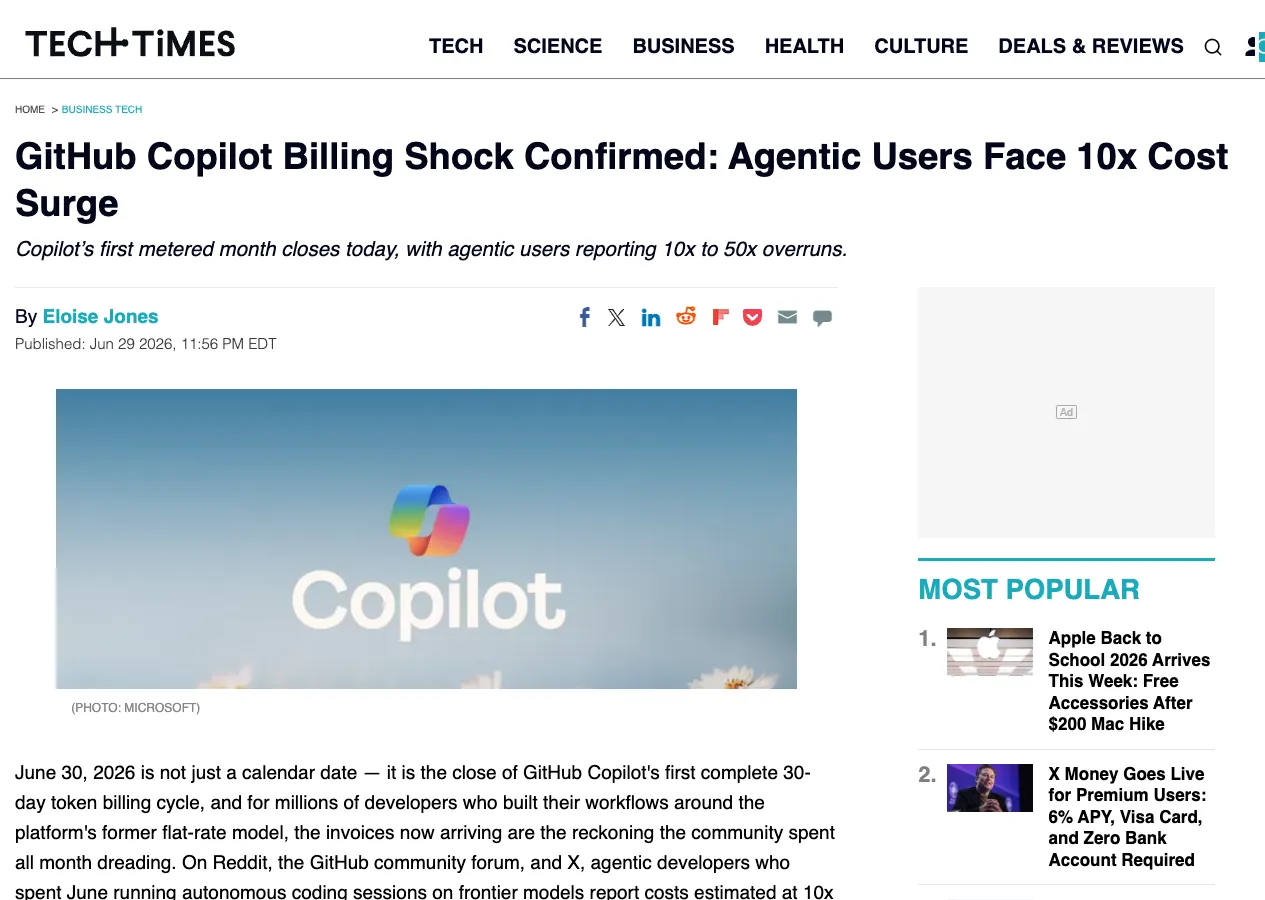
TechTimes: “GitHub Copilot Billing Shock Confirmed: Agentic Users Face 10x Cost Surge.”
On Reddit, GitHub’s community forum, and X, developers using agentic coding workflows are reporting bills 10x to 50x higher than their old flat subscriptions. A $29/month user is looking at nearly $750. A $50/month user is facing roughly $3,000. These are not edge cases — they are the result of a billing model that charges by the token for every autonomous agent session, with no spending ceiling unless one is manually configured.
If you use Copilot’s agent mode, chat, or code review features, there is one urgent action to take today: set a hard spending cap in Settings → Billing → GitHub Copilot. Without one, GitHub bills whatever credits the agent consumes above your monthly allowance, with no automatic stop. For a more durable fix, multi-provider gateways let you route agentic work across providers by cost, keeping a single vendor from setting the terms.
What changed on June 1
On April 27, GitHub CPO Mario Rodriguez announced that all Copilot plans would move from premium request units to GitHub AI Credits, effective June 1. Base subscription prices stayed the same:
| Plan | Monthly Price | Included AI Credits |
|---|---|---|
| Copilot Pro | $10/user | $10 |
| Copilot Pro+ | $39/user | $39 |
| Copilot Business | $19/user | $19 |
| Copilot Enterprise | $39/user | $39 |
One credit equals one cent. Every Copilot interaction — chat, agent mode, code review, Copilot CLI — draws from that balance at per-model API rates. Input tokens, output tokens, and cached tokens all count.
Two things stayed free: code completions and Next Edit Suggestions. The autocomplete experience that most Copilot users rely on minute to minute is completely unaffected. This is the main reason GitHub can say base pricing has not changed. For completion-only users, it hasn’t.
The fallback safety net is gone
What changed more quietly is what happens after the included credits run out. Under the old system, exhausting premium requests triggered an automatic downgrade to a lighter, cheaper model so work could continue. That fallback is gone. Once your credits are spent, the request is rejected, unless you’ve configured an additional-usage budget that defaults to unbounded.
GitHub added promotional credits to soften the transition for business customers: Business plans get an extra $30/month for June, July, and August, Enterprise gets $70/month. Organizations can also pool unused credits across the team. But for individual Pro and Pro+ users, there is no cushion.
Why agents drain your balance so fast
Agentic AI billing scales non-linearly in a way no prior form of metered billing has matched.
When a developer asks Copilot’s agent mode to refactor a module, the agent executes many model calls, not one. It reads relevant files; each file becomes input tokens. It plans the approach, generating more tokens. It produces changes as output tokens. If the result is unsatisfactory, it loops: on the next iteration, the full conversation history re-enters the context window as input tokens again.
A 20-turn agentic session where each turn carries 10,000 tokens of context does not consume 200,000 input tokens total. It processes approximately 2 million input tokens, because the transformer architecture processes the full conversation at each step. The 20th turn alone burns ~200,000 input tokens.
At frontier model API rates, that one session can consume a month’s worth of credits.
IAmTimCorey runs real Copilot billing scenarios and shows what different usage patterns actually cost.
The bills that landed
| User profile | Old flat cost | Projected new cost | Multiple |
|---|---|---|---|
| Heavy agentic user (Reddit: “What a joke”) | $29 | ~$750 | ~25x |
| Pro+ agentic workflow user | $50 | ~$3,000 | ~60x |
| Completion-only user | $10 | $10 | No change |
| Light chat + completions | $19 | ~$25-40 | Minimal |
The pattern is consistent across reports: developers who lean on Copilot for code completions see little to no change. Developers who run daily agentic workflows with frontier models are the ones staring at multiples. The more turns, the more context, the more expensive the session — and there is no ceiling unless you set one.
What to do right now
1. Set a hard spending cap
In your GitHub account: Settings → Billing → GitHub Copilot. Enable the option to stop usage when the budget limit is reached. Setting the additional usage budget to $0 creates a hard stop at your monthly included allowance — you cannot exceed your plan’s credit pool without explicit approval.
This is the single most important action a Copilot user can take today.
2. Reroute heavy agentic work to flat-rate tools
The most common response emerging from the developer community is a hybrid approach: keep Copilot for completions (still free and unlimited) and move agentic coding sessions to a flat-rate tool like Claude Code or Cursor. The metered model makes sense for lightweight use but punishes the looping, high-context workflows that autonomous agents produce.
3. Monitor your burn rate weekly
Copilot’s billing dashboard shows real-time credit consumption. Check it weekly — especially early in the month — so you are not surprised at cycle close. The preview bill feature that GitHub launched in May was many users’ first warning, and for some, the numbers were already locked in.
4. Evaluate model-level cost differences
Not all models drain credits at the same rate. Using a cheaper, faster model for simpler tasks extends your credit pool. Reserve frontier models for the work that genuinely needs them. Your billing settings include model-level controls — use them.
Decision framework
- When to keep Copilot: You primarily use code completions and occasional single-turn chat. Your bill will not meaningfully change. Copilot is still the best-integrated autocomplete tool for most editors.
- When to reconsider: You run daily agent mode sessions, multi-file refactors, or automated code review through Copilot. The 10x-50x multiples are real. A hybrid approach (Copilot for completions, flat-rate tool for agents) will cost less.
- Trade-off: Copilot’s integration depth is unmatched, but its billing model now punishes precisely the workflows that AI coding tools were built to enable — long, iterative, agentic sessions. The product incentives are misaligned with the use case.
- Recommendation: Set your spending cap today. Then decide whether agentic work should move to a tool whose pricing matches the workload pattern.
- Final takeaway: The end of flat-rate AI is here. Copilot’s first billing cycle is the canary in the coal mine — every AI developer tool will eventually face the same economics.
Related reading
- Multi-Provider AI Gateways: Fallback Routing — Practical architectures for routing between providers by cost and capability
- OpenRouter Fusion: Match Fable 5 on Deep Research at Half the Cost — Route cheaper models for simpler tasks to control costs
- GPT-5.6 Sol: Government-Gated at Launch, Here’s What Ships — Tiered pricing is becoming the norm everywhere
Sources
- TechTimes — GitHub Copilot Billing Shock Confirmed: Agentic Users Face 10x Cost Surge
- Let’s Data Science — GitHub Just Put a Meter on Copilot: One Developer’s Bill Jumped to $750
- GitHub Blog — GitHub Copilot is moving to usage-based billing
- TechCrunch — Copilot billing backlash: ‘What a joke’
- LinkedIn — Did Your GitHub Copilot Bill Just Jump 10x?
About the author
Charles Jasthyn De La Cueva is a full-stack developer and the founder of Open TechStack. He writes about AI engineering, developer tools, and practical model evaluation — grounded in real workflows, not press releases.