Why this matters now
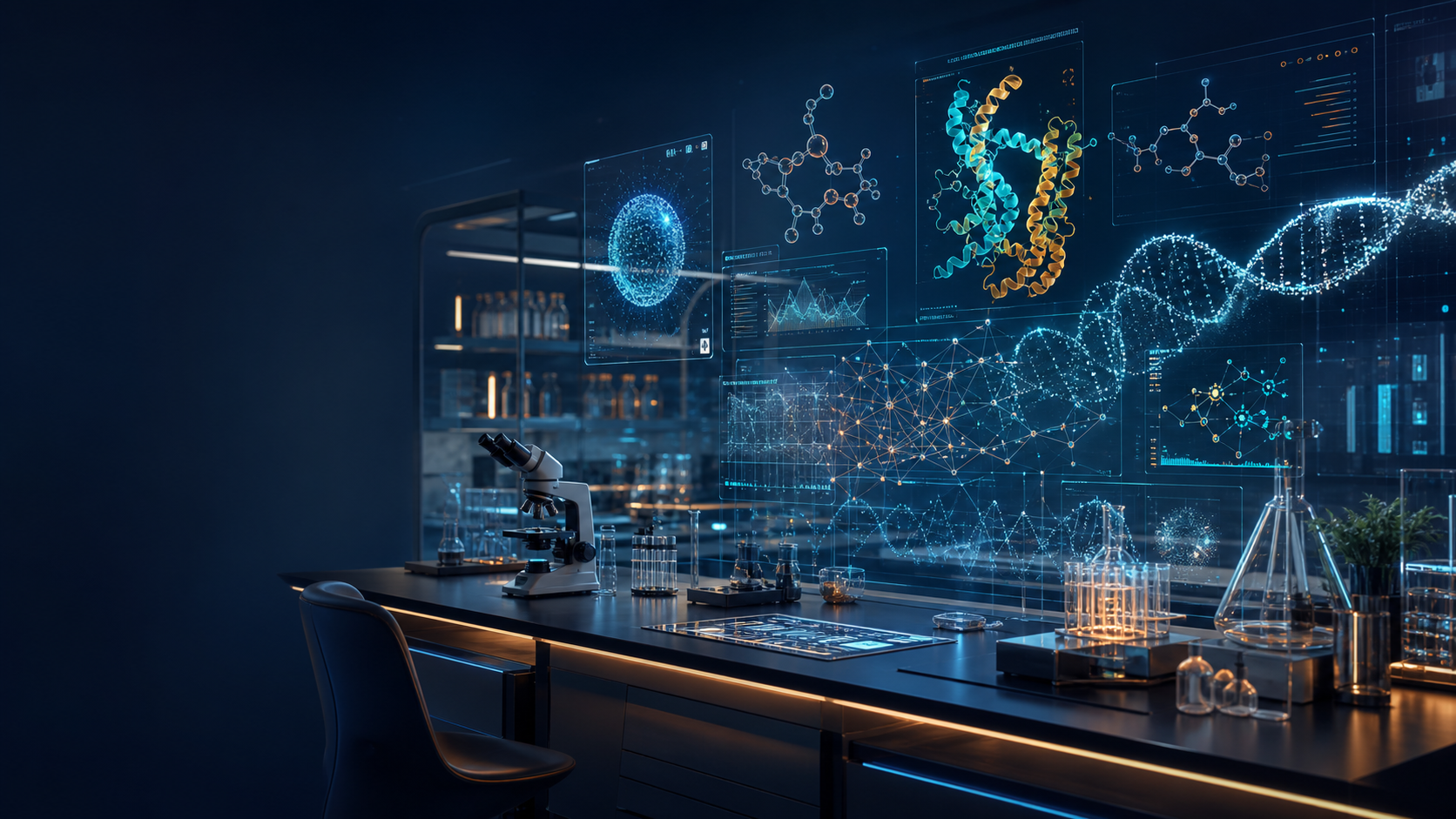
On June 30, 2026, Anthropic shipped Claude Science — an AI workbench for scientific research. Unlike the Sonnet 5 model launch that same day, Claude Science is not a new model. It’s an application layer that wraps Anthropic’s existing models (Opus 4.8 included) in a purpose-built environment for lab work: 60+ pre-configured scientific databases, a multi-agent architecture that splits tasks across specialist sub-agents, a dedicated reviewer agent that catches hallucinated citations, and hardware integration with NVIDIA’s BioNeMo toolkit for GPU-accelerated life sciences.
This is Anthropic’s second major product after Claude Code, and it represents a strategic bet: that the friction in scientific research is not the model’s intelligence but the harness around it. OpenAI went the other direction — GPT-Rosalind is a specialized biology model gated to vetted enterprise partners. Anthropic put the same model everyone already uses into a better toolkit and opened it to every paid subscriber.
Sonnet 5 made agents cheaper. Claude Science makes agents useful in a lab — which is a different problem.
What Claude Science actually is
| Dimension | Detail |
|---|---|
| What it is | An AI workbench app for computational research |
| What it is not | A new model — runs Opus 4.8, same as any paid subscriber |
| Availability | Beta, open to all Claude Pro ($20/mo), Max, Team, and Enterprise users |
| Architecture | Multi-agent: coordinating agent → sub-agents → reviewer agent |
| Databases | 60+ pre-configured (UniProt, PDB, ChEMBL, PubMed, and more) |
| Compute | Local (macOS/Linux), SSH remote, HPC cluster, or Modal cloud |
| Key integration | NVIDIA BioNeMo Agent Toolkit (Evo 2, Boltz-2, OpenFold3, RAPIDS, nvMolKit, Parabricks) |
| Data privacy | Raw data stays on lab infrastructure; only analysis context sent to Claude |
| Reproducibility | Every figure bundles code + environment + description + full message history |
The engineering bet is explicit: a general-purpose model with the right orchestration can match or exceed a specialized model at most research tasks, while remaining accessible to anyone with a paid subscription rather than restricted to vetted enterprises.
The multi-agent architecture
Claude Science uses a hierarchical multi-agent pattern — not a monolithic model calling tools.
A coordinating agent receives a researcher’s plain-language request, decomposes it into subtasks, and delegates to domain-specific sub-agents pre-configured for genomics, single-cell RNA sequencing, proteomics, structural biology, and cheminformatics. Each sub-agent has context about its purpose, required inputs, and the databases or tools it connects to — it’s a specialist that knows the relevant workflows for its domain, not a generalist navigating unfamiliar territory.
A separate reviewer agent then inspects the output. It checks citations against actual sources, flags numerical mismatches between code and figures, and corrects errors before they reach the researcher. This matters because AI models fabricate references. The reviewer agent is the same underlying model checking its own work, not an independent auditor, but the pattern — build error-detection into the tool rather than hoping the model stops hallucinating — is the right architectural choice.
What the NVIDIA partnership unlocks
The hardware integration is worth separate attention. Claude Science plugs directly into NVIDIA’s BioNeMo Agent Toolkit, which packages GPU-accelerated life sciences capabilities as callable skills:
- Evo 2 for genomic sequence analysis
- Boltz-2 for biomolecular structure prediction
- OpenFold3 for protein folding
- RAPIDS-singlecell — compresses a 1.3M-cell preprocessing and clustering workflow from 52 minutes to 25 seconds
- nvMolKit — accelerates similarity search and conformer generation by up to 3,000x vs. standard implementations
- NVIDIA Parabricks — cuts genomics analysis pipelines from hours to minutes
These are not abstract benchmarks. A researcher with a genomics pipeline that used to run overnight can now get results during a coffee break. The acceleration doesn’t come from a smarter model — it comes from routing the compute-intensive work to hardware designed for it.
Early results: what the first users found
Three beta users provide concrete data points:
Manifold Bio — a therapeutics company designing tissue-specific medicines — used Claude Science to nominate targets for its next experiments, weighing surface expression, trafficking, and safety across past program data. The draw was end-to-end execution with built-in context from prior work.
Jérôme Lecoq, Allen Institute for Brain Science — built a multi-agent template of about 20 custom skills to write long-form literature reviews. Sub-agents read thousands of papers, extracted key findings into a database, then drafted the review section by section. Lecoq reported that a single review formerly took his team up to two years. He now has about 10 reviews running, many past 100 pages.
That number is also the risk. A tool that compresses a two-year review into a batch of 10 could speed real synthesis, or it could flood an already strained literature with machine-generated papers. Anthropic’s answer — the reviewer agent plus human validation — is honest about the limits.
UCSF Brain Tumor Center — glioma analysis ran in roughly one-tenth the normal time. Results were hand-verified and confirmed.
John Drake, University of Georgia (Forbes) — ran a $26 experiment asking Claude Science to analyze 490 papers on zoonotic spillover. The tool extracted concepts and causal claims from full text, built a vocabulary from the bottom up, and compared it to the field’s formal ontologies. Result: 864 of 915 relationships used regularly in the literature had no counterpart in the official reference. The field’s working vocabulary was 4x richer than its formal one. Twelve hundred conceptual categories appeared in just 490 papers and nowhere in the official schemes.
The grant program
Anthropic is funding up to 50 research projects with up to $30,000 each in compute credits. Modal is adding $2,000 in additional compute for select projects.
| Detail | Value |
|---|---|
| Compute credits | Up to $30,000 per project |
| Additional (Modal) | $2,000 for select projects |
| Application deadline | July 15, 2026 |
| Award notifications | July 31, 2026 |
| Project period | September 1 – December 1, 2026 |
| Priority | Postdoctoral and graduate projects, biomedical research focus |
Why this is a different bet than GPT-Rosalind
The contrast with OpenAI’s approach is instructive.
| Dimension | Anthropic Claude Science | OpenAI GPT-Rosalind |
|---|---|---|
| Model | Same Claude Opus 4.8 as everyone | Specialized biology model |
| Access | All paid subscribers (Pro $20/mo) | Vetted enterprise partners only |
| Architecture | Multi-agent harness + tools | Single model, fine-tuned |
| Built-in databases | 60+ connectors | API-based integration |
| NVIDIA integration | BioNeMo native | Separate |
| Grant program | Yes, $30k credits | No |
Anthropic’s thesis: the intelligence ceiling is not the bottleneck. The bottleneck is the harness — the databases, the compute orchestration, the artifact tracking, the error checking. A general model with excellent tools beats a specialized model with bare tools, and the specialized model costs more to build and maintain while reaching fewer users.
What’s missing: the rest of science
The launch is heavily tilted toward pharmaceutical and molecular research — genes, proteins, small molecules, structures. Every database and prebuilt skill points at the same target: drug discovery, where the budgets live.
The rest of science is wide open. Earth and atmospheric sciences, environmental science, ecology, behavioral science, epidemiology — none of it has pre-configured connectors. The databases these fields rely on (biodiversity records, climate reanalysis, census data, remote sensing) are not among the 60. A field ecologist or a public health researcher gets the general agent but none of the domain-specific wiring.
This is not a criticism of the launch strategy — starting where the money is makes business sense for a company planning an IPO. But it creates an opportunity. A lab with a few weeks of engineering time could build custom skills for its own field, and the multi-agent architecture makes that possible without Anthropic doing the work.
Decision framework
Reach for Claude Science if:
- You’re doing computational research across molecular biology, genomics, proteomics, or cheminformatics
- Your lab spends more time wiring tools together than actually analyzing data
- You need built-in reproducibility and provenance tracking
- You have an HPC cluster or Modal account and want to offload job management
Skip it if:
- Your work is in field sciences (ecology, climate, social science) — the connectors don’t exist yet
- You need a locally private, air-gapped solution (context still reaches Anthropic servers)
- You’re happy with the Claude Code + custom MCPs approach and don’t need the science-specific databases
Trade-off: Anthropic’s harness is deeper than anything you could assemble with Claude Code alone, but it’s opinionated toward pharmaceutical research. If your field isn’t molecular, you’re building the skills yourself.
The bottom line: Claude Science is not a model breakthrough. It’s an infrastructure breakthrough — and for the labs whose field it covers, that infrastructure may be more valuable than a smarter model behind an enterprise gate.

Related reading
- Claude Sonnet 5: Agentic Coding at Opus-Level for Half the Price
- Multi-Provider AI Gateways: Fallback Routing
- Introducing Open TechStack: Practical AI Analysis for Builders
- The Fable 5 Incident: Multi-Agent Jailbreaks and Sovereign Safety
Sources
- Anthropic Blog — Claude Science, an AI workbench for scientists
- TechCrunch — Anthropic’s Claude Science bets on workflow, not a new model
- Forbes — Anthropic’s New AI Workbench Mapped My Field For $26
- TNW — Anthropic launches Claude Science, an AI lab workbench
- TechTimes — Anthropic Launches Claude Science: AI Research Workbench Open to All Paid Subscribers
- HPCwire — Anthropic Launches Claude Science AI Workbench for Scientific Research
- Claude Science sign-up
About the author
Charles Jasthyn De La Cueva is a full-stack developer and the founder of Open TechStack. He writes about AI engineering, developer tools, and practical model evaluation — grounded in real workflows, not press releases.