TL;DR
If you have been searching for the latest Codex computer use update, the short answer is this:
On April 16, 2026, OpenAI pushed Codex past its earlier “multi-agent coding app” framing and much closer to a general desktop workflow tool for developers.
That is the real story.
The headline feature is background computer use on macOS, which lets Codex see, click, and type across apps with its own cursor. But the broader release matters more than the headline. OpenAI paired computer use with an in-app browser, image generation, more than 90 new plugins, deeper PR-review workflows, multiple terminal tabs, SSH devbox connections in alpha, thread-reuse automations, and a preview of memory. (OpenAI)
This is not just another model update. It is OpenAI making a larger product bet that Codex should help across more of the software development lifecycle, including the parts that usually happen outside the editor.
What changed on April 16, 2026
OpenAI’s April 16 product post says Codex can now:
- operate your computer alongside you
- work with more desktop tools and apps
- generate images
- remember preferences and prior corrections
- learn from previous actions
- take on ongoing and repeatable work
The same release also adds a more practical set of developer-facing workflow changes:
- background computer use on macOS
- an in-app browser for commenting directly on pages
- support for addressing GitHub review comments
- multiple terminal tabs
- remote devbox connections over SSH in alpha
- a sidebar with previews for files such as PDFs, spreadsheets, slides, and docs
- a summary pane for plans, sources, and artifacts
- automations that can re-use existing conversation threads
- a preview of memory
OpenAI says these updates started rolling out on April 16, 2026 to Codex desktop app users signed in with ChatGPT, and that computer use is initially available on macOS. (OpenAI)
That date matters because it separates this release from the earlier February 2, 2026 Codex app launch and the March 4, 2026 Windows expansion. If you want that earlier “what is the app?” context first, read OpenAI Codex App Lands on Windows: What Changes for Real Coding Workflows.
The important shift is not computer use by itself
The easy read is that OpenAI copied the “computer use” direction that has become common across agent products.
That is incomplete.
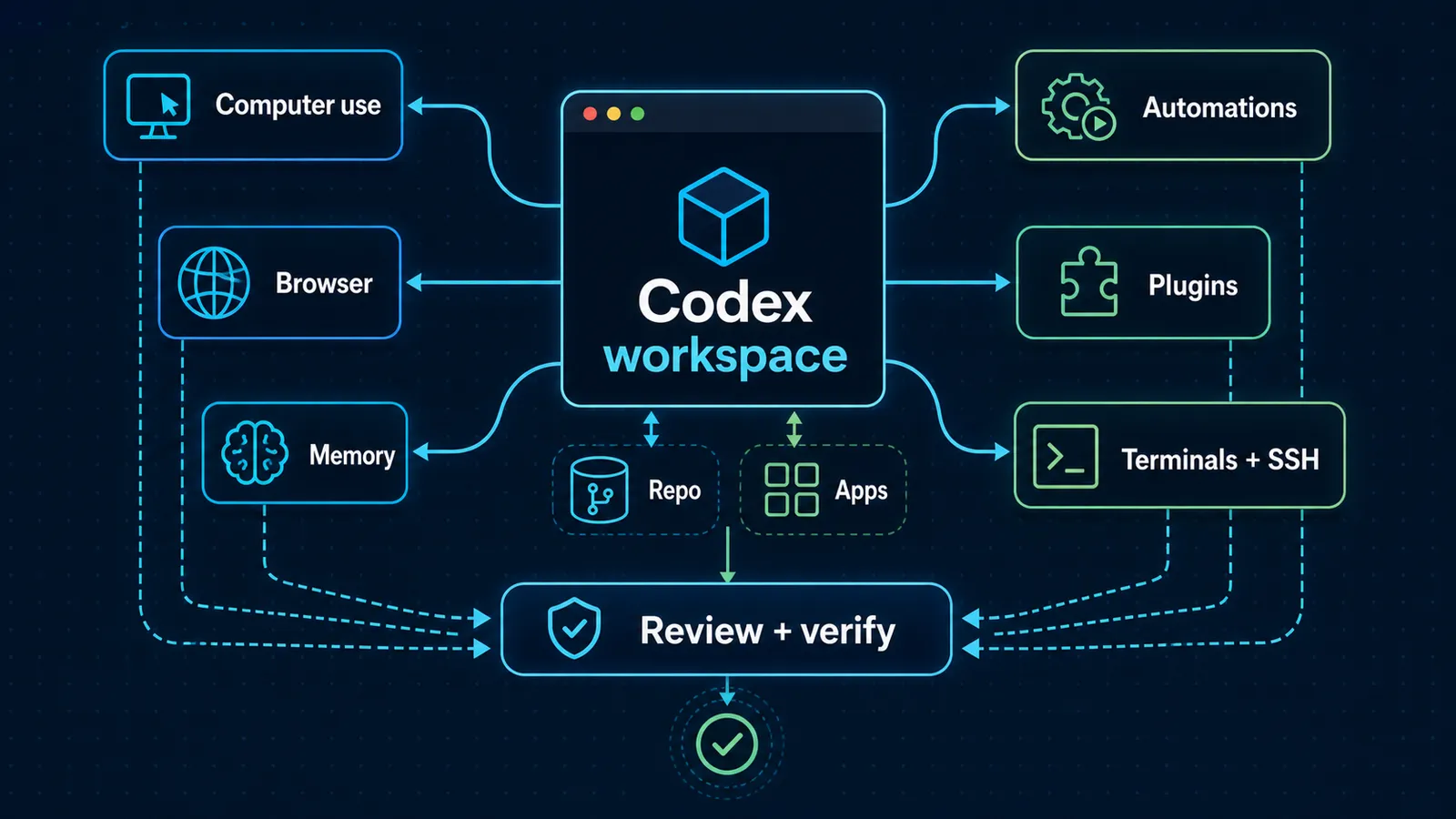
The bigger product shift is that OpenAI is trying to turn Codex into a workspace that spans:
- local coding work
- browser-based iteration
- desktop app interaction
- longer-running follow-up work
- workflow memory and recurring tasks
That is meaningfully different from the original Codex app launch in February, which was mostly about running multiple agents in parallel with isolated worktrees and reviewable diffs. (OpenAI)
Now the pitch is broader: Codex should not stop at editing files in a repo. It should stay useful while you test a frontend, inspect a browser state, handle review comments, reconnect to a remote environment, and schedule follow-up work for later.
Why background computer use matters for developers
OpenAI says Codex can now use all of the apps on your computer by seeing, clicking, and typing with its own cursor, and that multiple agents can work on a Mac in parallel without interfering with what you are doing in other apps. (OpenAI)
That matters in a few practical cases:
- testing UI changes in apps that do not expose an API
- checking frontend behavior across local tools and desktop windows
- moving across coding work and operational tooling without forcing every action through a terminal
- reducing the gap between “agent wrote code” and “agent verified the result”
The value here is not raw novelty. It is that many real developer workflows break precisely where the tooling surface stops being a repo and starts being a browser, a desktop app, or an approval-driven interface.
That said, this feature still has a real boundary: OpenAI explicitly says computer use is initially available on macOS. So if you are evaluating this from Windows, Linux, or a browser-only workflow, the launch is relevant strategically but narrower operationally.
The in-app browser may matter more than it sounds
The in-app browser is easy to underrate because “browser in the app” sounds cosmetic.
It is not.
OpenAI says you can now comment directly on pages to give Codex precise instructions, which makes the feature immediately useful for frontend work, design iteration, and game development. The post also says OpenAI plans to expand the browser so Codex can eventually command it more fully beyond localhost web apps. (OpenAI)
That is important because browser work is where a lot of coding-agent workflows still get awkward:
- the code is in one place
- the rendered behavior is in another
- screenshots and issue reports live somewhere else
An integrated browser pulls those loops closer together.
It also fits the same direction we covered in Cloudflare Browser Run: What Changed on April 15, 2026 and Why It Matters for AI Agents: browser-connected agents get more useful once the runtime becomes more observable and less brittle.
Memory and thread automations show where Codex is really heading
The most forward-looking part of the release may not be computer use at all.
OpenAI also expanded automations so Codex can re-use existing threads and wake itself later to continue long-running work, and it introduced a memory preview so Codex can remember preferences, corrections, and previously gathered context. (OpenAI)
That combination matters because it turns Codex from a session-based coding assistant into something closer to a persistent operator:
- it can carry context forward
- it can resume a task later
- it can reuse prior conversation state instead of starting cold each time
For teams, that is a bigger workflow change than “the app has more buttons.”
It means Codex is being shaped for recurring operational work, not just one-off coding prompts. That also lines up with OpenAI’s broader agent-runtime direction in the OpenAI Agents SDK sandbox update, where longer-running, file-grounded workflows are becoming first-class product surfaces.
The workflow support additions are what make the release credible
The flashy parts of the announcement will get attention. The quieter features are what make the product more usable.
OpenAI added:
- GitHub review comment handling
- multiple terminal tabs
- SSH connections to remote devboxes in alpha
- richer file previews
- a summary pane for plans, sources, and artifacts
Those changes matter because they reduce tool-switching and make agent work easier to inspect instead of just easier to launch. That is usually the difference between a demo and a real daily tool.
The supporting Help Center article also reinforces how OpenAI now positions the Codex app: as the surface for multiple agents in parallel, with built-in worktree support, skills, automations, and git functionality across ChatGPT-connected plans. (OpenAI Help Center)
Where this update fits in a real workflow
The best read on this release is not “Codex can now do everything.”
The better read is narrower:
Codex is becoming more useful for developers whose work crosses repos, browsers, desktop apps, and recurring operational loops.
You should care more about this update if you are:
- doing frontend or product iteration that needs browser verification
- supervising multiple parallel agent threads
- using Codex inside a broader ChatGPT-connected workflow
- interested in recurring automations, memory, and longer-running task handoffs
You should care less if you only need:
- lightweight CLI edits
- pure cloud code generation
- cross-platform computer use today
- a workflow that never leaves the terminal
Practical adoption checklist
| Question | Use Codex for this when… | Be cautious when… |
|---|---|---|
| Desktop access | The task needs browser or desktop verification that cannot be done from code alone. | The workflow involves sensitive apps, accounts, or approvals that should stay manual. |
| Reviewability | The agent can produce files, diffs, screenshots, summaries, or logs you can inspect. | The output would be hard to audit after the agent clicks through external tools. |
| Recurrence | Automations can safely resume a thread with bounded instructions. | The task requires fresh human judgment every time. |
| Memory | Preferences and prior corrections reduce repeated setup. | Remembered context could cause stale assumptions or wrong project carryover. |
| Platform fit | macOS computer use and ChatGPT-connected Codex workflows match your environment. | Your team needs the same computer-use behavior on Windows, Linux, or browser-only setups today. |
Bottom line
The April 16, 2026 Codex update matters because OpenAI is expanding Codex from a coding surface into a broader developer-workflow surface.
Yes, computer use on macOS is the headline. But the more important move is the package around it: browser-native iteration, repeatable automations, persistent memory, richer review flows, and tighter movement across the software development lifecycle.
That makes this a stronger release than the headline alone suggests.
The caveat is simple: the most interesting feature, computer use, is still macOS-first right now. So the launch is immediately practical for some teams and mostly directional for others.
Still, the direction is clear. Codex is no longer being positioned as just a coding agent inside a repo. OpenAI wants it to be useful across the messy surfaces where software work actually happens.
When to Use
Use this Codex workflow when the task crosses more than one surface: repo edits, local browser testing, desktop app checks, pull request feedback, terminal sessions, or scheduled follow-up work. The update is most useful when Codex can both make a change and gather enough evidence for you to review the result.
When Not to Use
Do not treat computer use as a blank check for unsupervised desktop automation. Avoid it for sensitive personal accounts, irreversible production actions, private data movement, payments, credential handling, or anything where you cannot inspect what happened afterward.
For small repo-only edits, a normal coding-agent session may still be simpler. For workflows that must be cross-platform today, remember that OpenAI described computer use as initially available on macOS, so the headline feature may not match every team’s environment yet.
SEO FAQ
What changed in the April 2026 Codex computer use update?
OpenAI’s April 16, 2026 Codex update added background computer use on macOS and paired it with broader workflow features, including an in-app browser, image generation, plugins, GitHub review-comment handling, multiple terminal tabs, SSH devbox support in alpha, automations that can reuse threads, and memory preview.
Is Codex computer use available on every platform?
OpenAI said computer use was initially available on macOS for Codex desktop app users signed in with ChatGPT. Teams using Windows, Linux, or browser-only workflows should verify current availability before planning around the feature.
Why does the in-app browser matter for Codex?
The in-app browser matters because it connects code changes to rendered behavior. It lets developers point Codex at a page, comment on the visible issue, and tighten the loop between implementation and frontend verification.
How do Codex automations and memory change the workflow?
Automations let Codex resume or continue work later, while memory can preserve preferences and prior corrections. Together, they make Codex more useful for recurring operational work, but they also require careful review so stale context does not drive the wrong behavior.
Is Codex computer use safe for sensitive workflows?
It should be used cautiously. Computer use is most appropriate when actions are bounded, observable, and reviewable. Avoid using it for credentials, payments, irreversible production changes, private data movement, or workflows where a human cannot verify the outcome.
Sources