TL;DR
The useful way to read AMD’s latest France announcement is not as a normal chip-company partnership.
It is a sovereignty signal.
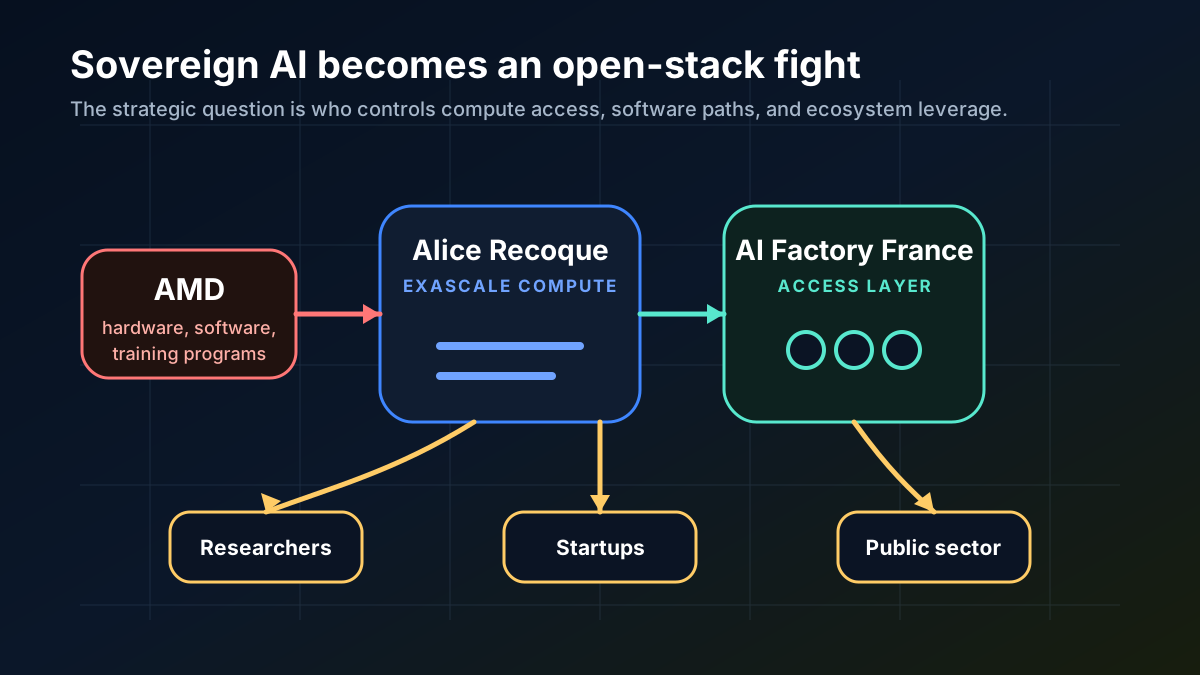
On April 16, 2026, AMD and representatives of the French government said they had signed a letter of intent to deepen cooperation around AI infrastructure, research, and training in support of France’s National Strategy for AI. AMD said the plan includes broader access to AMD hardware, software, and training for researchers, developers, educators, and startups, plus deeper work around Alice Recoque, France’s planned first exascale supercomputer, and the broader AI Factory France ecosystem. (AMD, French Ministry of the Economy)
That matters because France is no longer treating AI as just a model race or a startup-funding story.
It is trying to shape the whole stack: public compute, research access, startup tooling, training, and industrial control points.
The sharper point for builders is this:
sovereign AI is starting to mean open ecosystem leverage, not just local hosting.
What happened
AMD’s announcement makes three concrete claims.
First, the company said the new collaboration is multi-year and aimed at strengthening France’s AI ecosystem through infrastructure, research, and education.
Second, AMD said it plans to provide hardware, software, and training through programs including its AMD University Program, AMD AI Developer Program, and AMD AI Academy.
Third, AMD said it will deepen collaboration with GENCI, the Jules Verne Consortium, and CEA around Alice Recoque, with a planned Center of Excellence intended to help researchers and ecosystem participants use the machine effectively and support the broader AI Factory France effort. (AMD)
The French government’s own AI infrastructure direction gives that announcement more weight than a normal vendor press release.
The Ministry of the Economy said AI Factory France was selected under the EuroHPC program and that France will contribute existing national compute assets plus the future Alice Recoque exascale system, which it described as planned for 2026. The European Commission separately said on November 18, 2025 that Alice Recoque will sit at the center of AI Factory France, carry a total budget of about EUR355 million, and connect into a wider EuroHPC network built to support startups and SMEs across Europe. (French Ministry of the Economy, European Commission)
And Bpifrance said on March 27, 2025 that it is mobilizing EUR10 billion by 2029 to develop the French AI ecosystem and accelerate AI adoption across French companies. (Bpifrance)
So this is not a standalone AMD-France headline.
It sits inside a broader French attempt to build a national AI position that mixes public money, domestic research infrastructure, startup support, and selective partnerships with non-French vendors.
Why this matters more than a normal infrastructure deal
The easy read is that France wants more AI chips and AMD wants a stronger position in Europe.
That part is true, but it is not the interesting part.
The interesting part is that France seems to be making a more specific bet:
sovereign AI should not require dependency on a single U.S. hyperscaler or a single silicon winner.
That has three builder-relevant implications.
1. France is trying to make sovereignty compatible with ecosystem diversity
Many “sovereign AI” stories collapse into one of two models:
- build local data centers but still depend on foreign cloud control planes
- fund local champions but still inherit a very narrow hardware and software stack
This announcement points in a slightly different direction.
France is pairing:
- public and academic compute infrastructure
- startup and developer enablement
- a named exascale system
- an explicitly open ecosystem framing from AMD
That is consistent with how France has framed the broader national push. On February 11, 2025, the Elysee said more than EUR109 billion in AI infrastructure projects had been announced in France and explicitly argued the country had the electricity, grid, sites, and permitting posture needed to host dedicated AI infrastructure. (Elysee)
That does not make the stack fully independent. AMD is still a U.S. company, and France is still deeply tied to global semiconductor supply chains.
But it does suggest France wants more bargaining power inside the stack, not just more capacity.
That is a materially different goal.
2. Alice Recoque is becoming more than an HPC project
If Alice Recoque were only a science machine, this would matter mostly to academics.
But that is not how France is presenting it.
AMD ties the system directly to AI capability-building and startup support. The Ministry ties it to AI Factory France. That combination turns the machine into a national platform asset rather than a niche research installation.
For builders, the practical implication is straightforward: compute access may increasingly arrive through public-interest and ecosystem programs, not only through normal commercial cloud channels.
That can matter for:
- early-stage model work
- regulated-sector pilots
- public-private research partnerships
- companies that need domestic or EU-aligned infrastructure narratives in procurement
3. The real fight is now over the control layer around compute
Europe already has no shortage of AI rhetoric.
What it has lacked is enough control over the operating layer: who gets access to advanced systems, what software stack is privileged, how training and inference capacity is allocated, and whether local startups can build without defaulting into other companies’ platform economics.
That is why this story is more important than its surface-level wording.
AMD is not just selling chips here. It is offering a way for France to argue that sovereign AI can be:
- high-performance
- developer-accessible
- institutionally legible
- less locked to one vendor path
Whether France succeeds is still open.
But the strategic direction is clearer than before.
Who is affected
European builders selling into public sector or regulated industries
If your customers care about procurement language such as sovereignty, residency, auditability, or industrial policy alignment, this is the sort of announcement that changes the conversation.
You may start seeing stronger demand for products that can run in:
- nationally backed compute environments
- EU-aligned infrastructure programs
- mixed public-private deployment models
That does not mean every startup suddenly needs an exascale strategy.
It does mean “which cloud are you on?” is becoming less useful than “which infrastructure governance model can you support?”
Startups building on open or portable AI stacks
AMD’s explicit open-ecosystem language matters here.
France appears to be encouraging a stack where tooling, training, and compute access do not automatically collapse into one vertically integrated platform.
That is good news for teams that want:
- portable model serving
- alternatives to a single CUDA-first posture
- room to negotiate around cost, hosting, and deployment topology
It does not mean that portability is free. ROCm maturity, software compatibility, and ecosystem gravity still matter. Builders should not pretend those tradeoffs disappeared because the announcement used the word “open.”
But the policy direction is still meaningful.
Nvidia, hyperscalers, and anyone assuming Europe will stay structurally dependent
The broader French signal is that Europe wants leverage, not just supply.
We already saw the financing side of that in Mistral Raised $830M in Debt for a Paris AI Data Center. Here’s What Changes.
This AMD move highlights a different layer of the same pattern:
France wants sovereign AI to include compute access, developer enablement, and stack diversity.
That is not yet full independence.
But it is absolutely an attempt to reduce structural dependence.
What changes next
Three things are worth watching after April 16, 2026.
1. Whether France can turn infrastructure announcements into real developer access
This is the execution test.
If “AI Factory France” and the Alice Recoque ecosystem produce actual, usable pathways for startups, labs, and enterprise pilots, then France’s strategy gets more credible fast.
If the benefits stay trapped in institutional messaging and elite research access, the builder impact will be limited.
2. Whether open-stack language survives contact with production reality
AMD is leaning into an open ecosystem frame.
That is strategically smart, because it distinguishes the company from both hyperscaler lock-in and Nvidia monoculture fears.
But builders should watch the operational details:
- software compatibility
- deployment tooling
- performance tuning burden
- procurement simplicity
If those stay too hard, the open-stack pitch will remain politically attractive but commercially secondary.
3. Whether other European governments copy the model
If France can combine public funding, research infrastructure, and alternative silicon partnerships into a coherent offer, other countries will likely follow with their own versions.
That would matter a lot more than one country’s procurement story.
It would mean Europe is moving from abstract “AI sovereignty” talk toward a more distributed compute-and-platform strategy.
That, in turn, would affect how builders plan for model portability, regional deployment, and infrastructure concentration risk.
We have already been tracking the chip-and-capacity version of that concentration problem in Broadcom, Google, and Anthropic Just Turned TPU Capacity Into a Strategic Weapon and ASML’s 2026 Outlook Shows Why the AI Buildout Is Still Hardware-Led.
The France-AMD story belongs in the same category, but with a more political edge:
it is about who gets to shape the stack, not just who gets to sell into it.
Bottom line
AMD’s April 16, 2026 France agreement is easy to underread.
On the surface, it is a letter of intent around infrastructure, training, and one important supercomputer.
In practice, it is a clearer signal that sovereign AI in Europe is evolving from data-center nationalism into a fight over ecosystem control, compute access, and vendor leverage.
For builders, that changes the right question.
Not “is Europe building AI?”
That answer is already yes.
The better question is:
what kind of AI stack will Europe be able to build without defaulting to someone else’s operating model?
France’s move with AMD is one of the more concrete recent attempts to answer that.
SEO FAQ
What is AI Factory France?
AI Factory France is a EuroHPC-backed initiative that combines existing French national compute assets with the planned Alice Recoque exascale supercomputer. It was selected under the European Commission’s EuroHPC program with a total budget of about EUR355 million and is designed to give startups, SMEs, and researchers access to large-scale AI compute.
Does AMD’s France deal mean France is moving away from Nvidia?
Not necessarily. The deal signals France wants vendor diversity in its sovereign AI stack, but it does not replace existing Nvidia infrastructure. France is betting that an open-ecosystem approach with AMD gives it more leverage and reduces single-vendor dependency over time.
What is Alice Recoque?
Alice Recoque is France’s planned first exascale supercomputer, expected in 2026. It is named after a French computer scientist and sits at the center of AI Factory France. The system is intended to support AI research, startup access, and public-interest compute alongside traditional HPC workloads.
How does sovereign AI affect builders outside France?
If France’s model works, other European governments may adopt similar approaches. That means builders selling into regulated or public-sector markets may need to support nationally backed compute environments, EU-aligned infrastructure, and mixed public-private deployment models — not just standard hyperscaler offerings.
Sources
- amd.com — 2026 4 16 Amd And The French Government Announce Plans To Advance
- presse.economie.gouv.fr — Ai Factory France La France Laureate Du Programme Europeen Eurohpc
- bpifrance.com — Bpifrance Deploys E10 Billion To Develop The Ai Ecosystem And Facilitate The Adoption Of
- digital-strategy.ec.europa.eu — Alice Recoque Europes Second Exascale Supercomputer Its Way
- elysee.fr — Make France An Ai Powerhouse