TL;DR
If you have been searching for whether Claude Cowork is still a preview feature, the short answer is now clearer:
On April 9, 2026, Anthropic said Claude Cowork became generally available on macOS and Windows through the Claude Desktop app.
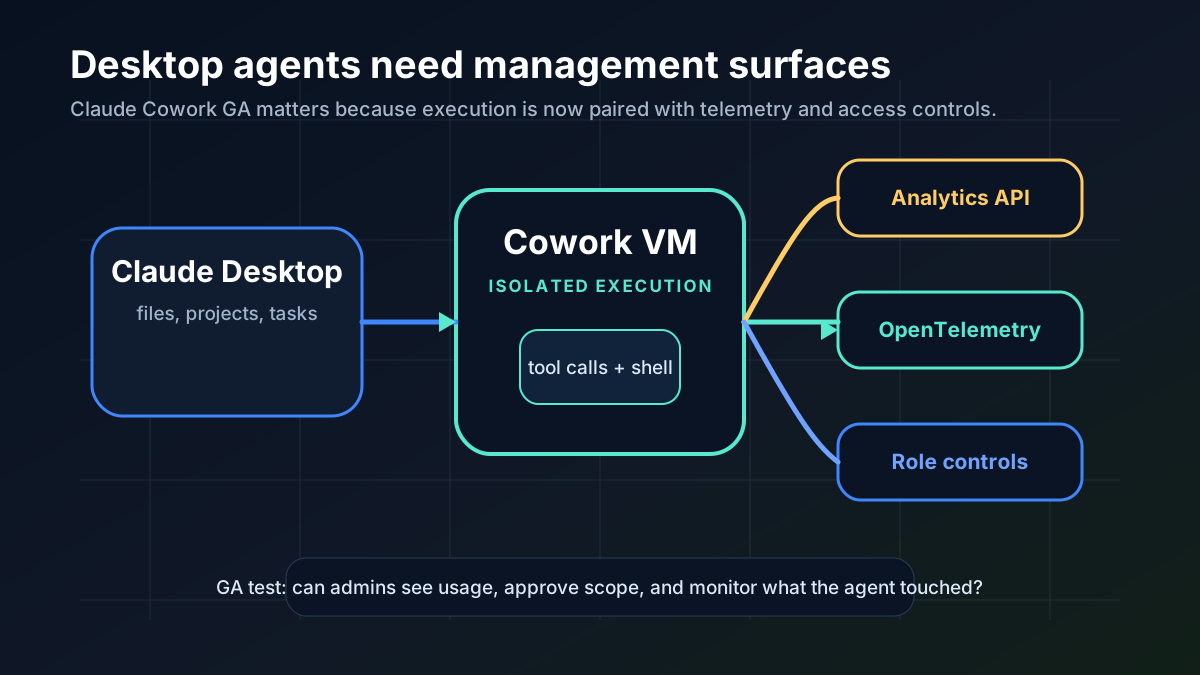
That matters because Anthropic did not just remove preview language. It paired general availability with the kinds of controls that make a desktop agent more usable inside real organizations: Analytics API coverage, usage analytics, OpenTelemetry support, and Enterprise role-based access controls. (Anthropic release notes)
The bigger story is not “Anthropic has another agent mode.” It is that desktop agents are turning into managed work surfaces with telemetry, access policy, and workflow boundaries, not just more autonomy. That is the same shift we have already seen across coding tools like GitHub Copilot in VS Code, Vercel Sandbox, and OpenAI Codex.
What Claude Cowork actually is
Claude Cowork is Anthropic’s task-oriented mode inside Claude Desktop. Anthropic says it runs directly on your computer, can access the files you choose to share, executes code and shell commands inside an isolated virtual machine, and can break complex work into subtasks or parallel workstreams when appropriate. Anthropic also says finished outputs are delivered back to your local filesystem. (Get started with Claude Cowork)
That is an important distinction.
Cowork is not just chat with a bigger context window. It is Anthropic’s answer to the question: what should an agent workspace look like when it can actually act on a desktop machine?
According to Anthropic’s current help docs, Cowork is available only in the desktop app, not on the web, and requires a paid Claude plan. The same getting-started guide says Cowork supports global instructions, folder instructions, plugins, projects, and scheduled tasks. (Get started with Claude Cowork)
What changed on April 9, 2026
Anthropic’s release notes list four concrete changes tied to the April 9, 2026 general-availability move.
1. Claude Cowork is now generally available on macOS and Windows
This is the headline change.
Earlier 2026 Cowork releases were explicitly staged as a research preview and expanded gradually by plan and platform. Anthropic’s January 12 release introduced Cowork in research preview for Max users on macOS. On January 16, Anthropic expanded that preview to Pro users on macOS. The April 9 note is the first release note that explicitly says generally available on macOS and Windows. (Anthropic release notes)
That shift matters for branded search because teams evaluating Cowork are no longer just asking whether the feature exists. They are asking whether it has crossed into a state that Anthropic is willing to treat as a normal product surface.
2. Cowork activity now shows up in Anthropic’s Analytics API
Anthropic says Cowork is now included in the Claude Enterprise Analytics API. The Analytics API gives organizations programmatic access to daily engagement and adoption data, and Anthropic’s usage docs now show Cowork-specific analytics including Cowork sessions per day, the percentage of users with one or more Cowork sessions, and daily, weekly, and monthly active Cowork users. (Anthropic release notes, View usage analytics for Team and Enterprise plans)
This is a meaningful product change because desktop agents are hard to operationalize if they disappear into individual laptops.
Once Cowork usage can be measured centrally, organizations can start answering practical questions:
- which teams are actually using Cowork
- whether usage is broadening or stalling
- whether the feature is producing enough task throughput to justify rollout
- which parts of the organization may need training, policy, or tighter controls
3. Cowork now has OpenTelemetry support
Anthropic’s help docs say Team and Enterprise owners can now stream Cowork events to SIEM and observability tools through OpenTelemetry. The article specifically calls out visibility into tool calls, file access, and human approval decisions. (Use Claude Cowork on Team and Enterprise plans)
That is one of the most important details in the whole launch.
Agent products become much easier to defend internally once security and platform teams can see what the agent touched, what it asked to do, and where human approvals happened. This does not magically make a desktop agent safe, but it does move Cowork closer to a system that can participate in a normal enterprise observability stack.
It also fits the broader pattern we covered in LLM Tracing Without Lock-In: A Practical OpenTelemetry Stack: OpenTelemetry is increasingly the boring infrastructure layer that makes AI workflows governable.
4. Enterprise plans now get role-based access controls
Anthropic’s April 9 release notes also introduced role-based access controls for Enterprise plans. Anthropic says admins can organize users into groups, manually or via SCIM, and assign custom roles defining which Claude capabilities members can use. The setup docs give examples like enabling Cowork for Engineering while giving other departments a narrower Claude feature set. (Anthropic release notes, Set up role-based permissions on Enterprise plans)
This matters because “everyone gets the same agent permissions” is not a serious governance model.
The teams that should have access to local-file automation, code execution, or heavier agent workflows are not always the same teams that just need chat, search, or projects. Anthropic’s new role model is a sign that Cowork is being positioned less like an experimental premium perk and more like a capability that needs staged rollout.
Why this launch matters for developers
For individual users, Claude Cowork general availability mainly means the feature is easier to take seriously.
For teams, the important point is different:
Anthropic is finally adding the admin and monitoring surface that desktop agents need before they can spread safely inside an organization.
That makes Cowork more interesting in four real workflow situations.
1. Knowledge-work and desktop-task automation
Anthropic positions Cowork beyond coding. The docs emphasize file-based tasks, projects, recurring tasks, and plugins that bundle skills, connectors, and sub-agents. If your work involves repeatable desktop tasks rather than pure software engineering, Cowork now looks more like a first-class product lane instead of a preview experiment. (Get started with Claude Cowork)
2. Mixed technical and non-technical teams
The new Enterprise role system matters because Cowork is not only for engineers. Anthropic’s own role-planning examples split access by function, such as giving Engineering Cowork plus Claude Code while giving Business or Research narrower capability sets. That is exactly how most real rollouts happen. (Set up role-based permissions on Enterprise plans)
3. Security and observability-conscious organizations
OpenTelemetry support gives Cowork a better story for organizations that need visibility before they expand access. Anthropic is also explicit that Cowork still has meaningful compliance limitations: one support article says Cowork activity is not captured in Audit Logs, the Compliance API, or Data Exports, and Anthropic advises against enabling Cowork for regulated workloads that require audit trails. (Use Claude Cowork on Team and Enterprise plans)
That combination is the honest read:
- Cowork is more observable than it was before
- Cowork is still not equivalent to a full enterprise audit and compliance surface
If you are security-conscious, that nuance matters more than the GA label.
4. Teams evaluating agent workflows beyond the IDE
Cowork sits in an interesting slot between Claude Code and general chat.
It inherits some of the same agentic ideas that are now spreading across coding tools: plans, subtasks, parallel work, file outputs, plugins, and long-running execution. But it applies them to a broader desktop context. In that sense, Cowork matters even if you never use Anthropic as your primary coding tool, because it is another example of the market converging on the same interface shape: chat plus tools is not enough; the product needs task execution, policy, memory, and monitoring.
One nuance worth knowing: Anthropic’s docs are still in transition
There is a documentation wrinkle here.
Anthropic’s April 9, 2026 release note clearly says Claude Cowork is generally available on macOS and Windows. But Anthropic’s current Team and Enterprise guidance page still contains some older preview-era wording in its availability section. The page was updated after the April 9 release and also includes the newer OpenTelemetry and access-control guidance. (Anthropic release notes, Use Claude Cowork on Team and Enterprise plans)
The reasonable inference is that Anthropic’s documentation is in the middle of a transition from preview-era admin guidance to GA positioning.
That does not invalidate the launch. But if you are checking multiple Anthropic help pages and seeing slightly different language, that is likely why.
Should you care about Claude Cowork now?
You probably should if your team is evaluating any of the following:
- desktop agent workflows that need local file access
- recurring task automation inside a managed desktop app
- staged enterprise rollout of agent capabilities
- observability for agent actions without building a custom stack from scratch
You should care less if your needs are purely browser-based, highly regulated, or already satisfied by an IDE-native agent plus a separate governance layer.
Cowork also does not erase the underlying risk model. Anthropic’s own support docs warn about prompt injection risk, sensitive-file handling, and compliance gaps. If you are adopting desktop agents, the right operating model is still the one we have argued for elsewhere: AI Coding Agents Need Guardrails, Not More Autonomy.
Bottom line
The most important thing that happened on April 9, 2026 is not just that Anthropic changed a label from preview to GA.
It is that Claude Cowork now has enough analytics, telemetry, and access policy around it to look more like a deployable team product than a power-user experiment.
That does not mean every organization should turn it on everywhere. Anthropic’s own docs give you reasons to stay cautious.
But if you have been wondering whether Claude Cowork is becoming a real platform surface worth evaluating, the answer is now much closer to yes.
SEO FAQ
Is Claude Cowork generally available?
Anthropic’s April 9, 2026 release notes say Claude Cowork is generally available on macOS and Windows through the Claude Desktop app. Some support pages still include transition-era wording, so teams should confirm plan and admin availability inside their own Claude tenant.
What is Claude Cowork used for?
Claude Cowork is used for task-oriented desktop work in Claude Desktop. Anthropic describes it as a mode that can work with selected local files, run code and shell commands in an isolated virtual machine, use projects and plugins, and return outputs to the local filesystem.
Why do analytics and OpenTelemetry matter for Claude Cowork?
Analytics and OpenTelemetry matter because desktop agents are hard to govern if their activity is invisible. Cowork analytics help teams see adoption, while OpenTelemetry events can help security and platform teams observe tool calls, file access, and approval decisions.
Should regulated teams enable Claude Cowork everywhere?
No. Anthropic’s own Team and Enterprise guidance notes compliance limitations around Cowork activity, including areas where it is not equivalent to full audit-log coverage. Regulated teams should start with limited groups, narrow permissions, and explicit data-handling rules.
Sources