TL;DR
If you are trying to understand whether California just created a new AI regulator, the answer is no.
What California did on March 30, 2026 is narrower and, in some ways, more practical.
Governor Gavin Newsom signed Executive Order N-5-26, directing state agencies to design new procurement certifications, contractor responsibility reforms, supply-chain review procedures, and watermarking guidance for AI-related purchases and deployments across California government. Most of the deliverables are due within 120 days, which means July 28, 2026. (Executive Order N-5-26, Governor of California)
The useful read is this:
California is trying to use procurement, not just legislation, to shape how AI vendors prove they can be trusted.
That matters because procurement is one of the few levers states clearly still control even while Washington keeps pushing for lighter-touch federal rules. As AP noted on March 20, 2026, the White House framework argues that Congress should preempt some burdensome state AI laws, but it does not argue that states should lose control over how they buy and use AI themselves. (AP)
That makes this order more important than it may first look.
It is not a symbolic press release. It is an attempt to turn California’s purchasing power into a de facto policy instrument.
What California actually ordered on March 30, 2026
The order does not immediately impose a new licensing scheme on private AI companies.
Instead, it tells multiple state agencies to come back with recommendations and guidance that could later be built into real state contracting processes.
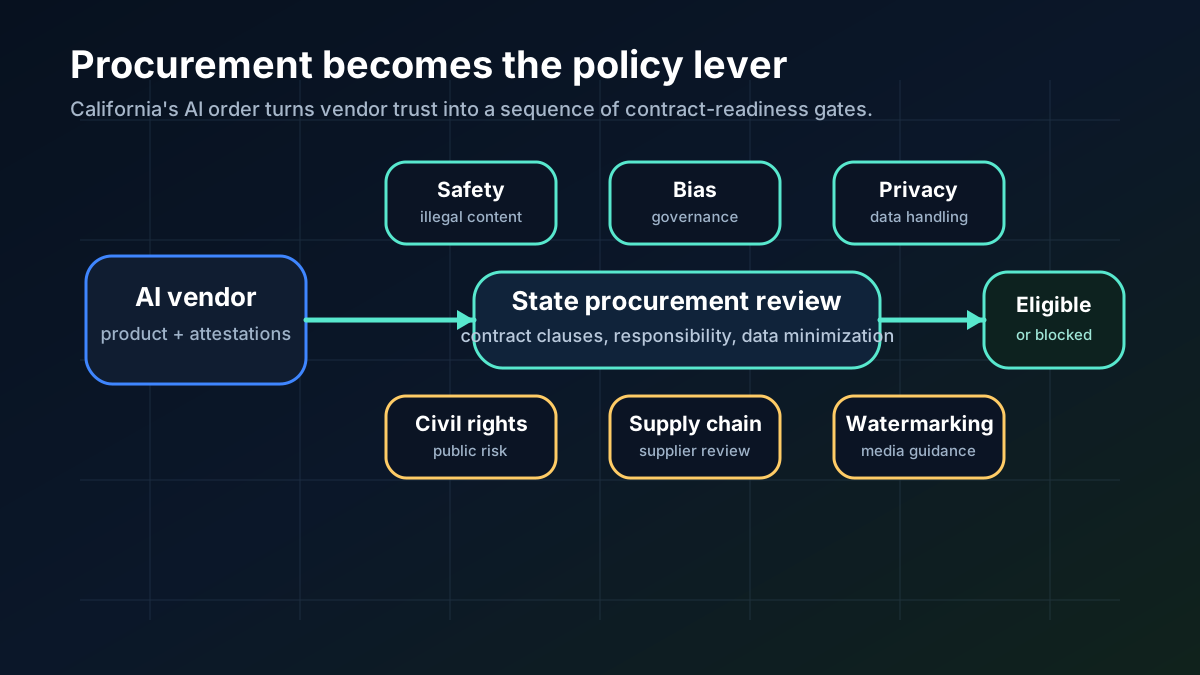
The biggest directives are concentrated in five areas.
1. New vendor certifications for state contracting
The California Department of General Services and Department of Technology must recommend, within 120 days, new certifications that may be incorporated into state contracting processes.
The order says vendors seeking to do business with California may need to attest to and explain their policies and safeguards around:
- exploitation or distribution of illegal content, including child sexual abuse material and non-consensual intimate imagery
- models that display harmful bias or lack governance to reduce that risk
- violations of civil rights and civil liberties, including unlawful discrimination, detention, and surveillance
That is the center of gravity.
California is not saying, “tell us your benchmark score.” It is saying, “show us your governance posture in the categories that create public-sector risk.” (Executive Order N-5-26)
2. A state review path for federal supply-chain designations
The order also directs California’s state Chief Information Security Officer to review any new federal company designations made as supply-chain risks.
If the CISO concludes such a designation is improper, the order says California agencies should receive joint guidance so they can continue procuring from that company. The CISO may also review other federal procurement changes to assess whether they improperly restrict state procurement.
That is not normal procurement housekeeping. It is California explicitly building a mechanism to avoid automatically inheriting every federal AI supplier judgment. (Executive Order N-5-26)
3. Contractor responsibility reforms tied to privacy and civil liberties
Within the same 120-day window, the Government Operations Agency must recommend reforms to contractor responsibility provisions, including suspension and ineligibility authorities, so the state does not contract with entities judicially determined to have unlawfully undermined privacy or civil liberties.
That matters because it moves the conversation from abstract “responsible AI” language toward actual eligibility consequences in the procurement pipeline.
4. Expanded internal AI adoption across California government
The order is not only restrictive.
It also tells state agencies to expand vetted employee access to GenAI tools, share procurement and adoption best practices, update the State Digital Strategy, and develop a pilot application or website using GenAI to help Californians navigate government services organized by life event, such as disaster relief, starting a business, or finding a job. (Executive Order N-5-26, Governor of California)
So the order is not anti-adoption.
It is trying to pair faster use of AI inside government with a stricter qualification bar for the vendors providing it.
5. Watermarking and data minimization guidance
The order also directs the California Department of Technology, within 120 days, to issue best-practice guidance for departments and agencies to appropriately watermark AI-generated or significantly manipulated images or video, consistent with California law.
On the operations side, it also calls for a data minimization toolkit with best practices, templates, special contract provisions, and review checklists for agencies handling sensitive data.
That combination matters for builders because it tells you California is not looking only at model outputs. It is also looking at handling rules, contract language, and operational review. (Executive Order N-5-26)
Why this is more consequential than it sounds
The easy take is that this is just one state executive order.
That undersells it.
The stronger interpretation is that California is testing a path other governments can copy:
- do not wait for Congress to settle private-sector AI law
- use procurement rules to demand disclosures and safeguards now
- tie vendor trustworthiness to privacy, bias, civil liberties, and security controls
- keep deploying AI internally where the state sees operational value
This is also why the order is materially different from the broader federal-state fight we covered in The White House Wants One Federal AI Rulebook. Here’s What That Means..
That earlier fight is about who gets to regulate AI development more broadly.
This one is about something more immediate:
what a state can demand before it buys, deploys, or scales AI inside real government workflows.
For vendors, that can matter faster than a major federal bill.
What it means for AI vendors right now
If you sell AI products into government, the order is a warning that “good enough for enterprise” may not be good enough for public-sector procurement.
The most practical preparation steps are pretty obvious.
1. Expect attestation pressure, not just feature demos
Teams should assume California will want structured answers on:
- content abuse controls
- harmful bias governance
- privacy protections
- civil-liberties safeguards
- surveillance-related limitations
If those answers currently live only in scattered blog posts, internal wikis, or sales calls, that is weak positioning.
2. Treat procurement documentation as part of product readiness
This order favors vendors that can explain policy and operational controls cleanly.
That means:
- documented escalation and incident response
- explicit prohibited-use language
- auditability and governance artifacts
- data handling and minimization policies
- clear explanations of how risk controls actually work
The legal effect is not immediate, but the procurement signal is. DLA Piper’s April 6 analysis puts it clearly: the order creates a framework for recommendations and guidance first, yet those recommendations can mature into real attestation and disclosure requirements for companies seeking California contracts. (DLA Piper)
3. Public-sector AI security is now partly a supply-chain positioning problem
The CISO review section is especially important.
California is reserving room to question federal supply-chain designations instead of automatically treating them as final. That means vendors operating in politically sensitive or contested procurement environments may face a more complicated map:
- one federal view of supplier risk
- another state-level procurement response
- and a growing need to prove operational trustworthiness in both contexts
For builder teams, this looks less like traditional compliance and more like market access engineering.
What this does not do
It is also important not to overstate the order.
This is not a new California licensing law for all AI developers.
It does not directly create private rights of action. The order itself says it is not intended to create enforceable rights or benefits against the state or any other person. (Executive Order N-5-26)
So the correct framing is not “California already imposed binding new obligations on every AI company.”
The correct framing is:
California started the administrative process for turning procurement into a stronger AI governance tool, with July 28, 2026 as the first serious deadline.
That distinction matters, especially for builders trying to separate real obligations from political messaging.
Why builders should care even if they never sell to California
Because this is how policy often spreads.
Large buyers create qualification standards. Other governments copy them. Enterprise procurement teams start borrowing the same language. Then “voluntary” documentation becomes table stakes.
We have already seen a similar pattern in AI security, where once real-world failures become visible, the market starts demanding controls that were previously treated as optional. That is the same broader lesson behind Anthropic Project Glasswing Is a Warning Shot for AI Security Teams: the control surface around AI systems matters as much as the model itself.
California’s order applies that logic to procurement.
Instead of arguing first about model ideology, benchmarks, or frontier thresholds, it starts with a simpler question:
what should a government buyer demand from an AI vendor before deployment?
That is a question many other buyers will ask too.
Bottom line
California’s March 30, 2026 executive order matters because it shows a more practical path for state AI governance.
Rather than waiting for Congress to settle the whole federal-state fight, California is using the lever it already controls: procurement.
By July 28, 2026, state agencies are supposed to deliver recommendations on vendor certifications, contractor responsibility reforms, data minimization, watermarking guidance, and state AI adoption practices. That does not instantly rewrite the market. But it does tell vendors where the market is heading.
The builder takeaway is simple:
if your AI product cannot clearly explain its safeguards around illegal content, bias, privacy, civil liberties, and operational controls, California is signaling that future government buyers may treat that as a procurement problem, not a PR problem.
SEO FAQ
Does California’s Executive Order N-5-26 create new AI licensing requirements?
No. The order does not create a licensing scheme for AI developers. It directs state agencies to develop procurement certifications, contractor responsibility reforms, and vendor attestation requirements that may be built into California state contracting processes by July 28, 2026.
What do AI vendors need to attest to under this order?
Vendors seeking California state contracts may need to attest to their policies on illegal content distribution (including CSAM and non-consensual imagery), harmful bias governance, civil rights and civil liberties protections, and surveillance-related limitations. The order focuses on governance posture, not benchmark scores.
Does this order affect companies that don’t sell to California government?
Not directly. But procurement standards from large buyers often spread. Other governments may copy California’s approach, and enterprise procurement teams may borrow similar attestation language. What starts as a state requirement can become de facto market expectations.
What is the July 28, 2026 deadline?
July 28, 2026 is 120 days after the March 30 signing. By that date, the California Department of General Services, Department of Technology, and Government Operations Agency must deliver recommendations on vendor certifications, contractor responsibility reforms, watermarking guidance, and data minimization best practices.
Sources
- gov.ca.gov — As Trump Rolls Back Protections Governor Newsom Signs First Of Its Kind Executive Order
- gov.ca.gov — 3.30 Final Trusted Ai Procurement Eo N 5 26 Attested
- apnews.com — White House Donald Trump Artificial Intelligence 479Eb3D0A50Fe7237678A9Bfb146Ac7A
- dlapiper.com — California Governor Issues Executive Order On Ai Procurement Standards