TL;DR
If you have been searching for whether Claude Opus 4.7 is a real new release or just another routing-layer update, the short answer is:
Anthropic launched Claude Opus 4.7 on April 16, 2026 as its new generally available top-end model for coding, agentic work, and complex professional tasks.
This is a meaningful release, not a cosmetic model rename.
Anthropic says Opus 4.7 improves coding, vision, and complex multi-step task performance, while current Claude API docs position it as the recommended replacement for older Opus variants on the API. Vercel also published a dedicated AI Gateway rollout note for the model on April 16, 2026, which matters because it put the new model into a workflow developers can actually adopt quickly. (Anthropic Opus page, Claude API models overview, Claude API model deprecations, Vercel release note)
The useful framing is not “Anthropic made Opus smarter again.”
The useful framing is that Anthropic is pushing Opus harder toward long-running coding agents, multi-tool execution, and visual verification work at the same time it is tightening the migration path away from older Claude API models.
What actually launched on April 16, 2026
Anthropic’s official Opus page lists Claude Opus 4.7 as new on April 16, 2026 and describes it as a hybrid reasoning model focused on stronger coding, vision, and complex multi-step work. Anthropic also says it is now available:
- in Claude for paid users
- on the Claude Platform
- through Amazon Bedrock
- through Google Cloud Vertex AI
- through Microsoft Foundry
Anthropic’s current model docs list the API ID as claude-opus-4-7. The same model overview says Opus 4.7 has:
- a 1 million token context window
- up to 128k output tokens
- adaptive thinking
- moderate latency relative to Sonnet and Haiku
- pricing of $5 per million input tokens and $25 per million output tokens
Those details matter because they make this a real platform-level release, not just a Claude app update. (Anthropic Opus page, Claude API models overview)
What changed for developers
The launch is easiest to understand through four practical changes.
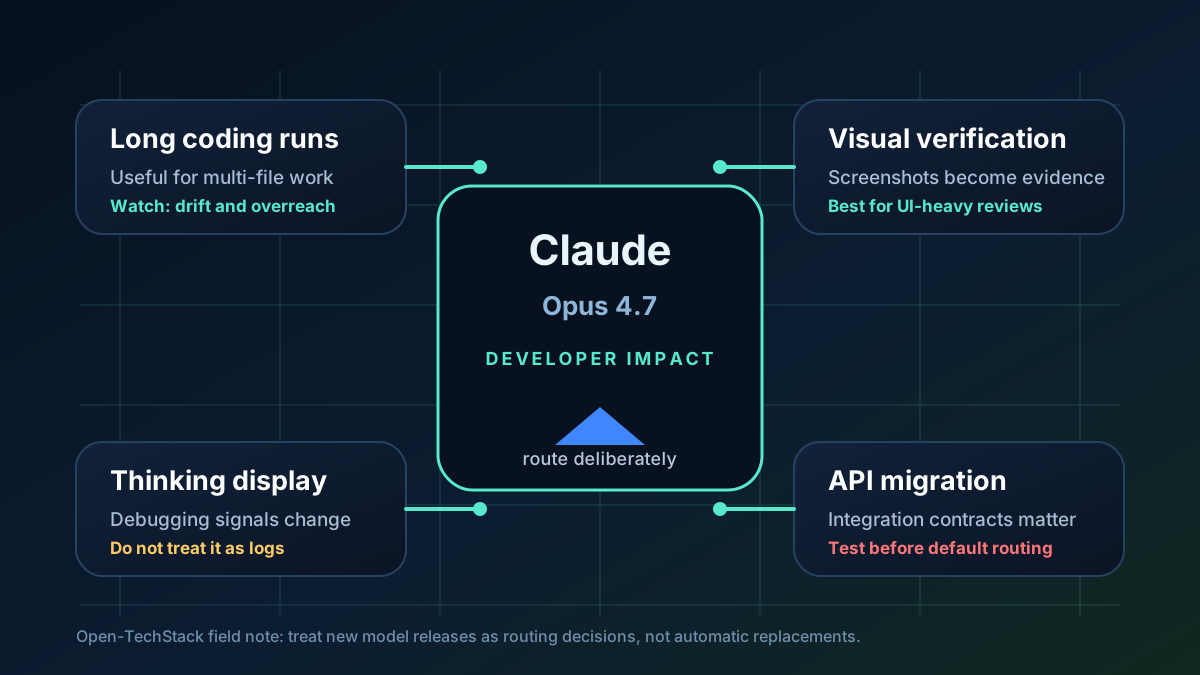
1. Anthropic is clearly steering heavy coding work toward Opus 4.7
Anthropic’s product page describes Opus 4.7 as its most capable generally available model and explicitly positions it for:
- professional software engineering
- sophisticated AI agents
- complex document work
- multi-day enterprise workflows
That alone would be typical launch language, but the surrounding evidence makes the positioning more concrete.
Anthropic’s model deprecations page says that on April 14, 2026, developers using claude-opus-4-20250514 were notified of retirement on June 15, 2026, with claude-opus-4-7 named as the recommended replacement. (Claude API model deprecations)
That is the part developers should pay attention to.
Anthropic is not just offering Opus 4.7 as an optional premium upgrade. It is using the release to simplify the top end of the API lineup and make Opus 4.7 the forward path.
2. The model is aimed at long-running agent workflows, not just chat quality
Anthropic’s Opus page repeatedly emphasizes sustained execution, memory, and reliability across multi-step work. Vercel’s April 16, 2026 AI Gateway release note is even more direct, describing Opus 4.7 as optimized for long-running, asynchronous agents and for complex tasks where the model may need to visually verify its own outputs. Vercel also says the model is stronger at programmatic tool calling with image-processing libraries and high-resolution image analysis. (Anthropic Opus page, Vercel release note)
That combination matters because it pushes Opus 4.7 into a narrower but more valuable part of the market:
- code agents that run for a while instead of answering once
- workflows that inspect screenshots, charts, diagrams, or documents
- agents that need to keep state straight across multiple steps
- higher-cost tasks where dropped facts or tool failure are more expensive than model latency
This is also why the launch matters more than a normal benchmark story. A model that is merely “better at coding” is easy to ignore. A model that is better at staying on task across long, tool-heavy runs changes what teams can automate with acceptable risk.
3. Opus 4.7 changes how thinking output behaves
Anthropic’s current docs say that on Claude Opus 4.7, thinking display defaults to "omitted" rather than "summarized". That means if you want summarized reasoning content returned in the API response, you now need to set display: "summarized" explicitly. Anthropic also notes that billed output still reflects the full generated thinking, not just the visible summary. (Claude API extended thinking docs)
That is a small but important implementation detail.
Developers who rely on visible reasoning summaries for debugging or product UX should not assume Opus 4.7 behaves like older Claude 4 defaults. This is the kind of change that quietly breaks internal expectations if you upgrade without checking the docs.
4. The launch already landed in a real developer distribution surface
On April 16, 2026, Vercel published a release note adding anthropic/claude-opus-4.7 to AI Gateway. The announcement shows developers can call the model through AI SDK and use new options like effort: 'xhigh' and taskBudget on the gateway integration. (Vercel release note)
That matters because new model launches only become relevant to most teams once they show up inside normal tooling.
The gateway angle makes Opus 4.7 easier to test inside:
- existing AI SDK applications
- routed multi-provider stacks
- usage-tracked team workflows
- model playground evaluation loops
That is the same practical pattern we saw in our earlier piece on Claude Opus 4.6 Fast Mode on Vercel AI Gateway: the model release gets more interesting once it reaches a production-friendly surface instead of staying trapped in provider marketing.
It also fits the larger shift we covered in Claude Cowork Is Now Generally Available, where Anthropic’s product direction is moving toward instrumented, durable agent work rather than one-shot chat answers.
Where Opus 4.7 fits in real workflows
For most teams, the real question is not whether Opus 4.7 is impressive.
It is whether Opus 4.7 is the right expensive model for the right expensive jobs.
Based on Anthropic’s current documentation and launch positioning, the strongest fit looks like this:
- high-context coding and debugging inside large codebases
- long-running async agents that need to recover from failure instead of stopping halfway
- screenshot-heavy or diagram-heavy workflows
- document analysis where precision and source discipline matter
- premium internal tools where reliability matters more than raw throughput cost
The weaker fit looks familiar:
- fast everyday chat
- routine automation at scale
- low-margin background generation
- simple classification or extraction
- teams that mostly care about speed-per-dollar
That is why Opus 4.7 does not invalidate cheaper models. It sharpens the split.
If Sonnet-class models are the default for broad usage, Opus 4.7 looks like the model you reach for when the workflow is expensive enough that one failed long-running attempt costs more than the extra tokens.
That logic also lines up with our broader argument in AI Coding Agents Need Guardrails, Not More Autonomy: the valuable part of agent progress is not raw independence. It is reliable execution inside bounded workflows.
Why this launch matters more than the benchmark sheet
The benchmarks and customer quotes on Anthropic’s launch page are designed to show that Opus 4.7 is stronger than Opus 4.6. That is useful, but it is not the most important thing.
The bigger signal is the package around the model:
- Anthropic made Opus 4.7 the new flagship general-availability path
- Anthropic updated docs and migration guidance around it immediately
- older Opus API variants were put on a retirement path
- a major integration layer shipped the model right away
That is what makes the launch actionable.
If you build AI products, you do not just need to know that a model got better. You need to know whether:
- it is broadly available
- it has a stable API identifier
- the migration path is real
- the docs have already changed
- the model is showing up in tooling your team actually uses
On those criteria, Opus 4.7 looks like a genuine adoption event, not just a press-cycle event.
Bottom line
Claude Opus 4.7 is the real new top-end Claude release developers should evaluate right now.
On April 16, 2026, Anthropic launched the model as its most capable generally available option for coding, AI agents, and complex professional work. The surrounding docs show a clear migration signal: Anthropic is already steering older Opus API users toward it, and Vercel’s April 16, 2026 AI Gateway rollout means teams can test it quickly in a familiar stack. (Anthropic Opus page, Claude API model deprecations, Vercel release note)
For developers, the right interpretation is simple:
Opus 4.7 is not “Claude, but a bit better.” It is Anthropic’s latest attempt to make premium coding and agent workflows more reliable over long runs, with better visual verification and a cleaner upgrade path for serious API users.
That does not make it the default model for everything. It makes it one of the clearest models to test when your workflow is expensive enough that reliability, memory, and multi-step execution quality matter more than token frugality.
When to Use
Use Claude Opus 4.7 when the task is expensive enough that failed execution, missed context, or weak visual reasoning costs more than the extra model spend. The strongest fits are long-running coding agents, large-codebase debugging, complex document analysis, high-context reviews, and workflows that need screenshots, diagrams, or visual verification.
It is also a good evaluation target when you are migrating from older Opus API variants. Anthropic’s docs position claude-opus-4-7 as the forward path for older Opus users, so teams with existing Opus workflows should test behavior, latency, cost, and thinking-display changes before the migration deadline.
When Not to Use
Do not make Opus 4.7 the default model for routine background work without a cost reason. Fast chat, simple extraction, classification, small transformations, and high-volume low-margin automation usually fit cheaper or lower-latency models better.
Be cautious when product UX depends on visible reasoning summaries. Anthropic’s extended-thinking docs say Opus 4.7 defaults thinking display to omitted, so teams that rely on summarized reasoning should configure that explicitly and confirm billing expectations before rollout.
SEO FAQ
What is Claude Opus 4.7?
Claude Opus 4.7 is Anthropic’s generally available top-end Claude model released on April 16, 2026, positioned for coding, agentic work, vision, complex document analysis, and multi-step professional workflows.
What is the Claude Opus 4.7 API model ID?
Anthropic’s model documentation lists the API ID as claude-opus-4-7. Developers should confirm current model IDs in the Claude API docs before updating production code.
Why does Claude Opus 4.7 matter for developers?
It matters because Anthropic is steering premium coding and long-running agent workflows toward Opus 4.7, while also documenting migration guidance from older Opus variants. The release affects model selection, cost planning, reasoning display, and integration testing.
Is Claude Opus 4.7 the best default model for every workload?
No. Opus 4.7 is best for harder, higher-value workflows where reliability and context handling matter more than cost. Simpler or high-volume tasks may be better served by faster and cheaper models.
What should teams test before migrating to Claude Opus 4.7?
Teams should test output quality, latency, cost, long-context behavior, visual verification, tool-calling reliability, and the extended-thinking display setting. They should also compare results against the older Opus model they are replacing.
Sources