TL;DR
If you have been searching for what changed in the OpenAI Agents SDK this week, the short answer is simple:
On April 15, 2026, OpenAI turned the SDK into something much closer to a real agent runtime for file-based work, not just a convenient orchestration library.
That is the important shift.
The launch adds a model-native harness plus native sandbox execution for Python, so agents can work over filesystems, run commands, edit files, and resume longer tasks inside controlled environments. OpenAI also tied the release to a more explicit security and durability story: keep the agent harness separate from the compute environment where model-generated code runs, externalize state, and make sandbox work portable across providers. (OpenAI, Agents SDK docs, GitHub repo)
That matters because most “agent framework” discussions still skip the part that usually breaks in production:
- where the files live
- where commands run
- how long-running work resumes
- how you keep model-written code away from sensitive credentials
What changed on April 15, 2026
OpenAI’s product post says the updated SDK now includes:
- a more capable harness for agents working with documents, files, and systems
- configurable memory
- Codex-like filesystem tools
- standardized integration with MCP, skills, AGENTS.md, shell access, and patch-based file editing
- native sandbox execution so agents can run in controlled computer environments with the files, tools, and dependencies they need
OpenAI also says the new capabilities are available to all customers through standard API pricing, with the new harness and sandbox path launching first in Python. TypeScript support is planned later, not part of this release. (OpenAI)
At the package level, the open-source repository says Sandbox Agents are new in version 0.14.0, and the repo showed v0.14.1 as the latest release on April 15, 2026 when this piece was written. (GitHub repo)
The real product change is not “agents can use shell”
That would be too small a read.
The bigger change is that OpenAI is packaging a stronger opinion about how frontier agents should be structured.
The launch post explicitly frames the harness around patterns that look a lot like what serious coding and research agents already need:
- filesystem-aware tools
- shell execution
- patch-based edits
- skills
- AGENTS.md instruction loading
- MCP tool connectivity
In other words, OpenAI is not just adding another tool call.
It is moving the SDK closer to the operating pattern used by coding agents that need to inspect a workspace, manipulate real files, run verification steps, and stay grounded in local context instead of improvising from a single prompt.
If you want the setup side rather than the product-update side, How to Use OpenAI Agents SDK with MCP and Approvals (2026) is still the practical implementation guide. This article is about the April 15 release itself.
What sandbox agents actually are
The docs are clearer than the marketing copy here.
OpenAI’s sandbox guide says modern agents work best when they can operate on real files in a filesystem, and that Sandbox Agents are meant for workflows where the workspace is part of the product design. The docs describe:
SandboxAgentas the agent definition plus sandbox defaultsManifestas the contract for the fresh workspaceSandboxRunConfigas the per-run configuration that injects, resumes, or creates the sandbox session- saved state and snapshots as the mechanism for continuing later work
That is a more useful abstraction than “an agent with tools.”
It means the SDK now has a first-class model for:
- starting from a GitHub repo, local directory, or remote storage mount
- persisting workspace state across runs
- switching sandbox clients without rewriting the agent definition
- combining sandbox-native work with local tools and MCP servers on the same agent
The docs also make an important distinction many launch summaries will miss:
- if you do not need access to files or a living filesystem, keep using a normal
Agent - if shell access is just an occasional capability, hosted shell may be enough
- if the workspace boundary itself matters, use sandbox agents
That is the right framing. Not every agent should become a sandbox workload. (Sandbox guide)
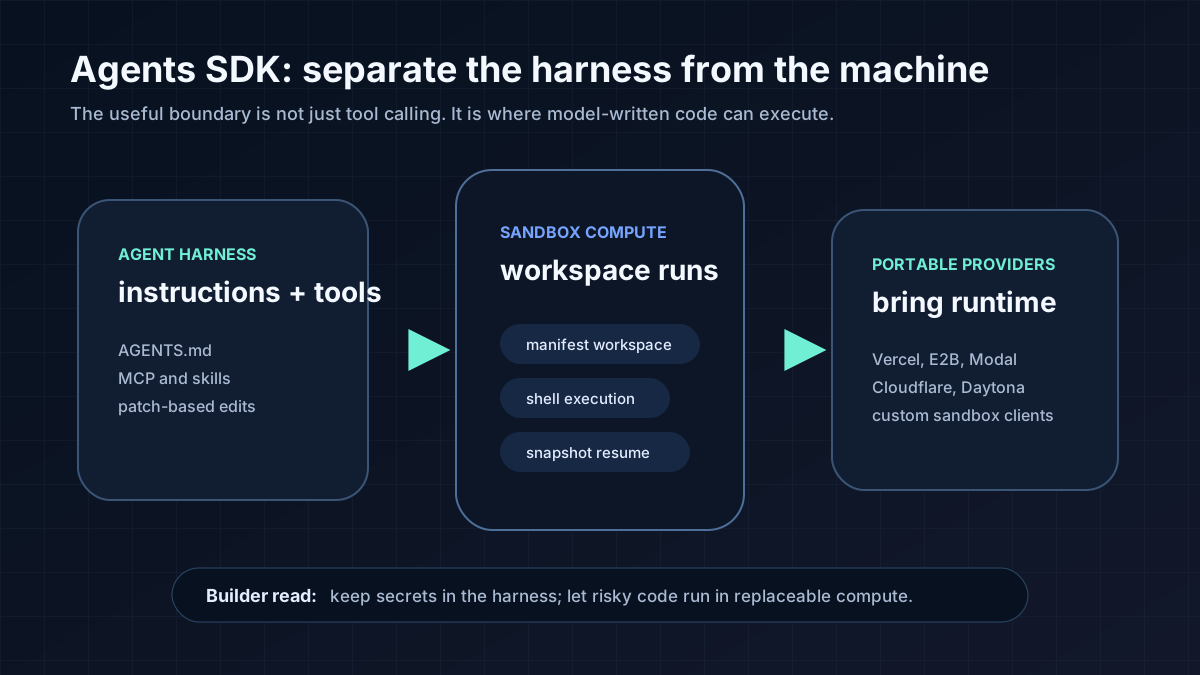
Why the harness-compute split is the most important part
The strongest section in OpenAI’s announcement is the one about security, durability, and scale.
OpenAI says agent systems should be designed assuming prompt injection and exfiltration attempts, and argues that separating the harness from the compute layer helps keep credentials out of environments where model-generated code executes. The same separation also enables snapshotting and rehydration, so the system can continue a run in a fresh container if the original sandbox expires or fails. (OpenAI)
That is the part builders should take seriously.
The market has too many “agent” demos that quietly assume:
- the model can run arbitrary commands near secrets
- the workspace and the control plane are the same machine
- long-running tasks never fail mid-run
Those assumptions are fine for demos and bad for production.
This launch is OpenAI acknowledging that the agent runtime is not just about model quality. It is about execution boundaries.
That lines up with the argument we made in AI Coding Agents Need Guardrails, Not More Autonomy: the useful question is no longer whether an agent can act. It is whether the action surface is structured well enough to review and contain.
OpenAI is also trying to make the runtime portable
OpenAI says developers can bring their own sandbox or use built-in support for Blaxel, Cloudflare, Daytona, E2B, Modal, Runloop, and Vercel. The launch also introduces a Manifest abstraction for shaping the workspace and mounting data from sources including AWS S3, Google Cloud Storage, Azure Blob Storage, and Cloudflare R2. (OpenAI, Sandbox guide)
That matters because it gives the SDK a stronger portability story than “use OpenAI’s runtime exactly our way.”
The design seems to be:
- keep the model-side harness opinionated
- keep the compute layer swappable
- let the same agent definition move from local development to hosted execution with fewer rewrites
That is a better story for teams that want the OpenAI model/runtime pairing but do not want to hard-code themselves into one execution provider.
The nuance you should not miss: available now does not mean fully settled
This release has one tension that is worth stating directly.
OpenAI’s product post says the new Agents SDK capabilities are available now to all customers via the API under standard pricing.
But the sandbox guide itself labels sandbox agents as a beta feature and says the API details, defaults, and supported capabilities may change before general availability. (OpenAI, Sandbox guide)
So the honest read is:
- the capability is publicly usable now
- the design direction is clear
- the exact sandbox-agent surface is still stabilizing
That should affect adoption decisions.
If you are building an internal prototype or a controlled developer workflow, this is early enough to start.
If you are standardizing a broad production platform around it, keep some tolerance for API churn.
What this means for developers right now
You should care about this update if you are building:
- coding agents that need a real workspace, not just tool calls
- long-running file-grounded workflows such as document review, report generation, or repo maintenance
- agent systems that need resumability, snapshots, or cleaner execution isolation
- Python-first workflows where you want stronger defaults without building the harness yourself
You should care less if you only need:
- single-turn agents
- lightweight tool calling
- ordinary function tools with no filesystem state
- TypeScript-first parity today
The practical conclusion is not “every OpenAI agent should use sandbox agents.”
It is this:
OpenAI now has a much more credible answer for the class of agents that need to behave like bounded operators inside a workspace.
That makes the SDK more relevant for developer tools, internal copilots, and coding workflows than it was a week ago.
It also pushes the product closer to the broader “agent runtime” conversation happening across the market, where the real competition is no longer just model access. It is about who provides the most workable combination of tools, state, isolation, and control.
Bottom line
The April 15, 2026 OpenAI Agents SDK update is not just an SDK increment.
It is OpenAI making a stronger claim about how agents should be built:
- closer to files and real systems
- inside explicit sandbox boundaries
- with resumable state
- with portable execution providers
- and with a cleaner separation between orchestration and code execution
That is the right direction.
The main caveat is that the sandbox-agent surface is still marked beta in the docs, so this is better read as a serious public step toward a production agent runtime than as a fully settled end state.
For developers evaluating agent stacks in April 2026, that is enough to make the release worth paying attention to.
When to Use
Use OpenAI Agents SDK sandbox agents when the workspace is part of the product: the agent needs files, shell access, patches, saved state, snapshots, or a sandbox provider boundary. The best fit is a bounded workflow where the harness can orchestrate work while generated code runs in a separate compute environment.
This is especially relevant for coding agents, document pipelines, repo maintenance, report generation, migration assistants, and internal tools where resumability and reviewability matter more than a single function call.
When Not to Use
Do not default to sandbox agents for every agent. If the workflow is a single-turn response, a normal tool-calling agent, or a simple function call with no filesystem state, the sandbox layer adds complexity without much benefit.
Be cautious with production standardization while the sandbox-agent API is still marked beta. For broad rollout, isolate secrets from generated code, review snapshots and state handling, and avoid assuming the sandbox provider surface will remain unchanged.
SEO FAQ
What changed in the April 2026 OpenAI Agents SDK update?
OpenAI added a more capable agent harness and native sandbox execution support for Python workflows. The update focuses on filesystem-aware agents, shell access, patches, MCP, skills, AGENTS.md instruction loading, memory, and resumable sandbox work.
What are sandbox agents in the OpenAI Agents SDK?
Sandbox agents are Agents SDK constructs for workflows where the agent needs a living workspace. They can operate over files, run commands in a sandbox, save state, and resume work through snapshots or provider-backed sessions.
When should developers use sandbox agents instead of a normal Agent?
Use sandbox agents when the workspace boundary matters: repo work, document workflows, long-running file tasks, or execution that should happen in a controlled environment. For ordinary tool calls or single-turn workflows, a normal Agent is usually simpler.
Why does the harness-compute split matter?
Separating the agent harness from the compute environment helps keep orchestration, credentials, and generated code execution in different layers. That makes it easier to reason about prompt injection risk, state recovery, and sandbox portability.
Is the Agents SDK sandbox feature generally available?
The feature is publicly usable, but the sandbox guide labels sandbox agents as beta. Developers should expect some API or capability changes before treating the surface as fully stable.
Sources