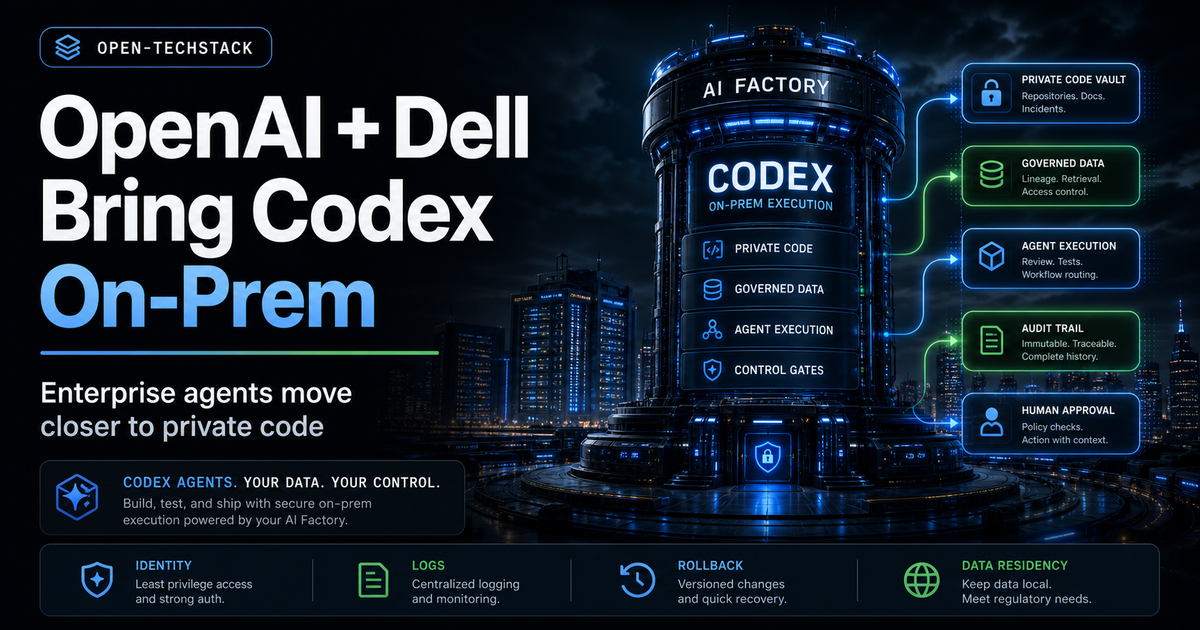
OpenAI and Dell are turning Codex into a more serious enterprise infrastructure story.
On May 18, 2026, OpenAI announced a partnership with Dell Technologies to bring Codex into hybrid and on-premises enterprise environments. The stated goal is straightforward: help customers deploy Codex where their codebases, documentation, business systems, operational knowledge, and workflows already live.
That matters because the most useful coding and workflow agents are rarely blocked by model intelligence alone. They are blocked by access to private context, data residency rules, infrastructure policy, cost controls, and security evidence.
The real question is not “can Codex write code?” The enterprise question is sharper: can Codex operate close enough to private enterprise data to be useful, while still leaving enough proof that it stayed inside the rules?
This is independent Open-TechStack analysis. It is not official OpenAI or Dell guidance, legal advice, procurement advice, or a sponsored post.
TL;DR
OpenAI says Codex is becoming one of its fastest-growing enterprise products, with more than 4 million developers using it weekly. The company also says Codex is expanding beyond coding into agent workflows such as gathering context across tools, preparing reports, routing product feedback, qualifying leads, writing follow-ups, and coordinating work across business systems.
Dell’s side of the story is broader. At Dell Technologies World 2026, Dell framed its AI Factory as distributed enterprise infrastructure for agentic AI, with Dell AI Data Platform, on-premises AI Factory deployments, deskside agentic systems, and ecosystem support that includes OpenAI Codex.
The practical read:
- Codex is moving from a cloud-first coding assistant story toward a hybrid enterprise-agent story.
- Dell gives OpenAI a path into infrastructure and data platforms that large companies already buy and operate.
- The strongest use cases are likely code review, test coverage, incident response, large-repository reasoning, internal report prep, and workflow coordination.
- The biggest risk is treating “on-prem” as automatic safety. It is not.
- Teams still need identity controls, secret handling, network policy, audit logs, rollback, cost accounting, and human approval gates.
What changed
OpenAI’s announcement says the partnership with Dell is intended to help enterprises deploy Codex in the environments where their important data, systems, and workflows already live. It specifically points to the Dell AI Data Platform and Dell AI Factory as examples of the enterprise environments Codex needs to work across.
The timing is not isolated. Dell’s May 18 Dell Technologies World coverage says Dell and OpenAI are building an on-premises solution based on OpenAI Codex, connecting GPT and GPT-Codex models through the Dell AI Data Platform. Dell also announced broader AI Factory moves around agentic AI, local deployments, data foundations, and infrastructure from deskside workstations to data-center systems.
That combination changes the shape of the market. Instead of coding agents being positioned only as developer tools that sit outside the enterprise perimeter, they are being pulled into the infrastructure conversation: where compute runs, where data lives, how governance works, and how costs are managed.
Why this is a bigger deal than another Codex integration
Most enterprise AI pilots fail in the space between “the model can do it” and “the organization can allow it.”
For Codex, the hard problems usually look like this:
- The agent needs repository context, but the source code cannot leave a controlled environment.
- The agent needs incident history, but tickets and logs contain sensitive customer data.
- The agent needs to run tests, but CI secrets and internal package registries must stay protected.
- The agent needs to inspect business systems, but every action must be logged and reversible.
- The agent saves time, but uncontrolled token and infrastructure usage becomes a new cost center.
Putting Codex closer to Dell-managed enterprise data and infrastructure does not solve all of those problems. It does, however, make them easier to frame as architecture decisions rather than ad hoc exceptions.
That is why this announcement is worth watching. The enterprise agent market is shifting from “which model is best?” to “which deployment model lets us use the model on real work?”
Who should care
This is most relevant to:
- platform engineering teams managing internal developer tooling
- CIO and CTO teams planning enterprise AI infrastructure
- security teams evaluating AI agents near private code and data
- regulated-industry teams that cannot treat public-cloud AI as the default path
- software organizations with large monorepos, private CI systems, or high incident volume
- IT teams already standardizing on Dell infrastructure or Dell AI Factory components
It is less urgent for small teams already comfortable with cloud-hosted agents and low-sensitivity repositories. For them, the practical benefit may not justify the added infrastructure and governance overhead.
Decision matrix
Use this before piloting Codex in a hybrid or on-premises environment.
| Team situation | Recommended move | Why |
|---|---|---|
| You already use Codex for code review or tests | Pilot a private-context workflow | You can compare value against existing cloud workflows. |
| Your repositories contain sensitive IP | Evaluate with strict read/write boundaries | On-prem placement helps, but permissions still matter. |
| You need agents to inspect logs, tickets, and docs | Start with read-only retrieval | Prove context quality before allowing actions. |
| You run regulated workloads | Require audit evidence before rollout | Data locality is not enough without logs and review. |
| You struggle with API token costs | Model the full workload cost | On-prem economics depend on utilization, hardware, ops, and support. |
| Your dev platform is fragmented | Wait until ownership is clear | Agents amplify weak platform boundaries. |
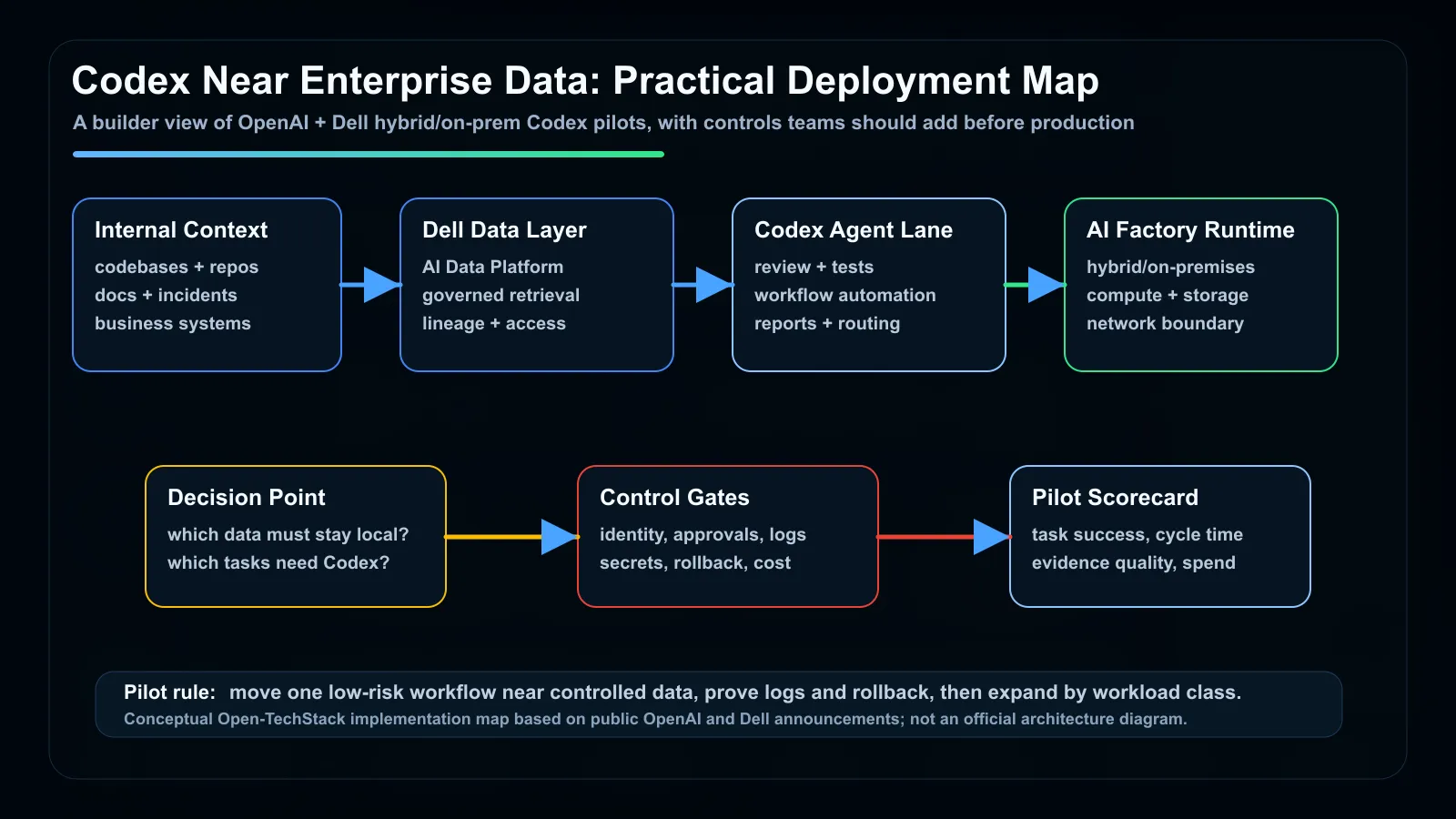
The highest-value pilot is not “let Codex work on everything.” It is one constrained workflow where Codex can access enough private context to beat a generic assistant while staying easy to inspect.
A practical rollout checklist
Start with one workflow and one ownership boundary.
Good first candidates:
- code review summaries for one repository
- test-failure triage for one CI lane
- incident timeline reconstruction from sanitized tickets and logs
- dependency update planning for one service family
- internal documentation refresh from approved source folders
Before turning it on, define:
- Data boundary: which repositories, docs, tickets, logs, and systems can Codex see?
- Action boundary: can it only suggest, or can it create branches, run commands, and open tickets?
- Secret boundary: which credentials are explicitly unavailable to the agent?
- Network boundary: which internal domains and package registries can the environment reach?
- Approval boundary: what requires human acceptance before it becomes real work?
- Evidence boundary: what logs, diffs, commands, and artifacts must be retained?
- Cost boundary: what is the per-task cost target and stop condition?
- Rollback boundary: how do you undo a bad change, bad ticket update, or bad recommendation?
That checklist sounds basic, but it is where most agent deployments either become durable or turn into demo debt.
What not to assume
Do not assume “on-prem” means safe.
On-premises infrastructure can reduce data movement and improve control, but an agent with the wrong access can still leak secrets, make bad changes, overreach across systems, or produce convincing but incorrect operational summaries.
Do not assume local deployment automatically lowers cost either. Dell’s messaging emphasizes predictable cost and local control, and that may be compelling for high-volume workloads. But the real math depends on utilization, hardware lifecycle, support, energy, staff time, workload shape, and how much agent traffic you can actually move from cloud APIs to local infrastructure.
Do not assume this is only about developers. OpenAI’s announcement explicitly points beyond software development into reports, feedback routing, follow-ups, and coordination across business systems. That makes governance more important, not less, because the agent is moving closer to operational workflows.
How it fits with the broader agent-platform race
This partnership sits alongside a broader pattern in 2026: major AI vendors are trying to bring agents closer to enterprise execution environments.
OpenAI has been expanding Codex and Managed Agents through enterprise channels. Anthropic has been moving Claude Managed Agents toward self-hosted sandboxes and private MCP connectivity. Google used I/O 2026 to position Antigravity 2.0, Managed Agents in the Gemini API, and the Interactions API as a fuller developer-agent stack.
The shared direction is clear: agents are leaving the chat box and moving into controlled execution layers.
Related Open-TechStack reads:
- Google Antigravity 2.0 and Managed Agents
- Claude Managed Agents Add Self-Hosted Sandboxes and MCP Tunnels
- OpenAI Agents SDK, Sandbox Agents, and Approvals
- AI Agent Observability Stack 2026
- How to Use OpenAI Agents SDK with MCP and Approvals
Bottom line
OpenAI and Dell’s Codex partnership matters because it moves enterprise agents closer to the places where enterprise work actually happens: private code, internal documentation, operational systems, governed data, and controlled infrastructure.
The smart move is a narrow pilot, not a broad rollout. Pick one high-friction workflow, put Codex near the minimum private context it needs, restrict actions, prove auditability, measure cost, and require human acceptance before expanding.
If the pilot cannot produce reliable evidence, it is not ready for production. If it can, this becomes one of the more important enterprise-agent deployment paths to watch in 2026.
FAQ
Is this the same as running Codex entirely offline?
Not based on the public announcement. The announcement is about bringing Codex into hybrid and on-premises enterprise environments, not a blanket claim that every Codex capability runs fully offline. Teams should verify the actual deployment model, data flows, and support boundaries before procurement.
Does on-premises Codex remove the need for security review?
No. Local or hybrid placement can help with data control, but teams still need identity, logging, approvals, network policy, secrets isolation, and rollback.
What is the first workflow to test?
Start with read-only code review summaries, test-failure triage, or incident timeline reconstruction. These are useful enough to measure but bounded enough to inspect.
Should this replace cloud-hosted coding agents?
Not automatically. The best architecture may be split: low-risk work in cloud-hosted agents, sensitive workflows near private data, and production actions behind human approval gates.
Sources
- OpenAI — OpenAI and Dell Technologies partner to bring Codex to hybrid and on-premises enterprise environments
- Dell — Dell Technologies World: A Bright and Beautiful Road Ahead
- Dell — Dell Technologies Delivers Production-Ready Agentic AI from Deskside to Data Center
- Dell — Dell Technologies World: Blueprint for the AI-Native Enterprise