TL;DR
The headline is that Anthropic committed more than $100 billion to AWS over the next decade.
The more important story is what that commitment buys.
On April 20, 2026, Anthropic said it signed a new agreement with Amazon to secure up to 5 gigawatts of capacity for training and deploying Claude. The company said the commitment spans Graviton and Trainium2 through Trainium4, includes new capacity coming online in Q2 2026, and expands inference capacity in Asia and Europe. Amazon is also investing $5 billion in Anthropic immediately, with the option for up to another $20 billion in the future. (Anthropic)
If you read this only as a financing story, you miss the point.
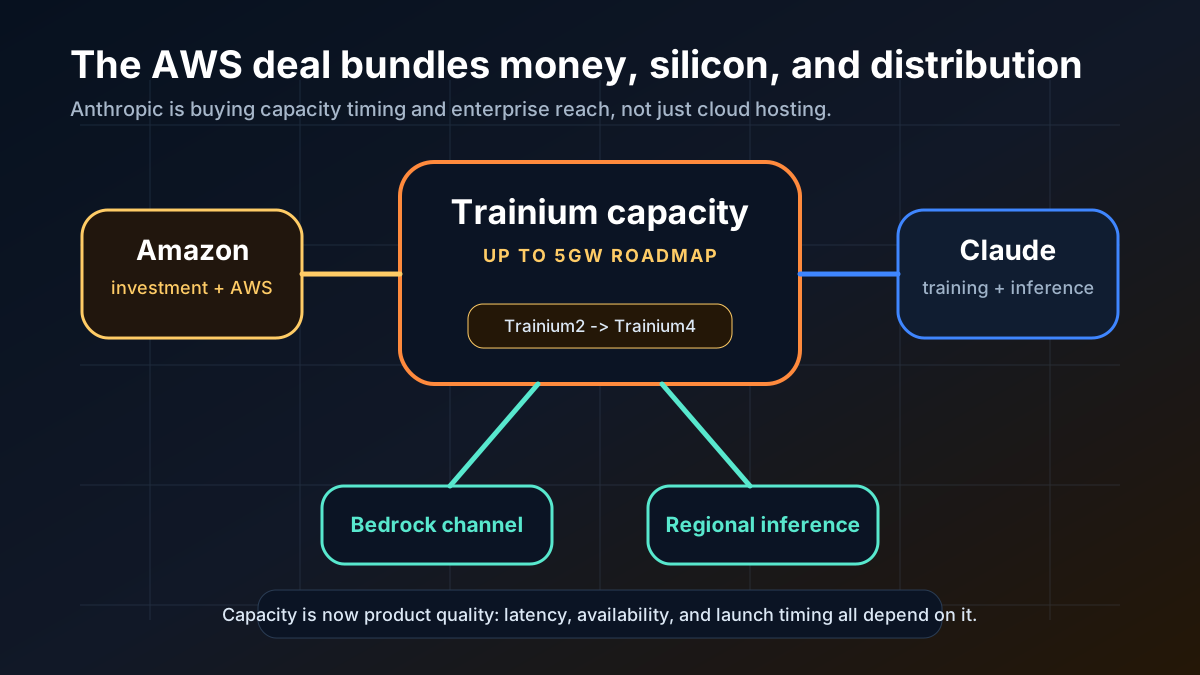
This is really a compute reservation, chip adoption, and distribution-channel deal wrapped into one announcement.
What happened
Anthropic’s April 20 post lays out three separate moves.
1. Anthropic is reserving a very large slice of AWS capacity
Anthropic said it is committing more than $100 billion over ten years to AWS technologies in exchange for up to 5GW of new capacity to train and run Claude. The agreement covers current and future generations of Amazon’s custom silicon, not just existing hardware. Anthropic also said meaningful new compute should arrive within the next three months and that nearly 1GW of total Trainium2 and Trainium3 capacity is expected before the end of 2026. (Anthropic)
That matters because frontier model competition is increasingly constrained by who can secure power, chips, and data-center capacity early enough to matter.
2. Amazon is deepening both the equity relationship and the product relationship
Anthropic said Amazon is investing $5 billion today, with up to $20 billion more later, building on the $8 billion Amazon had previously invested. Anthropic also said the full Claude Platform will become available directly inside AWS with the same account, billing, and governance controls customers already use there. Anthropic updated the post on April 21, 2026 to clarify that Claude Platform on AWS is coming soon, not already generally available. (Anthropic)
That clarification matters because the distribution layer is part of the real story here. AWS is not only financing Anthropic and supplying chips. It is becoming an even tighter enterprise access point for Claude.
3. Anthropic is responding to demand and reliability strain in public
Anthropic said its run-rate revenue has now surpassed $30 billion, up from roughly $9 billion at the end of 2025, and admitted that rapid consumer growth has affected reliability and performance for free, Pro, Max, and Team users during peak periods. (Anthropic)
That is one of the most useful parts of the announcement.
It turns a vague “compute race” narrative into a concrete operating problem: if Claude demand is rising fast enough to hurt product reliability, then capacity is not a background input. It is product quality.
Why this matters more than the investment number
The easy interpretation is that Amazon just bought more exposure to a top AI lab.
The better interpretation is that Anthropic has decided that long-term infrastructure dependence is preferable to short-term compute uncertainty.
That shows up in three ways.
1. Claude is getting more tightly bundled with AWS
Anthropic already had a deep AWS relationship. In November 2024, it said AWS had become its primary cloud and training partner and described close work with Annapurna Labs on future Trainium hardware and the AWS Neuron stack. (Anthropic)
The April 2026 deal pushes that much further.
Now the relationship includes:
- reserved long-term capacity on Amazon silicon
- direct Claude Platform distribution inside AWS
- Bedrock expansion for inference workloads
- new regional capacity in Asia and Europe
That combination makes AWS more than a supplier. It makes AWS part of Claude’s go-to-market and operating model.
For builders, this means the practical question is shifting from:
Can I call Claude from AWS?
to:
How much of my Claude deployment, governance, and procurement path will end up defaulting to AWS?
That is the same broader platform dynamic we already saw from the other side in OpenAI Says Enterprise Is 40% of Revenue. The Real Story Is Platform Control.
2. Anthropic is building a moat out of capacity timing, not just model quality
Anthropic’s official post says new capacity starts arriving in Q2 2026 and that nearly 1GW should come online by year-end. That timing matters because reserved capacity is only strategically useful if it lands early enough to affect model training schedules and inference reliability.
Amazon’s own February 2026 earnings release helps explain why Anthropic wants this locked in now. Amazon said Trainium2 powers Project Rainier, described as the world’s largest operational AI compute cluster with 500,000+ Trainium2 chips, and that Trainium3 production workloads are already underway with nearly all supply expected to be committed by mid-2026. (Amazon)
In other words, this is not a vague future-facing partnership. It is happening in a market where the next hardware generation is already getting spoken for.
That makes the deal less about financial theater and more about getting in front of the queue.
3. Anthropic is choosing dependence, but diversifying the dependence
There is an obvious risk in leaning harder on a hyperscaler that also has its own AI ambitions.
Anthropic appears to know that. Its own prior announcements show a multi-platform compute strategy:
- In October 2025, Anthropic said it was expanding Google Cloud usage, including up to one million TPUs, in a deal worth tens of billions of dollars and expected to bring well over a gigawatt of capacity online in 2026. (Anthropic)
- In February 2026, Anthropic said Claude remains available across AWS, Google Cloud, and Microsoft Azure, and that the company trains and runs Claude on AWS Trainium, Google TPUs, and NVIDIA GPUs. (Anthropic)
So the right read is not that Anthropic is becoming AWS-exclusive everywhere.
The better read is that Anthropic is becoming more AWS-dependent at the infrastructure and distribution layer while still hedging at the hardware and cloud level.
That is a rational compromise, but it is still a compromise.
Who is affected
Builders already standardizing on AWS
If your stack already lives inside AWS, this is good news in the near term.
Anthropic says the full Claude Platform is coming directly into AWS with the same controls and billing model customers already use. That should reduce friction for procurement, governance, and access management once it ships. It also means teams that prefer keeping models and application infrastructure in one cloud may get a cleaner path to adopting Claude features without additional vendor sprawl. (Anthropic)
Enterprise buyers comparing model vendors
This announcement is a reminder that model choice is becoming inseparable from cloud topology.
If one vendor can offer:
- more predictable reserved capacity
- tighter governance inside your existing cloud
- regional inference coverage
- fewer procurement layers
that vendor can win even before benchmark comparisons get decisive.
This is one reason AI competition increasingly looks like infrastructure strategy. We saw a different version of the same logic in Microsoft Takes Over OpenAI’s Abilene Expansion. The Real Story Is Forecasting.
Competing labs and cloud platforms
Anthropic’s move also puts pressure on other labs to explain their own compute story more concretely.
It is not enough anymore to imply that capacity exists somewhere in the stack. Buyers increasingly need to know:
- where the models run
- which hardware they depend on
- how much capacity is truly reserved
- whether product reliability can keep up with demand
Anthropic has now disclosed more of that than many peers do.
What changes next
Three practical consequences are worth watching after April 20, 2026.
1. Claude on AWS becomes a stronger enterprise default
If Claude Platform on AWS launches cleanly, AWS becomes harder to ignore as the default channel for enterprises that want Claude plus familiar governance controls. That would not make AWS the only Claude path, but it would make it the lowest-friction one for a large class of buyers.
2. Amazon’s custom silicon strategy gets a stronger proof point
Andy Jassy said Anthropic’s decade-long Trainium commitment reflects progress on Amazon’s custom AI silicon. That matters because custom silicon only becomes strategically credible when a top frontier lab is willing to anchor on it for both training and inference over multiple generations. (Anthropic)
If Anthropic successfully scales Claude on Trainium2 through Trainium4, Amazon will have a much stronger argument that its AI stack is not just cloud distribution with rented NVIDIA economics on top.
3. Reliability will become a more visible competitive metric
Anthropic’s admission that rapid usage growth strained reliability is more revealing than many polished announcements. It implies that the next phase of frontier AI competition will be judged not only by benchmark scores or flashy launches, but by whether labs can keep products responsive while demand spikes.
That is a builder-relevant metric. For many teams, the operational question is not “which model is smartest on paper?” It is “which model will still be fast and available when our workflow depends on it?”
Bottom line
Anthropic’s April 20, 2026 AWS expansion is easy to summarize as a giant cloud spend plus another Amazon investment.
That summary is incomplete.
The deeper story is that Anthropic is turning AWS into a bigger part of Claude’s long-term operating system: It is that Anthropic is turning AWS into a bigger part of Claude’s long-term operating system:
- a chip roadmap
- a capacity moat
- an enterprise distribution channel
- a governance and billing layer
For a look at how infrastructure financing is shaping up in a different region and with a different model, see Mistral Raised $830M in Debt for a Paris AI Data Center. Here’s What Changes., which shows European AI moving from equity to debt-financed compute.
For builders, that means the market is getting less abstract.
The future of frontier AI will not be decided only by which lab trains the best model. It will also be decided by which lab can lock in enough compute, route enough demand, and make that capacity show up where customers already work.
SEO FAQ
How much is Anthropic paying AWS over the deal’s lifetime?
Anthropic committed more than $100 billion to AWS technologies over the next decade. Amazon separately invested $5 billion immediately with the option for up to another $20 billion, building on $8 billion it had previously invested.
Does this deal make Claude AWS-exclusive?
No. Anthropic confirmed in February 2026 that Claude remains available across AWS, Google Cloud, and Microsoft Azure, and that the company trains and runs Claude on AWS Trainium, Google TPUs, and NVIDIA GPUs. The deal deepens the AWS relationship at the infrastructure and distribution layer, but does not eliminate other cloud paths.
What is Trainium and why does it matter for Claude?
Trainium is Amazon’s custom AI chip designed by Annapurna Labs. The deal covers Trainium2 through Trainium4. If Anthropic successfully scales Claude on Trainium across generations, it reduces Anthropic’s dependence on NVIDIA hardware and gives Amazon a credible proof point for its custom silicon strategy.
Will Claude become more reliable after this deal?
Anthropic publicly admitted that rapid consumer growth has strained reliability for free, Pro, Max, and Team users during peak periods. The $100 billion commitment is partly a bet that reserved capacity — nearly 1GW of Trainium expected by end of 2026 — will fix those reliability gaps.
Sources
- anthropic.com — Anthropic Amazon Compute
- apnews.com — Amazon Anthropic Ai Artificial Intelligence Aws Claude Cffa2Cc19F9928D9Ac44E44F2D967D36
- ir.aboutamazon.com — Amazon Com Announces Fourth Quarter Results
- anthropic.com — Anthropic Amazon Trainium
- anthropic.com — Expanding Our Use Of Google Cloud Tpus And Services
- anthropic.com — Anthropic Raises 30 Billion Series G Funding 380 Billion Post Money Valuation