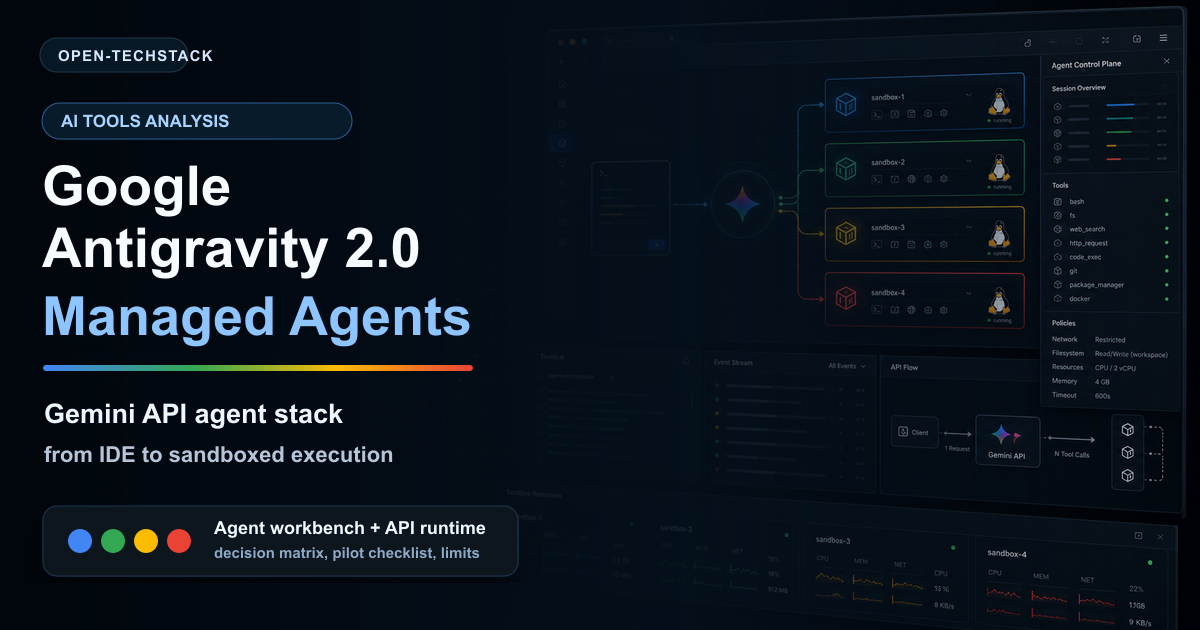
Google’s I/O 2026 developer announcements are not just another model launch. The more important signal is that Google is trying to package the full agent stack: a developer surface, an API interaction model, managed agent infrastructure, isolated execution, and a faster Gemini model tuned for agentic work.
On May 19, 2026, Google announced Google Antigravity 2.0, Managed Agents in the Gemini API, the Interactions API, and Gemini 3.5 Flash as part of its I/O developer push. The headline is easy to reduce to “Google has agents now.” That misses the actual shift.
The practical question for builders is this: does Google now have enough of the agent operating surface to make production pilots less custom?
This is independent Open-TechStack analysis. It is not official Google guidance, legal advice, procurement advice, or a sponsored post.
TL;DR
Google is moving from model-only developer messaging toward a fuller agent platform story.
- Antigravity 2.0 is positioned as Google’s agent-first development platform for turning an idea into a production-ready app.
- Managed Agents in the Gemini API let developers spin up the Antigravity agent with a single call, according to Google.
- Google says the agent can reason, use tools, execute code, manage files, and browse the web inside an isolated, ephemeral Linux environment.
- The Interactions API is the API surface Google names for managed agent interactions.
- Google says each interaction creates or receives an environment that can be resumed with files and state intact.
- AGENTS.md and SKILL.md matter because Google is turning markdown-defined instructions and skills into versionable agent configuration.
- Gemini 3.5 Flash is the model Google is tying to the agent push, with Google describing it as built for complex, agentic workflows.
The recommendation: evaluate it as a serious agent-platform candidate, but pilot it like infrastructure. Test state handling, tool boundaries, data policy, logs, cost behavior, failure recovery, and migration risk before moving critical workflows onto it.
What Google actually announced
Google’s developer-highlight post frames I/O 2026 around moving “from prompts to action.” The company lists a new Google Antigravity 2.0 desktop application, Managed Agents in the Gemini API, and native Android support in Google AI Studio as major developer updates.
The Managed Agents announcement is the most operationally interesting part. Google says the Gemini API now supports managed agents and that developers can run the Antigravity agent in a secure cloud sandbox. Google also says developers can build custom agents using their own instructions, skills, and data, with definitions stored as versionable files such as AGENTS.md and SKILL.md.
That file-based configuration detail matters. It pulls agent behavior closer to the same reviewable workflow teams already use for application code: pull requests, diffs, version history, staged rollouts, and rollback.
The other key detail is execution. Google says a single API call can spin up an agent that reasons, uses tools, and executes code in an isolated, ephemeral Linux environment. The same announcement says a remote Linux environment can execute code, manage files, browse the web, and preserve files and state across follow-up calls when the session is resumed.
That is the architecture line to watch. The hard part of production agents is not only model intelligence. It is the operational wrapper around that intelligence: where files live, how tools run, what state persists, how sessions resume, and what evidence exists after something goes wrong.
Why this is bigger than another coding assistant
Most coding-agent products start with the interface. They give you a chat panel, an IDE plugin, a CLI, or a browser task runner. That is useful, but it leaves teams stitching together the lower layers themselves: sandboxes, state storage, task queues, browser access, tool permissions, and logs.
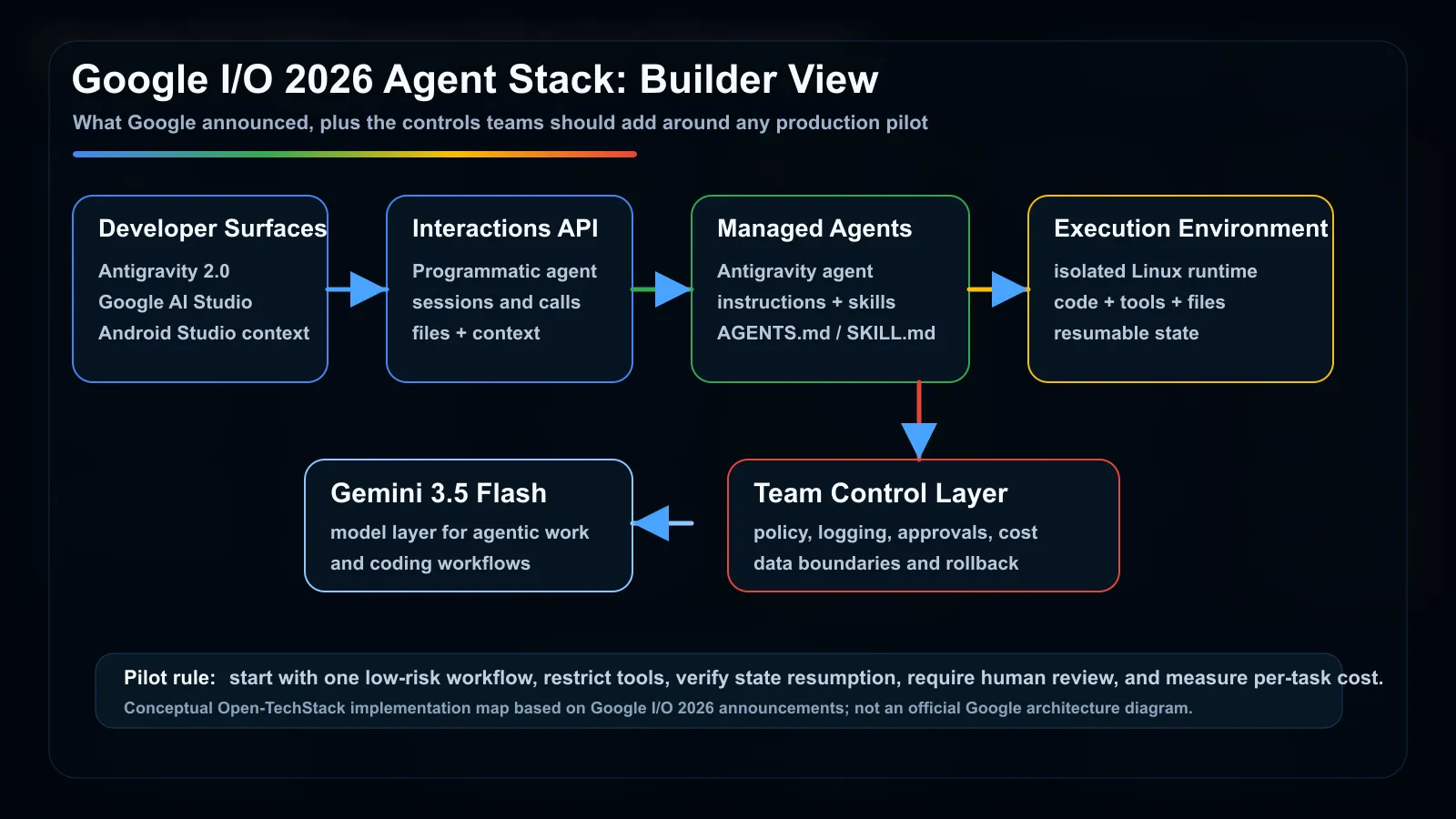
Google’s I/O 2026 stack is different because the pieces point toward a platform boundary:
| Layer | What Google is emphasizing | Why builders should care |
|---|---|---|
| Developer surface | Antigravity 2.0, Google AI Studio, Android Studio context | Agents can start closer to where developers already work. |
| API surface | Interactions API and Gemini API Managed Agents | Agent sessions become programmable product features, not only IDE workflows. |
| Runtime | Isolated Linux environment with files and state | Teams can test longer-running workflows without hand-rolling every sandbox primitive first. |
| Agent definition | AGENTS.md and SKILL.md | Behavior can be reviewed, versioned, and reused across teams. |
| Model layer | Gemini 3.5 Flash | Google is aligning the model launch with high-speed agent execution. |
This does not make the platform automatically production-ready for every workload. It does mean the competitive question is changing.
Instead of asking, “Which model gives the best coding answer?”, teams now need to ask, “Which stack gives us the most controllable agent lifecycle?”
The useful framing: agent stack, not agent feature
The most common mistake is to treat managed agents as a feature toggle. A platform team turns it on, gives it a repository or tool list, and waits to see whether the demos look impressive.
That is backwards.
Treat this as an agent stack with five separate decisions:
- Interface: where users request work and review output.
- Instructions: how behavior is specified, versioned, and approved.
- Execution: where code runs, which tools are available, and what isolation means.
- State: what persists between calls and who can inspect it.
- Governance: how logs, approvals, data boundaries, and incident response work.
Google appears to be addressing the first four directly in the I/O announcements. The fifth remains the part every serious adopter has to design around its own environment.
Decision matrix: evaluate now or wait
Use this quick matrix before putting real work behind Managed Agents.
| Team situation | Recommended move | Why |
|---|---|---|
| You are already testing Gemini API for developer workflows | Start a narrow Managed Agents pilot | The platform fit is close enough to test with low switching cost. |
| You need agents to execute code and preserve files across sessions | Evaluate now | The environment/session model is the core new capability. |
| You need strict private-network access, custom identity, or regulated data handling | Wait or isolate heavily | Validate data boundaries and operational evidence before use. |
| You only need autocomplete or simple code generation | Do not rush | A full managed agent stack may add unnecessary complexity. |
| You maintain internal coding-agent instructions today | Test AGENTS.md and SKILL.md workflows | Versionable instructions can reduce agent drift if review discipline is real. |
| You are vendor-neutral by policy | Run it as one lane in a bake-off | Compare lifecycle controls, not only benchmark scores. |
The important metric is not whether an agent completes one impressive task. The metric is whether the same agent can complete boring repeatable work with clear boundaries, recoverable state, and inspectable evidence.
Pilot checklist for a serious team
If you evaluate this stack, do not start with a production repository and broad write access. Start with one bounded workflow.
A good first pilot looks like this:
- Pick one repeatable workflow: dependency update, small documentation migration, test-failure triage, issue reproduction, or API-client scaffolding.
- Write the agent definition in
AGENTS.mdorSKILL.mdwith explicit allowed actions and forbidden actions. - Use a test repository or low-risk service mirror.
- Require the agent to produce a task log, changed-files list, and verification commands.
- Measure whether state resumption works after a paused or failed interaction.
- Track token/model cost, wall-clock duration, and number of human interventions.
- Review tool use after every run, especially shell, network, web browsing, and file access.
- Define a rollback rule before the pilot starts.
That checklist is intentionally operational. Agents fail in production less often because they “cannot code” and more often because the surrounding workflow is too vague.
What not to do
Do not treat Google’s managed sandbox as a substitute for your own security model.
An isolated Linux environment is useful. It does not automatically answer every enterprise question: which secrets are exposed, which domains can be reached, which files are retained, who can inspect logs, whether output can be reproduced, and how a failed or malicious tool call is contained.
Also do not use benchmark language as a deployment decision. Google says Gemini 3.5 Flash is faster than other frontier models and outperforms Gemini 3.1 Pro across almost all benchmarks. That is worth noting, but your own workload will still depend on tool latency, context size, environment startup time, retry behavior, and human review loops.
For comparison, the same pattern is showing up across the market. Anthropic’s recent Managed Agents update focused on self-hosted sandboxes and MCP tunnels, while OpenAI’s agent tooling has been pushing toward sandboxed execution and approvals. Google is now putting its own version of that architecture in front of Gemini API developers.
Related Open-TechStack reads:
- Claude Managed Agents Add Self-Hosted Sandboxes and MCP Tunnels
- OpenAI Agents SDK, Sandbox Agents, and Approvals
- How to Use OpenAI Agents SDK with MCP and Approvals
- AI Agent Observability Stack 2026
- LangGraph vs OpenAI Agents SDK vs PydanticAI
The practical architecture teams should design
A realistic Google Managed Agents pilot should have a wrapper around the Google pieces.
The minimal pattern:
| Component | Practical rule |
|---|---|
| Agent definition | Store it in source control and require review for behavior changes. |
| Input boundary | Start with issues, docs, or test repos before private production systems. |
| Tool boundary | Allow only the tools required for the pilot workflow. |
| Environment boundary | Treat resumed files and state as sensitive operational artifacts. |
| Output boundary | Require diffs, commands, evidence, and a human acceptance step. |
| Log boundary | Keep enough task history to debug incorrect actions. |
| Cost boundary | Track per-task cost, not only per-token pricing. |
That is where the real platform work lives. Managed agents can reduce infrastructure scaffolding, but they do not remove the need for product and security ownership.
FAQ
Is Google Antigravity 2.0 replacing normal IDEs?
Not in the short term. The better read is that Google is building an agent-first development surface that can sit alongside existing IDE and API workflows. Teams should evaluate it for agent tasks, not assume every coding workflow moves there.
Are Managed Agents in the Gemini API only for coding?
Google’s announcement highlights code execution, file management, web browsing, and custom instructions. Coding is the obvious first use case, but the architecture can also fit research, data processing, documentation, and workflow automation if tool and data boundaries are handled carefully.
Is AGENTS.md now becoming a standard?
It is too early to call it a universal standard, but Google’s support is a strong signal that file-based agent instructions are becoming a common pattern. The practical benefit is reviewability: teams can diff and approve behavior changes instead of hiding agent policy in a UI field.
Should teams migrate from their current agent framework?
Not from this announcement alone. Run a bake-off against your current stack and score lifecycle controls: sandbox behavior, state resumption, tool governance, observability, cost, and developer experience.
Bottom line
Google’s I/O 2026 agent announcements matter because they connect the pieces that make agents useful beyond demos: a developer surface, managed API calls, isolated execution, resumable state, versionable instructions, and a model positioned for agentic workflows.
The near-term move is not a broad migration. It is a controlled pilot. Pick one workflow, define the agent in files, restrict tools, measure state and cost behavior, and require human review before anything touches production.
If the stack performs well under those constraints, it deserves a place in the 2026 agent-platform shortlist.
Sources
- Google Blog: Building the agentic future: Developer highlights from I/O 2026
- Google Blog: Introducing Managed Agents in the Gemini API
- Google Blog: Gemini 3.5: frontier intelligence with action