TL;DR
People keep compressing the Nous stack into one label, and that is where the confusion starts.
As of April 2026, Nous Research, Hermes Agent, Hermes 4, and Nous Portal are related, but they are not the same thing. If you treat them as one product, you will make the wrong choice about what to install, what to test, and what to optimize.
The short version is:
- Nous Research is the lab/company.
- Hermes Agent is the autonomous agent product.
- Hermes 4 is a model family.
- Nous Portal is the model access and API surface.
That sounds obvious once you say it out loud. The problem is that the marketing names do not make the boundary obvious, and the docs are easy to skim past.
If you are deciding whether to install the agent, compare it with another self-hosted stack, or just understand what the Hermes brand actually refers to, this is the map that matters.
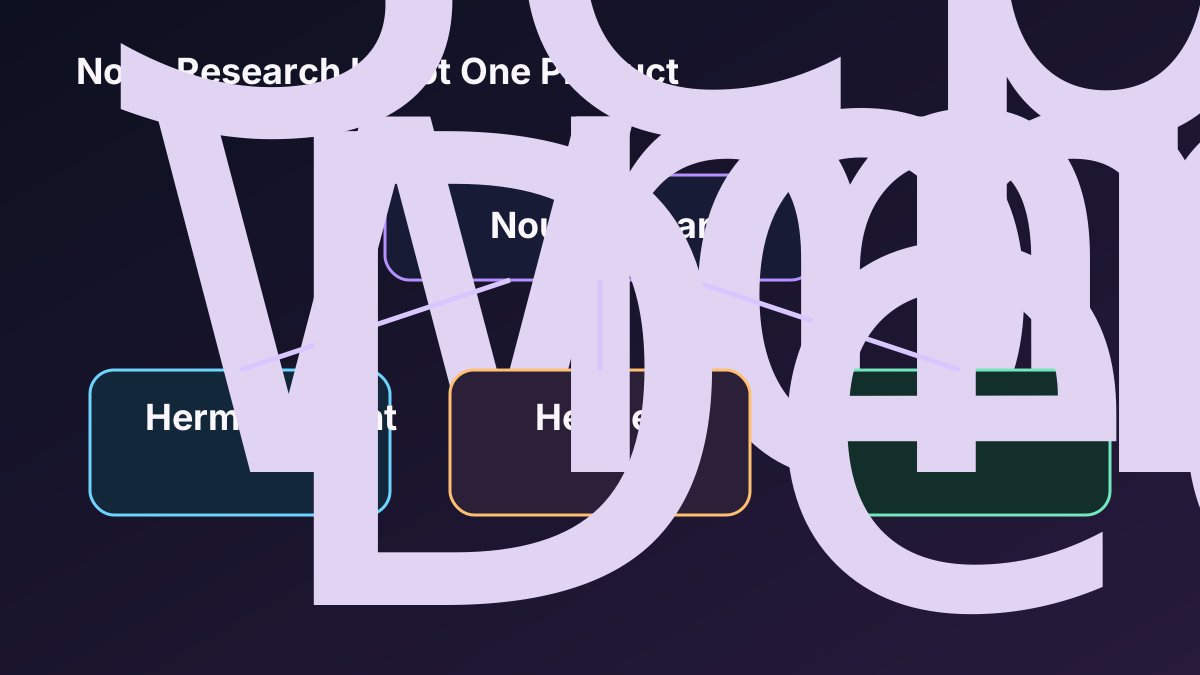
The stack in one table
| Layer | What it is | Why it matters |
|---|---|---|
| Nous Research | The company and research lab | It builds the models, the agent product, and the surrounding infrastructure. |
| Hermes Agent | An open source autonomous agent that runs on your server | This is the operational product if you want memory, scheduled automations, delegation, and tool use. |
| Hermes 4 | A model family | This is the thing you pick when you want a model, not an agent shell. |
| Nous Portal | The model portal and API access layer | This is where you pick from supported models and wire them into Hermes Agent or other clients. |
The key mistake is to assume that “Hermes” always means the agent.
It does not.
What Nous Research is actually building
The company homepage is explicit: Nous Research says it trains open source language models and builds infrastructure for distributed training. The site also links out to Hermes 4, Hermes Agent, and the portal.
That matters because it tells you the company is not just shipping a single assistant app. It is working across at least three layers:
- model training and releases,
- agent runtime and workflow tooling,
- hosted model access and product surfaces.
That is a different shape from a team that only ships a chat app or only ships a base model.
What Hermes Agent is
Hermes Agent is the piece most people actually want when they say they want “Hermes.”
The product homepage describes it as an open source agent that lives on your server, remembers what it learns, and gets more capable over time. The docs also emphasize:
- persistent memory,
- skills,
- scheduled automations,
- delegation and parallel workstreams,
- and support for many messaging surfaces and tool backends.
That makes Hermes Agent an operating layer, not just a prompt wrapper.
If you care about recurring work, file operations, browser tasks, or multi-step workflows, this is the product in the stack that matters.
If you want the practical install path, see How to Set Up Hermes Agent for Local Automation Workflows (2026).
What Hermes 4 is
Hermes 4 is a model family, not the agent product.
The Nous Portal models page describes Hermes 4 as a frontier hybrid reasoning model family and points to the technical report and model cards. That is a model-level release, which means it belongs in the same category as other foundation models, not in the same category as the agent runtime.
This distinction matters because model capability and agent capability are different concerns.
A stronger model can still be a poor fit inside a workflow tool if the surrounding agent stack is tuned for different tasks, different latency tradeoffs, or different tool policies.
What Nous Portal is
Nous Portal is the access surface around the models.
The portal lets you use supported models through the Nous API and points Hermes Agent users toward a recommended set of agentic models. The important part is not the number of models. The important part is that the portal is the place where model selection happens.
In other words:
- choose the agent when you need the workflow engine,
- choose the model when you need inference capability,
- choose the portal when you need a way to access and route those models.
Why the distinction matters
This is the part people usually skip, and it is the part that saves the most time.
The official Hermes Agent docs explicitly say that Hermes 4 models are not recommended for use in Hermes Agent. They recommend using an agentic model from the supported list instead.
That one line tells you a lot:
- Hermes Agent and Hermes 4 are not interchangeable.
- “Hermes” is a brand family, not a single runtime.
- model selection and agent selection are separate decisions.
If you miss that boundary, you can spend hours trying to force the wrong model into the wrong workflow and blame the agent when the problem is actually the stack choice.
The cleaner way to think about it is:
- use Hermes Agent when you want an autonomous workflow system with memory, tasks, skills, and delegation,
- use Hermes 4 when you want a model family for reasoning or deployment,
- use Nous Portal when you want a supported access layer for those models,
- and use the company docs to decide which surface fits your actual job.
A practical decision rule
If you are still unsure what to do, use this rule:
- If the question is “What should I install to run workflows?” start with Hermes Agent.
- If the question is “Which model family should I benchmark?” look at Hermes 4 and the other models in Nous Portal.
- If the question is “Who is behind all of this?” the answer is Nous Research.
That is the mental model that keeps the stack from turning into a branding puzzle.
Common confusion to avoid
The most common mistake is treating every Hermes-labeled asset as if it belongs in the same layer of the stack. That leads to bad evaluations.
Use this separation:
| Question | Correct layer to inspect |
|---|---|
| Who builds the models and agent ecosystem? | Nous Research |
| Which model should I benchmark? | Nous Portal / model docs |
| What should I install for local agent workflows? | Hermes Agent |
| How does the agent remember and use tools? | Hermes Agent docs |
| Which model is recommended for the agent? | Hermes Agent supported model guidance |
This distinction is especially important for readers coming from generic chatbot workflows. A model family can be excellent and still be the wrong default for a specific agent runtime. The right question is not “is Hermes good?” The right question is “which Hermes-related component belongs in this workflow?”
Related reading
- Hermes Agent vs OpenClaw (2026): Which Self-Hosted AI Agent Should You Use?
- How to Set Up Hermes Agent for Local Automation Workflows (2026)
SEO FAQ
Is Hermes Agent the same thing as Hermes 4?
No. Hermes Agent is an agent runtime for workflows, memory, tools, and scheduled work. Hermes 4 is a model family. They are related through the Nous ecosystem, but they solve different parts of the stack.
What is Nous Portal used for?
Nous Portal is the access layer for supported models. Use it when the decision is about model access or API routing, not when the decision is about installing an autonomous workflow agent.
Which Nous product should a builder start with?
Start from the job. If you need workflow automation, inspect Hermes Agent. If you need a model to benchmark, inspect Hermes 4 and the models listed in Nous Portal. If you need company-level context, inspect Nous Research.
Sources