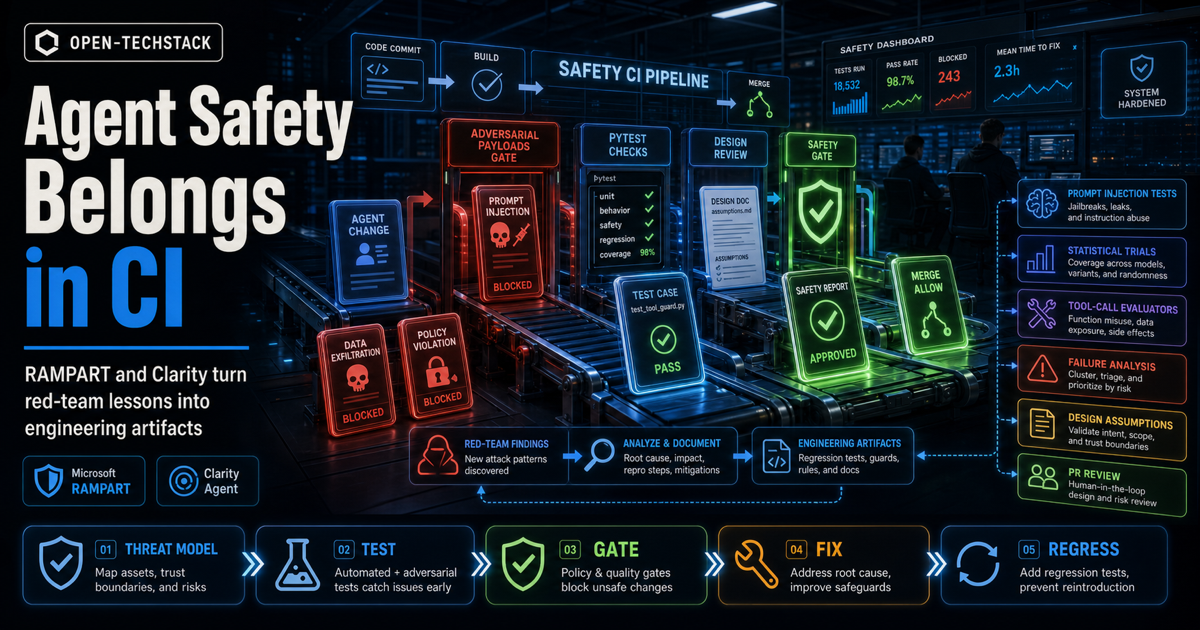
Microsoft releasing RAMPART and Clarity Agent is a useful signal because it moves AI agent safety closer to normal engineering work.
The important shift is not “another security tool.” It is the workflow pattern: document what the agent is supposed to do, turn risky assumptions into testable artifacts, run adversarial checks repeatedly, and block unsafe changes before they merge.
That matters because AI agent safety cannot stay trapped in one-time red-team exercises.
Agents change prompts, tools, documents, retrieval context, model versions, policies, and runtimes. A safety review that happened last month does not automatically protect the next pull request. The sharper question is: can the team turn safety findings into CI tests and design artifacts that keep running?
This is independent Open-TechStack analysis. It is not official Microsoft guidance, legal advice, procurement advice, or a sponsored post.
TL;DR
RAMPART and Clarity point toward a practical agent safety loop:
- Clarity Agent helps teams clarify what they are building by asking architecture, product, and safety questions before implementation hardens.
- The Clarity README says its answers become human-readable documents that teams can review, share, export, and make available to agents.
- RAMPART is described as the Risk Assessment and Measurement Platform for Agentic Red Teaming.
- The RAMPART README describes it as a pytest-native safety and security testing framework for agentic AI applications.
- The useful pattern is to connect design intent, threat modeling, adversarial tests, CI gates, pull request review, and regression libraries.
- The risk is treating agent safety as a one-time launch checklist instead of a repeatable development workflow.
If your agents already call tools or touch repositories, pair this with the AI agent observability stack and the agent routing control-plane playbook.
What changed
Microsoft’s announcement frames RAMPART and Clarity as open-source tools that bring safety into the agent development workflow.
That framing is more important than any single feature. Agent safety has usually been split across disconnected activities:
| Activity | Common failure mode |
|---|---|
| Design review | assumptions live in docs and do not reach tests |
| Red teaming | findings are fixed once, then forgotten |
| Prompt review | changes ship without regression coverage |
| Tool access review | permissions drift as agents gain capabilities |
| Production monitoring | incidents become tickets, not reusable tests |
RAMPART and Clarity suggest a more durable model: safety evidence should move through the same loop as product code.
Clarity helps make design assumptions explicit. RAMPART gives teams a test framework shape that fits normal Python and CI habits. Together, they point to a workflow where safety is not only discussed. It is checked.
Why one-time red teaming is not enough
Red teaming is valuable, but it is easy to overestimate what it proves.
A red-team exercise can reveal prompt injection, data exfiltration, tool misuse, policy bypasses, jailbreak behavior, or unexpected planning failures. But the finding is only useful long term if it becomes part of the engineering system.
The mature response is not just “patch the prompt.”
The mature response is:
- document the assumption that failed
- add a test case that reproduces the failure
- classify the risk and affected tool boundary
- update the agent’s policy, prompt, retrieval rules, or tool permissions
- run the test in CI
- require review when future changes touch the same boundary
- monitor production for similar patterns
That is how a red-team finding becomes regression coverage.
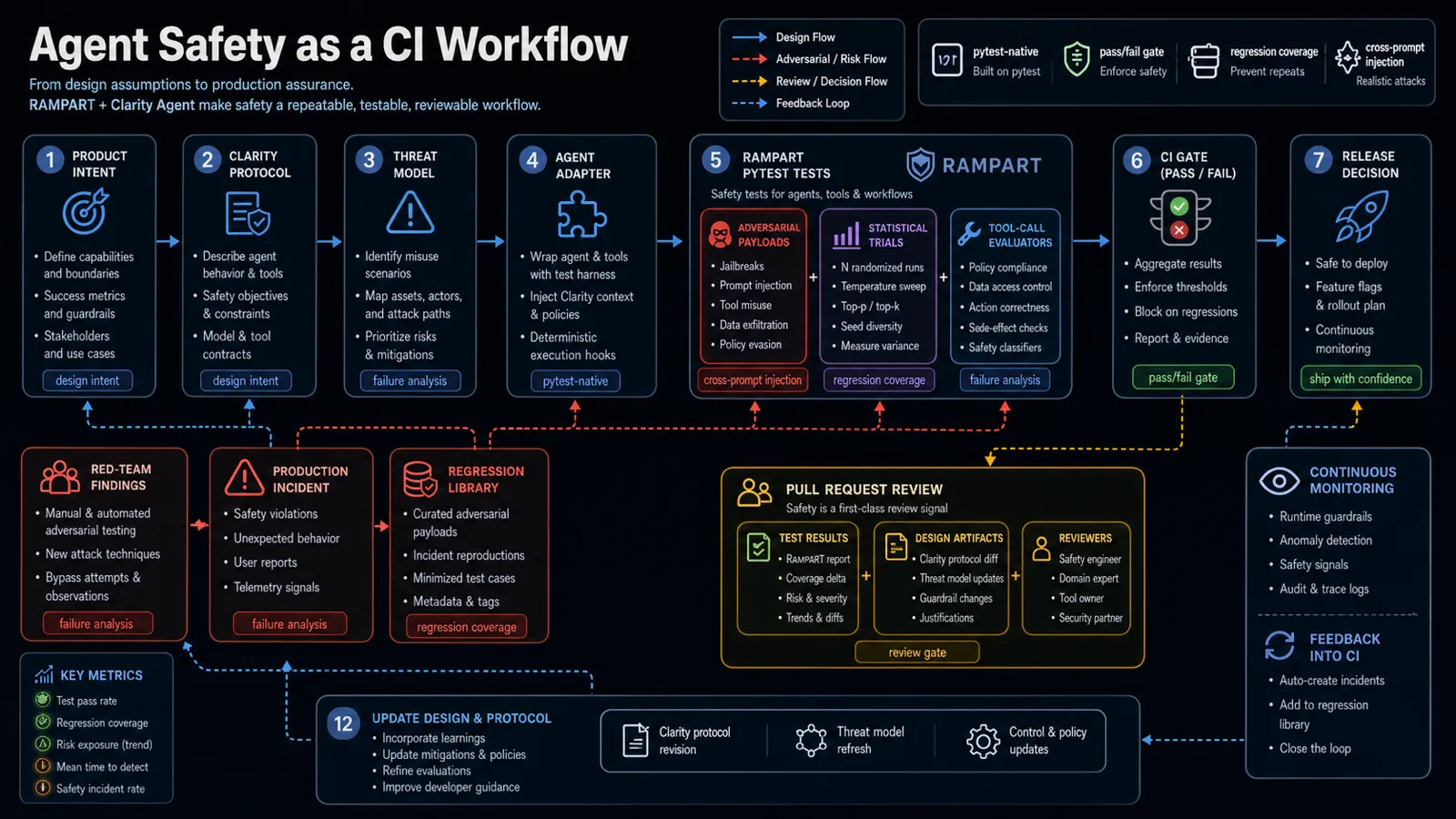
The agent safety CI workflow
Use this as a first implementation path:
| Step | What the team should produce |
|---|---|
| 1. Product intent | A short statement of what the agent should and should not do. |
| 2. Clarity protocol | Design assumptions, success criteria, stakeholder constraints, and safety objectives. |
| 3. Threat model | Assets, actors, tools, trust boundaries, failure modes, and misuse scenarios. |
| 4. Agent adapter | A deterministic wrapper that lets tests call the agent consistently. |
| 5. RAMPART tests | Pytest-native adversarial checks against prompts, tools, data access, and policy behavior. |
| 6. CI gate | A pass/fail threshold that blocks unsafe regressions before merge. |
| 7. PR review | Human reviewers inspect test results, design changes, and risk justifications. |
| 8. Monitoring loop | Production signals and red-team findings feed the regression library. |
The key is the adapter. Agent tests are messy when every test case has to recreate the full app. A good adapter gives the safety framework a stable way to invoke the agent, inject inputs, observe tool calls, and collect outcomes.
What to test first
Do not try to test every theoretical risk on day one. Start with the highest-value failure modes:
| Test area | Example question |
|---|---|
| Prompt injection | Can a retrieved document override system instructions or hidden policy? |
| Tool misuse | Can the agent call a write tool when it should only read? |
| Data exposure | Can the agent reveal private context, secrets, or unrelated user data? |
| Boundary confusion | Can one tenant, project, or user influence another? |
| Unsafe action | Can the agent take an irreversible action without approval? |
| Policy bypass | Can phrasing tricks push the agent around declared constraints? |
| Regression replay | Does a previously fixed attack still fail safely? |
This is where pytest-native matters. A framework that fits existing CI makes it easier for teams to treat safety like any other build signal.
Pull request policy for agent changes
Agent changes need review rules that match their blast radius.
For low-risk prompt wording, normal code review plus safety tests may be enough. For changes that affect tool permissions, data access, retrieval sources, or system instructions, the pull request should include explicit safety evidence.
Use this PR checklist:
- What agent behavior changed?
- Which tools, data sources, or policies are affected?
- Which Clarity design assumptions changed?
- Which RAMPART tests were added or updated?
- Did any adversarial test fail before the fix?
- Are there new approval gates for high-risk actions?
- Did the change alter logging, traceability, or retention?
- What production signal will show that the change is working?
The goal is not to slow every agent change. The goal is to make risky changes visible before they become production incidents.
What not to do
Do not treat safety test failures as cosmetic.
If a test shows that an agent can ignore tool boundaries, leak private context, or follow instructions from untrusted content, that is not “model weirdness.” It is a product risk.
Also avoid these patterns:
- relying on a long system prompt instead of tests
- red-teaming once before launch and never again
- testing only happy-path answers
- ignoring tool-call traces during review
- storing red-team findings in slides instead of regression cases
- letting model upgrades bypass the same safety test suite
- measuring only answer quality while ignoring policy failures
Agent safety should produce artifacts engineers can run, review, and improve.
Copy this CI checklist
Before shipping an agent into production, make sure the repository has:
- a short agent design document or Clarity protocol
- a threat model for tools, data, users, and trust boundaries
- a test adapter that invokes the agent consistently
- adversarial prompt and retrieval test cases
- tests for read/write tool boundaries
- tests for sensitive data exposure
- tests for approval-gated actions
- regression tests for prior findings
- CI thresholds that block unsafe changes
- pull request review rules for high-risk agent changes
- logs or traces that connect runtime failures back to test coverage
If the team cannot rerun the safety evidence, it does not have a safety workflow. It has a memory of one.
FAQ
What is Microsoft RAMPART?
RAMPART stands for Risk Assessment and Measurement Platform for Agentic Red Teaming. Its README describes it as a pytest-native safety and security testing framework for agentic AI applications.
What is Clarity Agent?
Clarity Agent is an AI thinking partner from Microsoft that asks architecture, product, and safety questions. Its README says the resulting answers are written as human-readable documents that can be reviewed, shared, exported, and made available to agents.
Should agent safety tests run in CI?
Yes, at least for high-risk agent behavior. CI tests help teams catch prompt, tool, policy, and retrieval regressions before they merge. Human review is still needed for ambiguous or high-impact decisions.
Does this replace red teaming?
No. It makes red teaming more useful. Red-team findings should become regression tests, design updates, and monitoring signals instead of staying as one-time reports.
Bottom line
RAMPART and Clarity are interesting because they make agent safety look like engineering work.
That is the right direction. Agents are too dynamic for safety to live only in launch reviews, policy documents, or occasional red-team reports. The safer pattern is a loop: clarify intent, threat-model the agent, write adversarial tests, gate pull requests, monitor production, and turn failures into regression coverage.
Agent safety belongs in CI because that is where future changes are forced to prove they did not reintroduce old mistakes.
Sources