TL;DR
The headline on April 7, 2026 was that Anthropic launched Project Glasswing and gave selected defenders access to Claude Mythos Preview.
The more important story is the workflow Anthropic is trying to normalize before these capabilities spread everywhere.
According to Anthropic, Mythos Preview has already found thousands of high-severity vulnerabilities, including bugs in every major operating system and major web browser, and Anthropic says the model can sometimes chain vulnerabilities into working exploits with little or no human steering. Anthropic also says the model is not planned for general availability right now. Instead, the company is putting it behind a coordinated, limited-access defensive program with launch partners including AWS, Google, Microsoft, Cisco, CrowdStrike, the Linux Foundation, Palo Alto Networks, JPMorganChase, Apple, Broadcom, and NVIDIA. (Anthropic Project Glasswing, Anthropic Frontier Red Team blog)
That matters because it signals a new assumption for security teams:
- frontier models are becoming good enough to change vulnerability discovery economics
- the window between discovery and exploitation is likely to shrink further
- defender access, patch triage, and disclosure workflows are now part of the AI platform story
This is why Project Glasswing matters more than the launch-day demo.
What happened on April 7, 2026
Anthropic announced Project Glasswing on April 7, 2026 as a coordinated defensive-security initiative rather than a normal model release.
The official structure is unusually specific:
- Anthropic says over 40 additional organizations that build or maintain critical software infrastructure are also getting access beyond the named launch partners
- Anthropic says it is committing up to $100 million in usage credits
- Anthropic says it is adding $4 million in direct donations to open-source security organizations
- Anthropic says it will publish a public report within 90 days on what was learned and what vulnerabilities or improvements can be disclosed
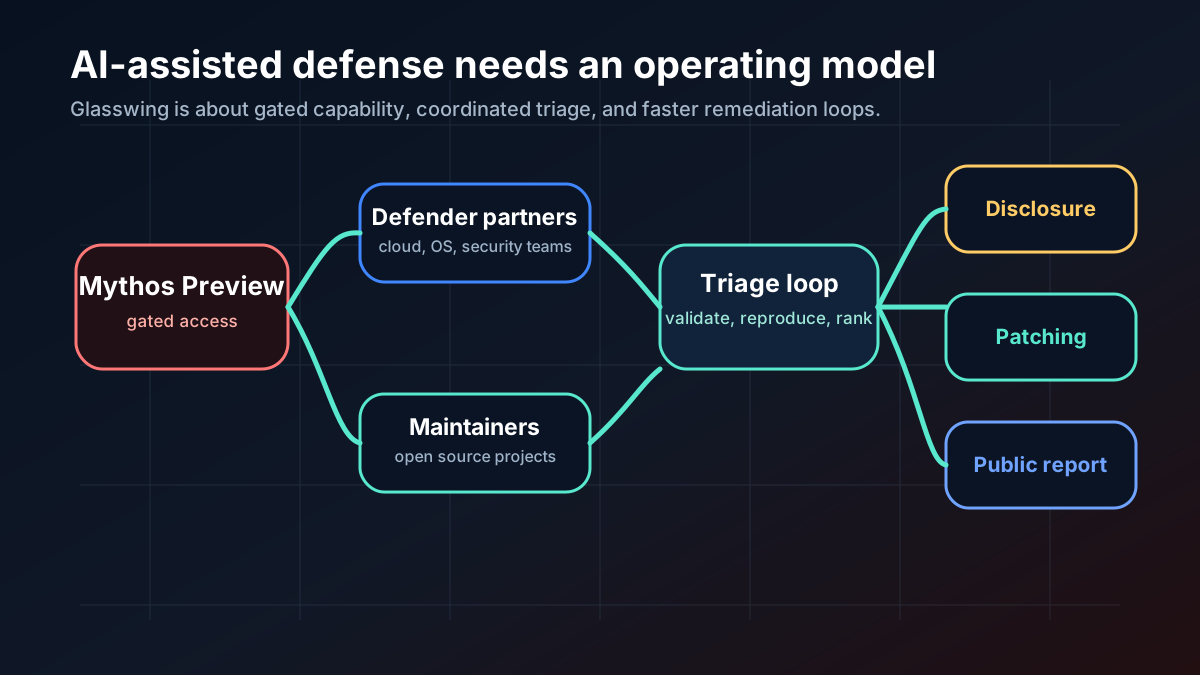
The access model is the key detail. Anthropic says Mythos Preview will be used for tasks like local vulnerability detection, black-box testing of binaries, endpoint security work, and penetration testing, and that the goal is to help defenders secure critical systems before similar capabilities become easier for attackers to use. (Anthropic Project Glasswing)
That is a very different posture from a normal “new model available now” announcement.
The security claim is aggressive, and Anthropic is backing it with a gated rollout
Anthropic is making unusually strong claims here, so the sourcing matters.
In the main announcement, Anthropic says Mythos Preview has already found high-severity vulnerabilities in major operating systems and browsers. In the technical write-up, Anthropic says the model identified and exploited zero-days across major operating systems and browsers during internal testing, including a 27-year-old OpenBSD bug, a 16-year-old FFmpeg vulnerability, and multi-step Linux kernel exploit chains. Anthropic also says expert human validators matched the model’s severity rating exactly in 89% of 198 manually reviewed reports, with 98% within one severity level. (Anthropic Project Glasswing, Anthropic Frontier Red Team blog)
Those are Anthropic’s own claims, not an independently replicated public benchmark across the full Glasswing workflow. That distinction matters.
What makes the story more credible than a pure self-report is that partners are attaching their own reputations to the rollout:
- AWS said on April 7, 2026 that it had already applied Mythos Preview to critical AWS codebases and that the model surfaced additional opportunities to strengthen code even in heavily reviewed environments. AWS also said access begins with a small allow-list and is available in gated research preview through Amazon Bedrock. (AWS Security Blog)
- Microsoft said on April 7, 2026 that it evaluated an early Mythos Preview snapshot with its CTI-REALM benchmark and saw substantial improvements relative to prior models. Microsoft also said Project Glasswing participants can access the model through Microsoft Foundry under Anthropic’s access rules. (MSRC blog, Microsoft Security Blog on CTI-REALM)
- The Linux Foundation framed the program as a way to get advanced AI security tooling into the hands of maintainers who usually cannot afford it, and said the tools are intended to be free for those maintainers inside the program. (Linux Foundation)
So the right read is not “Anthropic proved everything.” The right read is that Anthropic plus major security and platform partners are behaving as if this capability threshold is real enough to justify a coordinated containment-and-deployment strategy.
Why this matters for builders
Most builders are not going to get Mythos Preview access next week.
That does not mean this is irrelevant to them.
Project Glasswing changes the practical planning assumptions for anyone responsible for software that matters:
1. Vulnerability discovery is becoming a scale problem, not just a talent problem
Security teams used to think in terms of scarce elite researchers.
Glasswing points to a different world: one where frontier models can generate more candidate findings, more exploit attempts, and more patch suggestions around the clock, with humans shifting toward validation, prioritization, disclosure, and rollout.
If you maintain critical software, your backlog problem is about to get worse before it gets better.
That means teams should be ready for:
- higher inbound bug volume
- more AI-assisted bug reports of uneven quality
- faster pressure to validate or reject findings
- more need for reproducible remediation workflows
The Linux Foundation’s framing is especially important here. It argues that open source maintainers are already under pressure from more bug reports, more supply-chain attacks, and more AI-generated noise, and that Glasswing matters because maintainers need the same class of tooling defenders at big companies will use. That is a real builder consequence, not marketing copy. (Linux Foundation)
2. The real bottleneck is shifting from finding bugs to operationalizing fixes
Microsoft’s CTI-REALM work is useful context because it measures something closer to operational security work than trivia-style benchmarks. The benchmark focuses on turning threat intelligence into validated detections across Linux, AKS, and Azure cloud workflows, not just answering cyber questions. (Microsoft Security Blog on CTI-REALM)
That lines up with the bigger Glasswing story.
Finding more bugs is valuable, but the workflow that matters is:
- identify the issue
- validate severity
- reproduce cleanly
- develop a patch
- coordinate disclosure
- ship fixes before attackers catch up
In other words, the competitive edge is moving toward security operations quality, not just model access.
3. Open source security is becoming a first-order AI platform issue
Anthropic says it is donating $2.5 million to Alpha-Omega and OpenSSF through the Linux Foundation, plus $1.5 million to the Apache Software Foundation. That sits on top of the Linux Foundation’s broader March 17, 2026 announcement of a $12.5 million coalition investment in open source security through OpenSSF and Alpha-Omega, backed by Anthropic, AWS, Google, GitHub, Microsoft, OpenAI, and others. (Anthropic Project Glasswing, OpenSSF)
That is not charity for its own sake.
It is recognition that if AI systems can find and exploit bugs faster, then the weakest part of the software supply chain becomes a strategic problem for every cloud platform, model provider, and enterprise that depends on open source.
That logic rhymes with what we already saw in the LiteLLM PyPI compromise: AI teams often build on a fragile dependency graph full of privileged infrastructure glue. If the attack surface expands faster than maintainers can respond, the blast radius is not theoretical. See LiteLLM’s PyPI Compromise Is a Worst-Case Supply-Chain Incident for AI Teams.
What changes next
Project Glasswing is not just a one-off program. It looks more like a preview of the next security control plane.
Anthropic says the initiative will produce practical recommendations around:
- vulnerability disclosure processes
- software update processes
- open-source and supply-chain security
- secure-by-design software development lifecycle practices
- triage scaling and automation
- patching automation
That list is the real roadmap. (Anthropic Project Glasswing)
The likely next step is that major vendors start turning AI-driven vulnerability discovery into product and platform policy:
- tighter gated access for the most capable offensive-capable models
- more enterprise logging and governance around cyber-capable model usage
- more automated patch generation and triage inside developer workflows
- more pressure on maintainers to adopt machine-assisted validation and patch review
That last point is where builders should pay attention.
If your secure development lifecycle still assumes humans will manually read everything, manually reproduce everything, and manually patch everything at today’s pace, you are planning for the wrong threat model.
The practical takeaway
The short version is this:
Project Glasswing is a signal that frontier AI companies now see cyber capability as too consequential to release in a normal product cadence.
Anthropic is effectively saying that once models cross a certain threshold, the responsible move is not “ship broadly and add a safety page.” It is gate access, coordinate with major defenders, fund the open-source layer, and learn quickly in public before the capability diff spreads further.
For builders, the immediate question is not whether you can get into Glasswing.
It is whether your team is ready for the world Glasswing implies:
- AI-assisted vulnerability reports arriving faster
- exploit development getting cheaper
- remediation speed becoming a competitive security advantage
- open source maintainers becoming even more critical to your actual risk posture
If you are building agentic systems, this is also a reminder that stronger models do not just raise product upside. They raise misuse stakes and governance requirements too. That is the same underlying problem we described in AI Coding Agents Need Guardrails, Not More Autonomy.
And if you want the builder-side muscle memory for handling this shift, you should already be investing in structured evaluation and adversarial testing loops, not waiting for a crisis. A practical starting point is Promptfoo for LLM Evals and Red Teaming: A Practical Workflow.
Project Glasswing does not solve the AI security problem.
But on April 7, 2026, it made one thing much clearer: the security race is moving from “who has the smartest researcher” to “who can operationalize AI-assisted defense before AI-assisted offense becomes normal.”
Defensive rollout checklist
If your team gets access to AI-assisted vulnerability discovery tools, treat the first rollout as a controlled security program rather than a normal developer-tool pilot:
- limit access to named defenders and maintainers with a documented scope
- require reproducible evidence before filing or escalating findings
- separate model-generated hypotheses from validated vulnerabilities
- define disclosure ownership before scanning third-party or open-source code
- track mean time from finding to patch, not just finding volume
- keep logs of prompts, tool use, human approvals, and patch decisions
- review whether generated exploit chains should be retained, redacted, or deleted after validation
The goal is not to maximize impressive findings. The goal is to shorten the defensive loop without creating an unmanaged stream of sensitive vulnerability artifacts.
SEO FAQ
What is Anthropic Project Glasswing?
Project Glasswing is Anthropic’s limited-access defensive security initiative for Claude Mythos Preview. Anthropic positioned it as a way to give selected defenders, major technology partners, and open-source maintainers early access to cyber-capable AI tooling under a gated program.
Is Claude Mythos Preview generally available?
No. Anthropic says Mythos Preview is not planned for general availability right now. The company is routing access through Project Glasswing and selected partner channels because the model has dual-use security capabilities.
Why does Project Glasswing matter for open-source maintainers?
It matters because AI-assisted vulnerability discovery can increase both useful reports and noisy submissions. Open-source maintainers need help validating findings, prioritizing patches, and handling disclosure without being overwhelmed by automated security reports.
Does this article explain how to exploit vulnerabilities with Mythos?
No. This article is defensive analysis. It discusses access governance, disclosure, validation, and patching workflows, but it does not provide exploit steps, payloads, or instructions for offensive use.
Sources
- Anthropic: Project Glasswing
- Anthropic Frontier Red Team: Mythos Preview
- AWS Security Blog: Building AI defenses at scale before the threats emerge
- Microsoft MSRC: Strengthening secure software at global scale
- Microsoft Security Blog: CTI-REALM benchmark
- Linux Foundation: Project Glasswing and open-source maintainers
- OpenSSF: Tech coalition investment in open-source security