TL;DR
The immediate headline is simple: on April 21, 2026, Bloomberg reported that a small group of unauthorized users had accessed Anthropic’s Mythos model, and on April 22 Anthropic said it was investigating a claim of unauthorized access through one of its third-party vendor environments. (Bloomberg Law, The Guardian)
The more useful reading is not “a model got leaked.”
It is that the control plane around a restricted frontier model is now part of the product surface. If access can slip through a vendor environment, the model gating strategy is only as strong as the identity, contractor, and endpoint controls wrapped around it.
That is a much more builder-relevant problem than a one-off access rumor.
What happened
Anthropic announced Project Glasswing on April 7, 2026 as a tightly controlled cybersecurity initiative around Claude Mythos Preview. The company said the model was not being released publicly because it could find and exploit serious vulnerabilities, and it framed the program as a limited defensive rollout with major partners and security organizations. (Anthropic)
By April 17, 2026, the model was already drawing federal attention. AP reported that White House chief of staff Susie Wiles met with Anthropic CEO Dario Amodei to discuss Mythos and how the administration might work with Anthropic on cybersecurity, AI safety, and broader national-security implications. (AP News)
Then came the new problem.
On April 21, Bloomberg said a small group of users in a private forum had accessed Mythos on the same day Anthropic said it would be available only to a limited set of companies for testing. On April 22, The Guardian reported that Anthropic said it was investigating a claim of unauthorized access through one of its third-party vendor environments. (Bloomberg Law, The Guardian)
That sequence matters.
Anthropic is not dealing with a public consumer app where random users found a hidden feature. It is dealing with a restricted model that was intentionally kept behind a defensive-access program because the company says the model is strong enough to be dangerous if misused.
If the report is accurate, the failure is not just “someone got in.”
The failure is that an environment that should have been subordinate to the access policy became a route around it.
Why this is the real story
Most security coverage will stop at the phrase “unauthorized access.”
That undersells the actual risk.
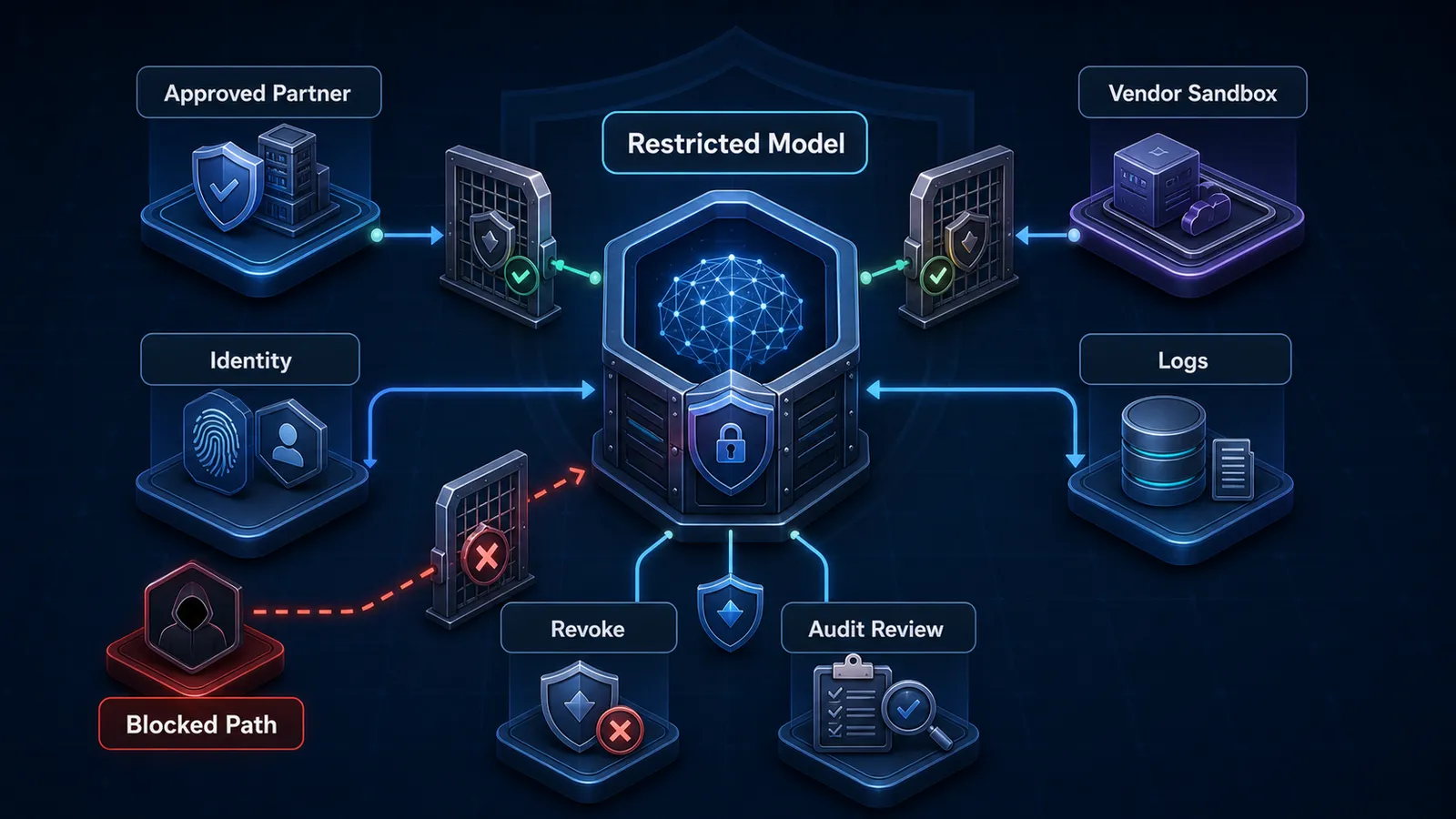
For frontier AI systems, the important question is not only whether the model is powerful. It is whether the surrounding deployment chain can enforce the intended limits:
- who can reach the model endpoint
- which vendor or contractor environments are allowed to touch it
- whether credentials are isolated per test, per user, and per partner
- whether logs are strong enough to prove who used what and when
- whether external testing paths are separated from production-like access
Anthropic’s own Glasswing announcement shows why the company was trying to keep the blast radius small. The model was presented as a defensive-security tool with limited access, not a public release. Anthropic said Mythos Preview had already found thousands of zero-day vulnerabilities in major operating systems and browsers, which is exactly why it treated the model as a controlled-access asset rather than a general-purpose product. (Anthropic)
That makes the access question more serious, not less.
If a model is dangerous enough to gate, then the gate has to work.
Who is affected
Three groups need to pay attention.
1. Anthropic and its approved partners
The obvious risk is reputational and operational. Anthropic built Glasswing around the idea that a tightly controlled launch could help defenders learn from a model with serious cyber capability. If unauthorized users can reach it through an adjacent environment, Anthropic has to prove its partner controls are better than a standard beta program. (Anthropic)
2. Enterprises that want access to dual-use models
AP’s reporting shows the government is already talking to Anthropic about the model’s security and national-security implications. That suggests the next phase is not “ship it broadly” but “justify access and monitor use.” Enterprises that want the same class of model should expect more paperwork, more access segregation, and more audit requirements, not fewer. (AP News)
3. Builders who treat vendor platforms as a trusted extension of their own stack
This is the part teams often miss.
If your contractor environment, external eval harness, or partner sandbox can touch a sensitive model, then that environment is part of your attack surface. The model is not isolated just because the UI is locked down.
We already saw a similar trust-chain lesson in OpenAI’s Axios Scare Is a Supply-Chain Warning for Every macOS Release Pipeline. The common thread is the same: privileged workflows fail when the surrounding toolchain is treated as harmless plumbing.
What changes next
The practical fallout is likely to be boring, which is usually how security hardens after a scare.
Expect more pressure on:
- per-partner allowlists
- short-lived credentials
- stronger environment isolation for external testers
- tamper-evident logs for model access
- separate paths for evaluation, research, and production use
- vendor reviews that include model-specific access routing, not just generic SOC 2 language
The other likely change is political. Axios reported on April 21, 2026 that CISA still did not have access to Mythos even as other agencies were using it or negotiating access. That is a sign that access policy is already fragmented across agencies and that the government has not settled on a single operating model for these tools. (Axios)
For builders, that fragmentation is the warning.
The more valuable a dual-use model gets, the more pressure there is to widen access. But the more you widen access, the more important it becomes to prove the surrounding controls are real.
That tension is the story.
Why this matters for builders
The lesson here is not “never use third parties.”
The lesson is that restricted AI is now a systems-integration problem, not just a model-choice problem.
If you are building with frontier models, your security review should not stop at the API key:
- Who can create or reuse access paths?
- Are partner environments segregated from production-grade secrets?
- Are human approvals and service accounts separated?
- Can you prove which identity touched which model instance?
- Do you know how fast an access path can be revoked?
If the answer to any of those questions is fuzzy, then the model rollout is already more fragile than the marketing suggests.
That is especially true for AI security use cases, where the model is supposed to find weaknesses before attackers do. A broken boundary around the model undercuts the entire premise.
Bottom line
On April 21 and 22, 2026, the news around Anthropic’s Mythos shifted from “this model is too dangerous to ship publicly” to “can Anthropic keep the access boundary intact?”
That is a better question for builders anyway.
The real competitive advantage in frontier AI is not only who can make the strongest model. It is who can control where that model runs, who can reach it, and which environments can accidentally become the back door.
SEO FAQ
What was the reported Anthropic Mythos unauthorized-access issue?
Bloomberg Law reported on April 21, 2026 that unauthorized users had accessed Anthropic’s restricted Mythos model, and The Guardian later reported that Anthropic was investigating a claim involving a third-party vendor environment. The useful security lesson is about access-boundary design, not about reproducing any access path.
Why does vendor isolation matter for restricted AI models?
Vendor isolation matters because a restricted model is only as protected as the systems allowed to reach it. If a vendor sandbox, test harness, contractor account, or partner environment can touch the model, that environment has to be governed as part of the model access boundary.
What should builders learn from the Mythos access reports?
Builders should review identity controls, per-partner credentials, logging, revocation, and environment separation before exposing sensitive models or tools to external testers. The goal is to make access narrow, auditable, and easy to revoke.
Is this article explaining how to access a restricted model?
No. This article is defensive security analysis. It does not provide bypass steps, exploit instructions, credentials, prompts, or operational details for reaching any restricted model.
Related reading
- AI Agent Browser Security Checklist: Let Agents Use Your Site Without Letting Bots Abuse It
- OpenAI’s Axios Scare Is a Supply-Chain Warning for Every macOS Release Pipeline
- Project Glasswing and the New Rules for AI Security Models
Sources