Anthropic’s latest acquisition is not a model lab, a data provider, or a flashy consumer app.
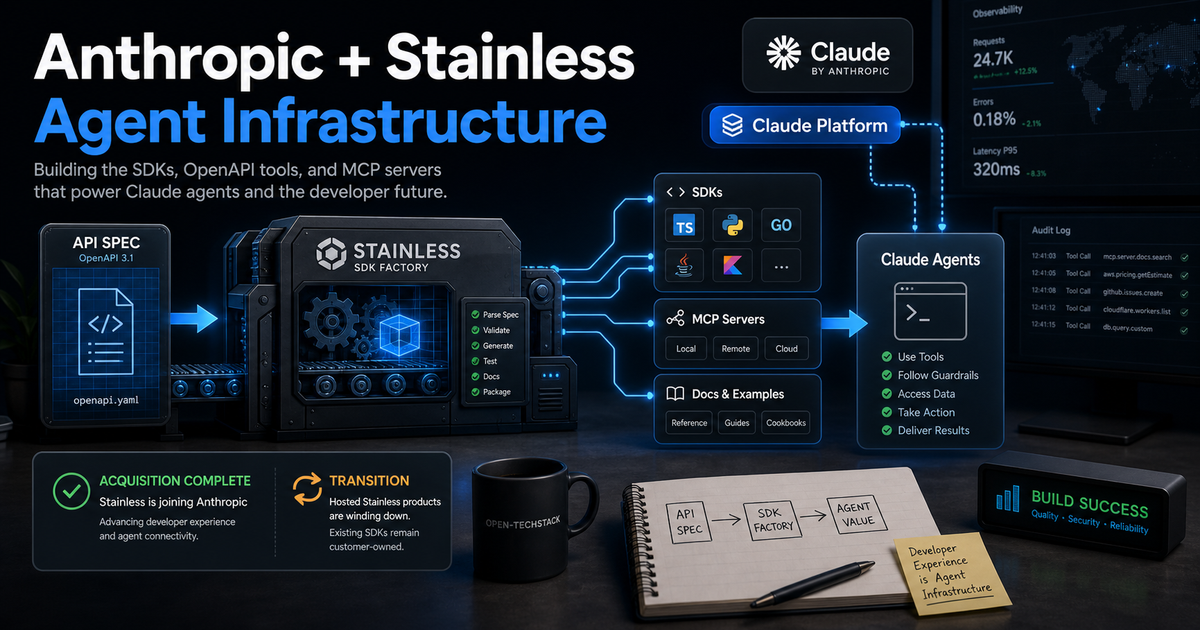
On May 18, 2026, Anthropic announced that it is acquiring Stainless, a developer-tools company known for generating SDKs, CLIs, and MCP server tooling from API specifications. Stainless says it has powered every official Anthropic SDK since the earliest days of the Claude API, and that it is now joining Anthropic to focus on Claude Platform capabilities and connecting agents to APIs.
That may sound like plumbing.
It is exactly why the deal matters.
The agent market is moving from “which model answers best?” to which platform makes agents reliably useful with real systems? In that world, SDKs, API specs, generated clients, docs search, MCP servers, authentication, and sandboxed execution are not background details. They are the rails that decide whether an agent can use a product correctly.
This is independent Open-TechStack analysis. It is not official Anthropic or Stainless guidance, legal advice, investment advice, or a sponsored post.
TL;DR
Anthropic buying Stainless matters because it brings a major SDK and MCP tooling layer into the Claude platform.
The practical takeaways:
- Stainless is joining Anthropic after years of powering official Anthropic SDK generation.
- Stainless says hosted products, including its SDK generator, are winding down, and new signups, projects, and SDKs are no longer available from Stainless-managed products.
- Existing generated SDKs remain customer-owned, according to Stainless, and customers can modify and extend them.
- The strategic value is agent connectivity, not just nicer client libraries.
- API teams should treat MCP support as a product surface, with versioning, docs, authentication, safety boundaries, and support expectations.
- The risk is platform dependency, especially for teams that relied on hosted Stainless workflows or planned to use Stainless-generated MCP servers outside the Claude ecosystem.
The short version: developer experience is becoming agent experience. If your API is hard for a human to use, an agent will probably make the same mistakes faster.
What Anthropic announced
Anthropic says it is acquiring Stainless to strengthen Claude’s ability to connect to data and tools. The announcement describes Stainless as a leader in SDKs and MCP server tooling, and says the company turns API specs into SDKs across TypeScript, Python, Go, Java, Kotlin, and other languages.
Anthropic also says Stainless has powered generation for every official Anthropic SDK since the early Claude API days.
Stainless’ own announcement adds the operational detail API teams need to notice: as Stainless focuses on Claude Platform capabilities, it will wind down hosted Stainless products, including the SDK generator. Stainless says new signups, projects, and SDKs are no longer available, while customers own SDKs already generated and can keep modifying them.
That makes this a two-sided event:
| For Anthropic | For existing Stainless customers |
|---|---|
| It gains a team and tooling layer focused on API developer experience and agent connectivity. | Hosted Stainless workflows need transition planning. |
| It can tighten Claude Platform integration around SDKs, CLIs, docs, and MCP servers. | Existing generated SDKs remain usable, but future generation strategy may need to change. |
| It strengthens the path from API specs to agent-usable tools. | Teams should review ownership, maintenance, publishing, and support plans. |
The acquisition is easy to underestimate because SDKs feel ordinary. They are not ordinary once coding agents become a main integration user.
Why SDKs matter more in the agent era
A normal developer can compensate for weak API experience.
They can read docs, inspect examples, search issues, infer missing types, debug authentication, and ask a teammate. That work is frustrating, but humans can recover.
Agents are less forgiving. If the API surface is unclear, the docs are stale, the SDK behaves differently across languages, or auth errors are vague, the agent may produce plausible code that fails later. Worse, it may build a workaround around a misunderstanding.
That is why SDK quality becomes agent infrastructure.
Good SDKs give agents:
- typed operations instead of free-form HTTP guesses
- idiomatic language patterns instead of generic REST calls
- stable error shapes
- examples that match actual package behavior
- versioned dependencies
- a smaller action space than a whole raw API
- a path for tests and validation
For teams building AI-enabled platforms, this changes the product question.
The old question was: Can developers integrate with our API?
The new question is: Can humans and agents both integrate with our API without inventing fragile glue code?
The MCP angle
MCP is the other half of the acquisition story.
The Model Context Protocol describes itself as an open-source standard for connecting AI applications to external systems, including data sources, tools, and workflows. Its own docs frame MCP as a way for applications such as Claude, ChatGPT, Visual Studio Code, Cursor, and other clients to connect to servers once and reuse those integrations across clients.
Stainless’ MCP docs show why generated MCP servers are attractive for API companies. Stainless describes generating MCP servers from OpenAPI specifications. The generated server can expose a code execution tool and a docs search tool, allowing agents to use the SDK and documentation instead of loading a massive list of endpoint tools into context.
That pattern matters because tool overload is a real agent problem. If every endpoint becomes a separate tool, the agent’s context fills up quickly and tool selection becomes noisy. A smaller tool surface backed by an SDK can be easier for the model to use and easier for the API team to reason about.
The basic shape is:
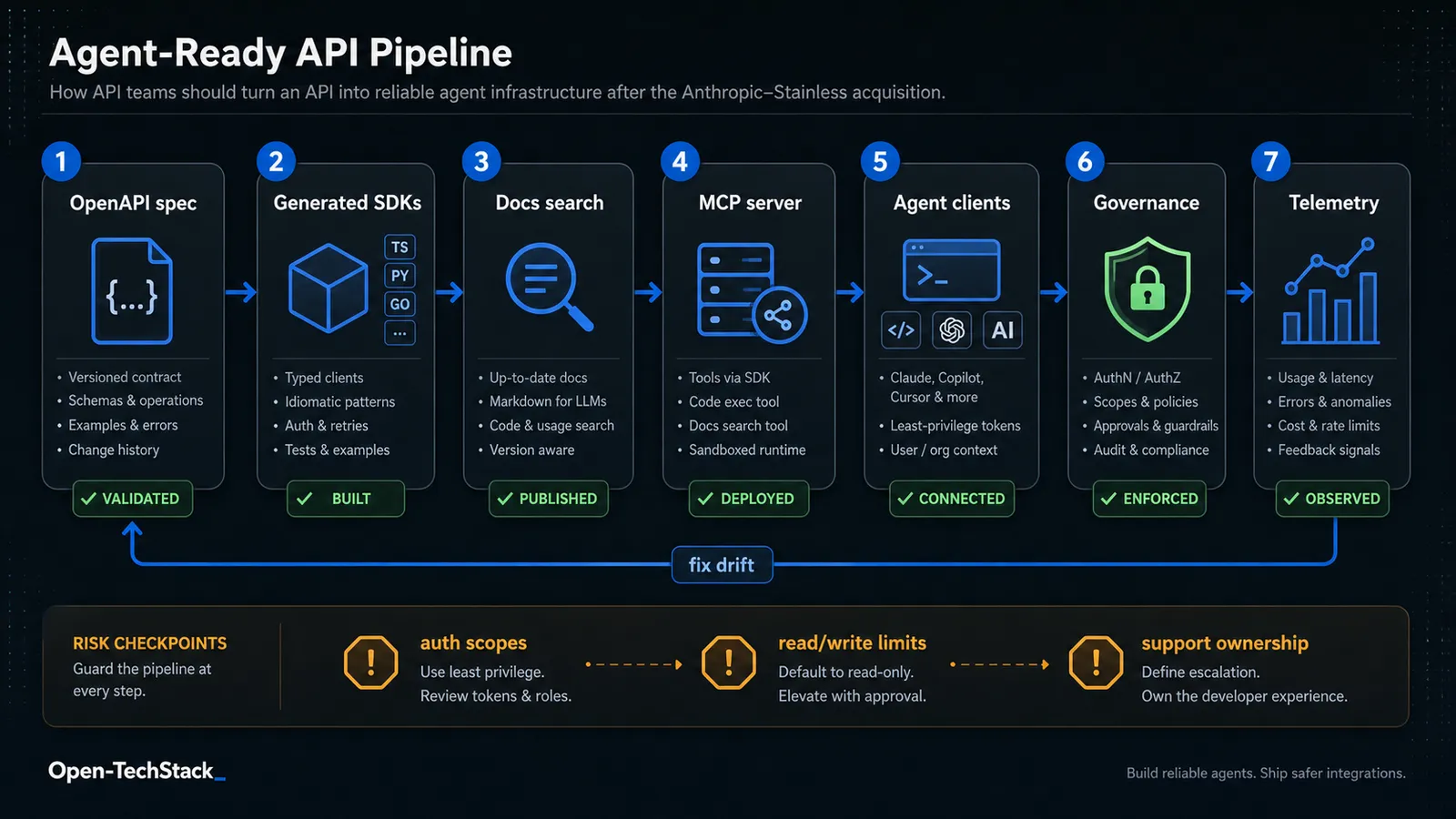
OpenAPI spec
-> generated SDKs and docs
-> MCP server
-> AI clients and coding agents
-> telemetry, review, and product feedback
For API-first companies, that is a product pipeline, not just a build artifact.
What API teams should do now
If your team used Stainless or planned to use it, start with a boring inventory. It will save pain later.
Use this checklist:
| Area | Action |
|---|---|
| Generated SDKs | Confirm which SDKs were generated, where they are published, and who owns maintenance. |
| Source specs | Make sure your OpenAPI specs are current, versioned, and part of your release process. |
| Hosted dependency | Identify any build, docs, publishing, or release task that depended on Stainless-hosted services. |
| MCP plans | Decide whether MCP support is still on the roadmap, and whether it should be self-hosted, vendor-provided, or postponed. |
| Docs search | Review whether agent-facing docs should be public, authenticated, or limited by product tier. |
| Auth boundaries | Re-check API keys, OAuth scopes, environment variables, and local server permissions for agent use. |
| Support model | Decide who handles developer questions when generated clients or MCP tools drift from the API. |
This is not a panic checklist. It is a dependency checklist.
If generated SDKs are already part of your public developer platform, they deserve the same release hygiene as the API itself.
Agent-ready API checklist
The Stainless acquisition is also a useful forcing function for teams that have never used Stainless.
An agent-ready API needs more than an endpoint list.
Use this as a starter standard:
- Keep the OpenAPI spec current and checked in near the API implementation.
- Publish SDKs for the languages your customers actually use.
- Include working examples that pass in CI.
- Make errors structured and documented.
- Provide read-only paths for exploration and testing.
- Separate sandbox credentials from production credentials.
- Keep authentication examples explicit and copyable.
- Version docs and SDKs together.
- Add MCP support only after the SDK and docs are stable enough to trust.
- Log agent-originated requests clearly enough to debug them.
The important move is to stop treating docs, SDKs, and MCP servers as separate afterthoughts. They should be generated, tested, released, and reviewed as one developer platform surface.
Where this helps Anthropic
Anthropic already has Claude, Claude Code, the Claude API, MCP, and a growing platform story. Stainless gives Anthropic a deeper bench around the layer where models meet software systems.
That helps in three places.
First, SDK quality. If developers use Claude through official client libraries, the API experience needs to be consistent across languages. Stainless’ history with Anthropic’s SDKs is directly relevant there.
Second, agent tool use. Agents become more valuable when they can operate through reliable tools instead of brittle scraped docs or guessed HTTP requests.
Third, enterprise adoption. Large companies do not only ask whether a model is strong. They ask whether integrations can be governed, supported, versioned, audited, and maintained.
This is why the deal fits the broader pattern we covered in Anthropic Finance Agent Templates: Why Vertical AI Agents Are Becoming the Real Product. Vertical agents need connectors. Connectors need SDKs, permissions, and support.
Risks and tradeoffs
The acquisition also creates real questions.
The first is continuity for Stainless customers. Stainless says customers can keep and modify generated SDKs, but teams that relied on hosted generation or future Stainless-managed products need a transition plan.
The second is ecosystem neutrality. MCP has broad support across clients and servers, but Anthropic buying a company focused on MCP server tooling will make some teams ask how open and vendor-neutral future tooling remains. That does not mean the standard changes overnight. It does mean developer-platform teams should avoid assuming one vendor will handle every connector problem for them.
The third is security. MCP servers and generated tools can make agents more capable, but they can also expand the blast radius of mistakes. A generated MCP server that exposes a production API still needs authentication, authorization, logging, rate limits, sandboxing, and clear read/write boundaries.
The fourth is support complexity. If agents become a major consumer of your API, support tickets may look different. Instead of “the developer called this endpoint wrong,” you may see “the agent generated a bad integration from incomplete docs.” That is still a product problem.
What not to do
Do not read this acquisition as permission to expose every API endpoint to agents.
Bad rollout patterns:
- publishing an MCP server before the underlying SDK is stable
- exposing write operations without clear approval boundaries
- treating generated docs as a substitute for tested examples
- giving agents production credentials during early experiments
- hiding agent traffic inside normal API analytics
- ignoring hosted-tooling dependencies until a release fails
The better approach is narrower:
- Stabilize the API spec.
- Generate and test SDKs.
- Publish agent-readable docs.
- Add read-only MCP workflows.
- Add write actions only with authorization and review.
- Watch real usage and support tickets before expanding.
That is less exciting than announcing “agent-ready API” on a landing page. It is also how the integration survives contact with production users.
How this fits Open-TechStack’s agent stack view
This acquisition connects directly to several pieces of the modern agent stack.
Why MCP Is Becoming the Default Standard for AI Tools in 2026 explains why the protocol layer matters. Cloud MCP Servers Compared: AWS vs Azure vs Cloudflare vs GitHub vs Google shows how cloud platforms are turning MCP into managed access surfaces. AI Agent Observability Stack 2026 covers the telemetry and review layer that should sit around those tools.
Stainless sits under all of that.
If MCP is the connector standard, SDK generation and API documentation are the manufacturing line. Anthropic buying Stainless is a sign that model companies now care deeply about the manufacturing line.
SEO FAQ
What did Anthropic acquire?
Anthropic announced on May 18, 2026 that it is acquiring Stainless, a developer-tools company focused on SDK generation, CLIs, documentation, and MCP server tooling.
Why does the Stainless acquisition matter?
It matters because AI agents need reliable ways to use APIs. SDKs, docs, and MCP servers help agents connect to external systems without guessing raw HTTP behavior.
What happens to Stainless hosted products?
Stainless says it is winding down hosted products, including its SDK generator. It also says new signups, projects, and SDKs are no longer available, while existing generated SDKs remain owned by customers.
Is MCP still open?
MCP is documented as an open-source standard with broad client and server support. The acquisition does not by itself change that, but teams should still design integrations so they are not locked to one vendor’s hosted tooling.
Should every API publish an MCP server?
No. Teams should first stabilize their API spec, SDKs, documentation, authentication model, and read-only workflows. MCP support is most useful when the underlying developer platform is already reliable.
Bottom line
Anthropic’s Stainless acquisition is a developer-platform move disguised as a tooling acquisition.
The signal is clear: agents need more than strong models. They need clean APIs, reliable SDKs, accurate docs, safe tool surfaces, and enough observability for teams to understand what happened.
For API teams, the next step is practical. Inventory your generated SDKs, harden your OpenAPI release process, decide where MCP belongs, and treat agent access as a product surface with real security and support obligations.
Sources