TL;DR
If you have been searching for what GitHub CLI gh skill actually is, the short answer is this:
On April 16, 2026, GitHub added a new gh skill command that turns agent skills into something developers can discover, install, pin, update, preview, and publish from the terminal.
That sounds like a small CLI addition. It is not.
The real change is that agent skills now have a package-manager-like distribution layer inside GitHub’s own developer workflow surface. That matters because skills were already useful, but the install path was still clumsy enough to slow broader adoption.
Before this launch, GitHub’s docs already supported agent skills in GitHub Copilot CLI, with skills stored in directories like .github/skills, .claude/skills, and .agents/skills. In other words, skills were already real. What GitHub launched on April 16, 2026 is the missing operational layer around them. (GitHub Docs, GitHub Changelog)
What gh skill actually does
GitHub’s changelog says gh skill makes it easier to discover, install, manage, and publish agent skills from GitHub repositories.
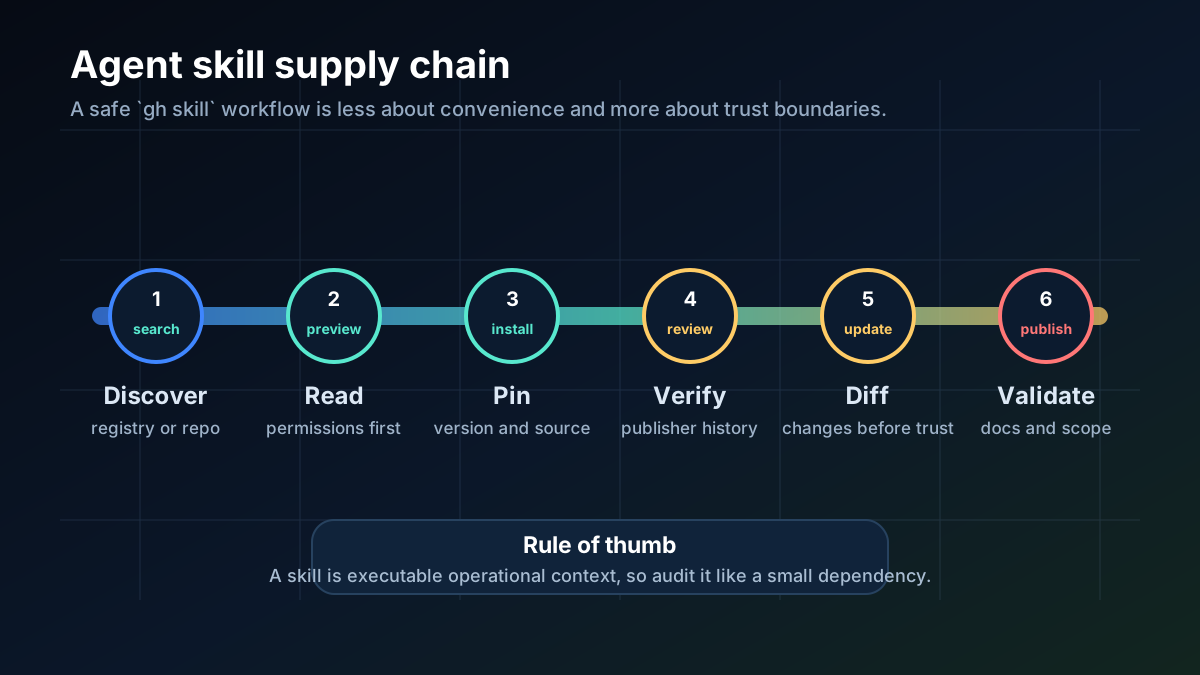
The initial workflow is straightforward:
- search for skills with
gh skill search - install a repository or a specific skill with
gh skill install - update installed skills with
gh skill update - validate and publish skills with
gh skill publish - inspect content before trusting it with
gh skill preview
GitHub says you need GitHub CLI v2.90.0 or later. The launch is in public preview and GitHub explicitly says it is subject to change. (GitHub Changelog)
That preview label matters, but the workflow shape is already clear enough to matter for branded search and practical evaluation.
The bigger point: GitHub is packaging the skills ecosystem
The important thing here is not that GitHub invented agent skills.
It did not.
GitHub’s own docs already describe skills as folders containing a SKILL.md file plus optional scripts and resources, and they point to the Agent Skills specification as an open standard used across multiple AI systems. GitHub also says agent skills work with Copilot cloud agent, GitHub Copilot CLI, and agent mode in Visual Studio Code. (GitHub Docs, Agent Skills specification)
What changed with gh skill is that GitHub is now trying to make skills feel more like a normal software artifact:
- something you can install intentionally
- something you can pin to a tag or commit
- something you can update without guessing what changed
- something you can publish with validation and supply-chain checks
That is a more consequential shift than a normal CLI subcommand release.
If you want the broader context for why skills matter at all, see MongoDB Agent Skills and Plugins and Why MCP Is Becoming the Default Standard for AI Tools in 2026. Skills and MCP are not the same layer, but both are part of the same market move toward more structured agent workflows.
Why this matters more than manual install docs
Before gh skill, GitHub Docs already told users how to add skills manually:
- create or download a skill directory
- place it under
.github/skills,.claude/skills, or.agents/skillsfor project scope - or use
~/.copilot/skills,~/.claude/skills, or~/.agents/skillsfor personal scope - reload skills from inside the CLI session
That works. It does not scale especially well.
Manual directory copying is fine for one skill and one machine. It is weak for:
- keeping multiple skills updated
- tracking where a skill came from
- pinning a skill to a known-good version
- publishing skills with consistent metadata
- sharing the same skill across more than one agent host
gh skill is GitHub’s answer to that operational gap. (GitHub Docs, GitHub Changelog)
The real differentiator is provenance and pinning
The most important part of the launch is not the search command. It is the trust model.
GitHub’s changelog says each installed skill records provenance information directly into the SKILL.md frontmatter, including:
- repository
- ref
- git tree SHA
GitHub also says gh skill update compares the local copy against the remote using the skill directory’s tree SHA, which lets it detect real content changes, not just a changed version label.
That is more serious than a convenience feature.
Agent skills are executable instructions. They can also bundle scripts and other resources. If a skill changes silently between installs, you do not just have a versioning problem. You have a behavior and supply-chain problem.
GitHub is trying to address that with three specific mechanisms:
- version pinning to a tag or commit SHA
- content-addressed change detection through the recorded tree SHA
- portable provenance stored in the skill file itself, so tracking metadata travels with the skill when it gets copied or moved
That last point is especially important because skills are intentionally portable. The Agent Skills format is file-based by design. Putting provenance into the file itself is GitHub’s way of keeping origin and version data attached to the artifact instead of burying it in one local database. (GitHub Changelog, Agent Skills specification)
gh skill publish is GitHub’s attempt to professionalize skills distribution
The publishing side is easy to miss, but it is probably the part that matters most long term.
GitHub says gh skill publish validates skills against the agentskills.io spec and checks repository-level settings such as:
- tag protection
- secret scanning
- code scanning
The changelog also says gh skill publish can offer to enable immutable releases. GitHub Docs define immutable releases as releases whose assets and associated git tag cannot be changed after publication. GitHub says immutable releases also generate a release attestation binding the release tag, commit SHA, and release assets. (GitHub Changelog, GitHub Docs)
That matters because GitHub is not just adding install commands. It is trying to nudge skill authors toward a more defensible release posture.
This is a sensible move. If skills are going to become a shared ecosystem across Copilot, Claude Code, Cursor, Codex, and Gemini CLI, then release hygiene starts mattering quickly.
Cross-agent support is the adoption story
GitHub’s launch post explicitly lists support for several agent hosts:
- GitHub Copilot
- Claude Code
- Cursor
- Codex
- Gemini CLI
- Antigravity
That is one of the strongest parts of the launch.
GitHub is not framing gh skill as a Copilot-only island. It is framing it as a terminal-native distribution tool for a cross-host skill format.
That is strategically important because the real developer environment in 2026 is fragmented. Teams mix tools. One engineer may use Copilot in VS Code, another may use Claude Code in the terminal, and another may bounce between Codex and Cursor. A skill format only becomes powerful when it is portable enough to survive that fragmentation.
That is also why this story fits next to GitHub Copilot CLI BYOK and Local Models and GitHub Copilot SDK. GitHub keeps moving toward a model where the runtime, the agent workflow, and the customization layer are all becoming more modular.
The security caveat is not optional
There is one point developers should not sanitize away.
GitHub explicitly warns that skills are not verified by GitHub and may contain:
- prompt injections
- hidden instructions
- malicious scripts
GitHub recommends inspecting skills before installation, including through the gh skill preview command. (GitHub Changelog)
That warning is not legal boilerplate. It is the honest model.
Skills can improve agent behavior, but they are also a new supply-chain surface for agent behavior. The fact that GitHub is adding provenance, pinning, publish validation, and immutable-release guidance is a sign that it understands this risk. The fact that GitHub still tells you to inspect skills manually is a sign that the risk is not solved.
That is why the right mental model is still: skills are useful, but they deserve the same suspicion you would give any code-adjacent package or automation layer.
If your team is thinking about broader agent governance, that is the same underlying theme we argued in AI Coding Agents Need Guardrails, Not More Autonomy.
So who should care about gh skill right now?
You should care if any of these describe your workflow:
- you already use more than one coding agent and want one way to distribute reusable workflows
- you maintain internal skills and want a cleaner install and update path
- you care about pinning, provenance, and reproducibility for agent customizations
- you publish skills and want lightweight validation plus stronger release hygiene
You should care less if you only use one agent and your skills are entirely local, informal, and unlikely to be shared. Even there, gh skill may still become the cleaner default once the preview stabilizes, but the immediate value is lower.
Bottom line
The April 16, 2026 gh skill launch is not the moment when agent skills became real.
They were already real.
It is the moment GitHub started treating them like a distribution ecosystem that needs install flows, provenance metadata, update logic, release hygiene, and cross-agent portability.
That is why this matters.
For developers, gh skill is not just another subcommand. It is one of the clearest signs that agent customization is turning into normal tooling infrastructure, not just prompt glue hidden in dotfiles.
When to Use
Use gh skill when skills need to be shared, pinned, inspected, updated, or published across more than one machine or agent host. It is strongest for teams that maintain internal agent workflows, want provenance metadata, or need a repeatable terminal-first install path instead of manual folder copying.
It is also useful when you publish skills publicly or internally. The publish workflow, spec validation, and release-hygiene checks help turn skills into reviewable software artifacts rather than loose prompt folders.
When Not to Use
Do not install skills blindly just because they are easy to fetch. GitHub explicitly warns that skills are not verified by GitHub and can contain hidden instructions, prompt injections, or malicious scripts. Preview and review the skill contents before installation, especially if the skill includes executable scripts.
For a one-off personal experiment, manual local skills may be enough. gh skill becomes more valuable when the skill needs provenance, version pinning, update checks, or reuse across a team.
SEO FAQ
What is gh skill in GitHub CLI?
gh skill is a GitHub CLI command for discovering, installing, previewing, updating, validating, and publishing agent skills from GitHub repositories.
What version of GitHub CLI is required for gh skill?
GitHub’s launch note says gh skill requires GitHub CLI v2.90.0 or later and is in public preview, so behavior may still change.
Are GitHub agent skills verified by GitHub?
No. GitHub warns that skills are not verified by GitHub and may contain prompt injections, hidden instructions, or malicious scripts. Developers should inspect skills before installing or running them.
Why does provenance matter for agent skills?
Provenance matters because skills can change agent behavior and may include scripts or resources. Recording repository, ref, and tree SHA information helps teams understand where a skill came from and whether installed content changed.
How is gh skill different from copying skill folders manually?
Manual copying can work for local experiments, but gh skill adds discovery, preview, install, update, pinning, provenance metadata, and publish validation. That makes it more suitable for shared or repeatable workflows.
Sources