TL;DR
The headline says Meta bought more AI cloud capacity from CoreWeave.
The more useful read is narrower and more important:
Meta is explicitly contracting third-party capacity for inference at the same time it is spending aggressively on its own data centers, chips, and cloud infrastructure.
That tells you where the pressure is.
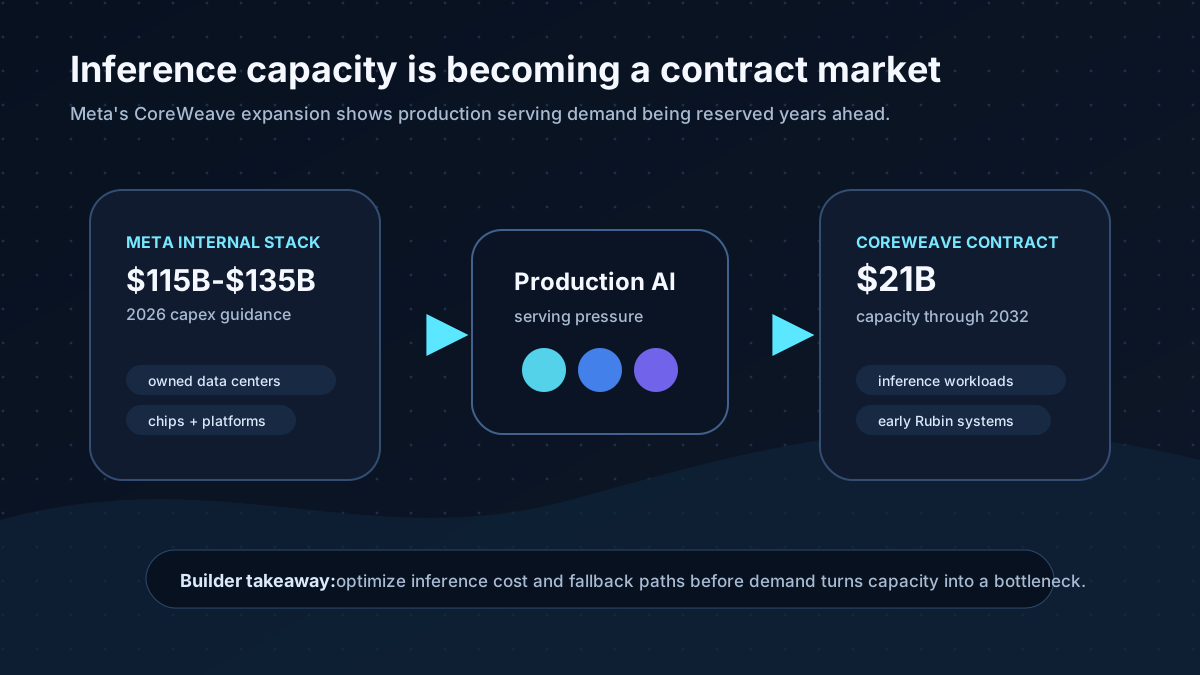
On April 9, 2026, CoreWeave announced an expanded long-term agreement with Meta to provide AI cloud capacity through December 2032 for approximately $21 billion. CoreWeave said the capacity will support Meta’s inference workloads, span multiple locations, and include some of the initial deployments of NVIDIA Vera Rubin systems. (CoreWeave announcement)
CoreWeave’s April 9, 2026 Form 8-K adds the tighter legal framing: the companies entered a new order form on March 31, 2026, and Meta has initially committed to pay CoreWeave about $21 billion, including new computing capacity through December 20, 2032 and the exercise of an existing option under a previous order form through April 10, 2032. (SEC filing)
That is the real story.
This is not just “Meta needs more GPUs.” It is a sign that AI inference capacity is now important enough to lock up years in advance, outside your own walls, even if you are one of the companies spending the most on internal infrastructure.
What happened
There are three pieces worth separating.
1. Meta expanded an existing CoreWeave relationship
This did not start on April 9.
In CoreWeave’s September 30, 2025 third-quarter results, the company said it had entered an up to approximately $14.2 billion multi-year deal with Meta, with an option to expand further. The April 2026 move is the expansion. (CoreWeave Q3 2025 results)
So the practical signal is not “Meta discovered CoreWeave.”
It is that Meta went from a very large reservation to an even larger, longer-duration commitment tied directly to production AI demand.
2. The workload called out is inference
CoreWeave’s own wording matters here.
The company said Meta will use its AI cloud platform to scale inference workloads. That is a different story from a training-only capacity grab.
Training deals tell you who is building the next model generation.
Inference deals tell you who expects real, sustained demand from products that have to run every day at scale.
That distinction matters for builders because inference pressure shows up downstream as:
- latency sensitivity
- traffic spikes
- cost pressure per request
- more aggressive optimization around hardware placement and routing
3. This is happening while Meta is still pouring money into its own stack
On January 28, 2026, Meta said it expected 2026 capital expenditures of $115 billion to $135 billion. In the same earnings call, the company said it was maintaining long-term flexibility by establishing strategic partnerships and contracting cloud capacity, while overall infrastructure expense growth would include third-party cloud spend. (Meta Q4 2025 earnings call transcript)
That combination is the key:
- Meta is building its own infrastructure harder than almost anyone
- Meta still wants outside capacity locked in for years
- the named use case is inference, not just future training
If even Meta is hedging this way, smaller builders should stop assuming the future AI market works like normal elastic cloud.
Why this matters more than the dollar figure
The easy version of this story is “$21 billion is huge.”
True, but not the point.
The more actionable read is that inference has become a strategic supply problem.
For a while, most AI infrastructure analysis centered on training clusters:
- who has the biggest model
- who can secure the next GPU generation
- who can afford the next large training run
That still matters. But once products scale, the operational bottleneck shifts:
- can you serve usage spikes without blowing out margins?
- can you place capacity close enough to users and applications?
- can you guarantee throughput when everyone else also wants the same hardware?
Meta’s CoreWeave expansion suggests those questions are now serious enough to justify multi-year external reservations.
What this changes for builders
Three practical consequences follow from this.
1. “Own stack” and “outsourced capacity” are no longer opposites
A lot of teams still think infrastructure strategy has to resolve into one answer:
- build your own
- or buy from cloud providers
The large-platform reality is increasingly both.
Meta already runs a broad internal infrastructure program across its own data centers and silicon efforts. But its earnings commentary also makes clear that flexibility now includes strategic partnerships and contracted cloud capacity.
That means the winning pattern may be:
- own what creates durable control
- contract what absorbs demand volatility
- keep enough supplier diversity that you can move when hardware or economics shift
This is similar to what we are seeing elsewhere in AI infrastructure. Related: Broadcom, Google, and Anthropic Just Turned TPU Capacity Into a Strategic Weapon
It also fits the forecasting problem we have already seen in hyperscaler-scale buildouts, where capacity planning becomes a product constraint long before end users notice. Related: Microsoft Takes Over OpenAI’s Abilene Expansion. The Real Story Is Forecasting.
2. Inference economics are becoming a first-order product constraint
This is the builder-facing consequence that matters most.
If large platforms are signing long-duration inference capacity deals, the message is not just “demand is strong.” The message is:
serving model outputs is becoming expensive, operationally sensitive, and strategically scarce enough that reserved access matters.
For application teams, that pushes a few priorities higher:
- optimize for request efficiency, not just model quality
- build fallback paths across providers or model classes
- separate premium, latency-sensitive workloads from background or batch work
- instrument cost per feature, not just cost per model
If you do not know which user flows are inference-expensive, you will end up discovering it when traffic grows and margins disappear.
3. Neoclouds are moving from overflow vendors to strategic suppliers
CoreWeave has spent the last year trying to prove it is not just a temporary GPU reseller.
This Meta expansion helps. So does the pattern around it: CoreWeave has also been announcing multi-year relationships for production AI workloads, including an April 10, 2026 agreement with Anthropic. (CoreWeave and Anthropic)
The broader inference here is mine, not CoreWeave’s stated claim: AI neoclouds are becoming strategic counterparties, not just emergency capacity providers.
That matters because it changes where builders may need to look for performance, availability, and commercial leverage. The “real cloud market” is no longer only the traditional hyperscalers.
For another flavor of infrastructure-as-balance-sheet, see Mistral Raised $830M in Debt for a Paris AI Data Center. Here’s What Changes., which shows a European AI lab financing compute assets through debt rather than pure equity. Also, China’s Domestic AI Chips Hit 41% Share. Here’s What Changes for Builders. highlights how domestic accelerator capacity is reshaping procurement and portability requirements across regions.
What changes next
After April 9, 2026, there are three things worth watching.
1. Whether more big labs and platforms start naming inference in their capacity deals
The training race gets most of the attention, but the next wave of infrastructure announcements may increasingly be about production serving rather than headline model runs.
2. Whether early Rubin access becomes a real commercial differentiator
CoreWeave said the Meta capacity will include some of the initial deployments of NVIDIA Vera Rubin. If that turns into measurable latency, throughput, or cost advantages, hardware generation timing will matter even more for application economics.
3. Whether builders start treating capacity provenance like platform risk
Most teams still evaluate model vendors on quality, price, and feature set.
They should increasingly also ask:
- where does this capacity actually come from?
- how concentrated is the provider’s hardware supply?
- what happens when usage spikes across the same fleet?
Those are infrastructure questions, but they quickly become product questions.
Bottom line
Meta’s CoreWeave expansion is important because it names the pressure point clearly.
On April 9, 2026, CoreWeave said Meta expanded its AI cloud agreement to roughly $21 billion through December 2032, with capacity aimed at inference workloads and spanning multiple sites, including some early Vera Rubin deployments. CoreWeave’s SEC filing adds that the deal also exercises existing optioned capacity from an earlier order form.
The builder takeaway is straightforward:
inference capacity is becoming contracted infrastructure, not just on-demand cloud usage.
If you build on top of frontier AI systems, that shift matters even if you never negotiate a multibillion-dollar deal yourself. It affects where capacity shows up first, which providers can guarantee performance, and how fast your own unit economics get squeezed when demand rises.
SEO FAQ
How much is Meta paying CoreWeave?
Meta and CoreWeave announced a $21 billion expanded AI infrastructure agreement in April 2026. The deal covers third-party inference capacity — not training compute — which is a significant distinction in how Meta is structuring its AI infrastructure.
Why is Meta using CoreWeave instead of building its own data centers?
Meta is building its own data centers for training, but inference demand is growing fast enough that it makes sense to contract third-party capacity. CoreWeave provides GPU cloud infrastructure that can scale quickly without Meta needing to build and power additional facilities.
What is the difference between training and inference compute?
Training is the process of building or updating an AI model, which requires massive sustained compute. Inference is running the model to serve user requests, which requires lower per-request compute but at much higher volume. Meta’s CoreWeave deal specifically targets inference, suggesting Meta expects demand to outpace its own inference capacity.
Does this deal affect Meta’s open-weight Llama models?
The deal is about infrastructure capacity, not model architecture. Meta’s Llama models will continue to be developed and released as open-weight. The CoreWeave capacity helps Meta serve Llama-based inference workloads at scale without bottlenecking on its own data center buildout.
Sources
- coreweave.com — Coreweave And Meta Announce 21 Billion Expanded Ai Infrastructure Agreement
- sec.gov — Crwv 20260331
- investors.coreweave.com — Coreweave Reports Strong Third Quarter 2025 Results
- s21.q4cdn.com — Meta Q4 2025 Earnings Call Transcript
- investors.coreweave.com — Default
When to Use
Use this article when analyzing inference-capacity strategy, GPU cloud procurement, or why large AI companies contract third-party capacity even while building their own data centers. It is useful for separating training compute from inference compute and for explaining why demand spikes can turn infrastructure access into a product constraint.
When Not to Use
Do not use this article as investment advice, procurement advice, or a forecast of CoreWeave or Meta financial performance. The safer takeaway is architectural: inference growth changes capacity planning, and teams should design fallbacks, traffic controls, and cost monitoring before demand outgrows a single provider path.