TL;DR
If you were searching for the latest GPT Cyber update, the precise release to read is OpenAI GPT-5.4-Cyber.
That matters because the product name is doing real work here. This is not just a generic “cyber mode” inside a chat app. On April 14, 2026, OpenAI said it was scaling Trusted Access for Cyber and giving higher-tier users access to GPT-5.4-Cyber, a variant of GPT-5.4 fine-tuned for defensive cybersecurity work. (OpenAI)
The practical takeaway is simple:
- GPT-5.4-Cyber is narrower than the main GPT-5.4 launch.
- It is more permissive for legitimate security work.
- It is not broadly open in the way a normal model launch is.
If you only want the broad developer-model context, start with GPT-5.4 Is Here: A Developer Playbook for Faster, Safer Agents. If you care about desktop and browser automation, Codex Computer Use Update (April 2026) is the more relevant read. GPT-5.4-Cyber sits in a different lane: defensive security workflows.
What changed on April 14, 2026
OpenAI’s April 14 post says it is scaling Trusted Access for Cyber to thousands of verified individual defenders and hundreds of teams responsible for critical software. The same announcement says customers in the highest tiers can access GPT-5.4-Cyber, which OpenAI describes as a version of GPT-5.4 with fewer capability restrictions and a lower refusal boundary for legitimate cybersecurity work. (OpenAI)
The specific capability that stands out is binary reverse engineering. OpenAI says GPT-5.4-Cyber can help security professionals analyze compiled software for malware potential, vulnerabilities, and robustness without source code access. That is a meaningful expansion over a generic coding model, because a lot of real security work happens after source is gone, obfuscated, or simply unavailable. (OpenAI)
The rollout is also intentionally limited:
- access starts with vetted security vendors, organizations, and researchers
- individual users verify identity at chatgpt.com/cyber
- enterprises request trusted access through their OpenAI representative
- OpenAI warns that Zero-Data Retention surfaces and third-party platforms can reduce visibility and tighten availability
That is the opposite of a broad consumer launch. It is a controlled deployment with trust gates.
Why builders should care
The obvious audience is security teams, but there is a broader builder lesson here.
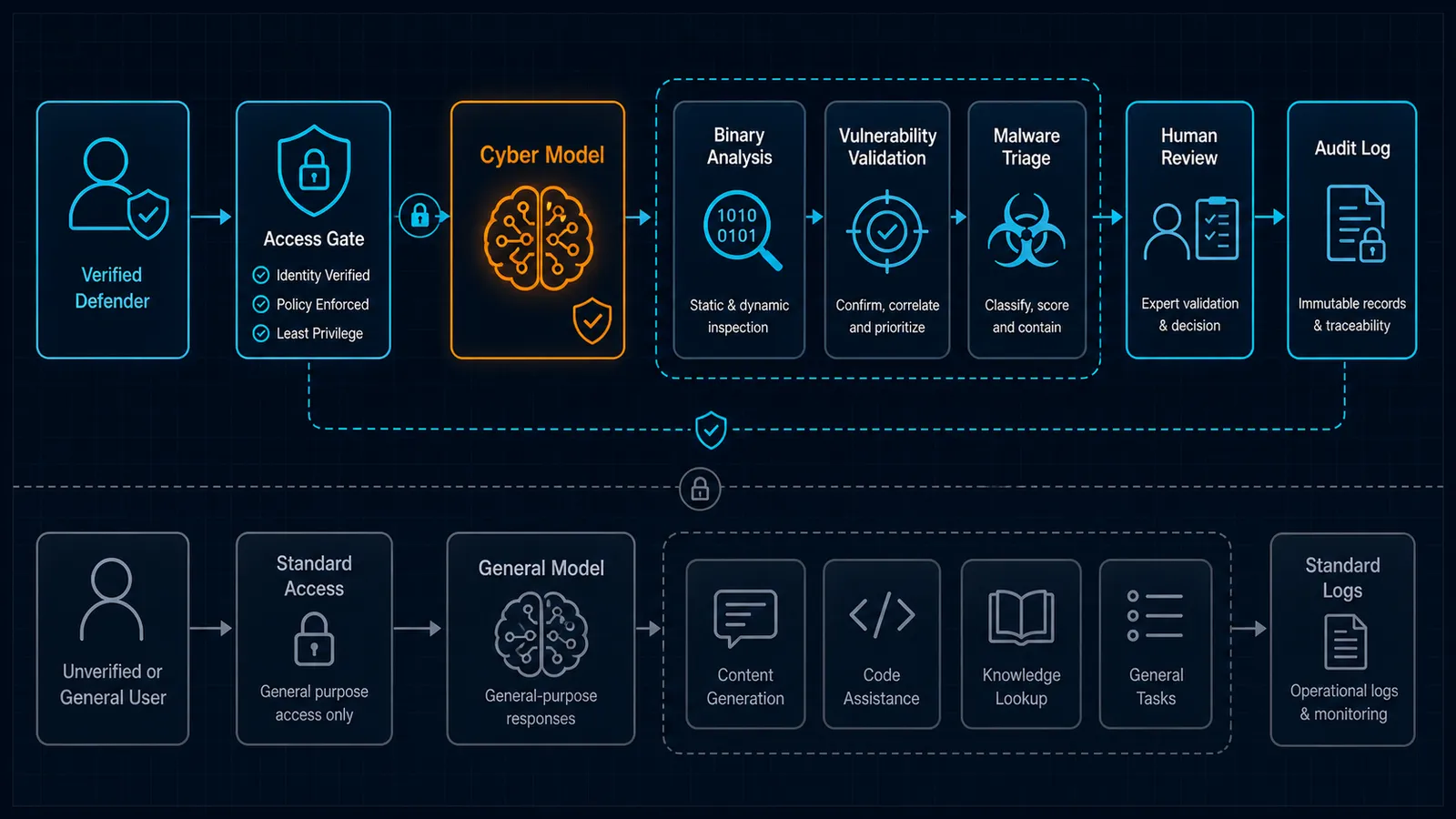
OpenAI is making a clear distinction between:
- the general-purpose model you use for everyday product and coding work
- the specialized, access-controlled model you use for defensive cyber work
That split is useful. It reduces the temptation to use one model for everything and then pretend all risk is equal. It is not.
For developers, this release points to a few practical patterns:
1. Security work is becoming more model-native
If you build internal security tooling, a model that can work on compiled binaries, validate issues, and support defensive research is more relevant than a generic chat model. The use case shifts from “write code for me” to “help me inspect, reason about, and triage software risk.” (OpenAI)
2. Trust and verification are becoming part of the product surface
OpenAI is explicit that access depends on identity, trust signals, and accountability. That matters because enterprise AI tools are moving away from pure capability tests and toward policy-driven access control. The model is only half the product; the trust layer is the other half. (OpenAI)
3. Specialization is now the sane default
This is the same pattern we saw with GPT-5.4’s broader release on March 5, 2026, where OpenAI emphasized professional work, computer use, tool support, and workflow reliability. GPT-5.4-Cyber is the narrower follow-on: same family, tighter scope, different access rules. (OpenAI)
Where it fits in a real workflow
Use GPT-5.4-Cyber when the job is specifically about defensive security, such as:
- triaging a suspected binary
- validating a potential vulnerability
- reasoning about malware behavior
- supporting responsible vulnerability research
- helping a security team move faster with human review in the loop
Do not treat it as the default answer for general coding, product analysis, or broad agent workflows. For that, the main GPT-5.4 release remains the better starting point, and Codex is still the more natural fit for repo-centric and desktop-centric work.
That distinction is why this release is worth covering but not overhyping.
The real product signal is not “OpenAI has another model.” The signal is that OpenAI is now packaging frontier capability together with explicit access control and use-case-specific deployment rules.
Defensive-use boundary
This post is about governance for verified defensive use. It is not a guide to bypassing model safeguards, exploiting systems, writing malware, evading detection, or reproducing vulnerabilities outside an approved environment.
Teams evaluating GPT-5.4-Cyber should keep three boundaries visible:
- Authorized scope: only analyze assets, samples, programs, or bug-bounty targets where the team has permission to work.
- Non-operational outputs: keep model output at the level of triage notes, validation evidence, detection ideas, and remediation planning unless a human reviewer approves the next step.
- Disclosure discipline: treat validated findings as sensitive security material until the owner, maintainer, or affected customer has a clear remediation path.
That framing matters for both safety and usefulness. A cyber model creates value when it helps defenders confirm, prioritize, and fix risk. It creates avoidable risk when organizations treat powerful analysis as permissionless experimentation.
The practical read for developers
If you are a builder, the question is not whether GPT-5.4-Cyber is impressive. It is.
The question is whether you have the surrounding system:
- clear user verification
- scoped permissions
- auditing
- sandboxing
- human approval for risky actions
- separate paths for general work and security work
If you do not, then a more capable cyber model mostly increases your risk surface.
If you do, then this release is a useful sign that defensive AI is becoming more operationalized instead of staying stuck in research demos.
What teams should verify before using it
The access gate is only the first control. The harder work happens inside the organization that receives access.
Before a team routes real investigations through a more permissive cyber model, it should verify three things.
First, the case boundary needs to be clear. A malware triage request, a bug bounty reproduction, a secure code review, and an incident-response investigation do not carry the same legal, privacy, or disclosure obligations. The model workflow should inherit the case type instead of treating every request as a generic security prompt.
Second, the evidence trail needs to survive the conversation. Security teams should preserve the original binary hash, sample source, ticket ID, test environment, timestamps, and human reviewer notes. If the model suggests a plausible vulnerability but the evidence cannot be reconstructed, the result is not ready for remediation or disclosure.
Third, the approval boundary needs to stay visible. A lower refusal boundary can help legitimate defenders, but it also means the surrounding system must know which actions still require human approval. Reproducing a vulnerability in a lab, drafting a detection rule, and preparing a customer-facing advisory are different steps. They should not be collapsed into one unchecked model session.
That is the practical security architecture lesson here: capability belongs behind workflow controls. The more specialized the model becomes, the more explicit the surrounding process needs to be.
Bottom line
On April 14, 2026, OpenAI turned its cyber-defense story into a more concrete product shape:
- scale Trusted Access for Cyber
- give vetted defenders access to GPT-5.4-Cyber
- lower refusal boundaries for legitimate security work
- support binary reverse engineering and other defensive workflows
That is a meaningful release, but it is not a general public model launch. It is a controlled security tool for verified users.
For most developers, the most useful takeaway is architectural: separate general coding workflows from security workflows, and treat access control as part of the model design.
Implementation checklist for security teams
If your organization qualifies for trusted cyber access, do not start by giving every engineer the strongest model surface. Start with a controlled workflow:
- Define allowed use cases: malware triage, binary analysis, secure code review, vulnerability reproduction, and defensive reporting are different risk categories.
- Require case tracking: every model-assisted security investigation should map to a ticket, incident, or approved research project.
- Separate production secrets: do not paste live credentials, private keys, customer data, or unredacted incident data into exploratory analysis unless the data path is approved.
- Preserve human sign-off: model output can speed triage, but vulnerability confirmation, disclosure, and remediation ownership should remain human-controlled.
- Measure false positives: a cyber model that floods analysts with plausible but wrong leads can waste more time than it saves.
This is the difference between a powerful defensive assistant and a risky internal toy. GPT-5.4-Cyber should make defenders faster, but the surrounding process still decides whether the speed becomes reliable security work.
The best first metric is not “how impressive were the answers?” It is analyst throughput with quality held constant. Track how many findings are confirmed, how many are discarded, how long review takes, and whether the model changes the team’s false-positive rate. If the cyber model only creates more plausible leads without better confirmation, it is adding noise rather than leverage.
That measurement discipline matters because security work already has enough alert fatigue. A specialized model should reduce uncertainty, not simply produce more confident language around uncertain evidence.
SEO FAQ
What is GPT-5.4-Cyber?
GPT-5.4-Cyber is OpenAI’s cyber-permissive variant of GPT-5.4 for vetted defenders using Trusted Access for Cyber. OpenAI describes it as a model fine-tuned for additional defensive cybersecurity capabilities with fewer capability restrictions.
Is GPT-5.4-Cyber generally available?
No. OpenAI describes GPT-5.4-Cyber as a limited, iterative deployment for vetted security vendors, organizations, and researchers through Trusted Access for Cyber.
What is Trusted Access for Cyber?
Trusted Access for Cyber is OpenAI’s access pathway for verified defenders and approved organizations that need lower-friction support for legitimate cybersecurity work.
What can GPT-5.4-Cyber help defenders do?
OpenAI says the model can support advanced defensive workflows, including binary reverse engineering for analyzing compiled software for malware potential, vulnerabilities, and security robustness.
What controls should teams keep around GPT-5.4-Cyber?
Teams should keep case tracking, sandboxing, audit logs, identity verification, scoped permissions, human review, and clear approval boundaries around any model-assisted security investigation.
Does this article provide offensive security instructions?
No. This article stays at the governance and defensive workflow level. It does not include payloads, exploit steps, evasion guidance, or instructions for unauthorized activity.
Sources