TL;DR
If you have been searching for what changed in GitHub Copilot cloud agent this month, the short answer is: GitHub spent the first third of April 2026 making the product feel less like a novelty PR bot and more like a governed async coding workflow.
That matters.
Across updates published between April 1 and April 10, 2026, GitHub expanded what the cloud agent can do before a pull request exists, made its validation loop faster, exposed more usage visibility to admins, and pushed stronger trust signals around agent-authored commits and session logs.
Taken one by one, each update looks small. Taken together, they show the real product direction.
GitHub is not just teaching Copilot to write code. It is trying to turn cloud agent into a branch-first developer surface where the model can research, plan, change code, run checks, and leave an audit trail that humans can review.
What changed in GitHub Copilot cloud agent in April 2026
The important timeline is short.
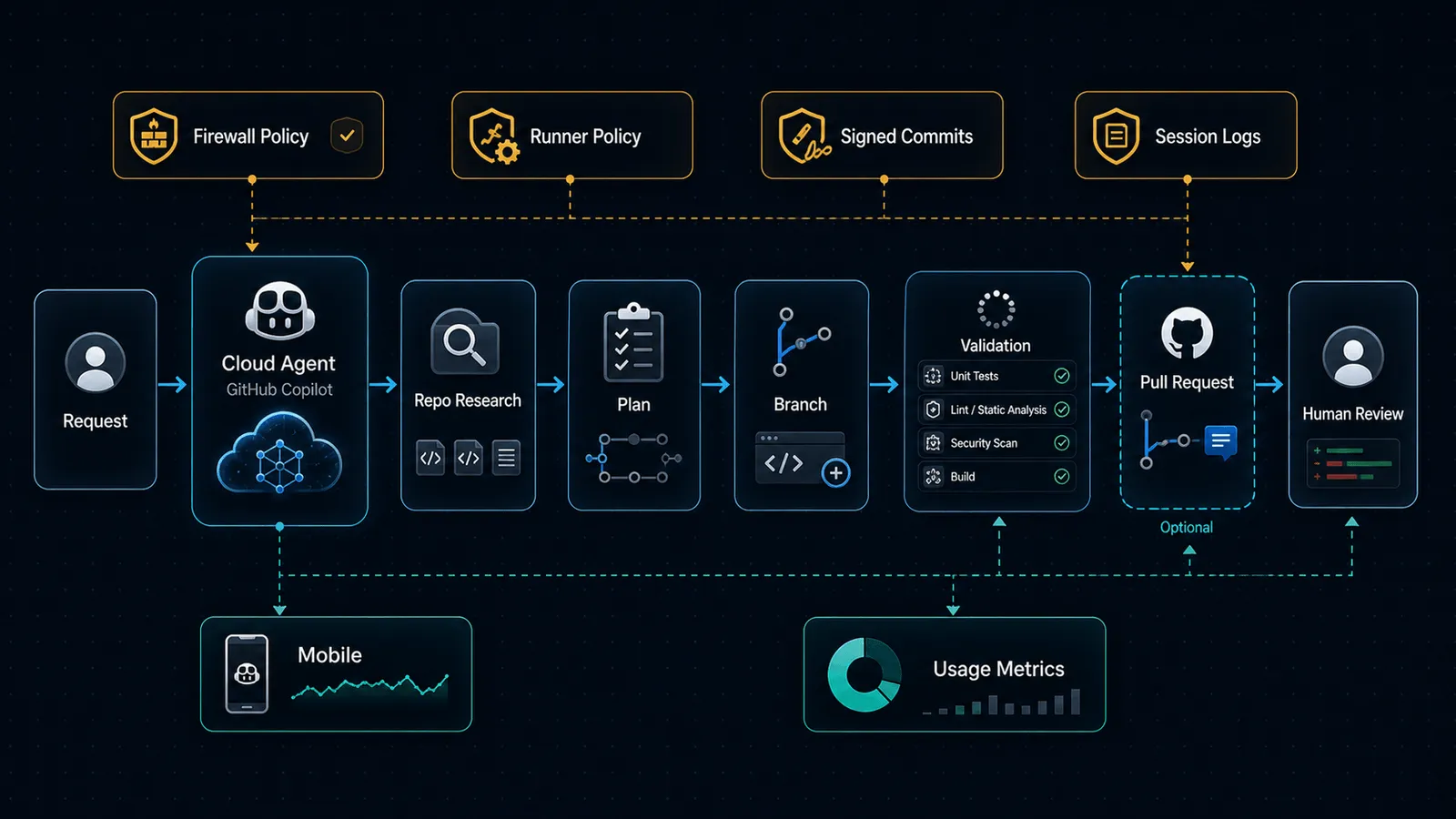
On April 1, 2026, GitHub documented a more interactive workflow where Copilot cloud agent can research a repository, create an implementation plan, make changes on a branch, and let you iterate before opening a pull request.
On April 3, GitHub shipped three governance-oriented changes:
- Copilot cloud agent now signs its commits
- organization firewall settings for cloud agent
- organization runner controls for cloud agent
GitHub’s responsible-use docs also say those commits are co-authored with the human who started the task and include links back to the session logs.
On April 8, GitHub shipped the same research-and-code flow to GitHub Mobile, so you can review diffs, keep iterating, and only create a pull request when you are ready.
On April 10, GitHub published two more operational updates:
- validation tools now run in parallel, which GitHub says reduces validation time by 20%
- Copilot usage metrics now aggregate cloud-agent active user counts, which gives admins a clearer read on adoption beyond the IDE
That is enough activity in ten days to treat April as a meaningful product-maturity window, not just routine changelog noise.
The biggest product shift is branch-first work before the PR
The most important change is not mobile and it is not the 20% speedup.
It is the workflow shape.
GitHub’s current cloud-agent docs now describe a path where Copilot can do deep repository research, draft an implementation plan, make code changes on a branch, and let you inspect the diff before you decide whether a pull request should exist at all.
That is a different product philosophy from the earlier mental model many developers had:
- assign the agent a task
- wait for a PR
- react after the fact
The April documentation reframes cloud agent as something closer to an async branch collaborator. You can use it to explore, plan, iterate, and only then publish work for wider review.
That makes the product more useful for:
- exploratory bug investigation
- implementation planning before code review overhead starts
- partial code changes that still need one more instruction cycle
- technical debt cleanup where the first draft is rarely the final draft
It also makes cloud agent easier to compare with the broader agent-runtime direction GitHub has been pushing across the stack. If you want the adjacent runtime story, see GitHub Copilot SDK: What It Is, What Changed in Public Preview, and Where It Fits and GitHub Copilot CLI /fleet: What It Is, How It Works, and When It Actually Helps.
Why signed commits, runner policy, and firewall policy matter more than they sound
The April 3 trust-and-governance updates are easy to underrate.
“Signed commits” sounds like a compliance detail. For agent workflows, it is more than that. So do runner defaults and firewall settings.
GitHub’s responsible-use docs say Copilot cloud agent commits are:
- authored by Copilot
- co-authored with the human who initiated the task
- shown as Verified on GitHub because they are signed
- linked back to the full session logs through the commit message
That is not just nice metadata. It improves traceability.
One of the hardest parts of reviewing agent-generated code is reconstructing intent after the fact. Why did the agent change this file? What instruction triggered the change? What checks ran? What did it see during the session?
A signed commit plus a durable session-log link does not solve all of that, but it makes the review path much less opaque. That is exactly the kind of product work AI coding tools need if they want to move from demo adoption to team adoption.
The same logic shows up in a lot of other serious agent products right now: the useful question is no longer just “can it generate code?” It is “can we inspect what happened when it did?” We made the same point in AI Coding Agents Need Guardrails, Not More Autonomy.
The other April 3 changes push in the same direction. GitHub says organization admins can now manage the cloud-agent firewall across repositories and can also set or lock default runners across the organization. That matters because rollout friction for agent tooling usually appears at the policy layer, not at the demo layer.
If a company wants cloud agent to:
- run on approved infrastructure
- follow consistent internet-access rules
- use shared defaults instead of repo-by-repo exceptions
then org-level controls are the difference between “interesting feature” and “something platform teams can standardize.”
GitHub is also making the safety model more legible
The documentation is now pretty explicit about the cloud agent’s boundaries.
GitHub says the agent works inside its own ephemeral development environment, where it can make changes, run tests, and execute linters. The docs also say built-in protections limit the agent to a single branch: either the current pull-request branch when triggered with @copilot, or a newly created copilot/ branch otherwise.
That means Copilot cloud agent cannot push directly to the default branch.
This matters because it makes the product easier to reason about operationally. The branch model is not a soft recommendation. It is part of the boundary.
For teams evaluating agent tooling, that is a better default than “the assistant can modify whatever it can reach.” It gives platform and security teams a clearer story:
- isolated environment
- constrained repo scope
- no direct default-branch writes
- auditable session trail
That still does not remove the need for human review. GitHub’s own responsible-use guidance explicitly says you should review and test cloud-agent output before merging. But the constraint model is at least aligned with how cautious teams actually want these tools to behave.
The April 10 speedup matters because validation is where agents often feel slow
GitHub’s April 10 changelog says the cloud agent’s validation tools now run in parallel rather than sequentially, cutting validation time by 20%.
According to GitHub, those validation tools include:
- CodeQL
- the GitHub Advisory Database
- secret scanning
- Copilot code review
This update is easy to dismiss because it is “only” a speed improvement. That would be a mistake.
In agent-assisted coding, the slowest part is often not code generation. It is the verification loop after code generation. If the product has to check for insecure dependencies, secret leaks, code quality issues, and security findings before it asks for review, then every improvement to the validation path changes how usable the agent feels in daily work.
The important thing here is not just that GitHub made the agent faster. It is that GitHub is reinforcing the idea that validation is part of the agent workflow, not an optional afterthought bolted on later.
That is also why this cloud-agent story is meaningfully different from pure “model launch” coverage. It is about operational workflow tooling, not benchmark headlines.
Mobile support is more consequential than it looks
On April 8, 2026, GitHub extended cloud-agent research and coding workflows to GitHub Mobile.
At first glance, that sounds like convenience-only product work. In reality, it expands where asynchronous agent management can happen.
GitHub says you can now:
- ask Copilot to research your codebase from mobile
- generate an implementation plan before writing code
- make code changes on a branch without immediately opening a PR
- review the diff and iterate until you are ready
- create the pull request later, or instruct Copilot to create it automatically
That matters because it pushes cloud agent further into the category of delegated background work rather than “desktop-only coding feature.” You are no longer limited to a workstation if the task is mostly review, instruction, and iteration.
That will not change how core engineering gets done. It probably will change how people keep tasks moving while away from the desk, especially for reviewable background work that already has good boundaries.
Admin visibility is catching up to product expansion
The other April 10 change is more boring on the surface and more important underneath.
GitHub says Copilot usage metrics now aggregate cloud-agent active user counts. Earlier updates had already exposed cloud-agent activity more directly, but this new aggregation makes admin reporting more complete.
That matters because once a product spreads across IDEs, CLI, code review, and background agents, leadership stops asking “is anyone using Copilot?” and starts asking more specific questions:
- which surfaces are getting real adoption
- where autonomous workflows are actually happening
- whether usage is growing because of IDE completion or because agents are taking on more task execution
This is not end-user magic. It is admin plumbing.
But products that want enterprise durability need admin plumbing.
What this means for developers right now
The best way to read the April 2026 Copilot cloud agent updates is this:
GitHub is trying to make cloud agent feel safer, more reviewable, and more operationally useful without requiring developers to treat it like a fully autonomous engineer.
That is the right direction.
Developers should care if they want:
- async repo research before coding starts
- implementation planning on a branch instead of straight-to-PR automation
- stronger provenance for agent-authored commits
- validation built into the agent loop
- a workflow that can continue from mobile when the work is mostly oversight
Platform teams should care if they need:
- clearer branch constraints
- auditable session links
- better admin visibility into actual agent adoption
- a product story that is easier to explain to security and compliance stakeholders
What this does not mean
It does not mean cloud agent is now trustworthy without review.
It does not mean GitHub solved the general problem of autonomous software delivery.
And it does not mean every coding task now belongs in the background-agent lane.
The product still looks strongest for bounded, reviewable work where:
- the repository context matters
- the branch boundary is enough protection
- the human still wants the last word before merge
For smaller edits, direct IDE or CLI flows may still be simpler. For heavily parallel work, GitHub’s CLI and SDK stories remain relevant. If you are evaluating that side of the stack, GitHub Copilot CLI BYOK and Local Models: What Changed and Why It Matters covers where the terminal product is getting more flexible.
Bottom line
GitHub Copilot cloud agent did not have one giant launch this month.
Instead, between April 1 and April 10, 2026, GitHub tightened the product from several angles at once:
- better pre-PR branch workflows
- stronger provenance through signed commits and session logs
- mobile access for delegated background work
- faster built-in validation
- clearer adoption reporting for admins
That combination is the real story.
The cloud agent is becoming less like a flashy autonomous coding demo and more like a controlled async development surface. For teams that want AI help without giving up reviewability, that is a meaningful product improvement.
Team rollout checklist
Before broadening use, platform teams should confirm:
- cloud-agent work stays on branches and never bypasses normal protected-branch policy
- signed commits and session-log links are visible to reviewers
- organization firewall settings match the repositories where agents are enabled
- runner defaults are documented and locked where consistency matters
- validation output is part of review, not a post-merge surprise
- usage metrics are reviewed separately from normal IDE completion usage
The practical goal is not to make the agent feel autonomous. It is to make delegated coding work inspectable enough that teams know when to trust it, when to reject it, and when to narrow the task.
When to Use
Use GitHub Copilot cloud agent for bounded async work where the branch boundary, session logs, validation output, and human pull-request review are enough control. It is strongest for repository research, implementation planning, small-to-medium branch changes, issue investigation, test or lint follow-up, and tasks where mobile or background iteration keeps work moving without bypassing review.
It is also a good fit when platform teams need more governance than a local prompt can provide: signed commits, organization firewall settings, runner controls, usage metrics, and reviewable session history all make the workflow easier to supervise.
When Not to Use
Do not use cloud agent for changes that should bypass normal engineering controls. It should not be used as an unsupervised path to protected branches, production secrets, destructive infrastructure changes, or broad codebase rewrites with unclear ownership.
It is also weaker for tiny edits that are faster in the IDE, heavily interactive debugging that needs live human judgment, or tasks where the agent cannot run meaningful validation. If the output cannot be reviewed cleanly, narrow the task before delegating it.
SEO FAQ
What is GitHub Copilot cloud agent?
GitHub Copilot cloud agent is an async coding-agent workflow that can research a repository, create an implementation plan, make changes on a branch, run validation, and prepare work for human review.
What changed in the April 2026 Copilot cloud agent updates?
GitHub’s April 2026 updates emphasized branch-first workflows before pull requests, signed commits with session-log links, organization firewall and runner controls, GitHub Mobile support, faster parallel validation, and improved admin usage metrics.
Can Copilot cloud agent push directly to the default branch?
GitHub’s documentation describes cloud agent work as branch-based. The agent works on a pull-request branch or a new copilot/ branch, so teams should keep protected-branch policy and human review in place before merge.
Why do signed commits matter for agent-generated code?
Signed commits improve provenance. They help reviewers see that a commit came from Copilot cloud agent, connect it to the initiating user, and follow links back to session logs for more context.
Is Copilot cloud agent safe without human review?
No. The safer operating model is delegated, reviewable branch work. Developers should inspect diffs, session logs, validation output, tests, and policy-sensitive changes before merging.
Sources
- GitHub Docs: About Copilot cloud agent
- GitHub Docs: Research, plan, and iterate with Copilot coding agent
- GitHub Docs: Responsible use of Copilot cloud agent
- GitHub Changelog: Copilot cloud agent signs its commits
- GitHub Changelog: Organization firewall settings for Copilot cloud agent
- GitHub Changelog: Organization runner controls for Copilot cloud agent
- GitHub Changelog: GitHub Mobile can research and code with Copilot cloud agent
- GitHub Changelog: Copilot cloud agent validation tools are faster
- GitHub Changelog: Copilot usage metrics aggregate cloud-agent active users