TL;DR
If you have been searching for whether Claude Opus 4.6 Fast Mode is real, available, and usable in normal developer workflows, the short answer is yes:
On April 7, 2026, Vercel added Fast Mode support for Claude Opus 4.6 in AI Gateway.
This is not a new model launch. It is a speed tier on top of the existing model.
According to Vercel’s changelog and the AI SDK Anthropic provider docs, Fast Mode keeps the same model but enables roughly 2.5x faster output token speeds. Vercel also calls it an early, experimental feature, and the pricing is the real catch: 6x standard Opus rates. That means pricing moves from $5 input / $25 output per 1M tokens to $30 input / $150 output per 1M tokens. (Vercel changelog, AI SDK Anthropic provider docs)
That combination makes this release more interesting than it first looks.
This is not about getting a slightly snappier chat tab. It is about whether some teams will pay a large premium to reduce waiting inside human-in-the-loop coding workflows, especially when the delay happens at the exact moment a developer is waiting on planning, review, or a long structured answer.
What actually shipped on April 7
Vercel’s April 7, 2026 changelog says Fast Mode support for Claude Opus 4.6 is now available on AI Gateway. The same announcement says the feature:
- delivers 2.5x faster output token speeds
- keeps the same model intelligence
- is still early and experimental
- is aimed at human-in-the-loop workflows
Vercel’s example shows Fast Mode enabled through the Anthropic provider options in AI SDK by passing:
providerOptions: {
  anthropic: {
    speed: 'fast',
  },
}
The AI SDK Anthropic provider docs match that behavior and clarify that the speed option accepts 'fast' or 'standard', with 'standard' as the default. The same docs note that Fast Mode applies to claude-opus-4-6. (Vercel changelog, AI SDK Anthropic provider docs)
That matters because this is not a Vercel-only abstraction layered on top of vague marketing copy. The setting shows up directly in the model provider docs developers would actually use.
Why this is more than a minor speed toggle
In AI products, latency only matters when it changes behavior.
That is the useful way to read this release.
If you are waiting two or three extra seconds for a trivial answer, Fast Mode is probably a bad deal. But if you are waiting on:
- a long codebase plan
- a structured migration strategy
- a review of a large diff
- a multi-file remediation proposal
- a high-context coding answer inside Claude Code
then output speed can become a workflow bottleneck rather than a cosmetic annoyance.
Vercel is explicit about that in the release note. The company frames Fast Mode as a way to run large coding tasks and get planning output without long waits or context switching. That is a strong hint about the intended use case: premium latency for expensive moments, not always-on acceleration for everything. (Vercel changelog)
That makes this a good fit for teams that already treat AI as part of an operator workflow rather than a standalone chat experience. It is the same pattern behind tools we have already covered like Vercel Sandbox in the main CLI, where the value is not the model alone but the workflow surface around it.
How it fits into Vercel AI Gateway
This launch also makes more sense in the context of what AI Gateway already does.
Vercel’s docs describe AI Gateway as a unified API that gives access to hundreds of models through a single endpoint. The docs also say teams can set budgets, monitor usage, load-balance requests, and manage fallbacks, with no markup on tokens relative to the provider’s direct pricing. (Vercel AI Gateway docs)
That last point is important.
Fast Mode is expensive, but AI Gateway gives teams a place to manage that expense as part of a routing and observability layer instead of scattering it across ad hoc API calls. If you are already using the gateway to:
- standardize model access
- monitor spend
- route between providers
- inspect traces and traffic
then adding a premium speed tier to a single high-value model becomes easier to reason about.
This is also why the feature is more relevant than a normal “provider added parameter X” update. Inside a gateway, speed tiers can become policy decisions, not just developer preferences.
Claude Code is the most practical workflow angle
The clearest applied use case is Claude Code.
Vercel’s changelog says you can use Fast Mode with Claude Code through AI Gateway by setting:
{
  "model": "opus[1m]",
  "fastMode": true
}
Vercel’s Anthropic Messages API docs also show that Claude Code can be routed through AI Gateway by pointing ANTHROPIC_BASE_URL to https://ai-gateway.vercel.sh, authenticating with an AI Gateway key, and then using Claude Code through that gateway path. The same docs say this setup lets teams route requests through multiple AI providers, monitor traffic and spend, view traces in Vercel Observability, and use any model available through the gateway. (Vercel changelog, Vercel Anthropic Messages API docs)
That is the strongest reason developers should care.
Fast Mode is easiest to justify when the wait happens in an interactive tool where a human is already blocked. A batch system can often tolerate slower output. A person sitting inside Claude Code usually cannot.
That is also where the 6x premium becomes less absurd than it looks at first glance. If a faster answer saves a high-value engineer from context switching during a difficult planning or review task, the cost model changes.
The pricing is the real story
The feature is easy to misread as “Opus got faster.”
The more accurate read is:
Vercel introduced a premium latency tier for Opus 4.6, and the price jump is large enough that most teams should use it selectively.
Here is the pricing Vercel published on April 7, 2026:
| Mode | Input | Output |
|---|---|---|
| Standard | $5 / 1M tokens | $25 / 1M tokens |
| Fast Mode | $30 / 1M tokens | $150 / 1M tokens |
Vercel also says standard pricing multipliers, such as prompt caching, still apply on top of those rates. (Vercel changelog)
That means this is not the sort of feature you should quietly enable everywhere.
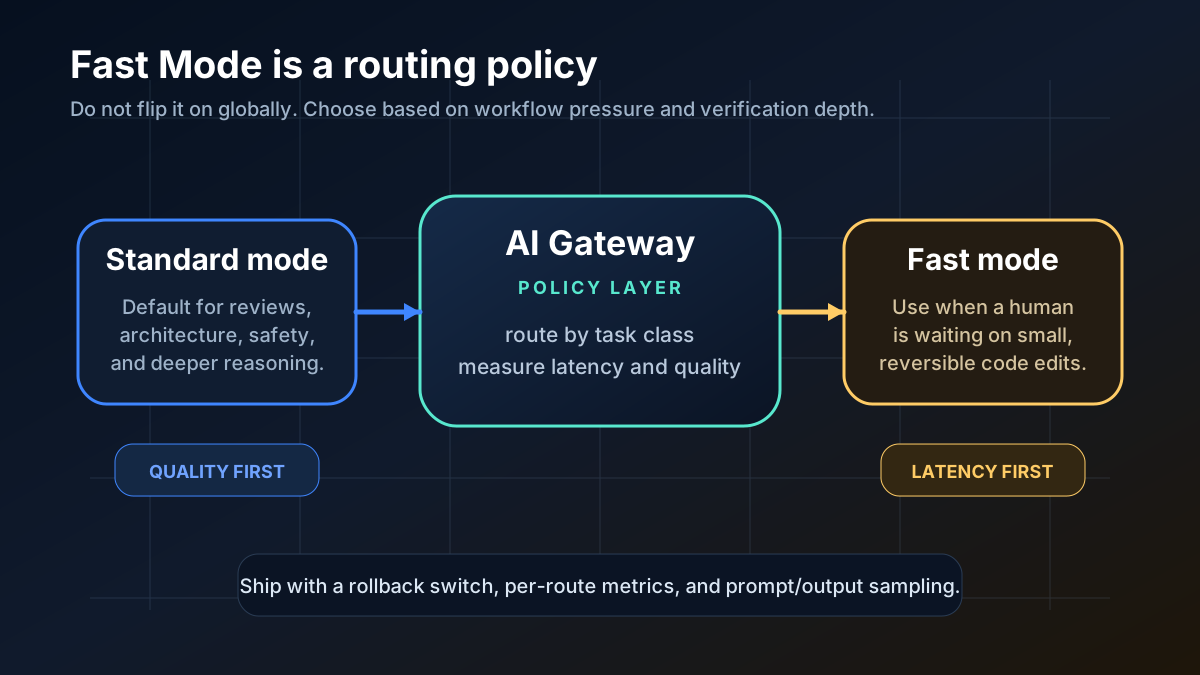
For many workloads, the better strategy will be:
- keep standard mode as the default
- reserve Fast Mode for workflows where a person is actively waiting
- apply it to planning, review, and high-context coding tasks
- avoid it for background jobs, low-value drafts, or routine generation
That is the practical reading developers need, because “2.5x faster” sounds attractive until the bill arrives.
One useful nuance: this is a speed option, not a separate model
The AI Gateway model catalog still lists anthropic/claude-opus-4.6 as the base model with its normal published latency, throughput, context window, and standard pricing. The Fast Mode announcement sits on top of that existing model entry rather than replacing it with a new SKU in the catalog. (Vercel AI Gateway model catalog)
That suggests the right mental model is:
- the model stays the same
- the serving tier changes
- the workflow decision is about latency budget versus cost budget
This may sound obvious, but it matters for search intent. People looking for “Opus 4.6 Fast Mode” are often really asking whether they need to migrate to a different model. Based on Vercel’s published docs, the answer is no. You are choosing a mode, not adopting a new foundation model.
Should developers actually use it?
Sometimes yes.
The best fit looks like this:
- senior developers using Claude Code for planning and review
- platform teams routing coding traffic through AI Gateway
- teams that already monitor AI usage and cost centrally
- workflows where a slow answer creates real interruption cost
The weak fit looks like this:
- hobby usage
- general chat
- low-stakes drafting
- fully asynchronous pipelines
- cost-sensitive automation at scale
That tradeoff is why this is a better morning-lane story than a generic model-addition post. It is not just “another model is available.” It is a concrete product decision about speed, cost, and developer workflow design.
If your team is already thinking about how to structure agent systems, the real question is not “is Fast Mode cool?” It is whether your routing layer should support premium low-latency paths for only the moments that justify them.
That is the more mature way to use these tools, and it lines up with the broader move toward instrumented, policy-aware AI workflows we have already covered in Claude Cowork general availability and GitHub Copilot SDK.
Bottom line
On April 7, 2026, Vercel added Claude Opus 4.6 Fast Mode to AI Gateway and exposed it in the places developers actually work: AI SDK and Claude Code via AI Gateway.
The feature is real, usable, and potentially valuable.
But the important qualifier is just as real:
it is experimental, and it costs 6x standard Opus pricing.
That means the most sensible use is selective. If your team has expensive, high-context, human-blocking tasks where waiting is the real bottleneck, Fast Mode may be worth testing. If not, standard Opus is still probably the better default.
When to Use
Use Claude Opus 4.6 Fast Mode when a human is actively blocked by model output speed and the work is valuable enough to justify the premium. The clearest fits are Claude Code planning, large-diff review, high-context debugging, migration planning, and interactive architecture work where slow output causes context switching.
It is also worth testing when AI Gateway is already your routing and observability layer. In that setup, Fast Mode can be treated as a policy-controlled path for specific tasks instead of a default setting scattered through application code.
When Not to Use
Do not enable Fast Mode globally. Vercel describes it as early and experimental, and the published rate is much higher than standard Opus pricing. Keep standard mode as the default unless the workflow has a clear latency problem and you can monitor usage.
Avoid it for background jobs, bulk generation, routine drafts, simple chat, low-margin automation, or any workload where waiting a little longer does not materially change developer productivity.
SEO FAQ
What is Claude Opus 4.6 Fast Mode on Vercel AI Gateway?
Claude Opus 4.6 Fast Mode is a premium serving mode exposed through Vercel AI Gateway. It uses the same Claude Opus 4.6 model but aims to produce output faster for latency-sensitive workflows.
Is Fast Mode a separate Claude model?
No. Based on Vercel’s documentation, Fast Mode is a serving option for anthropic/claude-opus-4.6, not a new foundation model.
How do developers enable Fast Mode in AI SDK?
Vercel’s changelog and AI SDK provider docs show Fast Mode enabled through Anthropic provider options with speed: 'fast'. Standard mode remains the default.
Why is Fast Mode expensive?
Fast Mode is priced as a premium latency tier. Vercel’s April 2026 changelog listed a 6x rate compared with standard Opus pricing, so teams should use it selectively and monitor spend.
When is Fast Mode worth testing?
It is worth testing when the cost of developer waiting is higher than the token premium, especially in interactive coding, planning, and review workflows where slow output interrupts focus.
Sources