TL;DR
The most important part of OpenAI’s April 8, 2026 enterprise note is not the revenue split by itself.
It is the architecture hiding behind it.
OpenAI said on April 8, 2026 that enterprise now makes up more than 40% of its revenue and is on track to reach parity with consumer revenue by the end of 2026. In the same note, Chief Revenue Officer Denise Dresser said Codex had reached 3 million weekly active users, OpenAI’s APIs were processing more than 15 billion tokens per minute, and GPT-5.4 was driving record engagement in agentic workflows. (OpenAI)
That would already be meaningful as a growth update.
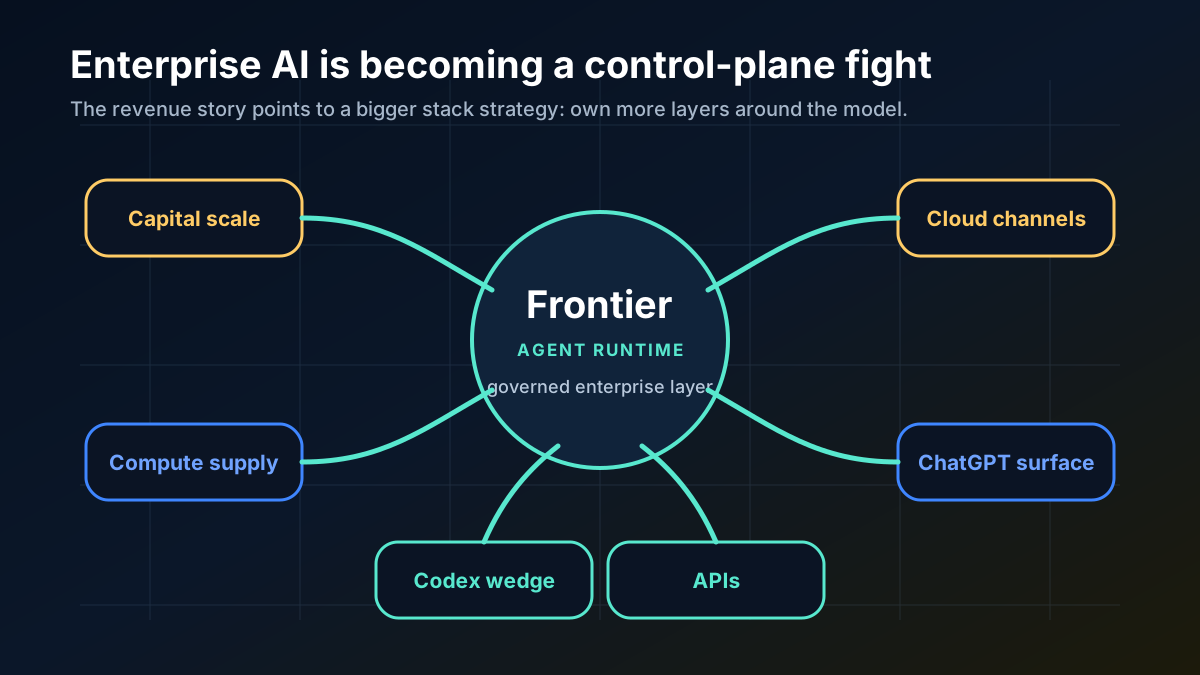
But OpenAI’s own materials from March 31, 2026 and February 27, 2026 make the bigger move clearer. The company is trying to control the enterprise AI stack across capital, compute, cloud distribution, agent runtime, developer adoption, and the end-user interface. (OpenAI funding announcement, OpenAI and Amazon partnership)
That is why this matters.
This is not just a company saying enterprise demand is strong. It is a company saying it wants to be the default operating layer for enterprise AI.
What happened
Three official OpenAI announcements now line up into one strategy.
1. OpenAI said enterprise is no longer a side business
In the April 8 note, OpenAI said enterprise revenue is already above 40% of total revenue and could reach parity with consumer by the end of the year. The same post says enterprise customers want fewer disconnected AI tools and more of a unified layer that can work across company systems and data with permissions and governance controls. OpenAI frames that answer as OpenAI Frontier, its platform for building and managing agents across a company. (OpenAI)
That is a stronger claim than “ChatGPT Enterprise is growing.”
It says OpenAI wants to move from model vendor to enterprise control plane.
2. OpenAI tied that enterprise push to a broader capital and compute flywheel
On March 31, 2026, OpenAI announced it had closed a $122 billion funding round at an $852 billion post-money valuation. In that announcement, the company repeated the same enterprise revenue claim, said it was generating $2 billion in revenue per month, and described compute as a strategic advantage that compounds across research, products, and deployment. It also laid out a multi-provider infrastructure strategy spanning Microsoft, Oracle, AWS, CoreWeave, and Google Cloud, plus silicon partnerships including NVIDIA, AMD, AWS Trainium, Cerebras, and Broadcom. (OpenAI funding announcement)
That matters because the enterprise story is not being sold as software alone.
It is being sold as software backed by reserved infrastructure and capital scale.
3. OpenAI is packaging the runtime and distribution layer, not just the model
OpenAI’s February 27, 2026 partnership with Amazon is important here. OpenAI said AWS would become the exclusive third-party cloud distribution provider for OpenAI Frontier, and that the two companies were building a Stateful Runtime Environment for agents on Amazon Bedrock. OpenAI also said it would consume about 2 gigawatts of Trainium capacity through AWS infrastructure to support Frontier and related workloads. (OpenAI and Amazon partnership)
This is the clearest sign that OpenAI does not want enterprise adoption to stop at API access.
It wants to own the layer where agents keep context, access tools, and run inside company workflows.
Why this matters more than the revenue number
The easy headline is that enterprise is getting big for OpenAI.
The more useful read is that OpenAI is trying to collapse several layers of the market into one system.
1. OpenAI is positioning itself as a full-stack enterprise vendor
A lot of AI companies still look like one of these:
- model providers
- copilots inside one app
- infrastructure vendors
- orchestration layers
OpenAI’s current materials describe something broader:
- frontier models
- agent runtime
- enterprise deployment platform
- coding agent surface through Codex
- a future “AI superapp” for everyday work
That is not accidental wording. It is a strategy to reduce how many layers of the enterprise AI stack OpenAI leaves to partners.
For builders, this matters because the strategic question is changing from:
Which model should we call?
to:
How much of our agent architecture are we willing to rent from one vendor?
That is the same pressure we are seeing elsewhere as products like Claude Cowork and coding agents converge on governed task execution, not just chat.
2. Consumer distribution is being used as enterprise leverage
OpenAI’s April 8 note says ChatGPT’s scale reduces rollout friction because employees already know how to use it. The March 31 funding announcement said ChatGPT had more than 900 million weekly active users and more than 50 million subscribers. Those are OpenAI’s own figures, not independently audited public-market disclosures, but the strategic point is still clear: OpenAI thinks consumer familiarity is now a direct enterprise advantage. (OpenAI, OpenAI funding announcement)
That creates a different kind of moat.
If workers already use ChatGPT personally, OpenAI can argue that enterprise rollout is less about teaching a new interface and more about adding governance, connectors, and agent controls on top of a familiar surface.
Competitors can match model quality in some areas. Matching installed user behavior is harder.
3. Codex looks less like a side product and more like the developer wedge
OpenAI’s numbers around Codex are moving fast enough that they should not be dismissed as a niche coding-tool update.
The April 8 post says Codex hit 3 million weekly active users. The April 2 pricing update says more than 9 million paying business users rely on ChatGPT for work, more than 2 million builders use Codex every week, and Codex usage inside ChatGPT Business and Enterprise has grown 6x since January. (OpenAI, Codex pricing update)
The discrepancy between the 2 million and 3 million figures is best read as a difference in measurement scope and timing across two separate company posts published six days apart, not as a number that can be reconciled precisely from public documentation alone.
The important point is the trend.
OpenAI is using developer workflows as one of the fastest paths into enterprise standardization. That is why Codex matters beyond coding. It can help normalize OpenAI’s runtime, plugins, approvals, and agent behavior before the rest of the company adopts similar patterns. Related: Codex for Windows Makes OpenAI’s Coding Agent Push Harder to Ignore
4. The cloud and chip strategy is becoming much less Microsoft-dependent
For two years, it was easy to treat OpenAI’s enterprise posture as basically “OpenAI plus Microsoft.”
That is now too simple.
OpenAI’s official materials now describe:
- cloud relationships across Microsoft, Oracle, AWS, CoreWeave, and Google Cloud
- silicon across NVIDIA, AMD, AWS Trainium, Cerebras, and Broadcom
- a runtime partnership with AWS
- enterprise distribution through both OpenAI’s own surfaces and cloud channels
That means builders should stop assuming that buying into OpenAI automatically means buying into one infrastructure path.
The more accurate read is that OpenAI is trying to make itself portable across multiple compute and distribution layers while keeping the intelligence layer, agent layer, and user-facing product surfaces increasingly centralized under its control.
Who is affected
Enterprise buyers
If you are a CIO, CTO, or platform lead, OpenAI’s recent announcements are a reminder that the platform decision is no longer just about benchmark quality.
You now have to decide how much of the following you want from one provider:
- model access
- agent runtime
- governance layer
- coding workflows
- end-user interface
- cloud distribution
That can simplify delivery. It can also increase switching costs.
Builders shipping on top of OpenAI
If your product depends on OpenAI APIs today, the near-term opportunity is obvious: more enterprise distribution, more runtime support, and better chances that your customers already understand the interface shape.
The risk is also obvious: if OpenAI keeps moving up the stack, some categories that looked like partner opportunities may turn into first-party features.
That is especially relevant for teams building wrappers around coding agents, internal enterprise assistant surfaces, or lightweight orchestration layers. Standards like MCP still matter because they lower the cost of not locking every workflow into one vendor-owned surface.
Competing model and platform vendors
OpenAI is effectively saying that enterprise AI will be won by whoever can connect:
- the best available models
- a production runtime for agents
- familiar end-user software
- enough compute to keep serving the demand curve
That raises the pressure on competitors to prove they can do more than offer a good model endpoint.
What changes next
Three things are worth watching over the rest of 2026.
1. Whether OpenAI Frontier becomes a real enterprise platform, not just a strategic label
OpenAI is talking about Frontier like a cross-company agent operating layer. The question is whether buyers start treating it that way in production or whether it stays concentrated inside high-touch enterprise deals.
2. Whether the superapp thesis creates channel conflict
OpenAI says it is building toward a unified AI superapp that combines ChatGPT, Codex, browsing, and broader agent capabilities. If that happens, some partners may benefit from distribution while others may find themselves competing with OpenAI’s own surface.
3. Whether multi-cloud supply really lowers enterprise risk
OpenAI’s infrastructure diversification looks rational. But it only becomes a real customer advantage if it translates into better pricing stability, more reliable capacity, or faster access to advanced workloads, not just more impressive partnership slides.
Bottom line
OpenAI’s April 8, 2026 enterprise note matters because it makes the company’s direction harder to miss.
Yes, enterprise now represents more than 40% of revenue, according to OpenAI, and the company says it could reach parity with consumer by the end of 2026.
But the more important point is this:
OpenAI is trying to become the default enterprise AI stack, not just the model behind somebody else’s product.
For builders, that creates both leverage and risk. The leverage is speed, distribution, and a maturing runtime layer. The risk is deeper dependence on one vendor that is increasingly trying to own the whole workflow.
SEO FAQ
What does OpenAI’s enterprise revenue share signal?
It signals that OpenAI is no longer positioning enterprise AI as a side channel. The stronger strategic signal is platform control across models, agents, developer workflows, cloud distribution, and end-user work surfaces.
Should enterprise buyers treat OpenAI as only a model provider?
No. The current strategy points toward a broader enterprise AI stack: model access, agent runtime, governance, developer tooling, and familiar ChatGPT-style work surfaces.
What is the main risk for builders using OpenAI?
The main risk is dependence on a vendor that keeps moving up the stack. Builders should benefit from distribution and runtime improvements while keeping data boundaries, standards, and escape paths clear.
Sources