If you want a self-hosted AI agent you can actually live with, the hard part is not picking a model. It is picking the operating model around the model. That is the real difference between Hermes Agent and OpenClaw.
- Hermes Agent is strongest when you want a CLI-first automation system with messaging gateways, scheduled jobs, MCP, checkpoints, and parallel delegation.
- OpenClaw is strongest when you want a persistent personal assistant gateway you can reach from many chat surfaces with a browser dashboard, plugin-heavy extensibility, and explicit hardening guidance for that personal-assistant trust model. They overlap, but they are not the same product wearing different branding.
TL;DR
| If your priority is… | Default pick | Why |
|---|---|---|
| the fastest path from install to a personal assistant you can message from many chat apps | OpenClaw | Its docs are optimized around a single gateway, onboarding, dashboard chat, and multi-channel access in about five minutes |
| a more automation-heavy agent with cron jobs, checkpoints, MCP control, and isolated delegated subtasks | Hermes Agent | Its docs center on CLI workflows, scheduled tasks, rollback safety, subagents, and practical tool composition |
| minimal installation friction on macOS/Linux/WSL2 when you do not want to pre-install language runtimes | Hermes Agent | The official installer only requires Git and pulls in the rest automatically |
| a broader plugin and channel ecosystem around one long-running gateway | OpenClaw | Plugins can extend channels, tools, providers, memory, speech, and compatible Codex/Claude/Cursor bundles |
The real decision: automation workbench or assistant gateway?
Most comparisons will get stuck on superficial feature overlap:
- both support messaging
- both support tools
- both support multi-step agent work That framing misses the point. The better question is: Do you want to operate an automation workbench, or a personal assistant gateway?
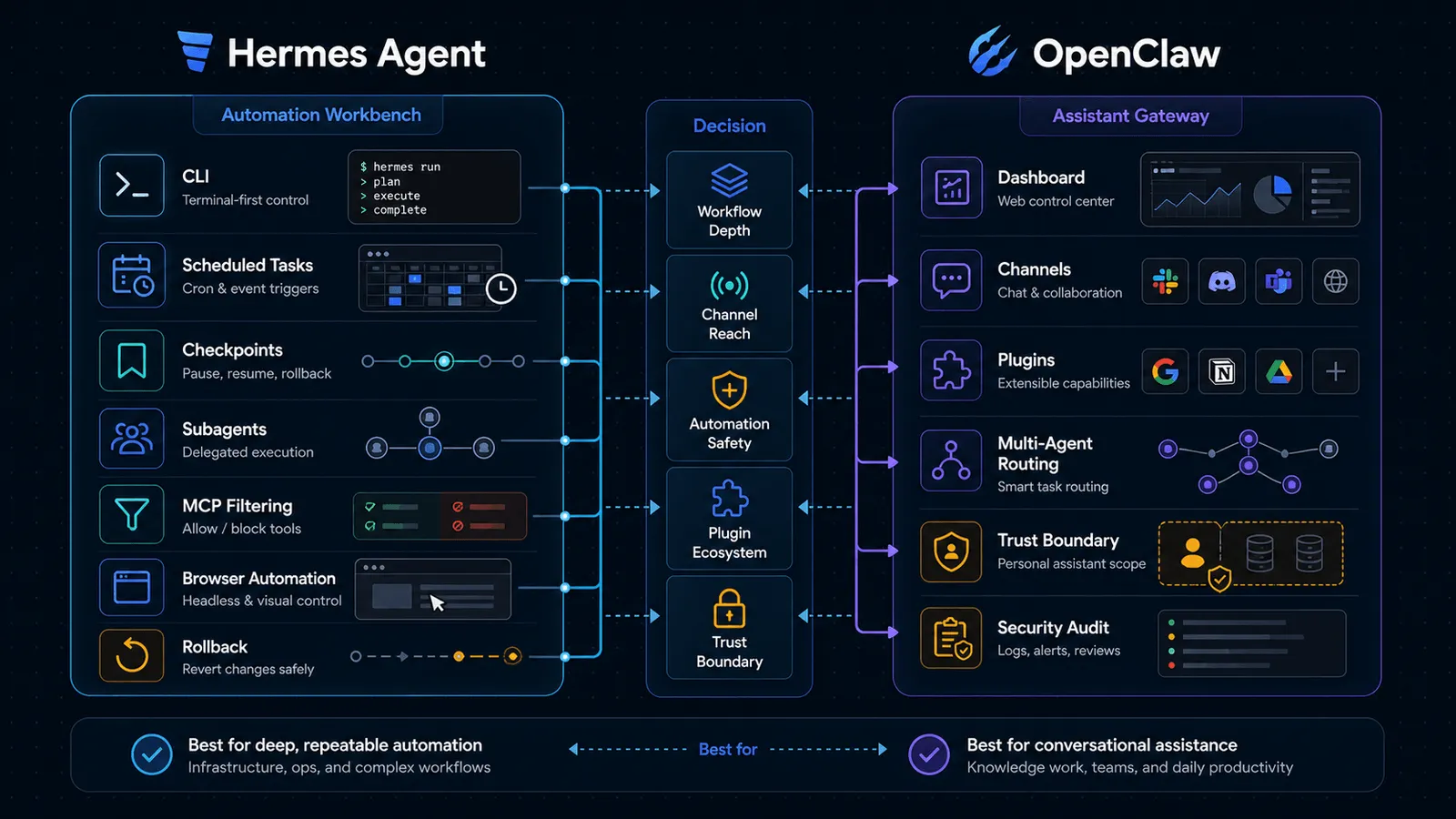
- Hermes Agent feels like an automation workbench that can also live in messaging channels.
- OpenClaw feels like a personal assistant gateway that can also run serious tools and multi-agent workflows. Once you look at them that way, the tradeoffs become much easier to reason about.
Setup reality: Hermes is lighter on prerequisites, OpenClaw is faster for channel-first use
Hermes Agent
Hermes has one of the more forgiving install stories in this category. Its installation docs say:
- the only prerequisite is Git
- the installer handles Python 3.11, Node.js, ripgrep, and ffmpeg
- native Windows is not supported, so Windows users need WSL2 That is a meaningful advantage if you want a clean developer workstation install without doing runtime prep first.
OpenClaw
OpenClaw is also easy to start, but the mental model is different. The docs say you need:
- Node 24 recommended
- Node 22.14+ supported
- a model-provider API key Then the path is:
- install OpenClaw
- run
openclaw onboard --install-daemon - verify the gateway
- open the dashboard That is a very good onboarding path if your end goal is “I want one always-on assistant gateway with a web control plane and chat channels.”
What each product is actually optimized for
Hermes Agent: agent automation with rollback, cron, and MCP discipline
Hermes’ feature overview tells you exactly where the center of gravity is. The docs highlight:
- checkpoints that snapshot the working directory before file changes
- scheduled tasks
- subagent delegation with isolated child agents and restricted toolsets
- browser automation across Browserbase cloud, Browser Use cloud, local Chrome via CDP, or local Chromium That stack is unusually practical for people doing real automation work. It means Hermes is a strong fit if you care about:
- recurring jobs
- rollback safety
- bounded parallel workstreams
- tool-heavy CLI execution
- connecting MCP servers without exposing more surface than necessary The MCP guide is especially clear about operator discipline. It explicitly recommends fine-grained per-server exposure control and warns against connecting a huge dangerous tool surface just because it is available. That is the kind of documentation that usually ages well in production.
OpenClaw: one gateway, many channels, lots of surfaces
OpenClaw’s docs emphasize something different:
- one self-hosted gateway
- many messaging surfaces
- one browser dashboard
- isolated sessions per agent, workspace, or sender
- multi-agent routing Its home page and getting-started docs frame the product as a persistent assistant you can reach from Discord, Slack, Telegram, WhatsApp, Signal, iMessage, Matrix, Microsoft Teams, and more. That matters because OpenClaw is not just “another coding agent CLI.” It is trying to be the always-on bridge between your models, tools, and communication surfaces. If what you want is:
- one assistant running all the time
- multiple inbound chat surfaces
- a central gateway and dashboard
- plugin-driven extensibility around that gateway then OpenClaw is the cleaner mental fit.
Messaging and channels: OpenClaw is broader by default, Hermes is deeper per workflow
OpenClaw’s docs are explicit that the gateway spans many chat apps and plugin channels. That makes it unusually good for people who want the agent to feel like an omnipresent operator rather than a terminal tool. Hermes supports a wide messaging gateway too, but the product feels less like “put me everywhere” and more like “connect the channels that serve the workflow.” A good example is the Hermes WhatsApp docs:
- Hermes uses a built-in bridge based on Baileys
- it does not require a Meta developer account or Business verification
- the docs also clearly warn that this is an unofficial path with some account-risk tradeoff That is a good sign. It shows Hermes is willing to document the convenience path and the operational risk in the same breath. My practical read:
- choose OpenClaw when cross-channel presence is a top-level requirement
- choose Hermes Agent when messaging is one control surface among several automation surfaces
Automation and delegation: Hermes has the stronger operations story
This is the biggest gap for power users. Hermes documents:
- scheduled tasks
- pause/resume/edit operations
- subagent delegation
- checkpoints with rollback That combination makes Hermes feel like the better choice for ongoing workflows such as:
- daily research jobs
- coding automations
- batch processing
- recurring ops tasks
- agent loops that need safe iteration over files OpenClaw has multi-agent routing, sub-agents, and a lot of tooling. But the product narrative still centers more on the gateway and assistant experience than on scheduled automation as the main event. If your core use case is “I want a self-hosted AI operator that keeps doing work on a schedule and can safely branch subtasks,” Hermes has the stronger shape.
Plugins and extensibility: OpenClaw is more platform-like
OpenClaw’s plugin docs are broader and more opinionated. The official docs say plugins can extend:
- channels
- model providers
- tools
- skills
- speech
- realtime transcription
- web fetch and web search
- image and video generation It also supports two plugin formats:
- native
openclaw.plugin.jsonplugins - compatible bundle layouts from Codex, Claude, and Cursor That second point is strategically important. It means OpenClaw is not only extensible. It is trying to absorb adjacent agent ecosystems without forcing every extension into one bespoke format. Hermes is extensible too, but the value is expressed more through:
- skills
- hooks
- gateway integrations
- MCP servers
- tool composition That is a good model for builders who want control without turning the whole system into a plugin marketplace. My read:
- choose OpenClaw if you want a more platform-like extension layer
- choose Hermes Agent if you want a more controlled operator stack built around skills, hooks, and MCP
MCP and tool surface: Hermes is the cleaner choice when restraint matters
Both products live in the modern tool ecosystem, but Hermes’ MCP docs are unusually explicit about safe scope. The Hermes guide recommends MCP when:
- a tool already exists in MCP form
- you want a clean RPC layer to a local or remote system
- you want fine-grained per-server exposure control It also says you should not use MCP when a built-in Hermes tool already solves the job well, or when the server exposes a huge dangerous tool surface you are not prepared to filter. That is the practical production mindset I would want from this class of product. OpenClaw can absolutely power serious tool workflows too. But when I compare the public docs posture, Hermes is the one that reads more like: “Connect the minimum surface that makes the workflow work.” If MCP standardization is part of your broader stack, read Why MCP Is Becoming the Default Standard for AI Tools in 2026.
Security model: OpenClaw is more explicit about its trust boundary
This is one area where OpenClaw deserves real credit. Its security docs are extremely direct:
- OpenClaw assumes a personal assistant trust model
- one gateway is meant for one trusted operator boundary
- it is not a hostile multi-tenant boundary for mutually untrusted users
- if you need adversarial-user isolation, you should split trust boundaries across separate gateways, credentials, and ideally separate OS users or hosts
That is the right kind of bluntness.
The docs also give operators an actual hardening workflow through
openclaw security audit,--deep, and--fix, plus guidance around allowlists, open-channel risk, plugins, browser exposure, and dangerous flags. Hermes has strong safety primitives too, especially: - checkpoints before file edits
- isolated child agents
- controlled MCP exposure But based on the current public docs, OpenClaw is more explicit about the security assumptions around shared use and gateway boundaries. That means:
- if you are evaluating trust boundaries carefully, read the OpenClaw security docs before deployment
- if you want safer editing and automation ergonomics inside the workflow itself, Hermes has stronger day-to-day guardrails
Which one should you use?
Choose Hermes Agent if…
- you want a self-hosted agent that feels closer to an automation operating system
- scheduled tasks, rollback checkpoints, and delegated subtasks matter more than multi-channel presence
- you want a lighter install path on macOS/Linux/WSL2 without manually managing runtimes first
- you care about MCP discipline and a smaller useful tool surface
Choose OpenClaw if…
- you want one assistant gateway that can live across many chat surfaces
- dashboard plus channels is the core UX, not just terminal-first workflows
- you want a richer plugin ecosystem and compatibility with bundle layouts from adjacent agent tools
- you are willing to think in terms of a personal assistant trust boundary and harden the gateway accordingly
My practical recommendation
If I were choosing for a single power user or builder who wants recurring work, safe file changes, CLI depth, and clean tool composition, I would start with Hermes Agent. If I were choosing for a personal assistant you want reachable from multiple chat surfaces all day, I would start with OpenClaw. That is the simplest honest distinction:
- Hermes Agent is better when the workflow is the product.
- OpenClaw is better when the assistant gateway is the product. If your next question is how to keep any self-hosted AI stack from turning into a money pit, this is the adjacent read: Practical AI Workflow Without Wasting Money.
Decision checklist
Use this as the practical cutoff before you install either stack:
| Question | Prefer Hermes Agent | Prefer OpenClaw |
|---|---|---|
| Is the main job scheduled automation or recurring background work? | Yes | Maybe |
| Is the main job a persistent assistant across many chat channels? | Maybe | Yes |
| Do you need rollback checkpoints before file edits? | Yes | Not the main differentiator |
| Do you want broad plugin and channel extensibility first? | Not first | Yes |
| Is MCP tool-surface discipline a top concern? | Strong fit | Possible, but review carefully |
| Are multiple untrusted users expected to share one gateway? | Split the deployment | Split the deployment |
The healthiest pilot is small: one workflow, one messaging surface if needed, one MCP server, and one rollback or audit path you can actually inspect.
SEO FAQ
Is Hermes Agent better than OpenClaw?
Hermes Agent is usually better for CLI-first automation, scheduled jobs, rollback checkpoints, and controlled MCP workflows. OpenClaw is usually better for a persistent assistant gateway across many messaging channels.
Can Hermes Agent and OpenClaw both be self-hosted?
Yes. Both are positioned around self-hosted agent workflows, but the operating model differs: Hermes feels more like an automation workbench, while OpenClaw feels more like an always-on assistant gateway.
Which one is safer for team use?
Neither should be treated as safe by default for untrusted multi-user access. Teams should separate trust boundaries, restrict channel access, minimize tool exposure, and keep review or rollback paths visible.
Sources